CFP for Special Issue in IEEE Transactions on Technology & Society: Trustworthy Data Ecosystems for Digital Societies

IEEE Transactions on Technology & Society launches the new Special Issue on the “Trustworthy Data Ecosystems for Digital Societies“, edited by Asif Gill, Anastasija Nikiforova, Ina M. Sebastian, Martin Lnenicka, Anushri Gupta. On behalf of the editors of this SI, I sincerely invite you to consider submitting your work to it.

Key topics surround intersection of data ecosystem and AI topics, i.e., AI in and for trustworthy data ecosystems, and include, but are not limited to:

  • Impact of trustworthy data ecosystem on digital societies at the local, national and global levels
  • Conceptualization of trustworthy data ecosystems domains and characteristics for digital societies
  • Data trust regulations, polices, strategies and standards
  • Trustworthy data ecosystem infrastructure as a social construct
  • Trustworthy data ecosystem architecture, interfaces, methodologies, orchestration, patterns, solutions, and technology platforms
  • System and data quality, governance, security, privacy, protection, and safety
  • Data linking, interoperability, sharing and observability

Read more in the below CFP or here.

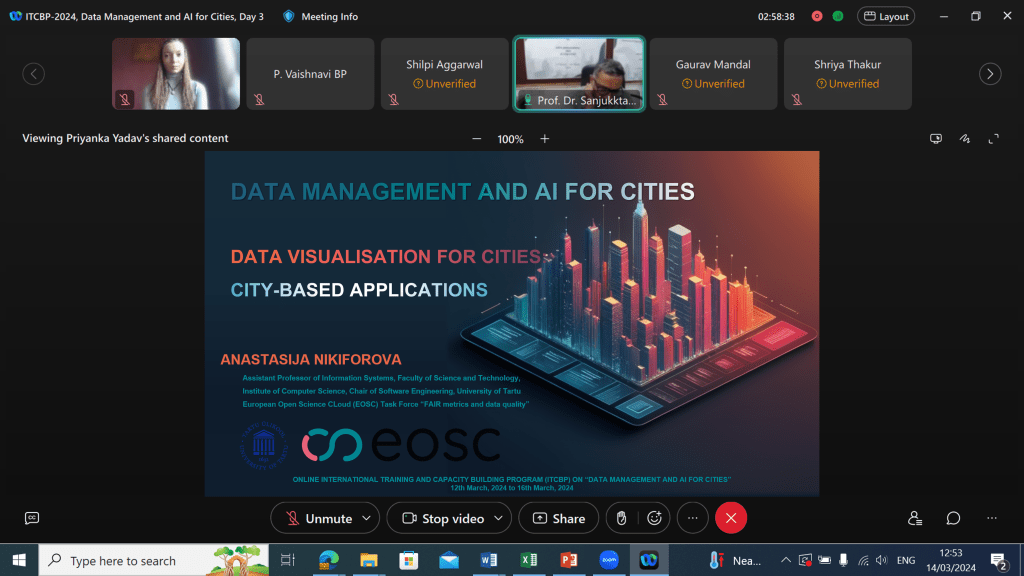
Online International Training and Capacity Building Program-2024 (ITCBP-2024) for the School of Planning and Architecture, New Delhi and my talk on “Data Management for AI Cities”

Yesterday, I had the honor of serving as an Expert speaker for an Online International Training and Capacity Building Program-2024 (ITCBP-2024) on “Data Management for AI Cities”, organised by the School of Planning and Architecture, New Delhi (SPA FIRST) that invited me to deliver a talk on “Data Visualisation for Cities: City Based Applications”.

During this talk, we touched on several important aspects surrounding data management and visualization in and for cities, including:

  • Data management that was then deduced to data quality management of both internal and external data, departing from understanding these data to managing their quality throughout the DQM lifecycle (stressing that data cleaning is not the same as DQM), touching on several approaches to this with greater emphasis on the AI-augmented data quality management – existing tools, underlying methods, and weaknesses that should be considered when using (semi-)automatic data quality rule recognition, depending on the method they use for this purpose;
  • Data governance was then discussed, stressing how it differs from DQM, and what it consists of and why it is crucial, incl. within the context of this talk;
  • Data visualization & storytellingrole, key principles, common mistakes, best practices. As part of this, we covered strategies for selecting data visualization type with tips on how to simplify this process, incl. by referring to chart selectors, but also stressing why “thinking outside the menu” is critical, esp. within city-level data visualization (where your audience is often citizens or policymakers). We looked at the most common and/or successful uses of non-traditional types of visualizations, incl. tools to be used for these purposes, breaking them into those that require coding and those that are rather low- or no-code; noise reduction – simplicity – strategic accents’ use, as well as drill-down (aka roll-down) & roll-up use to convey the message you want to deliver while overcoming highlighting everything and thereby losing your audience. In addition, a UX perspective was discussed, including but not limited some aspects that are often overlooked when thinking about the design and aesthetic color palette, namely the color-blindness of the audience that might “consume” these visualizations and again, tips on how to use it easier – did you you known that there are 300 million color blind people? And that 98% of those with color blindness have red-green color blindness?

So what was the key message or a “takeaway” of this talk? In a very few words:

  • Understand your data, audience and story you want to tell! Understand:
    • your data,
    • the story it tells,
    • your target audience’s preferences and needs,
    • the story you want to tell
    • data suitability
    • data quality
  • Attention-grabbing visuals & storytelling is a key!
    • reduce noise to avoid audience confusion and distraction
    • use drill-down and roll-up operations to keep visualization simple
    • add the context to provide all necessary information for clear understanding
    • add highlights to focus their attention – add accents strategically
  • Consider design – the optimal visualisation type, chart design, environment design, potential color-blindness of your audience
  • Keep track of the current advances, but also challenges and risks, of data visualization in urban settings, incl. but not limited to (1) privacy concerns, (2) data silos, (3) technological limitations.

All in all, it was quite a rich conversation and I am very grateful to the organizers for the invitation to be part of this event and to the audience for the very positive feedback!

Stanford University’s database of top-cited scientists for 2022 is published

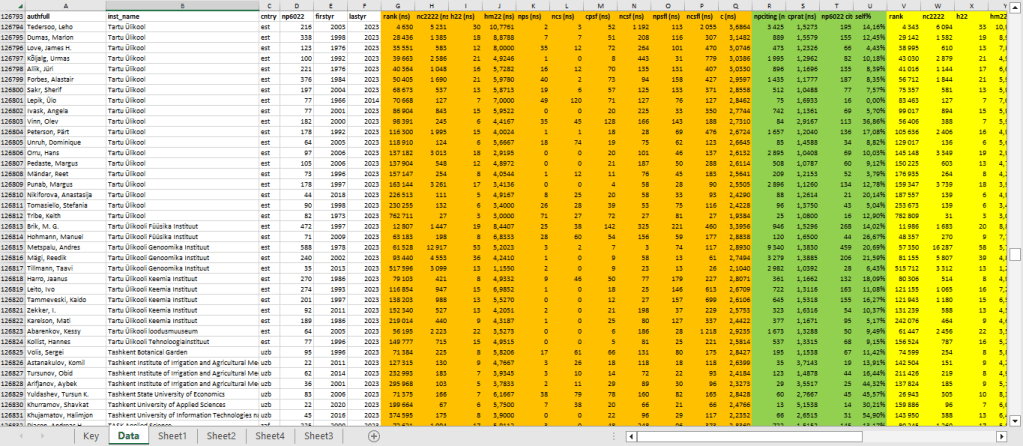
A few months ago, I celebrated 5 years since my first scientific publication – the time it took for me to get listed in the Stanford University‘s database of top 2% scientists! To be honest, I’ve missed this list, but given the growing number of LinkedIn posts on it, I decided to take a look at it and after browsing it for a while, decided – just out of curiosity – to check myself – can you imagine the level of my surprise? – all in all, quite surprised and honored, of course!

I recognize that this is just a single year category for 2022, it is about sub-fields (Artificial Intelligence – do not really get how Scopus knows this, given that although I am dealing with this topic, I do not much publish on it, Information Systems, Information & Communication Technologies) same as I realize that citation metrics-based evaluations is  not the best approach to assessing the impact and quality of research & researcher (although this database not only acknowledges, but also tries to tackle this issue to some extent), but for me it is still an achievement that makes this day special!

You might want to check out this list by Ioannidis and John (2023) and maybe it will make your day as well!

Ioannidis, John P.A. (2023), “October 2023 data-update for “Updated science-wide author databases of standardized citation indicators””, Elsevier Data Repository, V6, doi: 10.17632/btchxktzyw.6

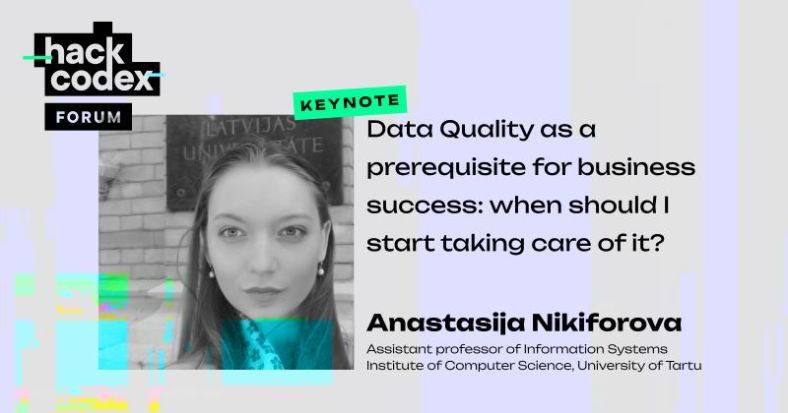
HackCodeX and my role of the Keynote speaker with “Data Quality as a prerequisite for business success: when should I start taking care of it?”

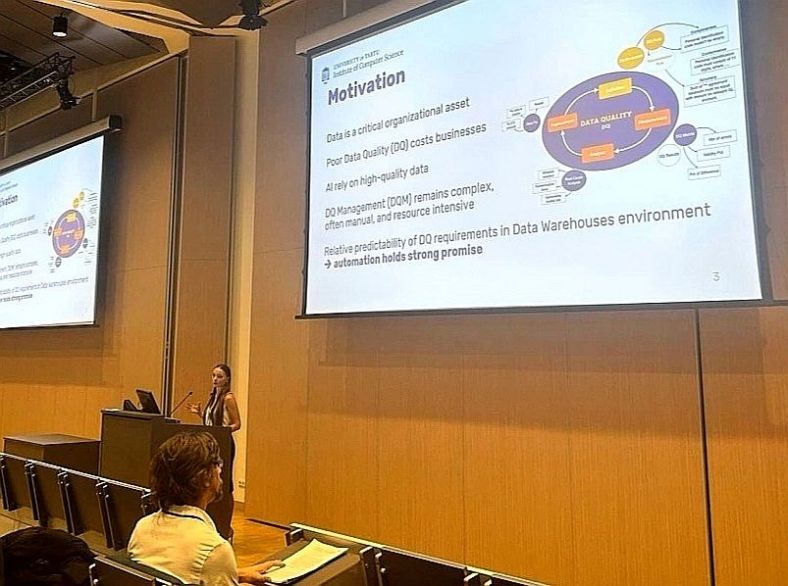
June 3-5, 2023 HackCodeX hackathon – a weekend-long experience, gathering tech enthusiasts from all over Europe to develop new ideas with the latest technology in a unique environment and atmosphere that serves as the meeting place for like-minded developers, designers, and business professionals eager to explore new paths – takes place. It will be accompanied by a one-day tech industry conference gathering international and local experts to discuss the key trends in technology and computing, where I act as one of those keynotes invited to deliver the talk devoted to the Data Quality that I entitled “Data Quality as a prerequisite for business success: when should I start taking care of it?

A full weekend of hacking and catching up with more than 400 other tech heads in an atmosphere and spirit like no other.

Sounds interesting? 🗓️ 🗓️ 🗓️ Save the date! June 5, 2023 – topics focused on the key topics, such as emerging technologies, security and privacy, hardware and infrastructure, data quality, quantum technologies, as well as language and framework updates. From the growing interest in Artificial Intelligence to practical tips for securing software applications and dwelling into performance optimization – HackCodeX aims to inspire and provide new knowledge for tech experts of all levels. 

Stay tuned and do not miss the opportunity to attend and meet me there! Read more here -> https://www.hackcodex.eu/forum