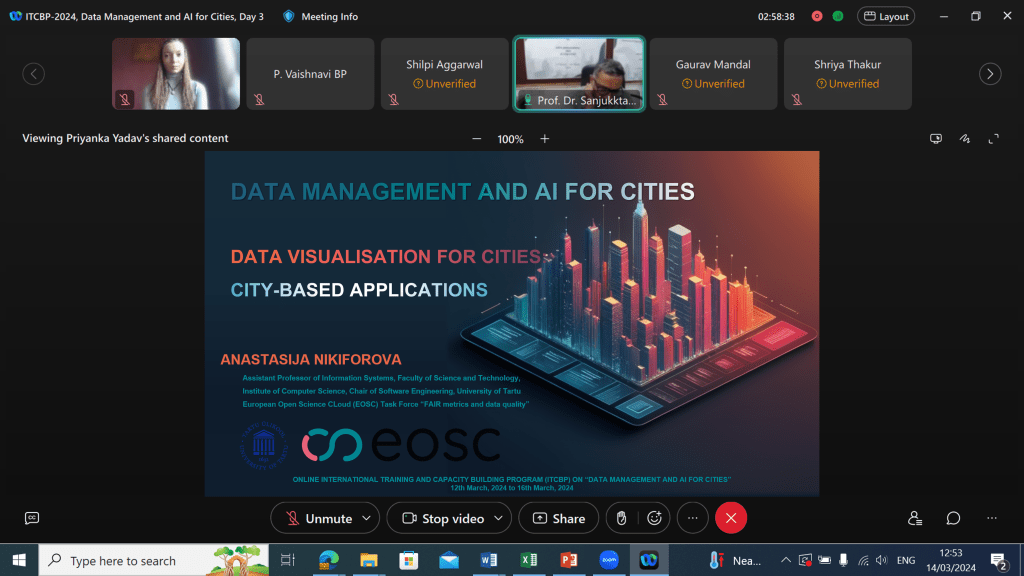
Yesterday, I had the honor of serving as an Expert speaker for an Online International Training and Capacity Building Program-2024 (ITCBP-2024) on “Data Management for AI Cities”, organised by the School of Planning and Architecture, New Delhi (SPA FIRST) that invited me to deliver a talk on “Data Visualisation for Cities: City Based Applications”.
During this talk, we touched on several important aspects surrounding data management and visualization in and for cities, including:
Data management that was then deduced to data quality management of both internal and external data, departing from understanding these data to managing their quality throughout the DQM lifecycle (stressing that data cleaning is not the same as DQM), touching on several approaches to this with greater emphasis on the AI-augmented data quality management – existing tools, underlying methods, and weaknesses that should be considered when using (semi-)automatic data quality rule recognition, depending on the method they use for this purpose;
Data governance was then discussed, stressing how it differs from DQM, and what it consists of and why it is crucial, incl. within the context of this talk;
Data visualization& storytelling – role, key principles, common mistakes, best practices. As part of this, we covered strategies for selecting data visualization type with tips on how to simplify this process, incl. by referring to chart selectors, but also stressing why “thinking outside the menu” is critical, esp. within city-level data visualization (where your audience is often citizens or policymakers). We looked at the most common and/or successful uses of non-traditional types of visualizations, incl. tools to be used for these purposes, breaking them into those that require coding and those that are rather low- or no-code; noise reduction – simplicity – strategic accents’ use, as well as drill-down (aka roll-down) & roll-up use to convey the message you want to deliver while overcoming highlighting everything and thereby losing your audience. In addition, a UX perspective was discussed, including but not limited some aspects that are often overlooked when thinking about the design and aesthetic color palette, namely the color-blindness of the audience that might “consume” these visualizations and again, tips on how to use it easier – did you you known that there are 300 million color blind people? And that 98% of those with color blindness have red-green color blindness?
So what was the key message or a “takeaway” of this talk? In a very few words:
Understand your data, audience and story you want to tell! Understand:
your data,
the story it tells,
your target audience’s preferences and needs,
the story you want to tell
data suitability
data quality
Attention-grabbing visuals & storytelling is a key!
reduce noise to avoid audience confusion and distraction
use drill-down and roll-up operations to keep visualization simple
add the context to provide all necessary information for clear understanding
add highlights to focus their attention – add accents strategically
Consider design – the optimal visualisation type, chart design, environment design, potential color-blindness of your audience
Keep track of the current advances, but also challenges and risks, of data visualization in urban settings, incl. but not limited to (1) privacy concerns, (2) data silos, (3) technological limitations.
All in all, it was quite a rich conversation and I am very grateful to the organizers for the invitation to be part of this event and to the audience for the very positive feedback!
Smart cities aim to enhance citizens’ lives, urban services, and sustainability, with open data playing a crucial role in this development. Cities generate vast data that, if properly utilized within an open data ecosystem, can improve citizens’ lives and foster sustainability. Central to this ecosystem is the platform, which enables data collection, storage, processing, and sharing. Understanding modern Open Data Ecosystems is pivotal for sustainable urban development and governance, promoting collaboration and civic engagement. In this study, we aimed to identify key components shaping these efforts by conducting a platform theory-based multi-country comparative study of 19 🇪🇺 European cities across 8 countries – Austria 🇦🇹, Belgium 🇧🇪, Croatia 🇭🇷, Czech Republic 🇨🇿, Latvia 🇱🇻, Poland 🇵🇱, Sweden 🇸🇪. Considering both managerial and organizational, political and institutional, as well as information and technological contexts, drawing on both primary and secondary data, we:
🔎🧐🔍identify 50 patterns that influence and shape sustainable Open Data Ecosystems and their platforms, i.e., Open Data Platform Ecosystems. We applied a cluster analysis to identify similarities between groups of patterns that influence and shape open (government) data efforts in smart cities.
🔎🧐🔍explore the relationships between platforms and other Open Data Platform Ecosystems’ components by developing a respective model, and identifying internal platforms and other components that we classified into four categories, (a) data and information disclosure platforms such as open data portals, transparency portals, and official city websites, (b) thematic city development platforms focused on the subject of information such as smart city and smart projects platforms, participation platforms, citizen reporting or accountability platforms, crowdfunding platforms for local projects, startup platforms, etc., (c) specific data format disclosure platforms, and (d) content of information focused platforms, i.e., domain-specific platforms focused on data visualizations and storytelling, which include but are not limited to smart data portals, IoT and big data portals etc. In addition, we identify four OGD strategies used in the strategic planning of the city;
🔎🧐🔍 empirically validate the conceptual findings of five types of Open Data Platform Ecosystems presented in the literature, redefining them from the conceptual to real-life implementation of the respective components in 19 cities with further description of how they contribute to the maturity concept of a sustainable ODE and respective platforms;
🔎🧐🔍 considering the experience gained during the study and external pressures and environments that shape or influence Open Data Platform Ecosystems, based predominantly on best practices or pain points for Open Data Ecosystems in the sampled smart cities, we define 12 recommendations for policy planning and urban governance of more sustainable Open Data Ecosystems.
And this is just a short overview of our contributions. Sounds interesting? Read the article here!
Recently, the United Nations University announced the launch of the United Nations University EGOV’s repository platform – a centralized hub of specialized repositories tackling global challenges, which is dedicated to two topics – EGOV for Emergencies that provides a set of content on innovations in digital governance for emergency response, and Data for EGOVis the repository intended “to supports policymakers, decision-makers, researchers, and the community interested in digitally transforming the public sector through emerging technologies and data. The repository combines diverse academic documents, use cases, rankings, best practices, standards, benchmarking, portals, datasets, and pilot projects to support open data, quality and purpose of open data, application of data techniques analytics in the public sector, and making cities smarter. This repository results from the “INOV.EGOV-Digital Governance Innovation for Inclusive, Resilient and Sustainable Societies” project on the role of open data and data science technologies in the digital transformation of State and Public Administration institutions“. The latter, recommends 286 reading materials (reports, articles, standards etc.) I find to be very relevant for the above described, and highly recommend to surf through. However, what made me specially happy while browsing this collection, is the fact that five of these reading materials are articles (co-)authored by me. Therefore, considering that not always I keep track of what I conducted in past, let me use this opportunity to reflect on those studies, in case you had not came across them previously, as well as to refresh mine memories (some of them dated back to times, when I worked on my PhD thesis).
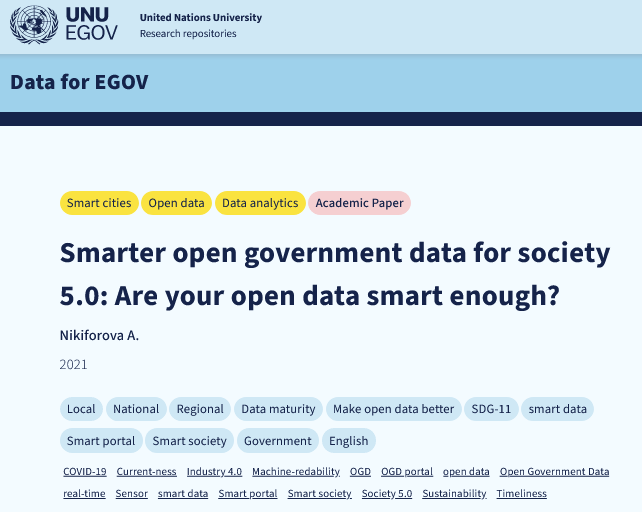
By the way, every article is accompanied with tags that enrich keywords by which that article was described by authors, with a particular attention being paid to main topics, incl. “data analytics”, “smart city”, “open data”, “sustainability” etc., where for “the latter”sustainability”, tagging based on the compliance with a specific Sustainable Development Goal (SDG) takes place, thereby allowing to filter out relevant articles by a specific SDG or find out what SDG does your article contributes, where although while conducting research I kept in mind some of those I find my research more suited with, for one of them (the last one in the list) I was pretty surprised to see that it is very SDGs-compliant, being compliant with 11 SDGs (SDG-2, SDG-3, SDG-6, SDG-7, SDG-9, SDG-11, SDG-13, SDG-14, SDG-15).
So, back to those studies that the United Nations University recommends…
A multi-perspective knowledge-driven approach for analysis of the demand side of the Open Government Data portal, which proposes a multi-perspective approach where an OGD portal is analyzed from (1) citizens’ perspective, (2) users’ perspective, (3) experts’ perspective, and (4) state of the art. By considering these perspectives, we can define how to improve the portal in question by focusing on its demand side. In view of the complexity of the analysis, we look for ways to simplify it by reusing data and knowledge on the subject, thereby proposing a knowledge-driven analysis that supports the idea under OGD – their reuse. Latvian open data portal is used as an example demonstrating how this analysis should be carried out, validating the proposed approach at the same time. We are aiming to find (1) the level of the citizens’ awareness of the portal existence and its quality by means of the simple survey, (2) the key challenges that may negatively affect users’ experience identified in the course of the usability analysis carried out by both users and experts, (3) combine these results with those already known from the external sources. These data serve as an input, while the output is the assessment of the current situation allowing defining corrective actions. Since the debates on the Latvian OGD portal serving as the use-case appear more frequently, this study also brings significant benefit at national level.
Transparency of open data ecosystems in smart cities: Definition and assessment of the maturity of transparency in 22 smart cities, which focuses on the issue of the transparency maturity of open data ecosystems seen as the key for the development and maintenance of sustainable, citizen-centered, and socially resilient smart cities. This study inspects smart cities’ data portals and assesses their compliance with transparency requirements for open (government) data. The expert assessment of 34 portals representing 22 smart cities, with 36 features, allowed us to rank them and determine their level of transparency maturity according to four predefined levels of maturity – developing, defined, managed, and integrated. In addition, recommendations for identifying and improving the current maturity level and specific features have been provided. An open data ecosystem in the smart city context has been conceptualized, and its key components were determined. Our definition considers the components of the data-centric and data-driven infrastructure using the systems theory approach. We have defined five predominant types of current open data ecosystems based on prevailing data infrastructure components. The results of this study should contribute to the improvement of current data ecosystems and build sustainable, transparent, citizen-centered, and socially resilient open data-driven smart cities.
Smarter open government data for society 5.0: Are your open data smart enough? in which, considering the fact that the open (government) data initiative as well as users’ intent for open (government) data are changing continuously and today, in line with IoT and smart city trends, real-time data and sensor-generated data have higher interest for users that are considered to be one of the crucial drivers for the sustainable economy, and might have an impact on ICT innovation and become a creativity bridge in developing a new ecosystem in Industry 4.0 and Society 5.0, the paper examines 51 OGD portals on the presence of the relevant data and their suitability for further reuse, by analyzing their machine-readability, currency or frequency of updates, the ability to submit request/comment/complaint/suggestion and their visibility to other users, and the ability to assess the value of these data assessed by others, i.e., rating, reuse, comments, etc., which is usually considered to be a very time-consuming and complex task, and therefore rarely conducted. The analysis leads to the conclusion that although many OGD portals and data publishers are working hard to make open data a useful tool moving towards Industry 4.0 and Society 5.0, many portals do not even respect the principles of open data, such as machine-readability. Moreover, according to the lists of most competitive countries by topic, there are no leaders who provide their users with excellent data and service, therefore there is room for improvements for all portals. The paper shows that open data, particularly those published and updated in time, are provided in machine-readable format and support to their users, attract audience interest and are used to develop solutions that benefit the entire society (the case in France, Spain, Cyprus, the Netherlands, Taiwan, Austria, Switzerland, etc.). Thus, the publication of open data should be done not only because it is a modern trend, but also because it incentivizes scientists, researchers and enthusiasts to reuse the data by transforming it into knowledge and value, providing solutions, improving the world, and moving towards Society 5.0 or the super smart society.
Definition and evaluation of data quality: User-oriented data object-driven approach to data quality assessmentproposes a data object-driven approach to data quality evaluation. This user-oriented solution is based on 3 main components: data object, data quality specification and the process of data quality measuring. These components are defined by 3 graphical DSLs, that are easy enough even for non-IT experts. The approach ensures data quality analysis depending on the use-case. Developed approach allows analysing quality of “third-party” data. The proposed solution is applied to open data sets. The result of approbation of the proposed approach demonstrated that open data have numerous data quality issues. There are also underlined common data quality problems detected not only in Latvian open data but also in open data of 3 European countries – Estonia, Norway, the United Kingdom. I.e., none of the very simple or intuitive and even obvious use cases in which the values of the primary parameters were analysed were satisfied by any Company Register. However, the Estonian and Norwegian Registers can be used to identify any company by its name and registration number, since only they have passed quality checks of the relevant fields.
Open Data Hackathon as a Tool for Increased Engagement of Generation Z: To Hack or Not to Hack? examines the role of open data hackathons, known as a form of civic innovation in which participants representing citizens can point out existing problems or social needs and propose a solution, in OGD initiative. Given the high social, technical, and economic potential of open government data (OGD), the concept of open data hackathons is becoming popular around the world. This concept has become popular in Latvia with the annual hackathons organised for a specific cluster of citizens – Generation Z. Contrary to the general opinion, the organizer suggests that the main goal of open data hackathons to raise an awareness of OGD has been achieved, and there has been a debate about the need to continue them. This study presents the latest findings on the role of open data hackathons and the benefits that they can bring to both the society, participants, and government. First, a systematic literature review is carried out to establish a knowledge base. Then, empirical research of 4 case studies of open data hackathons for Generation Z participants held between 2018 and 2021 in Latvia is conducted to understand which ideas dominated and what were the main results of these events for the OGD initiative. It demonstrates that, despite the widespread belief that young people are indifferent to current societal and natural problems, the ideas developed correspond to current situation and are aimed at solving them, revealing aspects for improvement in both the provision of data, infrastructure, culture, and government- related areas.
More to come, and let’s keep track of updates in this repository! Do not also to check other works in both the repository, as well as more work of mine you can find here.








 Anastasija Nikiforova, PhD