Online International Training and Capacity Building Program-2024 (ITCBP-2024) for the School of Planning and Architecture, New Delhi and my talk on “Data Management for AI Cities”

Yesterday, I had the honor of serving as an Expert speaker for an Online International Training and Capacity Building Program-2024 (ITCBP-2024) on “Data Management for AI Cities”, organised by the School of Planning and Architecture, New Delhi (SPA FIRST) that invited me to deliver a talk on “Data Visualisation for Cities: City Based Applications”.
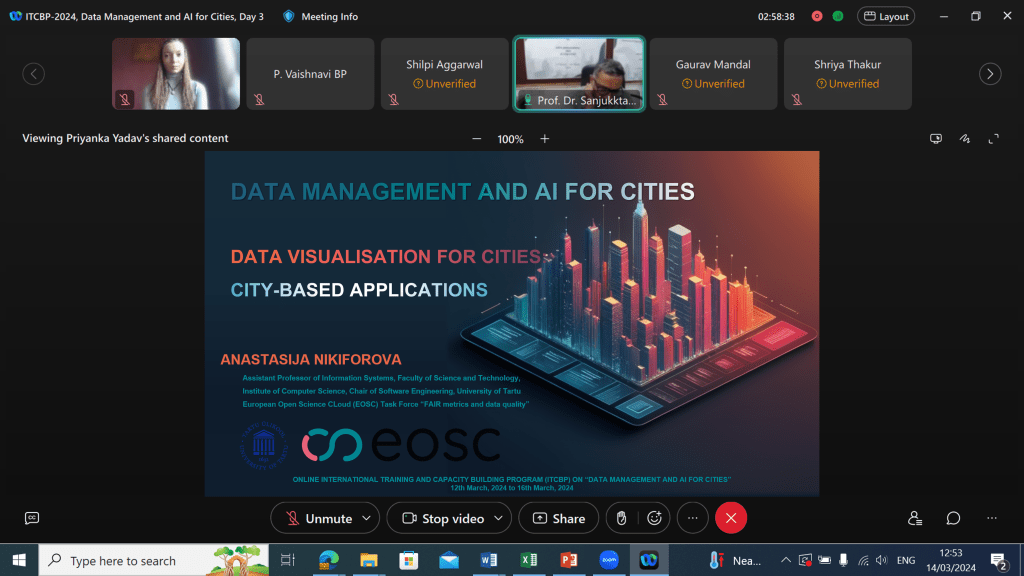
During this talk, we touched on several important aspects surrounding data management and visualization in and for cities, including:

  • Data management that was then deduced to data quality management of both internal and external data, departing from understanding these data to managing their quality throughout the DQM lifecycle (stressing that data cleaning is not the same as DQM), touching on several approaches to this with greater emphasis on the AI-augmented data quality management – existing tools, underlying methods, and weaknesses that should be considered when using (semi-)automatic data quality rule recognition, depending on the method they use for this purpose;
  • Data governance was then discussed, stressing how it differs from DQM, and what it consists of and why it is crucial, incl. within the context of this talk;
  • Data visualization & storytellingrole, key principles, common mistakes, best practices. As part of this, we covered strategies for selecting data visualization type with tips on how to simplify this process, incl. by referring to chart selectors, but also stressing why “thinking outside the menu” is critical, esp. within city-level data visualization (where your audience is often citizens or policymakers). We looked at the most common and/or successful uses of non-traditional types of visualizations, incl. tools to be used for these purposes, breaking them into those that require coding and those that are rather low- or no-code; noise reduction – simplicity – strategic accents’ use, as well as drill-down (aka roll-down) & roll-up use to convey the message you want to deliver while overcoming highlighting everything and thereby losing your audience. In addition, a UX perspective was discussed, including but not limited some aspects that are often overlooked when thinking about the design and aesthetic color palette, namely the color-blindness of the audience that might “consume” these visualizations and again, tips on how to use it easier – did you you known that there are 300 million color blind people? And that 98% of those with color blindness have red-green color blindness?

So what was the key message or a “takeaway” of this talk? In a very few words:

  • Understand your data, audience and story you want to tell! Understand:
    • your data,
    • the story it tells,
    • your target audience’s preferences and needs,
    • the story you want to tell
    • data suitability
    • data quality
  • Attention-grabbing visuals & storytelling is a key!
    • reduce noise to avoid audience confusion and distraction
    • use drill-down and roll-up operations to keep visualization simple
    • add the context to provide all necessary information for clear understanding
    • add highlights to focus their attention – add accents strategically
  • Consider design – the optimal visualisation type, chart design, environment design, potential color-blindness of your audience
  • Keep track of the current advances, but also challenges and risks, of data visualization in urban settings, incl. but not limited to (1) privacy concerns, (2) data silos, (3) technological limitations.

All in all, it was quite a rich conversation and I am very grateful to the organizers for the invitation to be part of this event and to the audience for the very positive feedback!

CFP for Data For Policy 2024 is open!

And CFP for Data For Policy 2024 scheduled for 9-11 July, 2024 is open! All submissions are welcome with the deadline of 27 November, 2023.

This year Data For Policy conference, which is organized in collaboration with Imperial College London and Cambridge University Press will take place in London, UK, and will be running under the title “Decoding the Future: Trustworthy Governance with AI” – trendy, isn’t it? In this edition the conference “[we] are focusing on the future of governance and decision making with AI. Firstly, what are the emerging capabilities, use cases, and best practices enabling innovation that could contribute to improved governance with AI? Secondly, what concerns are being raised regarding these advancements in areas such as data, algorithms, privacy, security, fairness, and potential risks? For both discussions, we invite proposals that delve into the role and capacity of governance in preventing AI-related harms and explore the potential for governance to generate added value through responsible AI deployment. For a more thorough consideration of the conference theme, please read this informative blog, by Zeynep Engin and conference co-chairs.

Data for Policy is looking forward to your submission to one of six areas of the respective Data & Policy journal, which are transformed into the tracks for this conference. In addition, this list is complemented with a rich list of 11 special tracks.

Of course, my personal recommendation is to consider Area 1 “Digital & Data-driven Transformations in Governance” (chairs: Sarah Giest, Sharique Manazir, Francesco Mureddu, Keegan McBride, Anastasija Nikiforova, Sujit Sikder). More specifically, the track seeks for contributions on topics that include but are not necessarily limited to:

  • From data to decisions: knowledge generation and evidence formation;
  • Process, psychology and behaviour of decision-making in digital era;
  • Government operations and services;
  • Government-citizen interactions; and open government;
  • Democracy, public deliberation, public infrastructure, justice, media;
  • Public, private and voluntary sector governance and policy-making.


Of course, do not ignore other tracks since each and every track definitely deserves your attention:

  • Area 1: Digital & Data-Driven Transformations in Governance – the one I just suggested;
  • Area 2: Data Technologies & Analytics for Governance;
  • Area 3: Policy & Literacy for Data;
  • Area 4: Ethics, Equity & Trustworthiness;
  • Area 5: Algorithmic Governance;
  • Area 6: Global Challenges & Dynamic Threats;
  • Special Track 1: Establishing an Allied by Design AI ecosystem
  • Special Track 2: Anticipating Migration for Policymaking: Data-Based Approaches to Forecasting and Foresight
  • Special Track 3: AI, Ethics and Policy Governance in Africa
  • Special Track 4: Social Media and Government
  • Special Track 5: Data and AI: critical global perspectives on the governance of datasets used for artificial intelligence
  • Special Track 6: Generative AI for Sound Decision-making: Challenges and Opportunities
  • Special Track 7: Governance of Health Data for AI Innovation
  • Special Track 8: Accelerating collective decision intelligence
  • Special Track 9: Artificial Intelligence, Bureaucracy, and Organizations
  • Special Track 10: AI and data science to strengthen official statistics
  • Special Track 11: Data-driven environmental policy-making

To sum up:

🗓️ WHEN? 9-11 July, 2024 -> deadline for papers and abstracts – 27 November, 2023

WHERE? London, UK

WHY? To understand what are the emerging capabilities, use cases, and best practices enabling innovation that could contribute to improved governance with AI? what concerns are being raised regarding these advancements in areas such as data, algorithms, privacy, security, fairness, and potential risks? For a more thorough consideration of the conference theme, please read this.

Find your favorite among tracks and submit! See detail on the official website.

The International Conference on Intelligent Metaverse Technologies & Applications (iMeta) and the 8th IEEE International Conference on Fog and Mobile Edge Computing (FMEC) in Tartu

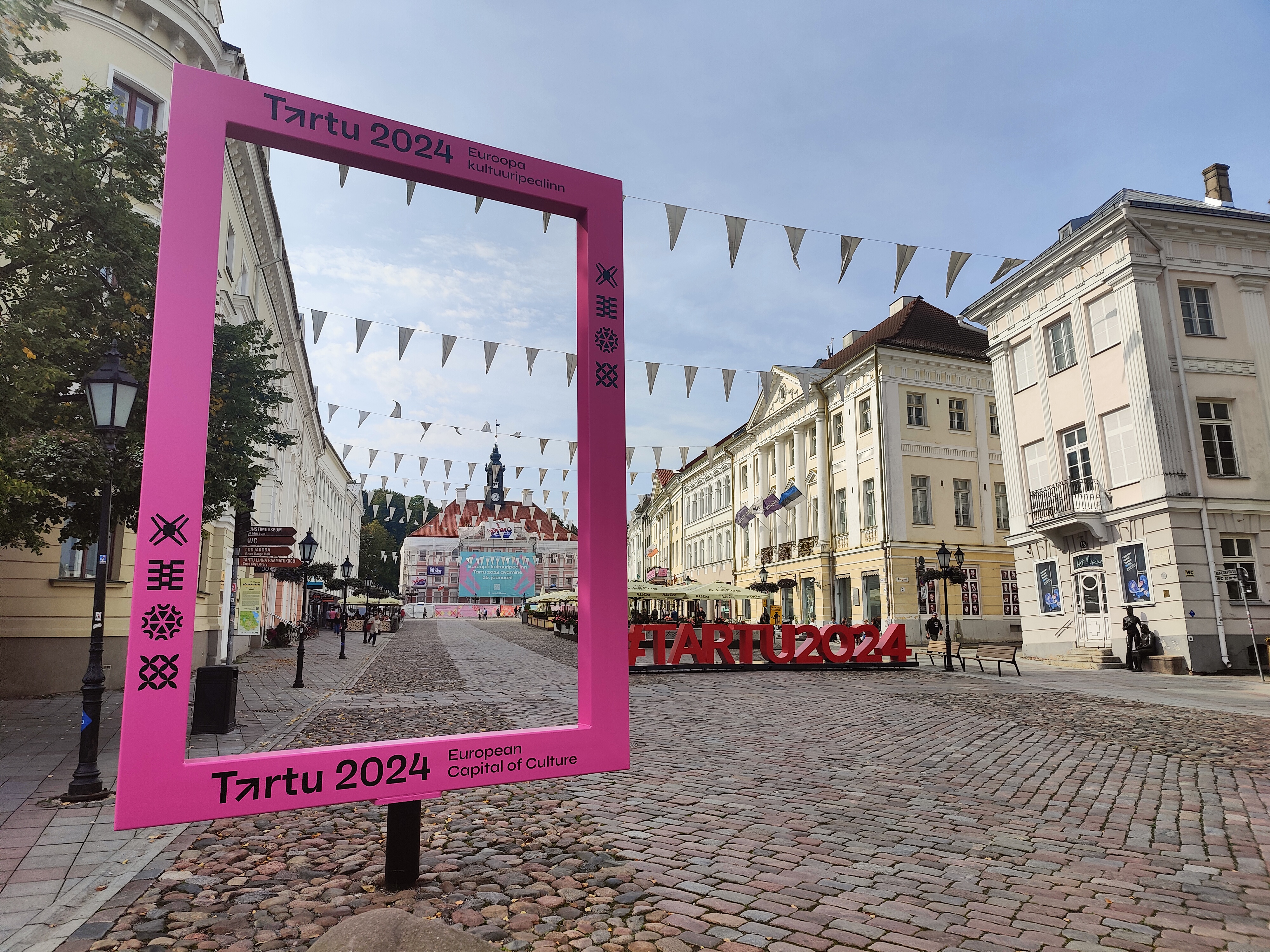
This year we – University of Tartu, Institute of Computer Science – have a pleasure to host FMEC2023, taking place in conjunction with iMETA, where iMETA, as you can assume, is associated with the metaverse (more precisely, the International Conference on Intelligent Metaverse Technologies & Applications), while FMEC – for the The Eighth IEEE International Conference on Fog and Mobile Edge Computing.

FMEC 2023 conference aims to investigate the opportunities and requirements for Mobile Edge Computing dominance, and seeks for novel contributions that help mitigating Mobile Edge Computing challenges. That is, the objective of FMEC 2023 is to provide a forum for scientists, engineers, and researchers to discuss and exchange new ideas, novel results and experience on all aspects of Fog and Mobile Edge Computing (FMEC) covering one of its major areas, which include, but not limited to the following tracks:

  • Track 1: Fog and Mobile Edge Computing fuels Smart Mobility
  • Track 2: Edge-Cloud Continuum and Networking
  • Track 3: Industrial Fog and Mobile Edge Computing Applications
  • Track 4: Trustworthy AI for Edge and Fog Computing
  • Track 5: Security and privacy in Fog and Mobile Edge Computing
  • Track 6: Decentralized Data Management and Streaming Systems in FMEC
  • Track 7: FMEC General Track

iMETA conference, in turn, aims to provide attendees with comprehensive understanding of the communication, computing, and system requirements of the metaverse. Through keynote speeches, panel discussions, and presentations, attendees had the opportunity to engage with experts and learn about the latest developments and future trends in the field, covering areas such as:

  • AI
  • Security and Privacy
  • Networking and Communications
  • Systems and Computing
  • Multimedia and Computer Vision
  • Immersive Technologies and Services
  • Storage and Processing

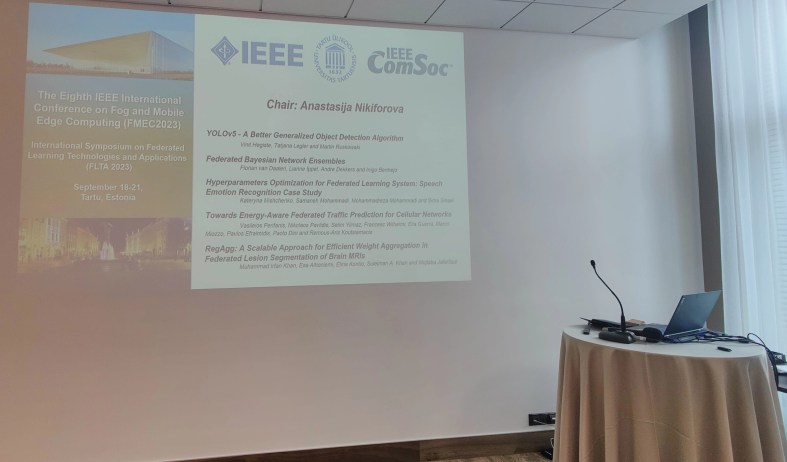
As part of these conferences, I had the pleasure of chairing one of the sessions, where the room was carefully selected by the organizers to make me feel as I would be at home – we were located in the so-called Baltic rooms of VSpa conference center, i.e., Estonia, Lithuania, and Latvia, so guess which room the session took place in? Bingo, Latvia! All in all, 5 talks were delivered:

  • Federated Object Detection for Quality Inspection in Shared Production by Vinit Hegiste
  • Federated Bayesian Network Ensembles by Florian van Daalen
  • Hyperparameters Optimization for Federated Learning System: Speech Emotion Recognition Case Study by Mohammadreza Mohammadi
  • Towards Energy-Aware Federated Traffic Prediction for Cellular Networks by Vasileios Perifanis
  • RegAgg: A Scalable Approach for Efficient Weight Aggregation in Federated Lesion Segmentation of Brain MRIs by Muhammad Irfan Khan, Esa Alhoniemi, Elina Kontio, Suleiman A. Khan and Mojtaba Jafaritadi

Each of the above was followed by a very lively discussion, which continued also after the session. This, in turn, was followed by an insightful keynote delivered by Mérouane Debbah on “Immersive Media and Massive Twinning: Advancing Towards the Metaverse”.

Also, thanks to our colleagues from EEVR (Estonian VR and AR Association), I briefly went to my school times and chemistry lessons having a bit of fun – good point, I’ve always loved them (nerd and weirdo, I know…).

Thanks to the entire FMEC and iMETA organizing team!