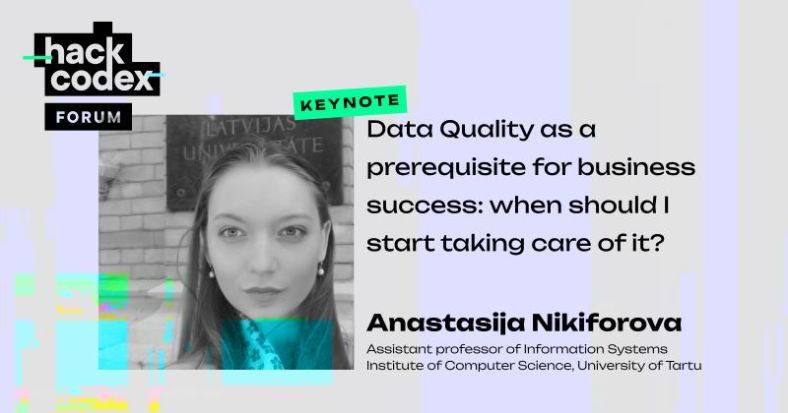
June 3-5, 2023 HackCodeX hackathon – a weekend-long experience, gathering tech enthusiasts from all over Europe to develop new ideas with the latest technology in a unique environment and atmosphere that serves as the meeting place for like-minded developers, designers, and business professionals eager to explore new paths – takes place. It will be accompanied by a one-day tech industry conference gathering international and local experts to discuss the key trends in technology and computing, where I act as one of those keynotes invited to deliver the talk devoted to the Data Quality that I entitled “Data Quality as a prerequisite for business success: when should I start taking care of it?”
A full weekend of hacking and catching up with more than 400 other tech heads in an atmosphere and spirit like no other.
Sounds interesting? 🗓️ 🗓️ 🗓️ Save the date! June 5, 2023 – topics focused on the key topics, such as emerging technologies, security and privacy, hardware and infrastructure, data quality, quantum technologies, as well as language and framework updates. From the growing interest in Artificial Intelligence to practical tips for securing software applications and dwelling into performance optimization – HackCodeX aims to inspire and provide new knowledge for tech experts of all levels.
Stay tuned and do not miss the opportunity to attend and meet me there! Read more here -> https://www.hackcodex.eu/forum
This September I was exceptionally proud to be invited to serve as one of two keynotes for the Innovation and Smart Government Conference 2022 (ISGOV2022) and open this conference, delivering my talk titled “Data as an asset for Sustainable Development of data-driven Smart Cities and Smart Society”. Another keynote was delivered by J. Ramon Gil-Garcia with the talk devoted to the use of Artificial Intelligence in the Public Sector.
ISGOV2022 keynotes
Some key takeaways or the main points of this talk (see slides above): 💡 Open data became a daily phenomenon, but making government data publicly available is not enough – there is time and need for the next steps towards sustainable and smart data ecosystems, requiring transformations at all levels; 💡 Open data is not only about OGD (B2G, crowdsourced data, sensor generated data etc.); 💡 Open data is not about data availability and accessibility. The data should –> must be qualitative (?), well-documented, valuabl (high value data (?)), smart (?), while the entry point from which they are available should be sufficiently user-friendly and interactive. Here, the concepts after which “?” follows is a subject for another 1.5h long talk :); 💡Open data quality is not only about metadata, their completeness and accuracy, it is also about the quality of content of dataset, where completeness of data is not the only criteria to be assessed! (reliability, internal and external consistency, timeliness, currency / up-to-date’ness and many more!); 💡{open, geospatial, smart, …} data ecosystem is not only about the platform (e.g., OGD portal), from which data can be downloaded, and not only about data governance or management. It is also not only about the data, which is, however, the key asset. It is many more… 💡Open data users – individuals, businesses (SME) etc., are not only end-users, they are (should be) an integral part of open data ecosystem. In other words, public data (eco)system is also about “public” –> stakeholders and actors of OD ecosystems should be identified (their role, needs etc.), which should then imply in requirements for newer and sustainable data ecosystems, which will facilitate interaction of (multiple) stakeholders 💡All in all, it’s all about data, portal, service, policy… 💡At the same time users and the whole society should be educated and acquire knowledge and skills needed to interact with the OD artifacts –> digital literacy, and open data literacy, where the latter term is not well-defined at this moment, while it is obvious that we need it!
I am very grateful ISGOV organizers, namely, the Autonomous University of Tamaulipas (UAT), the Autonomous University of the State of Mexico (UAEM), the University of Guadalajara (UDG), the I-Lab Public Innovation and Artificial Intelligence Laboratory – for having me as a part of this conference!!!
I am also grateful to all participants, especially those who participated in a discussion with so many relevant questions. Hope that this talk was interesting and contributed to the general understanding of the topic!
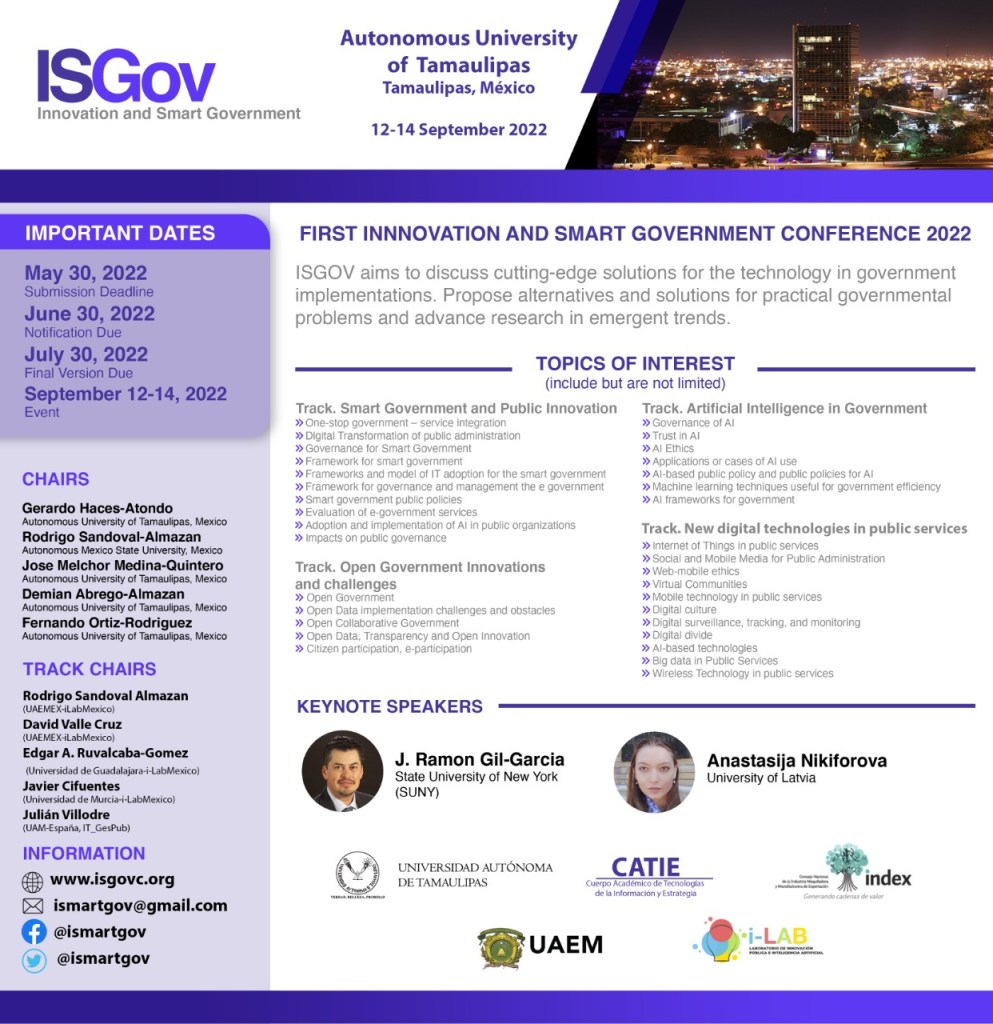
And today, celebrating the International Day of Women and Girls in Science dedicated to celebration of both science and gender equality (as part of United Nations Transforming our World: 2030 Agenda for Sustainable Development), I would like to share the information about very special event, in which I am invited to take a part – this time the role of mine is to be a keynote speaker for the international Innovation and Smart Government (ISGov)conference!!!
In case you are interested in topics related to public innovation, smart government, public governance, open government data, and changes in government organizations, I believe that this event, in which I will act as a keynote, could be of interest for you.
This conference aims to discuss cutting-edge solutions for the technology in government implementations. Propose alternatives and solutions for practical governmental problems and advance research in emergent trends. This conference seeks for contributions representing 4 different tracks:
TRACK 1. Smart Government and Public Innovation focused on research for public innovation and smart government in this challenging times. This track seeks research on new frameworks, ideas and evaluation of e-government services. Topics include but are not limited to: One-stop government – service integration, Digital Transformation of public administration, Governance for Smart Government, Framework for smart government, Frameworks and model of IT adoption for the smart government, Framework for governance and management the e government, Smart government public policies, Evaluation of e-government services, Adoption and implementation of AI in public organizations, Impacts on public governance, e-Government;
TRACK 2. Artificial Intelligence in Government focused on discussing AI applications, experiences, and unintended consequences, drawing on a variety of methodologies, techniques, applications, theoretical frameworks, and empirical cases, in order to capture the unique phenomena triggered by the increasing adoption of AI. Topics include but are not limited to: Governance of AI, Trust in AI, AI Ethics, Applications or cases of AI use, AI-based public policy and public policies for AI, Machine learning techniques useful for government efficiency, AI frameworks for government;
TRACK 3. Open Government Innovations and challenges focused on research about open government and related topics, such as government transparency, citizen participation, accountability, open data, among others. This track seeks to concentrate and disseminate research work on new case studies, theoretical frameworks, and evaluation of institutional openness policies.
TRACK 4. New digital technologies in public services focused on the investigation of the improvement of public services through new digital technologies. The investigations can be frameworks, applications, case studies, methodologies and empirical cases that allow knowing the impact of these technologies on public services. Topics include but are not limited to: Internet of Things in public services, Social and Mobile Media for Public Administration, Web-mobile ethics, Virtual Communities, Mobile technology in public services, Digital culture, Digital surveillance, tracking, and monitoring, Digital divide, AI-based technologies, Big data in Public Services, Wireless Technology in public services.
Two keynote speeches will be delivered during this event, delivered by J. Ramon Gil-Garcia and me. As regards Dr. J. Ramon Gil-Garcia, he is an Associate Professor of Public Administration and Policy and the Director of the Center for Technology in Government, University at Albany, State University of New York (SUNY). He is considered the most prolific author in the field of digital government research worldwide and in 2013 he was selected for the Research Award, which is “the highest distinction given annually by the Mexican Academy of Sciences to outstanding young researchers.” More recently, Dr. Gil-Garcia was named “One of the World’s 100 Most Influential People in Digital Government” in 2018 and 2019 by Apolitical. Dr. Gil-Garcia is the author or co-author of articles in prestigious international journals in Public Administration, Information Systems, and Digital Government and some of his publications are among the most cited in the field of digital government research worldwide. His research interests include collaborative electronic government, inter-organizational information integration, smart cities and smart governments, adoption and implementation of emergent technologies, digital divide policies, and multi-method research approaches. This makes my participation as the second keynote to be even more pleasant for me as for relatively young researcher.
At this moment, the topics of our speeches are not very well known, since we both work actively on our ongoing studies and perhaps will be ready to present some the most recent results, but, hopefully, despite the final decision on the topic to be covered (within the general scope of the conference, of course) they will be of interest for the audience and will result in a lively and fruitful discussion!
And Happy International Day of Women and Girls in Science! 👩🎓💻
First International Electronic Governance with Emerging Technologies Conference
Over the last decade, the importance of emerging technologies in government and public administrations has grown significantly. The growing demand for services that better meet changing user expectations for responsiveness and personalization, coupled with higher expectations of the role of government in the digital age, calls for a technologically mature public sector. There are many new emerging technologies serving as enablers to new forms of governance and novel applications in traditional governance functions, which role has been witnessed across various domains, including healthcare, medicine, education, tourism, and industry etc..
The aim of the First International Conference in Electronic Governance with Emerging Technologies (EGETC-2022) is to provide a forum for academics, scholars, and practitioners from academia and industry to share and exchange the recent developments in the domain of eGovernment and governance of digital organizations to shed light on the emerging research trends and their applications.
Topics of interest include, but not limited to:
Intelligent systems for coordination in crisis emergency management
Distributed ledgers and Blockchains: governance, decentralized autonomous organizations (DAO)
Machine Learning (ML), Artificial Intelligence (AI) and Big Data management for Public Sector
Privacy, security and legal Informatics – AI and Law
Open Data, Open Government Data: transparency, trust, public participation, co-creation and Open Innovation
Digital transformation and Society 5.0
Linked Data, Linked Open Data (LOD)
Semantic E-government applications
Public Sector Knowledge Representation
Decision Support Systems (DSS) in Digital Governance
Natural Language Processing (NLP)
Cloud Computing
Bots, Automation agents, Self-learning systems
Cryptocurrencies and incentive mechanism design
Multimedia and multilingual systems
It is particularly important that, in order to ensure the widest possible participation of communities, despite the availability of funding, the conference does not foresee any charges. I.e. both authors and presenters, and attendees/ listeners are welcome without registration fees.
First International Electronic Governance with Emerging Technologies Conference (author: Anastasija Nikiforova)
In addition to the great team of organizers and members of the program committee, which has a rich list of outstanding experts, participants of this event will have an opportunity to enjoy the keynote speeches by Prof. Marijn Janssen – Full Professor in ICT & Governance at TU Delft, Netherlands, Dr. B K Murthy, CEO – Innovation and Technology Foundation, IIT Bhilai, Prof. Luis Martinez – Full Professor, University of Jaén, Jaén Spain. More information on their talk will follow…
Accepted papers presented at the EGETC2022 will be published in the proceeding published by Springer in Lecture Notes in Computer Science series (approval pending…). A short list of best papers will be invited for a post-conference publication in Government Information Quarterly (GIQ), Elsevier, Q1, Cite Score: 11.6, Impact Factor: 7.279 and Technological Forecasting and Social Change, An International Journal, Elsevier, Q1, Cite Score: 12.1, Impact Factor: 8.593.
If you are interested in submitting your paper, add to your calendar the submission date – May 30, while the event will take place during September 12-14, 2022.
Due to the unpredictability of the current situation in the light of pandemic, we expect to have a hybrid event, i.e. both online and on-site participation will be possible. For the later mode, we will be very glad to meet participants, who will be able to attend the event physically, in peaceful and spectacular city of Tamaulipas, Mexico in mid-September, 2022. Hope to meet you there!!!





 Anastasija Nikiforova, PhD