AI, Data, and Public Benefit: Reflections from Data for Policy CIC 2025

At Data for Policy CIC 2025 in The Hague, themed “Twin Transition in Data and Policy for a Sustainable and Inclusive Future,” we explored how emerging technologies—especially AI—and diverse data sources can support accountable, inclusive, and sustainable policymaking.

Across several full days of sessions, the event brought together transdisciplinary researchers, policy practitioners, and technology experts. Notable contributions included:

  1. Research presentations“Proactive-by-Design: The Future of Governance Beyond Bureaucracy?,” on the study we conduct with Paula Rodriguez Müller & Luca Tangi (European Commission JRC) and “The Data Agency Awakens: A New Era for Official Statistics” we prepared with Luca Di Gennaro Splendore
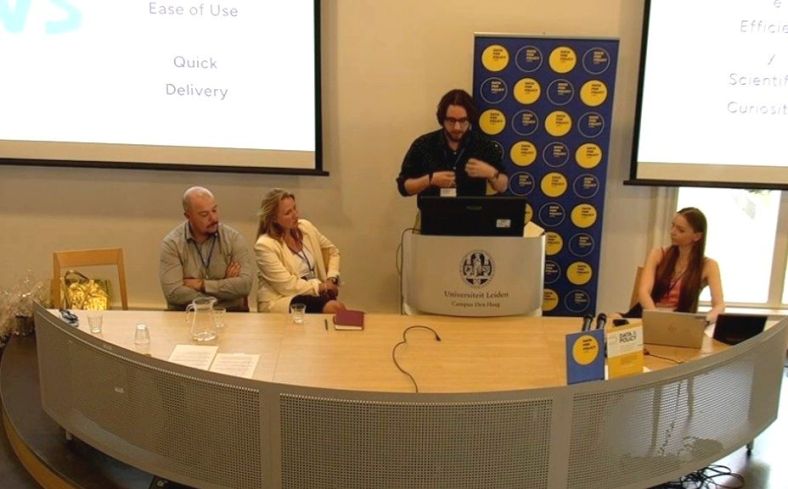
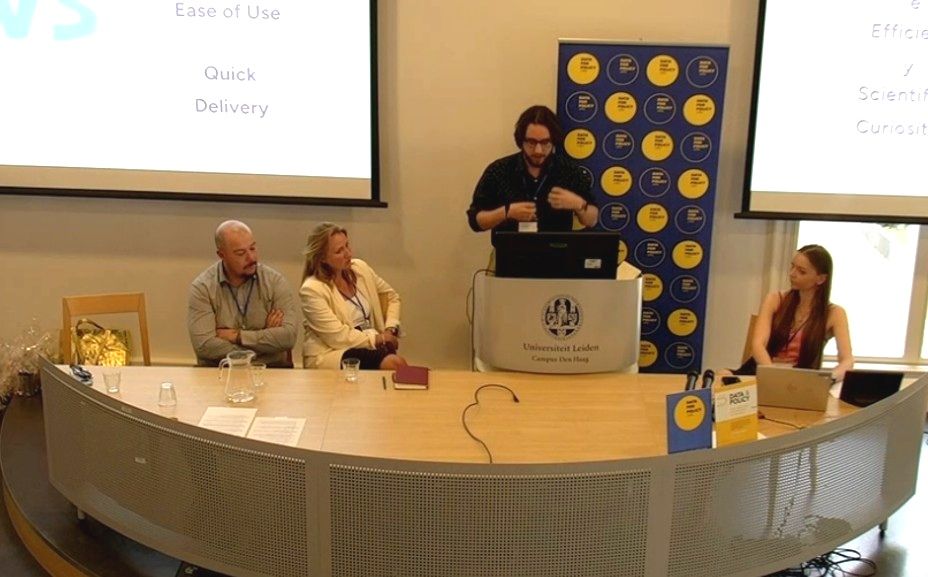
  2. Panel on National Data Strategies in Europe: Learning from and for the Dutch Data Strategy, which I joined the conversation as a panelists, along with Tim Faber (Ministry of Interior & Kingdom Relations), Anne Fleur van Veenstra, Iryna Susha, Adrianna Michałowicz (chaired by Devin Diran & Thijmen van Gend)
  3. finally, the paanel on Responsible AI and Data Science Revolutions: Implications for Public Benefit Research and Policy Making that I was honored to chair, with panelists representing Smart Data Foundry and the Joseph Rowntree Foundation (JRF), joined by Magdalena Getler, Oliver Berry, and Rosario Piazza.

Our discussion highlighted the immense potential of AI and data, but also the responsibilities that come with it. Key insights included:

  • Balancing optimism and realism: AI is transformative, but its adoption requires grounded, practical experience. It can support public benefit—if managed carefully;
  • Data quality over quantity: More data isn’t always better. Governance, documentation, bias mitigation, and transparency are essential for AI-readiness;
  • Embedding public trust: High-sensitivity contexts, such as health or finance, demand proportionality, oversight, and systems designed for inclusivity;
  • Human-in-the-loop mechanisms: Ensuring AI reflects human values and context is critical, even when those values are evolving;
  • Task-appropriate AI: Not every problem requires a large language model; careful alignment between technology and purpose is essential;
  • Data literacy for all: Understanding AI’s limitations and risks is as important as technical infrastructure;
  • Triangulating perspectives: Combining structured/unstructured and qualitative/quantitative data helps address bias, power imbalances, and complexity;
  • Sustainable and inclusive systems: Scalable infrastructure alone is insufficient; AI governance and operational design must prioritize long-term societal benefit.

As Amara’s Law reminds us: “We tend to overestimate the effect of a technology in the short run and underestimate it in the long run.” Our discussion echoed this sentiment: AI’s potential is enormous, but realizing it for public benefit requires careful design, governance, and collaboration.

The overarching theme through all days (beyond above) was clear: AI and data are not neutral tools. Their value for public policy depends on human-centered design, responsible governance, and active societal engagement. Tools alone won’t deliver public benefit—they must be operationalized thoughtfully, with attention to ethics, context, and inclusion.
Huge thanks to Sarah Giest, Bram Klievink, Zeynep Engin, and all participating institutions—Leiden University, TNO Vector, Cambridge University Press & Assessment, and The Hague Centre for Digital Governance—for creating the space for meaningful dialogue in such a rich, collaborative environment.

The CIC 2025 conversations reminded us: building a truly responsible, inclusive, resilient, and sustainable AI ecosystem is not just a technical challenge—it is a societal mission and each and every of us is part of it.

International Week in BabeČ™-Bolyai University 🇷🇴 any 6-hour long course on “Crafting Success: The Art of Business Process Management”

This May, I had a pleasure to take part in International Week in Babeș-Bolyai University (Romania) 🇷🇴 delivering 6-hour long “Crafting Success: The Art of Business Process Management” course for undergraduates, Master and PhD students that was based on the course we (with Marlon Dumas) deliver at the University of Tartu Institute of Computer Science.

As part of this course, we delved deep into the fundamental principles and methods of business process management along the lifecycle of business processes were introduced, providing students with the understanding on:

  1. Process Identification and Organization: students learned how to identify key business processes and organize them into a coherent architecture, laying the foundation for effective management and improvement;
  2. Performance Measurement and Prioritization: we explored methods for defining performance measures and prioritizing initiatives for process improvement, ensuring that efforts are focused on areas that deliver the most significant impact;
  3. Process Modeling and Analysis: through the BPMN notation, students were equipped to capture and analyze business processes effectively, facilitating clear communication and understanding across teams;
  4. Process Redesign: The course also delved into strategies for analyzing and redesigning processes to align with performance objectives, employing transformational and transactional approaches such as Business Process Reengineering (BPR) and redesign heuristics.

Additionally, an overview of BPM tools for process automation and monitoring, highlighting the pivotal role of BPM models in driving the design of IT solutions that support seamless process execution, was provided to students.

One of the most rewarding aspects of the course was witnessing the genuine interest and active participation of our students. Their enthusiasm and engagement presented a delightful challenge when selecting the most outstanding contributors for recognition at the course’s conclusion.

Beyond the confines of our classroom, involvement in the International Week themed “Business Education without Borders” opened doors for students to a myriad of interdisciplinary explorations. From data mining with AI to delving into digital market research ethics, students embarked on a journey encompassing finance, law, accounting, multicultural consumer behavior, supply chain dynamics, and risk management. This immersive experience, enriched by guest lecturers from diverse cultural backgrounds, fostered cross-cultural exchange and equipped participants with invaluable skills and knowledge essential for success in today’s global business landscape.

A heartfelt thank you to the organizers for the opportunity to be part of this enriching experience. While I regret not being able to join in person, I am certain that the event was a resounding success, thanks to the dedication and hard work of everyone involved.

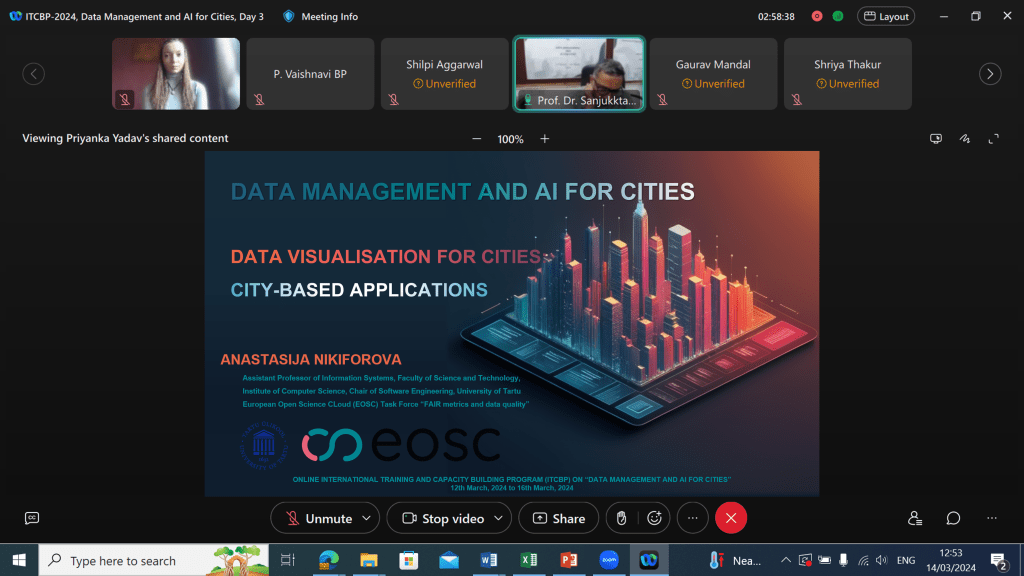
Online International Training and Capacity Building Program-2024 (ITCBP-2024) for the School of Planning and Architecture, New Delhi and my talk on “Data Management for AI Cities”

Yesterday, I had the honor of serving as an Expert speaker for an Online International Training and Capacity Building Program-2024 (ITCBP-2024) on “Data Management for AI Cities”, organised by the School of Planning and Architecture, New Delhi (SPA FIRST) that invited me to deliver a talk on “Data Visualisation for Cities: City Based Applications”.

During this talk, we touched on several important aspects surrounding data management and visualization in and for cities, including:

  • Data management that was then deduced to data quality management of both internal and external data, departing from understanding these data to managing their quality throughout the DQM lifecycle (stressing that data cleaning is not the same as DQM), touching on several approaches to this with greater emphasis on the AI-augmented data quality management – existing tools, underlying methods, and weaknesses that should be considered when using (semi-)automatic data quality rule recognition, depending on the method they use for this purpose;
  • Data governance was then discussed, stressing how it differs from DQM, and what it consists of and why it is crucial, incl. within the context of this talk;
  • Data visualization & storytelling – role, key principles, common mistakes, best practices. As part of this, we covered strategies for selecting data visualization type with tips on how to simplify this process, incl. by referring to chart selectors, but also stressing why “thinking outside the menu” is critical, esp. within city-level data visualization (where your audience is often citizens or policymakers). We looked at the most common and/or successful uses of non-traditional types of visualizations, incl. tools to be used for these purposes, breaking them into those that require coding and those that are rather low- or no-code; noise reduction – simplicity – strategic accents’ use, as well as drill-down (aka roll-down) & roll-up use to convey the message you want to deliver while overcoming highlighting everything and thereby losing your audience. In addition, a UX perspective was discussed, including but not limited some aspects that are often overlooked when thinking about the design and aesthetic color palette, namely the color-blindness of the audience that might “consume” these visualizations and again, tips on how to use it easier – did you you known that there are 300 million color blind people? And that 98% of those with color blindness have red-green color blindness?

So what was the key message or a “takeaway” of this talk? In a very few words:

  • Understand your data, audience and story you want to tell! Understand:
    • your data,
    • the story it tells,
    • your target audience’s preferences and needs,
    • the story you want to tell
    • data suitability
    • data quality
  • Attention-grabbing visuals & storytelling is a key!
    • reduce noise to avoid audience confusion and distraction
    • use drill-down and roll-up operations to keep visualization simple
    • add the context to provide all necessary information for clear understanding
    • add highlights to focus their attention – add accents strategically
  • Consider design – the optimal visualisation type, chart design, environment design, potential color-blindness of your audience
  • Keep track of the current advances, but also challenges and risks, of data visualization in urban settings, incl. but not limited to (1) privacy concerns, (2) data silos, (3) technological limitations.

All in all, it was quite a rich conversation and I am very grateful to the organizers for the invitation to be part of this event and to the audience for the very positive feedback!

CFP for The IEEE International Conference on Intelligent Computing, Communication, Networking and Services (ICCNS2023)

On behalf of the organizers (Technical Program Chair, Steering Committee, and finally publicity chair) of the IEEE International Conference on Intelligent Computing, Communication, Networking and Services (ICCNS2023), I am inviting everyone, who is conducting research in this area, to consider submitting the paper to it.

Call for Papers:

New advancements in wireless communication systems such as Fifth-Generation (5G), Beyond Fifth-Generation (B5G), and Sixth-Generation (6G) networks will allow for new and unprecedented services to be made available for users with nearly unlimited capacity. These services will be the core driver for future digital transformation of our cities and communities. This will be accompanied by a ubiquitous deployment of Internet of Things (IoT) infrastructure and supported by computing capacity that will be available at the edge of the network and in the cloud. This computing infrastructure will handle the processing of data generated by users and services. Such a complex and diverse system will require the applications running on the computing/networking infrastructure to be Intelligent, efficient and sustainable. Additionally, the infrastructure will require smart control and automation systems to integrate and manage its different components. Artificial Intelligence (AI) and its applications will play a significant role in the design, deployment, automation, and management of future services. This will include applications that will be running on the edge and on cloud servers, networking applications to handle the flow of data between the users and the computing system, and intelligent automation and management software operating on the system. The International Conference on Intelligent Computing, Networking, and Services is aiming to provide an opportunity to present state of the art research in the intersections of Computing, Networking, and Services that are supported by Artificial Intelligence.

Submission Link: https://easychair.org/conferences/?conf=iccns2023

Researchers from both the industry and academia are encouraged to submit their original research contributions in all major areas, which include, but are not limited to the following main tracks:

đź’ˇTrack 1: Artificial Intelligence Fundamentals

  • Artificial Intelligent Systems
  • Artificial Intelligent Theory
  • Artificial Intelligent applications in Computers and Communications
  • Artificial Intelligent and Robotics Technologies
  • Artificial Intelligent and cloud computing
  • Artificial Intelligent for Economic paradigms and game theory
  • Machine and Deep Learning of Knowledge
  • Artificial Intelligent based Distributed Knowledge and Processing
  • Artificial Intelligent for Human-Robot Interactions

đź’ˇTrack 2: Intelligent Internet of Things and Cyber-Physical Systems

  • Intelligent IoT Applications and Services
  • Intelligent security for the Internet of Things and cyber-physical systems
  • Intelligent Internet of Things architectures and protocols
  • Intelligent Cyber Physical Systems (CPS)
  • Blockchain-based application in Intelligent Manufacturing: Industrial Internet of Things,
  • Blockchain and Secure Critical Infrastructure with Industry 4.0
  • Intelligent manufacture and management
  • Consensus and mining algorithms suited for resource-limited IoTs
  • Blockchain-based Controlled mobility and QoS
  • Blockchain-based energy optimization techniques in WSN
  • Blockchain-based Software defined networks

đź’ˇTrack 3: Edge Intelligence and Federated Learning

  • Distributed and federated machine learning in edge computing
  • Theory and Applications of Edge Intelligence
  • Middleware and runtime systems for Edge Intelligence
  • Programming models compliant with Edge Intelligence
  • Scheduling and resource management for Edge Intelligence
  • Data allocation and application placement strategies for Edge Intelligence
  • Osmotic computing with edge continuum, Microservices and MicroData architectures
  • ML/AI models and algorithms for load balancing
  • Theory and Applications of federated learning
  • Federated learning and privacy-preserving large-scale data analytics
  • MLOps and ML pipelines at edge computing
  • Transfer learning, interactive learning, and Reinforcement Learning for edge computing
  • Modeling and simulation of EI and edge-to-cloud environments
  • Security, privacy, trust, and provenance issues in edge computing
  • Distributed consensus and blockchains at edge architecture
  • Blockchain networking for Edge Computing Architecture
  • Blockchain technology for Edge Computing Security
  • Blockchain-based access controls for Edge-to-cloud continuum
  • Blockchain-enabled solutions for Cloud and Edge/Fog IoT systems
  • Forensic Data Analytics compliant with Edge Intelligence

đź’ˇTrack 4: Intelligent Networking in Beyond 5G (B5G) and 6G Wireless Communication

  • Intelligent Networking in Beyond 5G/6G Network Architectures
  • large-scale Internet of Things in B5G/6G
  • Vehicular networks in B5G/6G
  • Blockchain with lightweight computation
  • Service and applications for vehicular clouds in B5G/6G
  • Future internet architectures for B5G/6G
  • Intelligent networking services
  • Emerging networks in B5G/6G
  • Byzantine-tolerant FL
  • Churn-tolerant FL
  • FL for NGN and 6G
  • B5G/6G based IoT healthcare systems

đź’ˇTrack 5: Intelligent Big Data Management and Processing

  • Intelligent Data Fusion
  • Intelligent Analytics and Data mining
  • Intelligent Distributed data management
  • Distributed transaction for blockchain
  • Intelligent Data Science and Data Engineering
  • Protocols for management and processing of data

đź’ˇTrack 6: Intelligent Security and Privacy

  • Authentication and authorization
  • Applications of blockchain technologies in digital forensic
  • Privacy technologies
  • Blockchain-based threat intelligence and threat analytics techniques
  • Blockchain-based open-source tools
  • Forensics readiness of blockchain technologies
  • Blockchain Attacks on Existing Systems
  • Blockchain Consensus Algorithms
  • Blockchain-based Intrusion Detection/Prevention
  • Security and Privacy in Blockchain and Critical Infrastructure
  • Attacks on Blockchain and Critical Infrastructure
  • Blockchain and Secure Critical Infrastructure with Smart Grid

đź’ˇTrack 7: Blockchain Research & Applications for Intelligent Networks and Services

  • State-of-the-art of the Blockchain technology and cybersecurity
  • Blockchain-based security solutions of smart cities infrastructures
  • Blockchain in connected and autonomous vehicles (CAV) and ITS)
  • Blockchain Technologies and Methodologies
  • Recent development and emerging trends Blockchain
  • New models, practical solutions and technological advances related to Blockchain
  • Theory of Blockchain in Cybersecurity
  • Applications of blockchain technologies in computer & hardware security
  • Implementation challenges facing blockchain technologies
  • Blockchain in social networking
  • Performance metric design, modeling and evaluation of blockchain systems
  • Network and computing optimization in blockchains
  • Experimental prototyping and testbeds for blockchains
  • Blockchain networking for Edge Computing Architecture
  • Blockchain technology for Edge Computing Security
  • Blockchain-based access controls for Edge-to-cloud continuum
  • Blockchain-enabled solutions for Cloud and Edge/Fog IoT systems
  • Forensic Data Analytics compliant with Edge Intelligence

Two workshops are scheduled to take place as part of ICCNS that you cannot miss, namely:

🗓️🗓️🗓️ IMPORTANT DATES

  • Full paper submission: April 21st, 2023 (Firm and Final)
  • Full paper acceptance notification: May 6th, 2023
  • Full paper camera-ready submission: May 20th, 2023

For any inquiries, please contact: intelligenttechorg@gmail.com.

Submit the paper and meet our team in Valencia in June, 2023!
 

With best wishes,

ICCNS2023 organizers

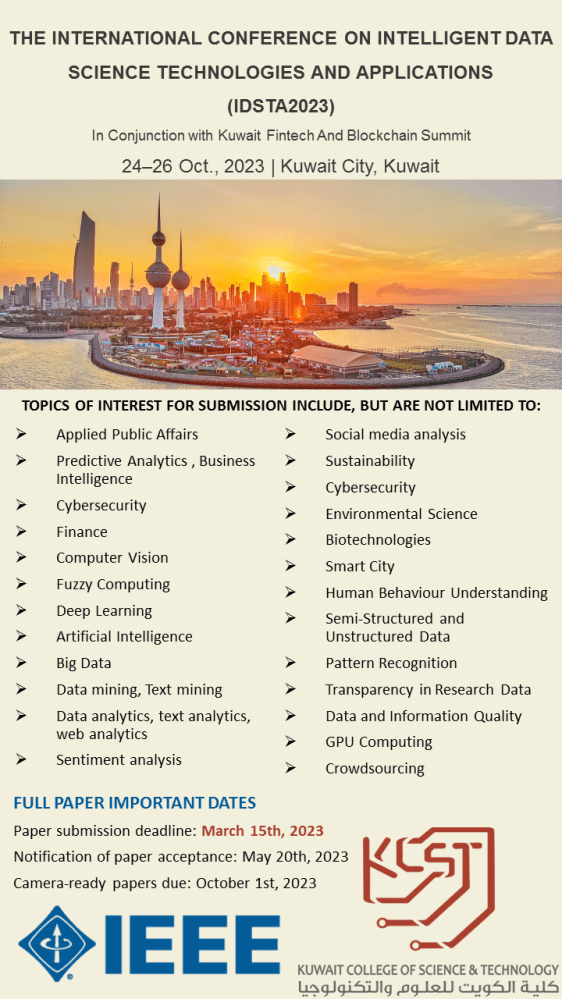
CFP: The International Conference on Intelligent Data Science Technologies and Applications (IDSTA2023)

On behalf of the organizers and as a publicity chair, I sincerely invite you to consider submitting the results of your recent research to The International Conference on Intelligent Data Science Technologies and Applications (IDSTA2023), which will be held in conjunction Kuwait Fintech and Blockchain Summit.

Huge amount of data is being generated and transmitted everyday. To be able to deal with this data, extract useful information from it, store it, transmit it, and represent it, intelligent technologies and applications are needed. The International Conference on Intelligent Data Science Technologies and Applications (IDSTA) is a peer reviewed conference, whose objective is to advance the Data Science field by giving an opportunity for researchers, engineers, and practitioners to present their latest findings in the field. It will also invite key persons in the field to share their current knowledge and their future expectations for the field. Topics of interest for submission include, but are not limited to:

đź’ˇApplied Public Affairs, incl. but not limited to Campaign Management, Mass Communication Politics, Political Analysis, Survey Sampling
đź’ˇBusiness Analytics, incl. but not limited to Stock Market Analysis, Predictive Analytics, Business Intelligence
đź’ˇFinance, incl. but not limited to Risk Management, Algorithmic Trading, Fraud Detection, Financial Analysis
đź’ˇComputer Science, incl. but not limited to Database Management Systems, Scientific Computing, Computer Vision, Fuzzy Computing, Feature Selection, Neural Networks, Deep Learning, Meta-Learning, Process Mining, Artificial Intelligence, Data Mining, Big Data, Web Analytics, Text Mining, Natural Language Processing, Sentiment Analysis, Social Media Analysis, Data Fusion, Performance Analysis and Evaluation, Evolutionary Computing and Optimization, Hybrid Methods, Granular Computing, Recommender Systems, Data Visualization, Predictive Maintenance, Internet of Things (IoT), Web Scraping
đź’ˇSustainability, incl. but not limited to Datasets on Sustainability, Sustainability Modeling, Energy Sustainability, Water Sustainability, Environmental Sustainability, Risk Analysis
đź’ˇCybersecurity, incl. but not limited to Data Privacy and Security, Network Security, Communication Security, Cryptography, Fraud Detection, Blockchain
đź’ˇEnvironmental Science, incl. but not limited to GIS, Climatographic, Remote Sensing, Spatial Data Analysis, Weather Prediction and Tracking,
đź’ˇBiotechnologies, incl. but not limited to Gnome Analysis, Drug Discovery and Screening and Side Effect Analysis, Structural and Folding Pattern, Disease Discovery and Classification, Bioinformatics, Next-Gen Sequencing
đź’ˇSmart City, incl. but not limited to City Data Management, Smart Traffic, Surveillance, Location-Based Services, Robotics
đź’ˇHuman Behaviour Understanding
đź’ˇSemi-Structured and Unstructured Data
đź’ˇPattern Recognition
đź’ˇTransparency in Research Data
đź’ˇData and Information Quality
đź’ˇGPU Computing
đź’ˇCrowdsourcing


🗓️🗓️🗓️ IMPORTANT DATES

  • Paper submission:  March 15, 2023  
  • Acceptance notification:  May 20th, 2023
  • Full paper camera-ready submission: October 1st, 2023
    Conference Dates: October 24-26, 2023

All papers that are accepted, registered, and presented in IDSTA2023 and the workshops co-located with it will be submitted to IEEEXplore for possible publication. 
For any inquiries, contact intelligenttechorg@gmail.com.

Submit the paper and meet our team in Kuwait in October, 2023!
 

With best wishes,

IDSTA2023 organizers