October – the month of Guest Lectures

This autumn, and more precisely in October, there were a lot of public activities, including delivering my talk at the ICEGOV2021 (14th International Conference on Theory and Practice of Electronic Governance (ICEGOV2021) “Smart Digital Governance for Global Sustainability“: “Towards enrichment of the open government data: a stakeholder-centered determination of high-value data sets for Latvia“ – this year I was able to take part in it in an online mode but hope this will change at some point), my Invited Talk delivered at the Nanotech2021, my participation in the Latvian Open Geospatial Data hackathon as a mentor – my team won, by the way 🙂 and my participation in the Europe Biobank Week 2021.
Yet another experience was related to a very new experience – the guest lectures. In the past, I had a few minor experiences, but these were mostly short talks that cannot be considered as normal lectures or lectures delivered only to Latvian students. It’s changed this autumn!

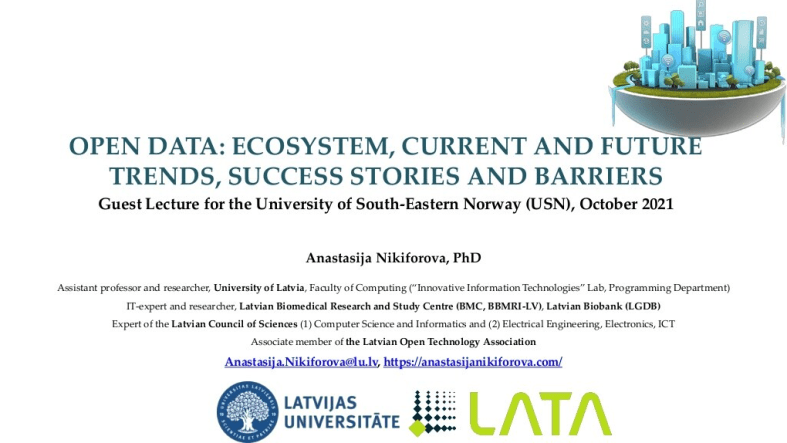
This autumn has changed this! I was very pleased and honoured to serve twice as a Guest Lecturer this October. One lecture for the University of South-Eastern Norway (USN) on the open data – its ecosystem, barriers, current and future trends in both worldwide and Norway context (see slides here), focusing on data quality, which the audience found to be especially interesting. I was extremely pleased to have such a lively discussion on the variety of points that we were able to cover during this lecture, because students have shown both an interest in my talk and what is more – their knowledge and ability to think and elaborate on the given points even without prior knowledge in this area. A very educated and intelligent audience!

The second lecture, however, was delivered at my neighboring Faculty of Social Sciences, University of Latvia (Latvijas Universitāte), on the potential of open data, reflecting the Latvian case and pointing out some examples that we can take over from other countries (see slides here). This lecture will also stay in my memory as one with a very fruitful discussion – hopefully this conclusion will be the same for the audience!

To sum up, thank you, for those professors who have invited me to serve as a Guest Lecture – Salah Uddin Ahmed and Visvaldis Valtenbergs. Hope that this was a great experience for us both!
Europe Biobank Week 2021

This is a short note about Europe Biobank Week 2021, which took place in an online mode this year during 8-10 November. EBW is jointly organized by ESBB (European, Middle Eastern & African Society for Biopreservation and Biobanking) and BBMRI-ERIC with this year’s theme “Biobanking for our Future – Opportunities Unlocked. The programme was plenty of very different events and opportunities, including rich programme of live presentations from high-level experts, and a collection of selected posters, where I was honored to be represented in two of them (14 main topics) as part of the Latvian Biomedical Research & Study centre team, where I work as an IT-expert.

One of them authored by me was presented within “Novel IT solutions, effective data storage, processing and analysis” section. This poster titled “Towards efficient data management of biobank, health register and research data: the use-case of BBMRI-ERIC Latvian National Node” (authors: Anastasija Nikiforova, Vita Rovīte, Laura Ansone) was devoted to the ongoing project (funded by the European Union under the Horizon 2020) called INTEGROMED – Integration of knowledge and biobank resources in comprehensive translational approach for personalized prevention and treatment of metabolic disorders, where some preliminary results of my activities on the inspecting and improving the ecosystem of the Latvian Biomedical Research and Study centre and then summarized and transformed into the set of guidelines towards efficient data management for heterogeneous data holders and exchangers, were presented.

European Biobank Week 2021, poster
“Towards efficient data management of biobank, health register and research data: the use-case of BBMRI-ERIC Latvian National Node” (authors: A. Nikiforova, V. Rovīte, L. Ansone)

Another poster titled “Development of a dynamic informed consent system for Latvian national biobank and citizen science data management, quality control and integration” (authors: Kante N., Nikiforova A., Kalēja J., Svandere A., Mezinska S., Rovīte V.) was presented under “Population-based cohorts – addressing global challenges for future generations” section and was dedicated to another project, which is funded by European Regional Development Fund (ERDF) – “DECIDE – Development of a dynamic informed consent system for biobank and citizen science data management, quality control and integration“.

“Development of a dynamic informed consent system for Latvian national biobank and citizen science data management, quality control and integration” (authors: Kante N., Nikiforova A., Kalēja J., Svandere A., Mezinska S., Rovīte V.)

This was another very nice experience!

My first Invited Talk

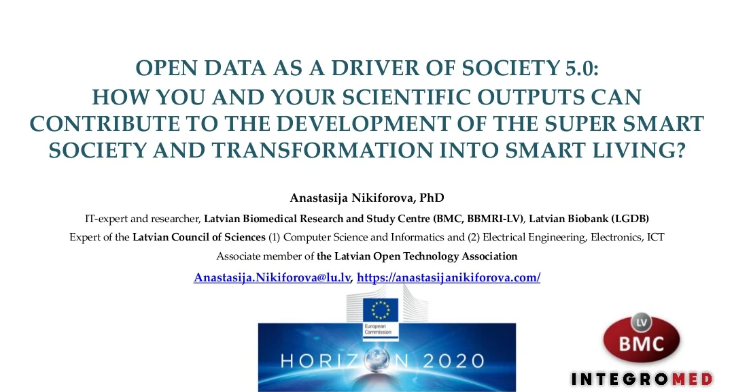
Recently, I was invited to deliver my talk on the openness (open data and open science) in the context of Society 5.0 during the International Conference and Expo on Nanotechnology and Nanomaterials. It was very pleasant to receive an invitation to deliver the invited talk on my recently published article Smarter Open Government Data for Society 5.0: Are Your Open Data Smart Enough? (Sensors 2021, 21(15), 5204), which I have entitled as “Open Data as a driver of Society 5.0: how you and your scientific outputs can contribute to the development of the Super Smart Society and transformation into Smart Living?. The paper has been briefly discussed in my previous post, thus, just a few words on this talk and overall experience. Although I have participated in different conferences as a speaker delivering presentations on my ongoing studies, this was my first experience of serving as an Invited Speaker, which is a sort of “Welcome to the senior league!”.

So, what was the main idea of the talk? Today, the open data and portals that provide these data and which can be accessed and used by everyone for their own needs became a daily phenomena. These phenomena became popular in science, contributing to the development of the concept of the “open science”, according to which making findings of the research available to the audience by means of articles, preferably OA, is not enough. Therefore, some more advanced guidelines have been defined and involved (or are involved, as is the case for (bio)medicine). These topic became valuable for both scientific and societal areas at (inter)national level. However, these initiatives, as well as users’ intent for open data, are evolving continuously and today, in line with IoT and smart city trends, real-time and sensor-generated data are of greater interest to users. This is all the more relevant for research-related data. These data may lead to solving problems that were not central research objects to the original data holders, improve previous results, establish cooperation to tackle challenges together. In addition, these data are considered to be one of the crucial drivers of a sustainable economy and can have an impact on information and communication technology innovation and become a creativity bridge in developing a new ecosystem in Industry 4.0 and Society 5.0. Although there are some studies reporting on open data and open science, understanding how and whether they have a positive impact on our lives at various levels and drives real transformation of the society, science, governments etc., this topic requires extensive work. Thus, in this talk I have provided my recent findings on this topic with some evidences of the importance of an “open science” trend, following the principles of open data. The aim of the talk is to make everyone ask themselves “am I promoting open science?” and “how can I promote open science?”.

To sum up, this was the first Invited Talk I have delivered and this was a great experience at the larger stage…. and… what to say, I liked it! It was a pleasure to get a very positive feedback on the talk and to see an interest from the researchers representing very medicine-related domains. Thank you, the International Conference and Expo on Nanotechnology and Nanomaterials.

The Open Data Daily (PSI Monitor) and World Health Organization (WHO) recommend my article “Smarter Open Government Data for Society 5.0”

The Open Data Daily (PSI Monitor), World Health Organization, Europe PMC and FreeMedArt recommend my recently published article Smarter Open Government Data for Society 5.0: Are Your Open Data Smart Enough? (Sensors 2021, 21(15), 5204), in which I explore OGD portals of 60 countries in order to understand the correspondence of their content to the Society 5.0 expectations. The paper provides a report on how much countries provide these data, focusing on some open (government) data success facilitating factors for both the portal in general and data sets of interest in particular.

The idea lies in the fact that the open (government) data initiative as well as users’ intent for open (government) data are changing continuously and today, in line with IoT and smart city trends, real-time data and sensor-generated data have higher interest for users. These “smarter” open (government) data are also considered to be one of the crucial drivers for the sustainable economy, and might have an impact on information and communication technology (ICT) innovation and become a creativity bridge in developing a new ecosystem in Industry 4.0 and Society 5.0.

The presence of “smarter” data, their level of accessibility, availability, currency and timeliness, as well as support for users, are analyzed. The list of most competitive countries by data category are provided. This makes it possible to understand which OGD portals react to users’ needs, Industry 4.0 and Society 5.0 request the opening and updating of data for their further potential reuse, which is essential in the digital data-driven world. View Full-Text

The world’s largest and most significant open data portal data.europa.eu publishes news article devoted to my scientific article

Feel honored, glad and surprised to notice that the world’s largest and most significant open data portal data.europa.eu, whose strategic objective is to promote access to open data band to increase their global value, have published news article devoted to my scientific article Timeliness of Open Data in Open Government Data Portals Through Pandemic-Related Data: a long-distance data from the publisher to the user.

2021-03-17_data-europa-eu

Source: https://data.europa.eu/en

Continue reading “The world’s largest and most significant open data portal data.europa.eu publishes news article devoted to my scientific article”