In the very last days of May 2023, I had yet another experience – I delivered a contributed talk at QWorld Quantum Science Days 2023 (QSD 2023)titled “Framework for understanding quantum computing use cases from a multidisciplinary perspective and future research directions” (Ukpabi, D.C., Karjaluoto, H., Botticher, A., Nikiforova, A., Petrescu, D.I., Schindler, P., Valtenbergs, V., Lehmann, L., & Yakaryılmaz, A), which, in fact, is based on the paper we made publicly available some time ago and developed it even earlier when together with Germany, Spain, Finland, Romania, and Latvia we built a consortia and submitted a project proposal to CHANSE call “Transformations: Social and Cultural Dynamics in the Digital Age”. We went there much far beyond my expectations, i.e. in fact, we were notified that this time we will not be granted the funding for the project at the very last stage, having gone through all those intermediate evaluation rounds, which were already fascinating news (at least for me). While working on the proposal and building our network, we conducted a preliminary analysis of the area, which then, regardless of the output of the application, we decided to continue and bring to at least some logical end. We like our result so decided to make it publicly available. And now, a few years from that, we submitted our work to QWorld Quantum Science Days 2023 (QSD 2023) and were accepted. It was a big surprise, and I, as the person delegated by our team to present our study, delivered this talk, where I finally familiarized the audience with our findings. What was my surprise when my talk, which followed immediately after the keynote “Let’s talk about Quantum; Societal readiness through science communication research” delivered on behalf of Quantum DELTA NL by Julia Cramer, was in the very similar direction? It is also worth mentioning a very interesting coincidence that while the keynote elaborated on the DELTA that stands for five major quantum hubs, namely Delft, Eindhoven, Leiden, Twente, Amsterdam, I was preparing the last things for my presentation located in the Delta building – it is the name of the building my office is located in. In both cases, no connection with COVID-19 😀
There has been increasing awareness of the tremendous opportunities inherent in quantum computing. It is expected that the speed and efficiency of quantum computing will significantly impact the Internet of Things, cryptography, finance, and marketing. Accordingly, there has been increased quantum computing research funding from national and regional governments and private firms. However, ❗❗❗ critical concerns regarding legal, political, and business-related policies germane to quantum computing adoption exist ❗❗❗
Since this is an emerging and highly technical domain, most of the existing studies focus heavily on the technical aspects of quantum computing. In contrast, our study highlights its practical and social uses cases, which are needed for the increased interest of governments. More specifically, our study offers a multidisciplinary review of quantum computing, drawing on the expertise of scholars from a wide range of disciplines whose insights coalesce into a framework that simplifies the understanding of quantum computing, identifies possible areas of market disruption and offer empirically based recommendations that are critical for forecasting, planning, and strategically positioning QCs for accelerated diffusion.
To this end, we conducted a gray literature research, whose outputs were then structured in accordance with Dwivedi et al., 2021 (Dwivedi et al. (2021). Setting the future of digital and social media marketing research: Perspectives and research propositions. International Journal of Information Management, 59, 102168), which embodies three broad areas—environment, users, and application areas—and the dominant sub-themes presented in figure below. We found that for application areas, business and finance, renewable energy, medicine & pharmaceuticals, and manufacturing are now the hottest. While for environment, we found subdomains such as ecosystem, security, jurisprudence, institutional change & geopolitics. And for the users, nothing surprising – as typically, customers, firms, countries. We then dive into each of those areas, as well as later come up with the most popular topics, the most promising, and overlooked.
Sounds interesting? Read the paper here, find slides here, watch video here.
Quantum Science Days is an annual, international, and virtual scientific conference organized by QWorld (Association) to provide opportunities to the quantum community to present and discuss their research results at all levels (from short projects to thesis work to research publications), and to get to know each other. The third edition (QSD2023) included 7 invited speakers, 10 thematic talks on “Building an Open Quantum Ecosystem”, 31 contributed talks, an industrial demo session by Classiq, and a career talk on quantum. QSD2023 was sponsored by Unitary Fund & Classiq and supported by Latvian Quantum Initiative.
It was a hard work, especially for the editors of the book, who indeed did a great job in adapting to the situation and taking care of us – authors – as much as possible! Kudos!
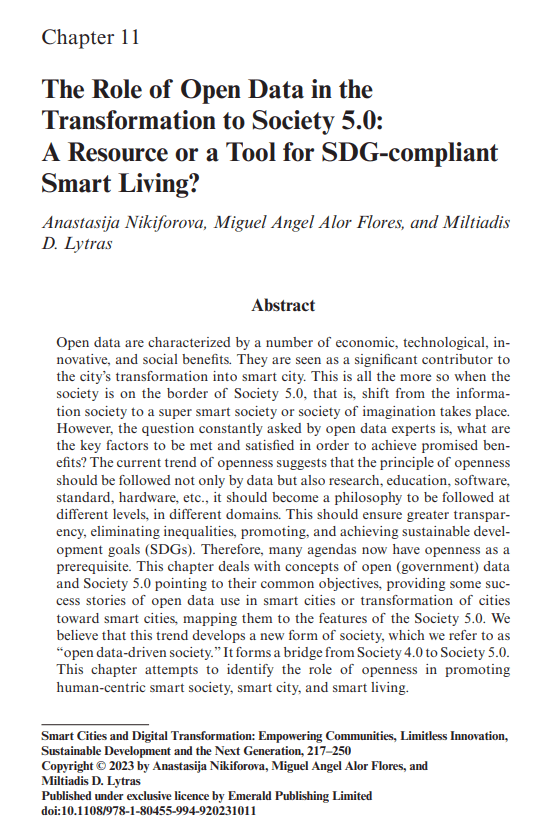
So, almost traditionally a few words about the content or “what is it about?“. Today we all know that open data and open government data are characterized by a number of economic, environmental, technological, innovative, and social benefits. They are seen as a significant contributor to the city’s transformation into smart city. This is all the more so when the society is on the border of Society 5.0, that is, shift from the Information Society (Society 4.0) to a “super smart society” or “society of imagination” (Society 5.0) takes place. However, the question constantly asked by open data experts is, what are the key factors to be met and satisfied in order to achieve promised benefits?The current trend of openness suggests that the principle of openness should be followed not only by data but also research, education, software, standard, hardware, etc., it should become a philosophy to be followed at different levels, in different domains. This should ensure greater transparency, eliminating inequalities, promoting, and achieving sustainable development goals (SDGs). I.e., the openness in both, data, science, technology (software or hardware) is considered as one of the keys for meeting SDGs, while supporting some of them “by default” simultaneously (general principles of open data covered by Open Data Charter applicable to all data to perceive and treat it as open data) and domain, which the open data represents. This was also emphasized at the 76th session of the United Nations General Assembly, highlighting that the openness contributes to the attainment of the United Nations Sustainable Development Goals (SDGs). Therefore, many agendas (sustainable development strategies, action plans) now have openness as a prerequisite. This chapter deals with concepts of open (government) data and Society 5.0 pointing to their interconnection, i.e., common objectives, providing some success stories of open data use in smart cities or transformation of cities toward smart cities, mapping them to the features of the Society 5.0. We believe that this trend develops a new form of society, which we refer to as “open data-driven society.” It forms a bridge from Society 4.0 to Society 5.0. This chapter attempts to identify the role of openness in promoting human-centric smart society, smart city, and smart living, incl. identifying and elaborating on both determinants or prerequisites capable of promoting the development of the Society 5.0 by means of open data and barriers, which stakeholders of different types may face on the way towards sustainable smart city and super smart society
Sounds catchy? Hope so! If yes, read the chapter here or find its preprint here.
Citation
Nikiforova, A., Flores, M.A.A. and Lytras, M.D. (2023), “The Role of Open Data in Transforming the Society to Society 5.0: A Resource or a Tool for SDG-Compliant Smart Living?”, Lytras, M.D., Housawi, A.A. and Alsaywid, B.S. (Ed.) Smart Cities and Digital Transformation: Empowering Communities, Limitless Innovation, Sustainable Development and the Next Generation, Emerald Publishing Limited, Bingley, pp. 219-252. https://doi.org/10.1108/978-1-80455-994-920231011
June 3-5, 2023 HackCodeX hackathon – a weekend-long experience, gathering tech enthusiasts from all over Europe to develop new ideas with the latest technology in a unique environment and atmosphere that serves as the meeting place for like-minded developers, designers, and business professionals eager to explore new paths – takes place. It will be accompanied by a one-day tech industry conference gathering international and local experts to discuss the key trends in technology and computing, where I act as one of those keynotes invited to deliver the talk devoted to the Data Quality that I entitled “Data Quality as a prerequisite for business success: when should I start taking care of it?”
A full weekend of hacking and catching up with more than 400 other tech heads in an atmosphere and spirit like no other.
Sounds interesting? 🗓️ 🗓️ 🗓️ Save the date! June 5, 2023 – topics focused on the key topics, such as emerging technologies, security and privacy, hardware and infrastructure, data quality, quantum technologies, as well as language and framework updates. From the growing interest in Artificial Intelligence to practical tips for securing software applications and dwelling into performance optimization – HackCodeX aims to inspire and provide new knowledge for tech experts of all levels.
Stay tuned and do not miss the opportunity to attend and meet me there! Read more here -> https://www.hackcodex.eu/forum
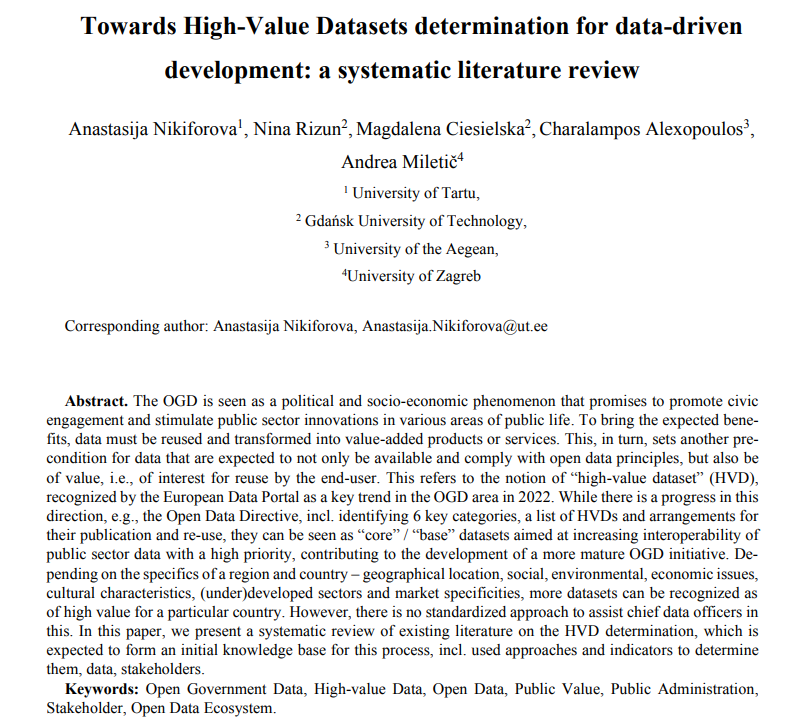
Our new article titled “Towards High-Value Datasets determination for data-driven development: a systematic literature review” (Nikiforova A., Rizun N., Ciesielska M., Alexopoulos C., Miletič A.) is now available at arXiv with supplementary data published at Zenodo and waiting for your read! Moreover, this is not only my recommendation – The Living Library has included it in their collection, which as you can remember from my posts on another paper that was also recommended by them for the reading, seeks to provide actionable knowledge on governance innovation, informing and inspiring policymakers, practitioners, technologists, and researchers working at the intersection of governance, innovation, and technology in a timely, digestible and comprehensive manner, identifying the “signal in the noise” by curating research, best practices, points of view, new tools, and developments.
The OGD is seen as a political and socio-economic phenomenon that promises to promote civic engagement and stimulate public sector innovations in various areas of public life. However, to bring the expected benefits, data must be reused and transformed into value-added products or services. This, in turn, sets another precondition for data that are expected to not only be available and comply with open data principles, but also be of value, i.e., of interest for reuse by the end-user. This refers to the notion of ‘high-value dataset’ (HVD). HVD are defined as datasets whose re-use is expected to create the most value for society, the economy, and the environment, contributing to the creation of “value-added services, applications and new, high-quality and decent jobs, and of the number of potential beneficiaries of the value-added services and applications based on those datasets” (Directive, 2019). HVD was recognized by the European Data Portal as a key trend in the OGD area in 2022, which is not included in the annual Open Data Maturity Report.
There has been some progress in this area over the last years, which refers to a list of initiatives and studies carried out by several organizations and communities, where at the European level, probably most notable progress has been made by the European Commission in the Open Data Directive (originally Public Sector Information Directive (PSI Directive), i.e. Directive (EU) 2019/1024 of the European Parliament and of the Council of 20 June 2019 on open data and the re-use of public sector information, according to which there are six thematic data categories of HVD – (1) geospatial, (2) earth observation and environment, (3) meteorological, (4) statistics, (5) companies and company ownership, (6) mobility data are considered as of high value. Further, a list of specific HVDs and the arrangements for their publication was developed and made available as “Commission Implementing Regulation (EU) 2023/138 of 21 December 2022 laying down a list of specific high-value datasets and the arrangements for their publication and re-use” (Commission, 2023) that can be seen as seeking for greater harmonization and interoperability of public sector data and data sharing across EU countries with reference to specific datasets, their granularity, key attributes, geographic coverage, requirements for their re-use, including licence (Creative Commons BY 4.0, any equivalent, or less restrictive open licence), specific format where appropriate, frequency of updates and timeliness, availability in machine-readable format, accessibility via API and bulk download, supported with metadata describing the data within the scope of the INSPIRE data themes that shall contain specific minimum set of the required metadata elements, description of the data structure and semantics, the use of controlled vocabularies and taxonomies (if relevant) etc. In addition, the Semantic Interoperability Community (SEMIC) is constantly hosting webinars on DCAT-AP (Data Catalogue Vocabulary Application Profile) for HVD to discuss with OGD portal owners, OGD publishers and enthusiasts the best approaches to use DCAT-AP to describe HVD and ensure their further findability, accessibility, and reusability.
In other words while it can be seen that progress has been made in this area, an examination of the above documents reveals that these datasets rather form a list of “mandatory” or “open by default”, sometimes also referred to as “base” or “core” datasets, aiming at open data interoperability with a high level of priority and a relatively equal level of value for most countries, which contributed to the development and promotion of a more mature open data ecosystem and OGD initiative. Depending on the specifics of a region and country – geographical location, social, current environment, social, economic issues, culture, ethnicity, likelihood of crises and / or catastrophes, (under)developed industries/ sectors and market specificities, and development trajectories, i.e., priorities. Depending on the above, more datasets can be recognized as having high value within a particular country or region (Utamachant & Anutariya, 2018; Huyer & Blank, 2020; Nikiforova, 2021). For example, meteorological data describing sea level rise can be of great value in the Netherlands as it has a strong impact on citizens and businesses as more than 1/3 of the country is below sea level, however, the same data will be less valuable for less affected to countries, such as Italy and France (Huyer & Blank, 2020). We believe that additional factors such as ongoing smart cities initiatives, as well as the Sustainable Development Goals, the current state of countries and cities in relation to their implementation and established priorities affect this list as well.
We find it is important to support the identification of country specific HVD that, in turn, could increase user interest ]by transforming data into innovative solution and services. Although this fact is recognized by countries and some local and regional efforts, mostly undertaken by governments with little support from the scientific and academia community, they are mainly faced with problems in the form of delays in their development or complete failure, or ending up with some set of HVD, but little information about how this was actually done. These ad-hoc attempts remain closed and not reusable, which is contrary to both the general OGD philosophy and the HVD-centric philosophy that is expected to be standardized. Most of them are ex-post or a combination of the ex-ante and ex-post, making the process of identifying them more resource-intensive, with an effect only visible after potentially valuable datasets have been discovered, published, and kept maintained, with the need for further evaluation of their impact, which is a resource-consuming task. All in all, it is considered that there is no standardized approach to assisting chief data officers in identifying HVDs, resulting in a failure in consistent identification and maintenance of HVDs.
Thus, we refer to this topic. As you can now from my blog it is not the first attempt we take. The very first activity related to this topic was taken by me back in 2019, where I studied this topic in Latvian settings, i.e. a stakeholder-centered determination of High-Value Data sets for Latvia was done as a response for the call made by the national OGD initiative, whose results were submitted to the holders of Latvia’s open data portal (Ministry of Environmental Protection and Regional Development) and used to prepare external reports submitted to Publications Office of the European Union). Later, several countries joined my study, namely, Poland, Greece, Croatia and Peru, and together with the colleagues we conducted several workshops that took place as part of international conferences, on which I posted before here and here.
This time, we conducted more theoretical study seeking for establishing a rich knowledge base for determining HVD, while the validation of identified indicators (as part of this study and derived from government reports) is expected to take place during the workshops with open (government) data and / or e-government experts. All in all, we focused on identifying all efforts taken with the reference to this topic. In other words, the objective was to examine how HVD determination has been reflected in the literature over the years and what has been found by these studies to date, incl. the indicators used in them, involved stakeholders, data-related aspects, and frameworks, which was done by conducting a Systematic Literature Review with the following research questions (RQ) defined to achieve the set objective:
(RQ1) how is the value of the open government data perceived / defined? In which contexts has the topic of HVD been investigated by previous research (e.g., research disciplines, countries)? Are local efforts being made at the country levels to identify the datasets that provide the most value to stakeholders of the local open data ecosystem?
(RQ1.1) How the high-value data are defined, if this definition differs from the definition introduced in the PSI /OD Directive,
(RQ1.2) What datasets are considered to be of higher value in terms of data nature, data type, data format, data dynamism?
(RQ2) What indicators are used to determine high-value datasets? How can these indicators be classified? Can they be measured? And whether this can be done (semi-)automatically?
(RQ3) Whether there is a framework for determining country specific HVD? In other words, is it possible to determine what datasets are of particular value and interest for their further reuse and value creation, taking into account the specificities of the country under consideration, e.g., culture, geography, ethnicity, likelihood of crises and/or catastrophes.
Although neither OGD, nor the importance of the value of data are new topics, scholarly publications dedicated to the topic of HVD are still very limited. This points out the limited body of knowledge on this topic, thereby making this study unique and constituting a call for action. Nevertheless, during this study, we have established some knowledge based on HVD determination-related aspects, including several definitions of HVD, data-related aspects, stakeholders, some indicators and approaches that can now be used as a basis for establishing a discussion of what a framework for determining HVD should look like, which, along with the input we received from a series of international workshops with open (government) data experts, covering more indicators and approaches found to be used in practice, could enrich the common understanding of the goal, thereby contributing to the next open data wave (van Loenen & Šalamon, 2022).
Sounds interesting? Want to know more? Read the article -> here! Please cite the paper as: Nikiforova, A., Rizun, N., Ciesielska, M., Alexopoulos, C., Miletič, A. (2023). Towards High-Value Datasets determination for data-driven development: a systematic literature review. In: Lindgren, I., Csáki, C., Kalampokis, E., Janssen, M.,, Viale Pereira, G., Virkar, S., Tambouris, E., Zuiderwijk, A. Electronic Government. EGOV 2023. Lecture Notes in Computer Science. Springer, Cham
References
Nikiforova, A. (2021, October). Towards enrichment of the open government data: a stakeholder-centered determination of High-Value Data sets for Latvia. In Proceedings of the 14th International Conference on Theory and Practice of Electronic Governance (pp. 367-372).
Directive (EU) 2019/1024 of the European Parliament and of the Council of 20 June 2019 on open data and the re-use of public sector information (recast)
Commission Implementing Regulation (EU) 2023/138 of 21 December 2022 laying down a list of specific high-value datasets and the arrangements for their publication and re-use
Huyer, E., Blank, M. (2020). Analytical Report 15: High-value datasets: understanding the perspective of data providers. Publications Office of the European Union, 2020 doi:10.2830/363773
Utamachant, P., & Anutariya, C. (2018, July). An analysis of high-value datasets: a case study of Thailand’s open government data. In 2018 15th international joint conference on computer science and software engineering (JCSSE) (pp. 1-6). IEEE
van Loenen, B., & Šalamon, D. (2022). Trends and Prospects of Opening Data in Problem Driven Societies. Interdisciplinary Description of Complex Systems: INDECS, 20(2), II-IV
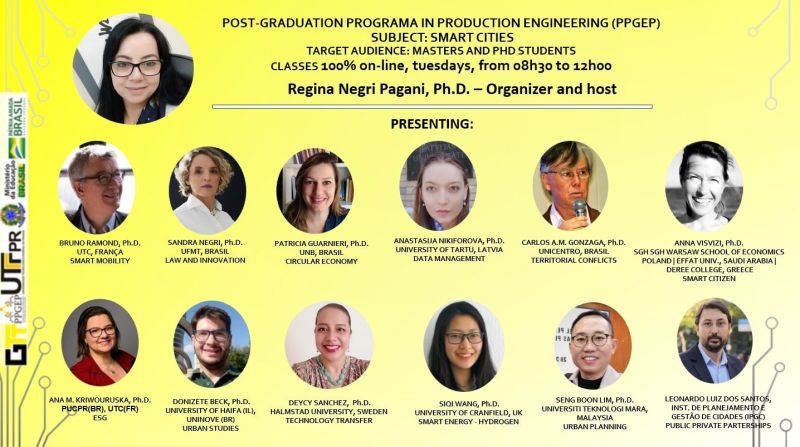
Today (May 16, 2023), I had a pleasure to deliver one more guest lecture for master and doctoral students of the Federal University of Technology – Paraná (Universidade Tecnológica Federal do Paraná (UTFPR))as part of Smart Cities course delivered by prof. Regina Negri Pagani. This time the topic of my lecture was “Open Data Ecosystems in and for sustainable development of data-driven smart cities and Society 5.0”.
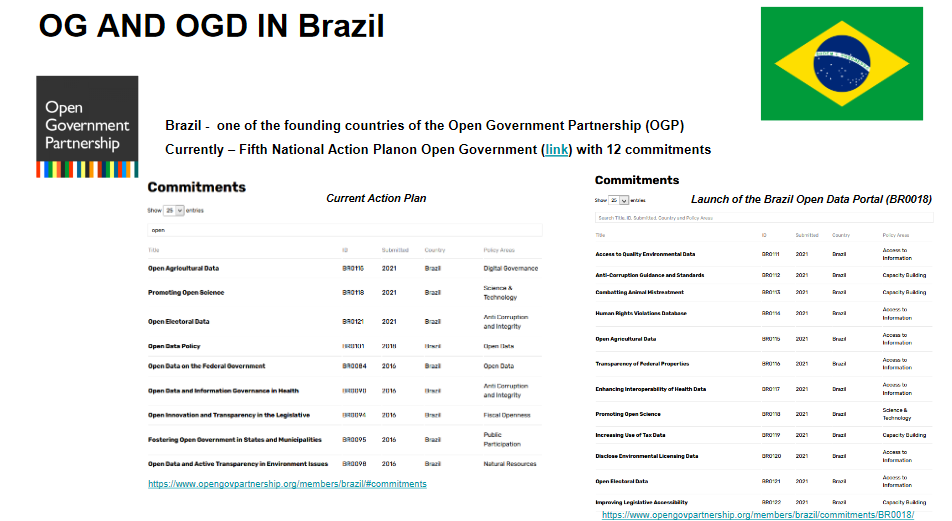
As part of this lecture we talked about open data and open government data (OGD) phenomena and how they evolved over years, what the open data ecosystem is and what constitutes it. I then tried to put it in the context of Brazil reflecting on the current state-of-the-art of open government and OGD in Brazil and its cities referring to both Open Government Partnership (Brazil was one of the the founding countries of OGP), existing OGD, transparency and central bank portals, studies that explored effects of predictors of citizens’ attitudes and intention to use OGD (*by de Souza, Ariel Antônio Conceição, Marcia Juliana d’Angelo, and Raimundo Nonato Lima Filho), factors influencing civil servant’s intention to disclose data (**by Fernando Kleiman, Sylvia J.T. Jansen, Sebastiaan Meijer, Marijn Janssen), as well as the relationship between transparency and open data initiatives in five Brazilian cities (identifying that they are not related for these five cities) (***by Araújo, Ana Carolina, Lucas Reis, and Rafael Cardoso Sampaio)
Then, presenting the concepts of Smart Cities and their “generations”, Sustainable Cities and Sustainable Smart Cities, as well as Society 5.0 (aka Super Smart Society and Society of imagination), I highlighted the overlaps and interweavings of the above and how the development of one contributes to the other, i.e. how interrelated they are and how complex this large ecosystem is.
And then, the remaining part of the lecture was focused around the topic of open data ecosystems starting with the current state of the art around the topic, i.e. different and similar definitions, components, characteristics etc., and finally the study we conducted some time ago with my colleagues from Czech Republic, Poland, Finland, Germany and Latvia, namely “Transparency of open data ecosystems in smart cities: Definition and assessment of the maturity of transparency in 22 smart cities“**** published in . Sustainable Cities and Society (Elsevier), in which we:
investigated smart city data portals’ compliance with the transparency requirements, where the developed framework has been applied to 34 portals representing 22 smart cities, allowing determination of the level of transparency maturity at general, individual, and group levels;
developed four-level transparency maturity model to allow the classification of the portal as developing, defined, managed, and integrated, thereby allowing to identify key issues to be transformed into corrective actions to be included into agenda and navigate to the set of more competitive portals;
ranked the portals concerned based on their transparency maturity, thereby allowing more successful portals to be identified in order to be used as an example for improving overall or feature-wised performance by providing recommendations for the identification and improvement of current maturity level and specific features;
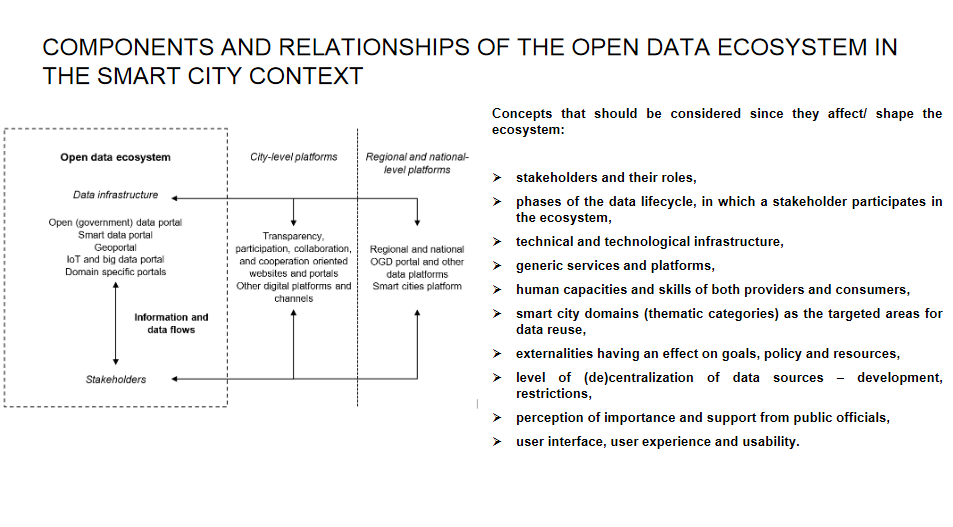
conceptualized an open data ecosystem in the context of a smart city (!!!) and determined its key components considering the data-centric and data-driven infrastructure and other components and relationships, using the system theory approach;
on the basis of the dominant components of data infrastructure, defined five types of current open data ecosystems (see below) thereby opening up a new horizon for research in the area of sustainable and socially resilient smart cities by means of open data and citizen-centered open smart city governance.
Our definition of open data ecosystem in the smart city context , established based on the knowledge and experience of the experts involved and observations made during the study is:
“systematic efforts to integrate ICT and technologies into city life to deliver citizen-centric, better-quality services, solutions to city problems with open data published through the data-centric and data-driven infrastructure.”
However, the concepts that affect/shape the ecosystem are:
stakeholders and their roles,
phases of the data lifecycle, in which a stakeholder participates in the ecosystem,
technical and technological infrastructure,
generic services and platforms,
human capacities and skills of both providers and consumers,
smart city domains (thematic categories) as the targeted areas for data reuse,
externalities affecting goals, policy, and resources,
level of (de)centralization of data sources – development, restrictions,
perception of importance and support from public officials,
user interface, user experience, and usability.
As for the types of current open data ecosystems, we identified 5 types that are as follows:
type#1: the city’s OGD portal is the center of the data infrastructure, and all OGD, including those labeled as smart, are published and centralized through it. For this type of open data ecosystem, other websites that had previously provided open data or other services to access public sector information have been replaced by the OGD portal. The focus is on datasets, providing features to work with them, reuse them, and make all data requests transparent in one place;
type#2: this ecosystem also usually has the OGD portal as the central point, but other portals and platforms publish open data. The smart data portal and online city dashboards focusing on different dimensions such as transport, health, air quality, etc., are important components of this ecosystem;
type#3: a decentralized type of ecosystem that includes many components such as OGD portal, smart data portal, geodata portal, etc. However, it increases the ecosystem’s complexity, which is more difficult to manage and less usable for stakeholders
type#4: the smart city portal focused on projects and services is usually the center of this ecosystem, but it is not the priority to provide data and appropriate features to reuse them. Most services are developed by public sector organizations, research institutions, or businesses and provided to citizens;
type#5: apart from the city’s OGD portal, there are additional transparency-, participation-, collaboration-, and cooperation-oriented websites and portals to support the formation and improvement of relations between stakeholders. This type of ecosystem is focused on processes to improve open data reuse.
Sounds interesting? Read the article here and see other recommended articles below! 🙂
This was then wrapped up by emphasizing key overseen topics that are paid to little attention to, although being crucial for a sustainable public data ecosystem.
And I can only hope that this lecture was just a little bit as interesting as my dear colleague prof. Regina Negri Pagani characterized it! It is always pleasure to hear her feedback, as her comments are so gentle and inspiring! And there is nothing better than hear such wonderful and positive feedback and an immediate invitation for the next editions of this course, which will be my pleasure – this was the 2nd edition of the course, when I served as a guest lecture and will be definitely glad to make this yet another good tradition!
References:
*de Souza, Ariel Antônio Conceição, Marcia Juliana d’Angelo, and Raimundo Nonato Lima Filho. “Effects of Predictors of Citizens’ Attitudes and Intention to Use Open Government Data and Government 2.0.” Government Information Quarterly 39.2 (2022): 101663.
**Kleiman, F., Jansen, S. J., Meijer, S., & Janssen, M. (2023). Understanding civil servants’ intentions to open data: factors influencing behavior to disclose data. Information Technology & People.
***Araújo, Ana Carolina, Lucas Reis, and Rafael Cardoso Sampaio. “Do transparency and open data walk together? An analysis of initiatives in five Brazilian capitals.” Media Studies 7.14 (2016).
****Lnenicka, M., Nikiforova, A., Luterek, M., Azeroual, O., Ukpabi, D., Valtenbergs, V., & Machova, R. (2022). Transparency of open data ecosystems in smart cities: Definition and assessment of the maturity of transparency in 22 smart cities. Sustainable Cities and Society, 82, 103906.
*****Lnenicka, M., & Nikiforova, A. (2021). Transparency-by-design: What is the role of open data portals?. Telematics and Informatics, 61, 101605.










 Anastasija Nikiforova, PhD