Editorial Board Member of Data & Policy (Cambridge University Press)

Since July 2022, I am elected by Syndicate of Cambridge University Press as an Editorial Board Member of the Cambridge University Journal Data & Policy. Data & Policy is a peer-reviewed, open access venue dedicated to the potential of data science to address important policy challenges. For more information about the goal and vision of the journal, read the Editorial Data & Policy: A new venue to study and explore policy–data interaction by Stefaan G. Verhulst, Zeynep Engin, and Jon Crowcroft. More precisely, I act as an Area Editor of “Focus on Data-driven Transformations in Policy and Governance” area (with a proud short name “Area 1“). This Area focuses on the high-level vision for philosophy, ideation, formulation and implementation of new approaches leading to paradigm shifts, innovation and efficiency gains in collective decision making processes. Topics include, but are not limited to:

  • Data-driven innovation in public, private and voluntary sector governance and policy-making at all levels (international; national and local): applications for real-time management, future planning, and rethinking/reframing governance and policy-making in the digital era;
  • Data and evidence-based policy-making;
  • Government-private sector-citizen interactions: data and digital power dynamics, asymmetry of information; democracy, public opinion and deliberation; citizen services;
  • Interactions between human, institutional and algorithmic decision-making processes, psychology and behaviour of decision-making;
  • Global policy-making: global existential debates on utilizing data-driven innovation with impact beyond individual institutions and states;
  • Socio-technical and cyber-physical systems, and their policy and governance implications.

The remaining areas represent more specifically the current applications, methodologies, strategies which underpin the broad aims of Data & Policy‘s vision: Area 2 “Data Technologies and Analytics for Policy and Governance“, Area 3 “Policy Frameworks, Governance and Management of Data-driven Innovations“, Area 4 “Ethics, Equity and Trust in Policy Data Interactions“, Area 5 “Algorithmic Governance“, Area 6 “Data to Tackle Global Issues and Dynamic Societal Threats“.

Editorial committees of Data & Policy (Area 1)

For the types of submission we are interested in, they are four:

  • Research articles that use rigorous methods that investigate how data science can inform or impact policy by, for example, improving situation analysis, predictions, public service design, and/or the legitimacy and/or effectiveness of policy making. Published research articles are typically reviewed by three peer reviewers: two assessing the academic or methodological rigour of the paper; and one providing an interdisciplinary or policy-specific perspective. (Approx 8,000 words in length).
  • Commentaries are shorter articles that discuss and/or problematize an issue relevant to the Data & Policy scope. Commentaries are typically reviewed by two peer reviewers. (Approx 4,000 words in length).
  • Translational articles are focused on the transfer of knowledge from research to practice and from practice to research. See our guide to writing translational papers. (Approx 6,000 words in length).
  • Replication studies examine previously published research, whether in Data & Policy or elsewhere, and report on an attempt to replicate findings.

Read more about Data & Policy and consider submitting your contribution!

Moreover, as a part of this journal, we (Data & Policy community) organize a hybrid physical-virtual format, with one-day, in-person conferences held in three regions: Asia (Hong Kong), America (Seattle) and Europe (Brussels). “Data for Policy: Ecosystems of innovation and virtual-physical interactions” conference I sincerely recommend you to consider and preferably to attend! While this is already the seventh edition of the conference, I take part in its organization for the first year, thus am especially excited and interested in its success!
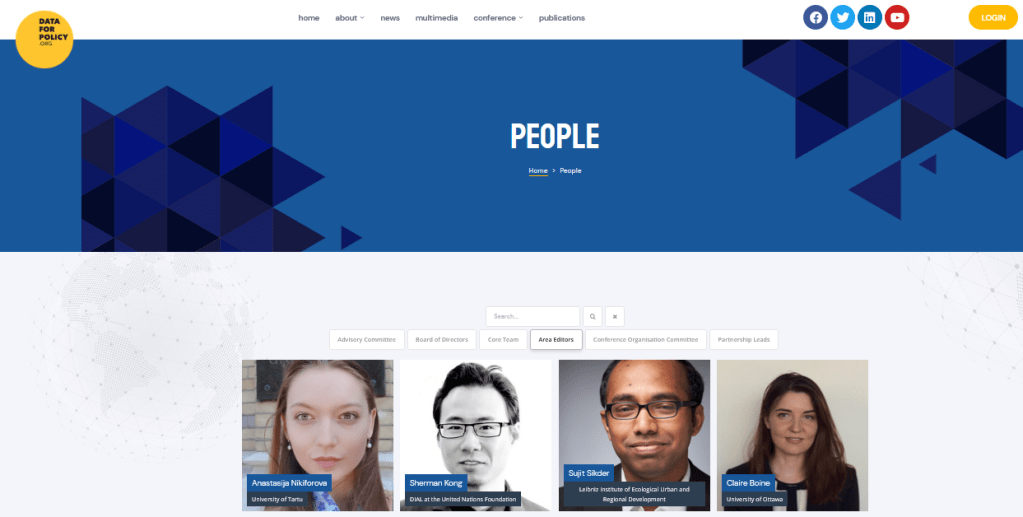
Data for policy, Area Editors

In addition to its six established Standard Tracks, and reflecting its three-regions model this year, the Data for Policy 2022 conference highlights “Ecosystems of innovation and virtual-physical interactions” as its theme. Distinct geopolitical and virtual-physical ecosystems are emerging as everyday operations and important socio-economic decisions are increasingly outsourced to digital systems. For example, the US’s open market approach empowering multinational digital corporations contrasts with greater central government control in the Chinese digital ecosystem, and radically differs from Europe’s priority on individual rights, personal privacy and digital sovereignty. Other localised ecosystems are emerging around national priorities: India focuses on the domestic economy, and Russia prioritises public and national security. The Global South remains underrepresented in the global debate. The developmental trajectory for the different ecosystems will shape future governance models, democratic values, and the provision of citizen services. In an envisioned ‘metaverse’ future, boundaries between physical and virtual spaces will become even more blurred, further underlining the need to scrutinise and challenge the various systems of governance.

The Data for Policy conference series is the premier global forum for multiple disciplinary and cross-sector discussions around the theories, applications and implications of data science innovation in governance and the public sector. Its associated journal, Data & Policy, published by Cambridge University Press has quickly established itself as a major venue for publishing research in the field of data-policy interactions. Data for Policy is a non-profit initiative, registered as a community interest company in the UK, supported by sustainer partners Cambridge University Press, the Alan Turing Institute and the Office for National Statistics.

Read more about Data for Policy and become a part of it!

ONE Conference 2022: why to attend and how to meet me there?

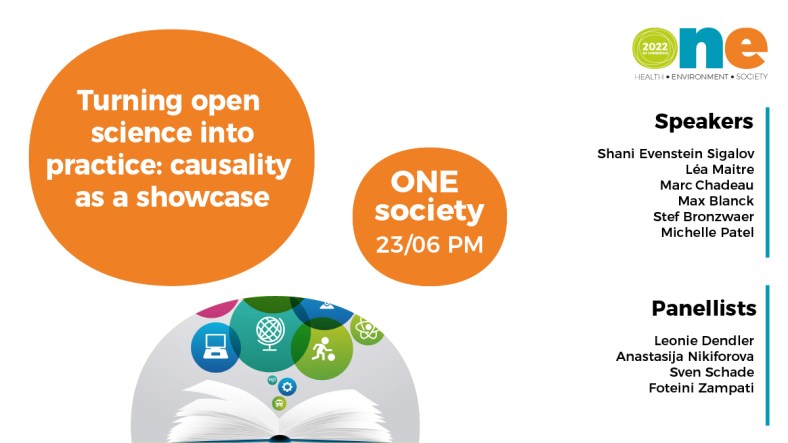
The ONE Conference 2022 (Health, Environment, Society) – a four-day event happening in Brussels and online, is coming! Register and meet me there ️(Brussels & online, 21-24 June) as one of panelists of the “Turning open science into practice: causality as a showcase” thematic session as part of “ONE society” thematic track.

ONE Conference 2022 provides its attendees with a series of break-out sessions grouped in four thematic tracks – ONE Life, ONE Planet, ONE Society and MANY Ways. The sessions are complemented by side events and networking opportunities for both in-person and online participants, where some side events, in the form of workshops, will take place before the formal start of the conference.

The ONE Conference 2022 is co-organised by EFSA and its European sister agencies – the European Centre for Disease Prevention and Control [ECDC], the European Chemicals Agency [ECHA], the European Environment Agency [EEA] and the European Medicines Agency [EMA] and the European Commission’s Joint Research Centre (JRC), with the ambition of embracing a ONE Health and ONE Society approaches.

Briefly about the above mentioned thematic tracks:

  • the ONE Society sessions will put the societal dimension of food safety and its ecosystem in the spotlight: from the role of society in policy making, to collaboration and partnerships right through to bringing research closer to policy. Dolors Montserrat from the European Parliament’s ENVI Committee will speak on the panel addressing citizens’ participation in EU decision-making, while former Dutch Minister Gerda Verburg from the Scaling up Nutrition (SUN) Movement features in the session on collaboration among actors in the food safety field. Michael Catchpole, Chief Scientist of the European Centre for Disease Prevention and Control (ECDC), will moderate the discussion on how ENVI agencies can work together to support research and bridge the gap between research and policy. Meanwhile, Shani Evenstein Sigalov, member of the Wikimedia Foundation and lecturer at the University of Tel Aviv, will share her views on opening up regulatory science.
  • the ONE Life sessions will focus on the questions on how to ensure safe, healthy and sustainable food, where Francesco Branca (Director of the Department of Nutrition and Food Safety of the World Health Organization (WHO)) will share his views on how to define healthy diets within sustainability boundaries as part of a session on sustainability and food security. Matias Zurbrigen (Head of the Institute of Synthetic Biology of the University of Dusseldorf) will consider safety aspects relating to new food production approaches such as synthetic biology as part of a session on innovative foods. Meanwhile, Ilaria Capua from the University of Florida, will focus on the post-pandemic environment and the concept of Circular Health as part of a discussion on improving our understanding of infectious diseases. How to ensure safety assessments keep pace with the emergence of new diseases will also be discussed. Luisa Peixe, professor at the University of Porto and member of EFSA’s Panel on Biological Hazards, will discuss the growing challenge of antimicrobial resistance (AMR) focussing on the link to food-producing environments.
  • the ONE Planet sessions will focus on the environmental dimension of food safety and sustainability, where Serenella Sala from the Joint Research Centre (JRC) of the European Commission is among the experts who will share their views on how to develop a framework for sustainability assessments to measure progress made towards environmental goals. Annette Aldrich from the Swiss Federal Office for the Environment (FOEN), an expert in ecotoxicology and member of EFSA’s Panel on Plant Protection Products and their Residues, will explain why a paradigm shift is needed in the environmental risk assessment of pesticides. Helen Elizabeth Roy from the UK Centre for Ecology & Hydrology will feature in discussions on plant protection in the face of globalisation, particularly how global trade and climate change will affect plant pests, invasive species and diseases. Meanwhile, Linda Keeling, professor of Animal Welfare at the Swedish University of Agricultural Sciences (SLU), will speak about the links between animal welfare and the UN Sustainable Development Goals (SDGs) in a session dedicated to improving animal welfare and reducing environmental impacts in relation to animal-sourced food.
  • the MANY WAYS sessions will cover topics ranging from Artificial Intelligence (AI) to new approach methodologies (NAMs), where Raluca Crisan, founder and CTO of the testing platform ETIQ AI, will speak in the session related to integrating AI technology and big data in food safety. Chris Gennings, professor at the Icahn School of Medicine at Mount Sinai, will discuss how the risk assessment of combined exposure to multiple chemicals can be developed. The session on new approach methodologies (NAMs) moderated by Maurice Whelan, head of the EU Reference Laboratory for alternatives to animal testing at the Joint Research Centre (JRC), will explore opportunities for moving beyond animal testing to in vitro and in silico approaches. The session on Endocrine Disruptors (EDs) will feature Andreas Kortenkamp, professor at Brunel University, who will deliver a talk on the science behind the identification of endocrine disruptors for humans and non-target organisms. The session will also look at benefits of shifting to a more integrated assessment for chemicals as a whole. Sangeeta Khare from the National Center for Toxicological Research of the US Food and Drug Administration will address risk assessment criteria for gastrointestinal toxicity induced by xenobiotics as part of a session on the microbiome. The session will examine the evidence base connecting the microbiome, chemicals and human health.
  • the closing plenary to wrap up the four-day programme will reflect on the outcomes of the thematic (break-out) sessions. The discussion will also address how the One Health principles could help advance food safety assessments, and how more integrated, cross-sectoral and collaborative health assessments could inform policies shaping the transition towards more sustainable food systems. Sandra Gallina, the European Commission’s Director-General for Health and Food Safety, will outline the EU’s policy vision for the transition towards more sustainable and resilient food systems. Bernhard Url, EFSA’s Executive Director, will bring the conference to a close with some concluding remarks.

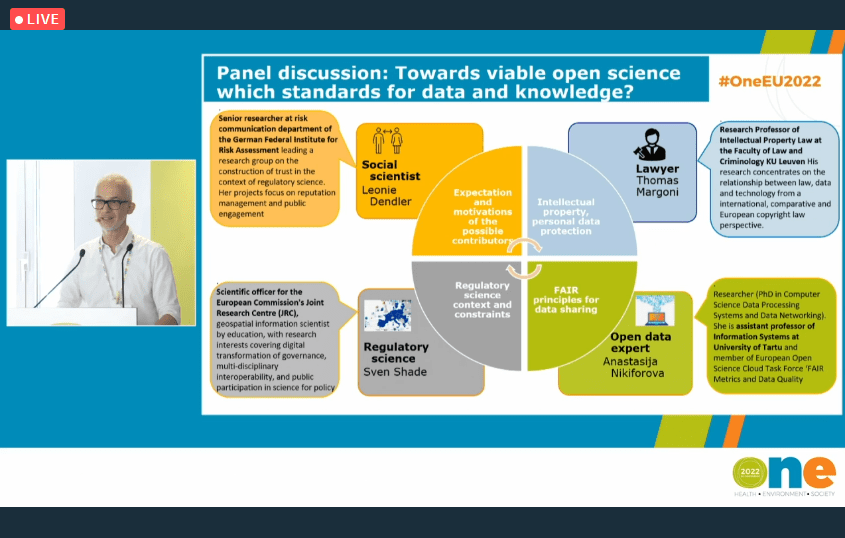
But let’s take a step back to the session “ONE society” thematic track I emphasized before and Turning open science into practice: causality as a showcase thematic session, in which I am involved as one of four panelists, invited to share my experience on the data quality, open science and open data questions in both academia and industry with the reference to the European Open Science Cloud I represent (Task Force “FAIR metrics and data quality”) and my previous experience working as IT-expert at the Latvian Biomedical Research and Study Centre, BBMRI-ERIC Latvian National Node. This session is devoted to the open science movement resulted in the demand for transparent and accessible-to-all scientific processes. Open science promotes and supports research collaboration and co-creation, including public participation in the scientific process via crowdsourcing data, methods, computational capacity and scientific knowledge. The adoption of a more participatory approach offers new opportunities to regulatory science organizations. It helps them extend the pool of data, expertise and knowledge from which to draw, thus accelerating their preparedness to address complex questions. It can also help in enhancing the public understanding of science, and in finally reducing citizens’ scepticism. An open science approach also poses challenges, including the need to monitor the accuracy and reliability of open data as well as their possible misuse. The session will offer an opportunity for sharing experiences on obstacles, benefits and the feasibility of adopting open science approaches in the context of regulatory science. The showcase example will focus on causality, i.e. the relationship between a cause and an effect. With larger availability of open access data, including those gathered using high-throughput techniques, unprecedented options for deeper insights into causality have emerged. Using causality as an illustrative example, the session intends to advance the discussion on how the principles of open science can be routinely implemented in the scientific activities performed by the European institutions. The guiding questions are: Can institutions benefit from open data and the open science movement, and if so, how? can participatory science accelerate finding solutions to quantitatively integrate heterogeneous sources to address causality? In other words, Whether and how open data currently available can be used to address the assessment of causal association between an agent and an effect in the regulatory domain? What are possible benefits and challenges from their use? How to guarantee that data and knowledge generated by an open science approach are accurate and reliable enough for use by regulatory science organisations? Which concrete actions need to be put in place to implement open science principles in the context of regulatory science? How to revise the legal framework to address new challenges related to personal data protection and intellectual property right? Although I am sure we will define many more questions to be asked and answered – hopefully answered 🙂

To sum up, this thematic session intends to advance the discussion on how the principles of open science can be routinely implemented in the scientific activities performed by the European Agencies/Institutions. Causality will be discussed as a case study topic, which, in fact, is among the most challenging questions which EU institutions are required to answer. 

All in all, it seems that the session should be incredibly interesting with many perspectives covered by its participants, with the coordinator of this session – Laura Martino, session contributors – Federica Barrucci, Claudia Cascio, Laura Ciccolallo, Marios Georgiadis, Giovanni Iacono, Yannick Spill both representing European Food Safety Authority (EFSA), and panelists – me – Anastasija Nikiforova representing both the EOSC European Open Science Cloud Task Force ‘FAIR metrics and data quality’ and University of Tartu, Institute of Computer Science, Leonie Dendler from the German Federal Institute for Risk Assessment (BfR), Sven Schade representing Joint Research Centre (JRC), Foteini Zampati.


Read more about the event here.

Looking forward this event, fruitful discussions, great talks and decisions on how to make this world better!!!
 

Research and Innovation Forum 2022: panel organizer, speaker, PC member, moderator and Best panel moderator award

As I wrote earlier, this year I was invited to organize my own panel session within the Research and Innovation Forum (Rii Forum). This invitation was a follow-up on several articles that I have recently published (article#1, article#2, article#3) and a Chapter to be published in “Big data & decision-making: how big data is relevant across fields and domains” (Emerald Studies in Politics and Technology) I was developing at that time. I was glad to accept this invitation, but I did not even think about how many roles I will act in Rii Forum and how many emotions I will experience. So, how was it?

First, what was my panel about? It was dedicated to data security entitled “Security of data storage facilities: is your database sufficiently protected?” being a part of the track called “ICT, safety, and security in the digital age: bringing the human factor back into the analysis“.

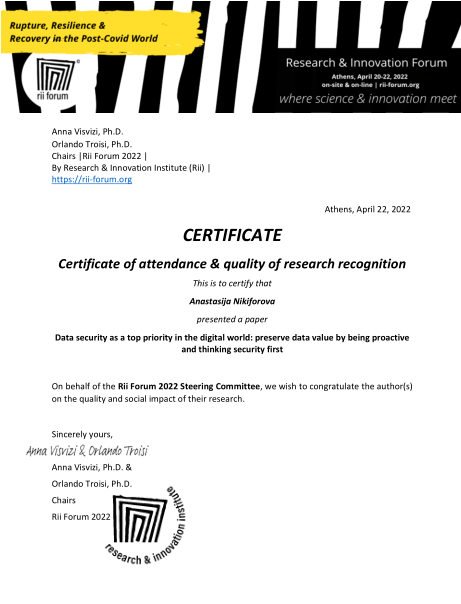
My own talk was titled “Data security as a top priority in the digital world: preserve data value by being proactive and thinking security first“, which makes it to be a part of the panel described above. In this talk I elaborated on the main idea of the panel, referring to an a study I recently conducted. In short, today, in the age of information and Industry 4.0, billions of data sources, including but not limited to interconnected devices (sensors, monitoring devices) forming Cyber-Physical Systems (CPS) and the Internet of Things (IoT) ecosystem, continuously generate, collect, process, and exchange data. With the rapid increase in the number of devices and information systems in use, the amount of data is increasing. Moreover, due to the digitization and variety of data being continuously produced and processed with a reference to Big Data, their value, is also growing. As a result, the risk of security breaches and data leaks. The value of data, however, is dependent on several factors, where data quality and data security that can affect the data quality if the data are accessed and corrupted, are the most vital. Data serve as the basis for decision-making, input for models, forecasts, simulations etc., which can be of high strategical and commercial / business value. This has become even more relevant in terms of COVID-19 pandemic, when in addition to affecting the health, lives, and lifestyle of billions of citizens globally, making it even more digitized, it has had a significant impact on business. This is especially the case because of challenges companies have faced in maintaining business continuity in this so-called “new normal”. However, in addition to those cybersecurity threats that are caused by changes directly related to the pandemic and its consequences, many previously known threats have become even more desirable targets for intruders, hackers. Every year millions of personal records become available online. Moreover, the popularity of IoTSE decreased a level of complexity of searching for connected devices on the internet and easy access even for novices due to the widespread popularity of step-by-step guides on how to use IoT search engine to find and gain access if insufficiently protected to webcams, routers, databases and other artifacts. A recent research demonstrated that weak data and database protection in particular is one of the key security threats. Various measures can be taken to address the issue. The aim of the study to which this presentation refers is to examine whether “traditional” vulnerability registries provide a sufficiently comprehensive view of DBMS security, or whether they should be intensively and dynamically inspected by DBMS holders by referring to Internet of Things Search Engines moving towards a sustainable and resilient digitized environment. The study brings attention to this problem and make you think about data security before looking for and introducing more advanced security and protection mechanisms, which, in the absence of the above, may bring no value.

Other presentations delivered during this session were “Information Security Risk Awareness Survey of non-governmental Organization in Saudi Arabia”, “Fake news and threats to IoT – the crucial aspects of cyberspace in the times of cyber war” and “Minecraft as a Tool to Enhance Engagement in Higher Education” – both were incredibly interesting, and all three talks were delivered by females, where only the moderator of the session was a male researcher, which he found to be very specific, given the topic and ICT orientation – not a very typical case 🙂 But, nevertheless, we managed to have a great session and a very lively and fruitful discussion, mostly around GDPR-related questions, which seems to be one of the hottest areas of discussion for people representing different ICT “subbranches”. The main question that we discussed was – is the GDPR more a supportive tool and a “great thing” or rather a “headache” that sometimes even interferes with development.

In addition, shortly before the start of the event, I was asked to become a moderator of the panel “Business in the era of pervasive digitalization“. Although, as you may know, this is not exactly in line with my area of expertise, it is in line with what I am interested in. This is not surprising, since both management, business, the economics are very closely connected and dependent on ICT. Moreover, they affect ICT, thereby pointing out the critical areas that we as IT-people need to refer to. All in all, we had a great session with excellent talks and lively discussion at the end of the session, where we discussed different session-related topics, shared our experience, thoughts etc. Although it was a brilliant experience, there is one thing that made it even better… A day later, a ceremony was held where the best contributions of the forum were announced and I was named the best panel moderator as a recognition of “the academic merit, quality of moderation, scheduling, and discussion held during the panel”!!!

These were wonderful three days of the forum with very positive emotions and so many roles – panel organizer, speaker / presenter, program committee member and panel moderator with the cherry on the cake and such a great end of the event. Thank you Research and Innovation Forum!!! Even being at home and participating online, you managed to give us an absolute amazing experience and even the feeling that we were all together in Athens!

Google.org supported programme by Riga TechGirls and my participation in it as a speaker and lead mentor for the digital development workshop on Information and data literacy

This February I got yet another experience by participating in a programme launched by Riga TechGirls and supported by Google.org (“Google Impact challenge” grant), in addition to local supporters such as the Ministry of Education and Science of Latvia, the Ministry of Culture, Riga city council (Rīgas Dome), titled “Human on technology” for more than 2000 Latvian teachers with the aim of disrupting technophobia and provide them with digital skills that are “must-have” in this digital world/ era. I have acted as both the lecturer and the lead mentor for the digital development workshop held as a part of the “Information and data literacy” module.

Hope the knowledge and experience I have shared will be beneficial and improve their lives, work-related and daily activities, and now they will be able “to train the “Google””. This, however is a reference to the title of my talk (and “How to train your dragon?” animated film) since I was asked to speak about working with information and entitled my lecture Work with information or how to train your “Google”?” During this lecture we discussed tips&tricks for data and information search, data analysis, fact checking in the digital environment, spoke about the “art” of searching for information in different browsers – how to create search requests, how to search more precisely so that searches are more accurate, including but not limited to the build of queries with searching operators for advanced search. And of course, we spoke about how the search engine works, i.e. what is the process of searching the information from the crawlers to indexing and sorting results returned to the end-user and different algorithms they are based on, and covered a rich list of search engines – Google, Bing, Yahoo, Ecosia, DuckDuckGo, Yandex, Baidu, Seznam and many more by trying to understand what is the difference between them and how they can be classified (i.e. security- and safety- oriented, regional search engines etc.).

The second meeting with the audience took place a bit later as the last activity of the “Information and data literacy” module, where I acted as the lead mentor of this digital development workshop. Here I delivered a lecture (mostly of practical nature), followed by splitting participants in rooms, where they were asked to complete tasks we have prepared to them and discuss questions they could have (both related and not related to these tasks, thereby providing the support to resolve their daily problems), where 11 female mentors, including myself, were actively involved. We worked hard, but it seems we were able to help combating challenges teachers face on a daily basis in their daily activities (from data sorting and organization of email to backup creation and their further maintenance), and that is great!!!

During this workshop we have discussed how to structure your data more wisely, effectively and efficiently with their further re-use in both local and cloud environments with the focus on OneDrive and Google Drive, which are used by teachers more frequently. We have covered a lot of tips&tricks for both the creation of their own pre-defined systems, which I have recommended to develop keeping in mind FAIR principles (this was an attempt to provide them with a brief overview of these principles, when and how they should be used etc. and why both FAIR and openness, including but not limited to open science, matter) and filling them with the information found applying previous knowledge acquired during the lecture I have delivered before (the use of different search engines (at least just to test), building of queries and use of operators to limit the resulting set and make it more search query-compliant etc.). We have also referred to other curious methods and techniques and took a brief overview on stuff like extensions for browsers, including those allowing video download from Youtube, Google Lens, data export and import “from-to and between” cloud storage and local system, image and video search in different search engines, verification of facts, searching for academic and scientific literature and many more…

It was an amazing experience of working with teachers – the target audience of this programme – and even more pleasant to hear that they will (continuously) apply these knowledge and practical experience gained during this weekend at their workplace (and outside it). We continue receiving their comments that they have started doing this immediately during the workshop and continue doing this today as the first activity to be done when arriving at the workplace AND everything works as expected or even better!!! It is the best assessment we could hope for!

I am very grateful for all those comments left for both the Riga TechGirls team and even more grateful for those left for me – I am very happy that both my lecture and the following hand-outs were both easy to understand & track (this audience was something really new for me in terms of both the nature – teachers, and amount – around 1 000 people (90 Zoom rooms for practical assignments and discussions) during the day in three time slots), and valuable at the same time!!! I am very glad to hear that teachers would likely meet me again – I will be glad to meet you again, too!!!

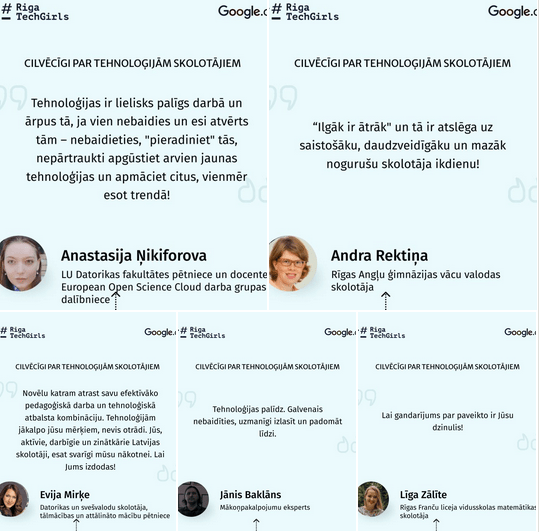
Riga TechGirls, mentors and supportive words for attendees

Thank you, Riga TechGirls team – the first community in Latvia aimed at educating and inspiring women and girls in IT, empowering them to be architects of the future – for your invitation and this valuable experience!