Google.org supported programme by Riga TechGirls and my participation in it as a speaker and lead mentor for the digital development workshop on Information and data literacy

This February I got yet another experience by participating in a programme launched by Riga TechGirls and supported by Google.org (“Google Impact challenge” grant), in addition to local supporters such as the Ministry of Education and Science of Latvia, the Ministry of Culture, Riga city council (Rīgas Dome), titled “Human on technology” for more than 2000 Latvian teachers with the aim of disrupting technophobia and provide them with digital skills that are “must-have” in this digital world/ era. I have acted as both the lecturer and the lead mentor for the digital development workshop held as a part of the “Information and data literacy” module.

Hope the knowledge and experience I have shared will be beneficial and improve their lives, work-related and daily activities, and now they will be able “to train the “Google””. This, however is a reference to the title of my talk (and “How to train your dragon?” animated film) since I was asked to speak about working with information and entitled my lecture Work with information or how to train your “Google”?” During this lecture we discussed tips&tricks for data and information search, data analysis, fact checking in the digital environment, spoke about the “art” of searching for information in different browsers – how to create search requests, how to search more precisely so that searches are more accurate, including but not limited to the build of queries with searching operators for advanced search. And of course, we spoke about how the search engine works, i.e. what is the process of searching the information from the crawlers to indexing and sorting results returned to the end-user and different algorithms they are based on, and covered a rich list of search engines – Google, Bing, Yahoo, Ecosia, DuckDuckGo, Yandex, Baidu, Seznam and many more by trying to understand what is the difference between them and how they can be classified (i.e. security- and safety- oriented, regional search engines etc.).

The second meeting with the audience took place a bit later as the last activity of the “Information and data literacy” module, where I acted as the lead mentor of this digital development workshop. Here I delivered a lecture (mostly of practical nature), followed by splitting participants in rooms, where they were asked to complete tasks we have prepared to them and discuss questions they could have (both related and not related to these tasks, thereby providing the support to resolve their daily problems), where 11 female mentors, including myself, were actively involved. We worked hard, but it seems we were able to help combating challenges teachers face on a daily basis in their daily activities (from data sorting and organization of email to backup creation and their further maintenance), and that is great!!!

During this workshop we have discussed how to structure your data more wisely, effectively and efficiently with their further re-use in both local and cloud environments with the focus on OneDrive and Google Drive, which are used by teachers more frequently. We have covered a lot of tips&tricks for both the creation of their own pre-defined systems, which I have recommended to develop keeping in mind FAIR principles (this was an attempt to provide them with a brief overview of these principles, when and how they should be used etc. and why both FAIR and openness, including but not limited to open science, matter) and filling them with the information found applying previous knowledge acquired during the lecture I have delivered before (the use of different search engines (at least just to test), building of queries and use of operators to limit the resulting set and make it more search query-compliant etc.). We have also referred to other curious methods and techniques and took a brief overview on stuff like extensions for browsers, including those allowing video download from Youtube, Google Lens, data export and import “from-to and between” cloud storage and local system, image and video search in different search engines, verification of facts, searching for academic and scientific literature and many more…

It was an amazing experience of working with teachers – the target audience of this programme – and even more pleasant to hear that they will (continuously) apply these knowledge and practical experience gained during this weekend at their workplace (and outside it). We continue receiving their comments that they have started doing this immediately during the workshop and continue doing this today as the first activity to be done when arriving at the workplace AND everything works as expected or even better!!! It is the best assessment we could hope for!

I am very grateful for all those comments left for both the Riga TechGirls team and even more grateful for those left for me – I am very happy that both my lecture and the following hand-outs were both easy to understand & track (this audience was something really new for me in terms of both the nature – teachers, and amount – around 1 000 people (90 Zoom rooms for practical assignments and discussions) during the day in three time slots), and valuable at the same time!!! I am very glad to hear that teachers would likely meet me again – I will be glad to meet you again, too!!!
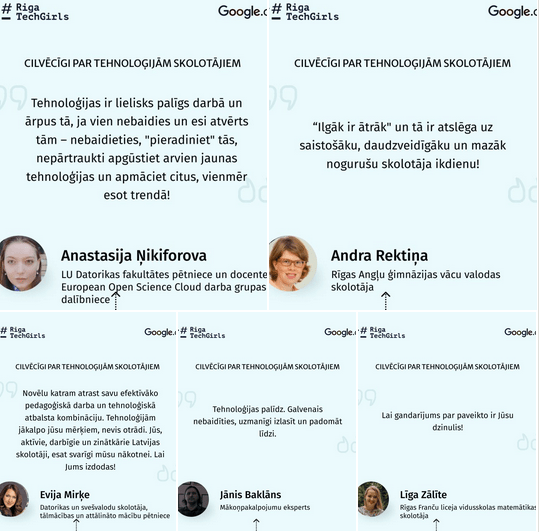
Riga TechGirls, mentors and supportive words for attendees

Thank you, Riga TechGirls team – the first community in Latvia aimed at educating and inspiring women and girls in IT, empowering them to be architects of the future – for your invitation and this valuable experience!

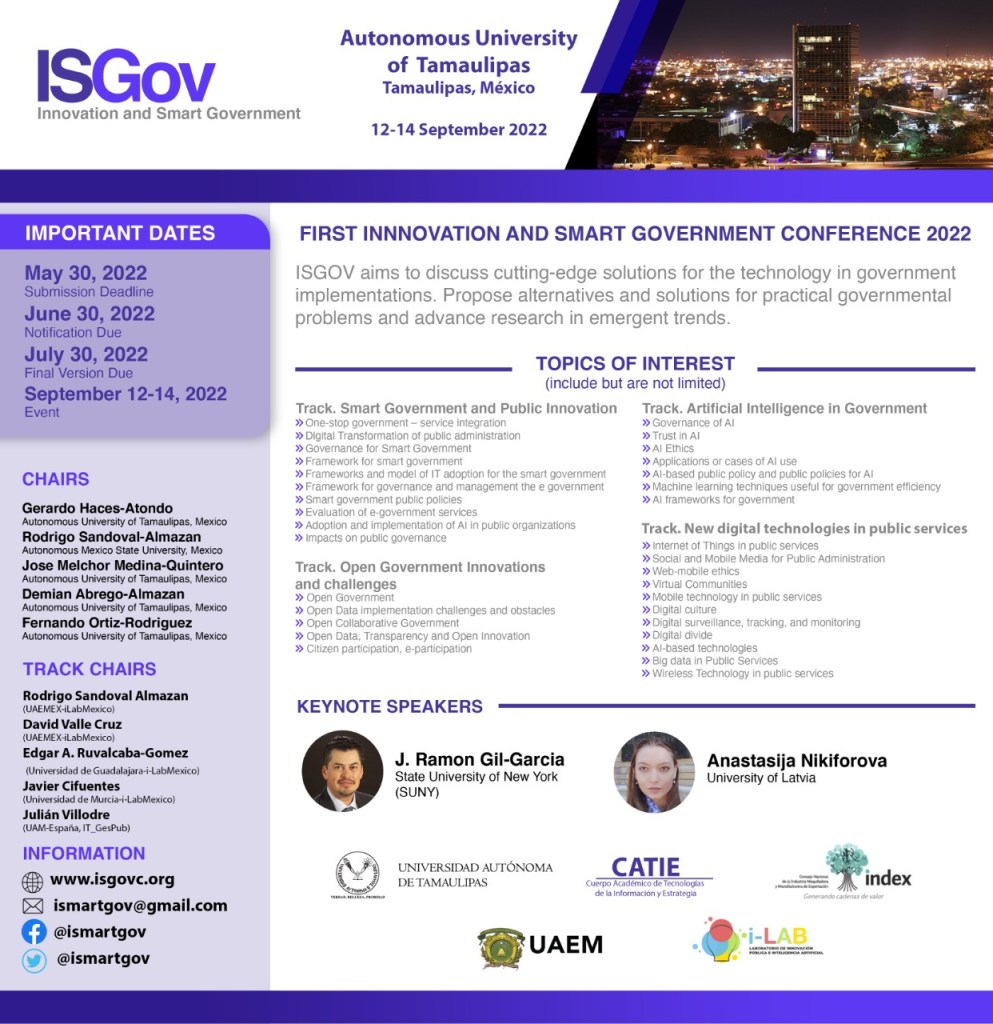
The International Day of Women and girls in Science and my new role – Keynote Speaker for the international Innovation and Smart Government (ISGov) conference

And today, celebrating the International Day of Women and Girls in Science dedicated to celebration of both science and gender equality (as part of United Nations Transforming our World: 2030 Agenda for Sustainable Development), I would like to share the information about very special event, in which I am invited to take a part – this time the role of mine is to be a keynote speaker for the international Innovation and Smart Government (ISGov) conference!!!

In case you are interested in topics related to public innovation, smart government, public governance, open government data, and changes in government organizations, I believe that this event, in which I will act as a keynote, could be of interest for you.

This conference aims to discuss cutting-edge solutions for the technology in government implementations. Propose alternatives and solutions for practical governmental problems and advance research in emergent trends. This conference seeks for contributions representing 4 different tracks:

  • TRACK 1. Smart Government and Public Innovation focused on research for public innovation and smart government in this challenging times. This track seeks research on new frameworks, ideas and evaluation of e-government services. Topics include but are not limited to: One-stop government – service integration, Digital Transformation of public administration, Governance for Smart Government, Framework for smart government, Frameworks and model of IT adoption for the smart government, Framework for governance and management the e government, Smart government public policies, Evaluation of e-government services, Adoption and implementation of AI in public organizations, Impacts on public governance, e-Government;
  • TRACK 2. Artificial Intelligence in Government  focused on discussing AI applications, experiences, and unintended consequences, drawing on a variety of methodologies, techniques, applications, theoretical frameworks, and empirical cases, in order to capture the unique phenomena triggered by the increasing adoption of AI. Topics include but are not limited to: Governance of AI, Trust in AI, AI Ethics, Applications or cases of AI use, AI-based public policy and public policies for AI, Machine learning techniques useful for government efficiency, AI frameworks for government;
  • TRACK 3. Open Government Innovations and challenges focused on research about open government and related topics, such as government transparency, citizen participation, accountability, open data, among others. This track seeks to concentrate and disseminate research work on new case studies, theoretical frameworks, and evaluation of institutional openness policies. 
  • TRACK 4. New digital technologies in public services focused on the investigation of the improvement of public services through new digital technologies. The investigations can be frameworks, applications, case studies, methodologies and empirical cases that allow knowing the impact of these technologies on public services. Topics include but are not limited to: Internet of Things in public services, Social and Mobile Media for Public Administration, Web-mobile ethics, Virtual Communities, Mobile technology in public services, Digital culture, Digital surveillance, tracking, and monitoring, Digital divide, AI-based technologies, Big data in Public Services, Wireless Technology in public services.

Two keynote speeches will be delivered during this event, delivered by J. Ramon Gil-Garcia and me. As regards Dr. J. Ramon Gil-Garcia, he is an Associate Professor of Public Administration and Policy and the  Director of the Center for Technology in Government, University at Albany, State University of New York (SUNY). He is considered the most prolific author in  the  field of digital government research worldwide and in 2013 he was selected for the Research Award, which is “the highest distinction given annually by the Mexican Academy of Sciences to outstanding young researchers.” More recently, Dr. Gil-Garcia was named “One of the World’s 100 Most Influential People in Digital Government” in 2018 and 2019 by Apolitical. Dr. Gil-Garcia is the author or co-author of articles in prestigious international journals in Public Administration, Information Systems, and Digital Government and some of his publications are among the most cited in the field of digital government research worldwide. His research interests include collaborative electronic government, inter-organizational information integration, smart cities and smart governments, adoption and implementation of emergent technologies, digital divide policies, and multi-method research approaches. This makes my participation as the second keynote to be even more pleasant for me as for relatively young researcher.

At this moment, the topics of our speeches are not very well known, since we both work actively on our ongoing studies and perhaps will be ready to present some the most recent results, but, hopefully, despite the final decision on the topic to be covered (within the general scope of the conference, of course) they will be of interest for the audience and will result in a lively and fruitful discussion!

And Happy International Day of Women and Girls in Science! 👩‍🎓💻

Research and Innovation Forum 2022 and my own panel on data security

Research and Innovation Forum 2022, Soruce: https://rii-forum.org/

This year I have been invited to organize my own panel session to take place during the Research and Innovation Forum (Rii Forum). This invitation was a follow-up to several articles I recently published (***see below) and Chapter I was developing at that time, and I was very glad to accept this invitation. So, what is this panel about? It is dedicated to data(base) security and is entitled “Security of data storage facilities: is your database sufficiently protected?” and is a part of the track called “ICT, safety, and security in the digital age: bringing the human factor back into the analysis“.

Another question to be asked is “why?” The answer is as follows – today, billions of interconnected devices form an Internet of Things (IoT) ecosystem. With an increasing number of devices and systems in use, the risk of security breaches increases. This even more the case in times of COVID-19 pandemics, when pandemics affected not only human beings’ health and lives but also lifestyle of the society, i.e. digital environment substituted the physical one. This led to an increase of cyber-security threats of different nature. At the same time, while security breaches and security protection mechanisms have been widely addressed in the literature, the notion of “primitive” artifact, such as database seems to have not been paid same attention of researchers and practitioners. But are databases always secure and protected by default, i.e. do databases follow the “security by design” principle? Previous research and regular updates on data leakages suggest that the number and nature of vulnerabilities of databases is very high. Several factors contribute to that and a variety of different measures can be employed to address the issue. Their complexity varies significantly. The aim of the panel is to examine both, the current research on data security, threats posed by weak security of databases, especially NoSQL databases, as well as the approaches to inspect and identify this issue with regards to the question of who owns data storage facilities, security by data storage facility type and country – whether this is country-specific or rather data storage facility-specific question?

In addition, this event and track to which my panel belongs to expects to cover broader security- and safety- related issue. To get a brief overview, let me provide an abstract of this track, which is as follows:

“The inroads of ICT in the fields of safety and security are overwhelming. While several opportunities have thus been created to foster the capacity of our security and defense systems, ICT is also the source of new risks and threats, e.g. cybersecurity issues and cyberwarfare. Amidst the debate on the added value that ICT may bring to the fields of public order (safety issues) and defending society from (mostly) external threats (security issues), ICT, and especially artificial intelligence (AI), has been hailed as the golden means to increased military capacity. The objective of this track is to map and explore recent advances in the field and to dwell on the question of the role of the human factor in contemporary defense systems, including the notions of leadership, administration, human-to-human interaction, and human-computer interaction. This track will be of particular interest to researchers and practitioners engaged with topics and issues relating to the military, policing, security, safety, and others” (source: Rii Forum)

In case you are interested in either my panel, or the track or the event in general, book the date – the event is scheduled to run on April 20-22, 2022 and will take place in hybrid mode, i.e. both online and offline modes will be acceptable. For those who prefer on-site events, it would be beneficial to know that it will be in Athens, Greece.

*** just in case you are interested in those articles I have referred to at the beginning of this post:

First paper in my Special Issue “Hybrid Data-Driven and Physical Modelling for Energy-Related Problems: Towards Smarter Energy Management”

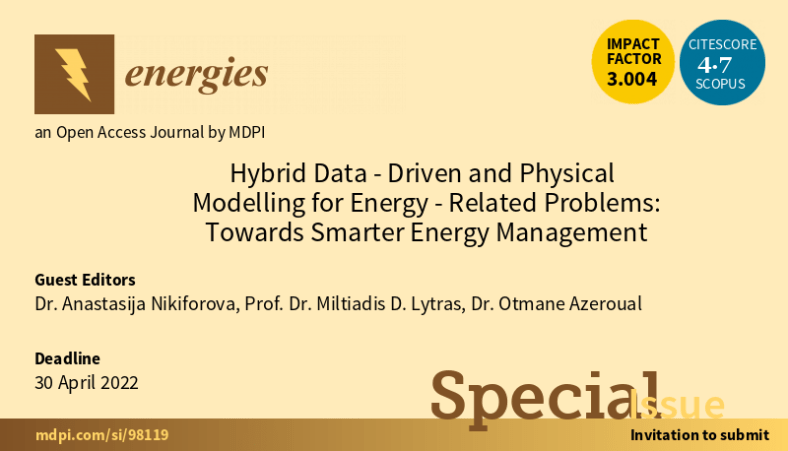
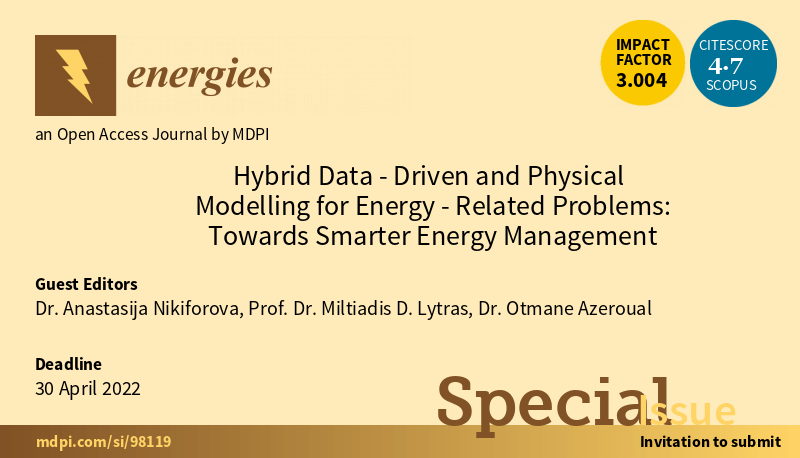
As an academic editor of the Special Issue “Hybrid Data-Driven and Physical Modelling for Energy-Related Problems: Towards Smarter Energy Management” (Energies MDPI, Impact Factor:3.004 (2020); 5-Year Impact Factor: 3.085 (2020)), I am glad to announce that the first article has been published!

This very special for me issue belongs to the section “A8: Artificial Intelligence and Smart Energy” and it seeking for the latest research on advances in the field covering both data-related topics and next-generation power electronic techniques and their applications. All papers accepted for their publishing are published in an Open Access, thereby significantly contributing to the visibility of these papers, and are submitted for their indexation in both Scopus and Web of Science in addition to other databases. The journal also falls in Q1 (Cite Score, Control and Optimization).

Topics of interest for this Special Issue include, but are not limited to:

  • energy management systems
  • data-driven approaches to energy-related issues
  • advances in energy analytic, including open data on energy, its benefits, re-uses and impact
  • Big Data management in the context of energy data
  • machine learning (ML) techniques
  • physical modelling for energy-related problems
  • disruptive technology of renewable energy
  • blockchain for Internet of energy management
  • the role of the “energy” within the context of Industry 4.0 and Sustainable Goals
  • energy data management in the context of the internet of things (IoT)
  • energy data management via distributed systems
  • smart grid and microgrid
  • sustainable electrical energy systems
  • hybrid and electric vehicle.

This Special Issue is of articular importance, given that energy-related issues are becoming more and more relevant today, including the topic of disruptive technologies, where renewable energy is referred to as one of the 12 most significant disruptive technologies. The topic is no longer limited to energy production/generation and storage and supply as a source of energy; it is becoming broader, including the close links with the electrification of transport, including electric vehicles (smart and green transportation), industrial automation, energy storage systems, data storage and data management systems. With both being very common, and at the same time disruptive and new, energy-related issues relate to both the adaptation of well-known foundations for recent trends and the optimization of the methods and techniques already used, as well as introducing completely new methods and developing new applications, thereby promoting open innovation and smarter living.

Special Issue “Hybrid Data-Driven and Physical Modelling for Energy-Related Problems: Towards Smarter Energy Management”


The first paper accepted for its publishing in the SI is entitled “Machine Learning Schemes for Anomaly Detection in Solar Power Plants” and is authored by Mariam Ibrahim (German Jordanian University), Ahmad Alsheikh (Deggendorf Institute of Technology), Feras M. Awaysheh (University of Tartu Institute of Computer Science) and Mohammad Dahman Alshehri (Taif University). The paper deals with the anomaly detection in photovoltaic (PV) systems by evaluating the performance of different machine learning schemes – AutoEncoder Long Short-Term Memory (AE-LSTM), Facebook-Prophet, and Isolation Forest – and applying them to detect anomalies on photovoltaic components. These models allow the authors to identify the PV system’s healthy and abnormal actual behaviors. The results provide clear insights to make an informed decision, especially with experimental trade-offs for such a complex solution space. The issue explored is all the more topical considering the rapid industrial growth in solar energy, which gains an increasing interest in renewable power from smart grids and plants.

I am very glad and honored to be an academic editor of both this issue (together with my colleagues from Germany and Greece) and this paper in particular.

Special Issue, Academic Editor

Looking forward further submissions (particular focus on advances in the field covering both data-related topics and next-generation power electronic techniques and their applications)!!!

First International Electronic Governance with Emerging Technologies Conference (EGETC)

As the general co-chair of the First International Conference in Electronic Governance with Emerging Technologies (EGETC-2022), I sincerely invite you to consider your participation as authors and presenters or the attendees in this event.

First International Electronic Governance with Emerging Technologies Conference

Over the last decade, the importance of emerging technologies in government and public administrations has grown significantly. The growing demand for services that better meet changing user expectations for responsiveness and personalization, coupled with higher expectations of the role of government in the digital age, calls for a technologically mature public sector. There are many new emerging technologies serving as enablers to new forms of governance and novel applications in traditional governance functions, which role has been witnessed across various domains, including healthcare, medicine, education, tourism, and industry etc.. 

The aim of the First International Conference in Electronic Governance with Emerging Technologies (EGETC-2022) is to provide a forum for academics, scholars, and practitioners from academia and industry to share and exchange the recent developments in the domain of eGovernment and governance of digital organizations to shed light on the emerging research trends and their applications. 

Topics of interest include, but not limited to:

  • Intelligent systems for coordination in crisis emergency management
  • Distributed ledgers and Blockchains: governance, decentralized autonomous organizations (DAO)
  • Machine Learning (ML), Artificial Intelligence (AI) and Big Data management for Public Sector
  • Privacy, security and legal Informatics – AI and Law
  • Open Data, Open Government Data: transparency, trust, public participation, co-creation and Open Innovation
  • Digital transformation and Society 5.0
  • Linked Data, Linked Open Data (LOD)
  • Semantic E-government applications
  • Public Sector Knowledge Representation
  • Decision Support Systems (DSS) in Digital Governance
  • Natural Language Processing (NLP)
  • Cloud Computing
  • Bots, Automation agents, Self-learning systems 
  • Cryptocurrencies and incentive mechanism design
  • Multimedia and multilingual systems

It is particularly important that, in order to ensure the widest possible participation of communities, despite the availability of funding, the conference does not foresee any charges. I.e. both authors and presenters, and attendees/ listeners are welcome without registration fees.

First International Electronic Governance with Emerging Technologies  Conference (author: Anastasija Nikiforova)

In addition to the great team of organizers and members of the program committee, which has a rich list of outstanding experts, participants of this event will have an opportunity to enjoy the keynote speeches by Prof. Marijn Janssen – Full Professor in ICT & Governance at TU Delft, Netherlands, Dr. B K Murthy, CEO – Innovation and Technology Foundation, IIT Bhilai, Prof. Luis Martinez – Full Professor, University of Jaén, Jaén Spain. More information on their talk will follow…

Accepted papers presented at the EGETC2022 will be published in the proceeding published by Springer in Lecture Notes in Computer Science series (approval pending…). A short list of best papers will be invited for a post-conference publication in Government Information Quarterly (GIQ), Elsevier, Q1, Cite Score: 11.6, Impact Factor: 7.279 and Technological Forecasting and Social Change, An International Journal, Elsevier, Q1, Cite Score: 12.1, Impact Factor: 8.593.

If you are interested in submitting your paper, add to your calendar the submission date – May 30, while the event will take place during September 12-14, 2022.

Due to the unpredictability of the current situation in the light of pandemic, we expect to have a hybrid event, i.e. both online and on-site participation will be possible. For the later mode, we will be very glad to meet participants, who will be able to attend the event physically, in peaceful and spectacular city of Tamaulipas, Mexico in mid-September, 2022. Hope to meet you there!!!