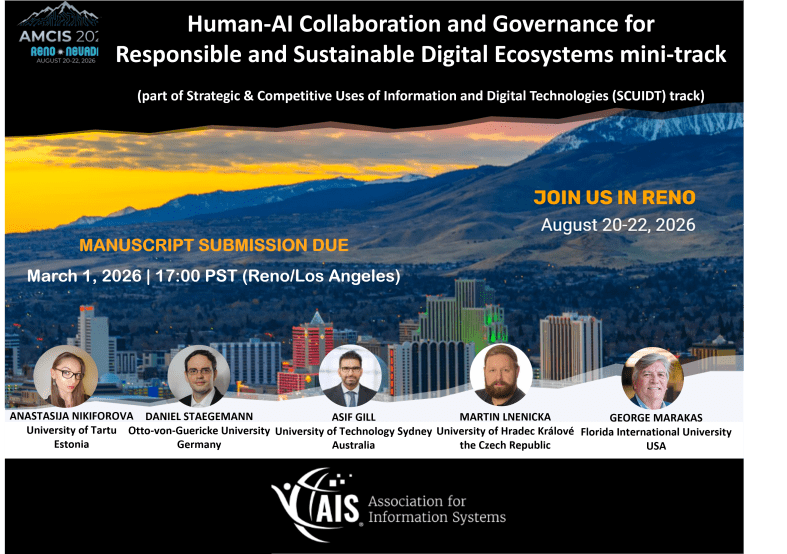
AMCIS2026 Human–AI Collaboration and Governance for Responsible and Sustainable Digital Ecosystems mini-track

As digital transformation accelerates, the convergence of AI, data governance, and ecosystem thinking is reshaping how organizations create strategic value, build competitiveness, and sustain innovation advantage. Digital and data ecosystems are increasingly complex, spanning cloud, edge, and decentralized architectures such as data meshes and lakehouses, raising critical questions of trustworthiness, responsibility, and sustainability in AI integration.

This AMCIS2026 mini-track (by Association of Information Systems (AIS)) explores how AI, including increasingly agentic systems, acts as both a strategic enabler and active participant in digital and data ecosystems, enhancing governance, augmenting and automating decision-making, and transforming how organizations create value, while raising important governance, ethical, and human-agency considerations. We invite research examining how these ecosystems can remain responsible, resilient, and sustainable, while enhancing organizational agility, competitiveness, and long-term strategic performance across sectors such as government, healthcare, finance, manufacturing, and education.

The track bridges perspectives from information systems, data science, AI governance, and sustainability research to understand how the strategic and responsible design and management of AI-driven data ecosystems can support long-term value creation, competitiveness, and societal transformation. We invite interdisciplinary contributions from fields such as computer science, management science, data science, process science, decision science, organizational design, policy-making, complexity, behavioral economics, and the social sciences. Submissions may include conceptual, design science, empirical, theoretical, or case-based studies, including literature reviews.

Topics of interest include but are not limited to:

  • AI for governance, accountability, and trustworthiness in digital and data ecosystems;
  • human–AI collaboration and delegation, human-in-the-loop and hybrid governance;
  • responsible, sustainable, and strategically aligned management of AI-augmented data ecosystems, including Green AI;
  • governance and data management in emerging architectures (e.g., data mesh, data lakehouse), including data quality, transparency, and explainability;
  • transition from centralized to decentralized data architectures – organizational and design challenges;
  • ethical, interoperable, observable, and explainable AI in connected and cross-sectoral data ecosystems;
  • co-evolution of digital and data ecosystem components;
  • coopetition between digital and data ecosystems;
  • resilience, sustainability, and long-term governance of digital infrastructures;
  • socio-technical, organizational, and policy approaches to trustworthy and responsible data ecosystems;
  • emerging technologies (e.g., blockchain, edge computing, generative AI, digital twins, IoT, AR/VR) shaping responsible, sustainable, and energy- or resource-efficient strategic ecosystem innovation;
  • empirical studies and sectoral case analyses (e.g., healthcare, finance, government, education) on evolving AI-driven ecosystems;
  • design science, conceptual, and interdisciplinary frameworks for responsible, sustainable, and strategically effective data ecosystem innovation.

This mini-track will serve as a platform for interdisciplinary dialogue on the critical role of responsible, sustainable, and strategically oriented digital and data ecosystems in driving competitive and societal innovation. Researchers and practitioners are invited to share insights, theoretical perspectives, and empirical findings in this rapidly evolving domain.

📌 Submission Deadline: March 1, 2026
📍 Venue: AMCIS 2026 — Reno, Nevada (August 20–22)

Mini-Track Chairs

Anastasija Nikiforova – University of Tartu, Estonia
Daniel Staegemann – Otto von Guericke University Magdeburg, Germany
Asif Gill – University of Technology Sydney, Australia
Martin Lnenicka – University of Hradec Králové, Czech Republic
George Marakas – Florida International University, USA
Read more and submit papers via AMCIS2026 website.

AI, Data, and Public Benefit: Reflections from Data for Policy CIC 2025

At Data for Policy CIC 2025 in The Hague, themed “Twin Transition in Data and Policy for a Sustainable and Inclusive Future,” we explored how emerging technologies—especially AI—and diverse data sources can support accountable, inclusive, and sustainable policymaking.

Across several full days of sessions, the event brought together transdisciplinary researchers, policy practitioners, and technology experts. Notable contributions included:

  1. Research presentations“Proactive-by-Design: The Future of Governance Beyond Bureaucracy?,” on the study we conduct with Paula Rodriguez Müller & Luca Tangi (European Commission JRC) and “The Data Agency Awakens: A New Era for Official Statistics” we prepared with Luca Di Gennaro Splendore
  2. Panel on National Data Strategies in Europe: Learning from and for the Dutch Data Strategy, which I joined the conversation as a panelists, along with Tim Faber (Ministry of Interior & Kingdom Relations), Anne Fleur van Veenstra, Iryna Susha, Adrianna Michałowicz (chaired by Devin Diran & Thijmen van Gend)
  3. finally, the paanel on Responsible AI and Data Science Revolutions: Implications for Public Benefit Research and Policy Making that I was honored to chair, with panelists representing Smart Data Foundry and the Joseph Rowntree Foundation (JRF), joined by Magdalena Getler, Oliver Berry, and Rosario Piazza.

Our discussion highlighted the immense potential of AI and data, but also the responsibilities that come with it. Key insights included:

  • Balancing optimism and realism: AI is transformative, but its adoption requires grounded, practical experience. It can support public benefit—if managed carefully;
  • Data quality over quantity: More data isn’t always better. Governance, documentation, bias mitigation, and transparency are essential for AI-readiness;
  • Embedding public trust: High-sensitivity contexts, such as health or finance, demand proportionality, oversight, and systems designed for inclusivity;
  • Human-in-the-loop mechanisms: Ensuring AI reflects human values and context is critical, even when those values are evolving;
  • Task-appropriate AI: Not every problem requires a large language model; careful alignment between technology and purpose is essential;
  • Data literacy for all: Understanding AI’s limitations and risks is as important as technical infrastructure;
  • Triangulating perspectives: Combining structured/unstructured and qualitative/quantitative data helps address bias, power imbalances, and complexity;
  • Sustainable and inclusive systems: Scalable infrastructure alone is insufficient; AI governance and operational design must prioritize long-term societal benefit.

As Amara’s Law reminds us: “We tend to overestimate the effect of a technology in the short run and underestimate it in the long run.” Our discussion echoed this sentiment: AI’s potential is enormous, but realizing it for public benefit requires careful design, governance, and collaboration.

The overarching theme through all days (beyond above) was clear: AI and data are not neutral tools. Their value for public policy depends on human-centered design, responsible governance, and active societal engagement. Tools alone won’t deliver public benefit—they must be operationalized thoughtfully, with attention to ethics, context, and inclusion.

Huge thanks to Sarah Giest, Bram Klievink, Zeynep Engin, and all participating institutions—Leiden University, TNO Vector, Cambridge University Press & Assessment, and The Hague Centre for Digital Governance—for creating the space for meaningful dialogue in such a rich, collaborative environment.

The CIC 2025 conversations reminded us: building a truly responsible, inclusive, resilient, and sustainable AI ecosystem is not just a technical challenge—it is a societal mission and each and every of us is part of it.

Advancing Democracy & AI: Reflections from IJCAI, PRICAI, and ICA 2025 Workshops

Artificial intelligence is rapidly reshaping how societies govern, deliberate, and make collective decisions. Over the past year, our Democracy & AI workshop series—held across IJCAI, PRICAI, and ICA—has become a global forum for examining both the promise and the perils of AI in democratic contexts. From Montréal to Wellington to Wuhan, our community continues to grow, connecting researchers across AI, political science, HCI, law, design, ethics, and public administration.

DemocrAI at IJCAI 2025: AI at the Service of Society

As part of the IJCAI International Joint Conferences on Artificial Intelligence in Montréal, themed “AI at the service of society,” we (Jawad Haqbeen, Takayuki Ito, Rafik Hadfi, and myself) convened the 6th International Workshop on Democracy & AI (DemocrAI25).
Although I could not attend in person, I am deeply grateful to my co-organizers for leading the workshop and for representing our team—as well as for the chance to meet Yoshua Bengio, one of the pioneers of modern deep learning and the one who recently became the very first researcher who while still being active in research achieved the milestone of 1 million citations!

The workshop opened with two outstanding keynote talks:

  • Mary Lou Maher (UNC Charlotte) — “The Imperative for AI Literacy”
  • Michael Inzlicht (University of Toronto) — “In Praise of Empathic AI”

Across 13 diverse presentations, contributors explored: AI’s impact on trust, civic engagement, and deliberation, risks and governance of LLMs in judicial settings and policymaking, collective intelligence and value aggregation for democratic processes, AI applications in education, law, and policy design, governance, fairness, inclusion, and global research equity.

We were delighted to recognize several exceptional contributions:

  • Best Paper Award“LLMs in Court: Risks and Governance of LLMs in Judicial Decision-Making” (Djalel Bouneffouf & Sara Migliorini)
  • Best Student Paper Award“Finding Our Moral Values: Guidelines for Value System Aggregation” (Víctor Abia Alonso, Marc Serramia & Eduardo Alonso Sánchez)
  • Best Extended Abstract Award“Group Discussions Are More Positive with AI Facilitation” (Sofia Sahab, Jawad Haqbeen & Takayuki Ito)
  • Best Presentation Award“Democracy as a Scaled Collective Intelligence Process” (Marc-Antoine Parent)

A key message echoed throughout the day: AI can enhance social cohesion, participation, and equity—but only through responsible design and robust governance frameworks.

DemocrAI at PRICAI 2025: Participation, Values, and Governance

Following IJCAI, I joined the organizing committee for the 7th Democracy & AI Workshop at PRICAI 2025, held in Wellington, New Zealand. Two years ago, I had the privilege of giving a keynote at PRICAI DemocrAI on symbiotic relationship of Artificial Intelligence, Data Intelligence, and Collaborative Intelligence for Innovative Decision-Making and Problem Solving. This year, I am excited to help shape the conversation from the organizing side.

The workshop explored the expanding role of AI in democratic life, including AI-assisted policy design and decision-making, AI in governance, elections, and public administration, citizen participation and deliberative democracy tools, behavioral impacts of AI on trust, engagement, and polarization, transparency, accountability, and legitimacy of algorithmic decisions, ethics, socio-technical risks, and AI’s impact on societal wellbeing, and reimagining democracy in the LLM era.

Special Track at ICA 2025: AI in e-Government & Public Administration

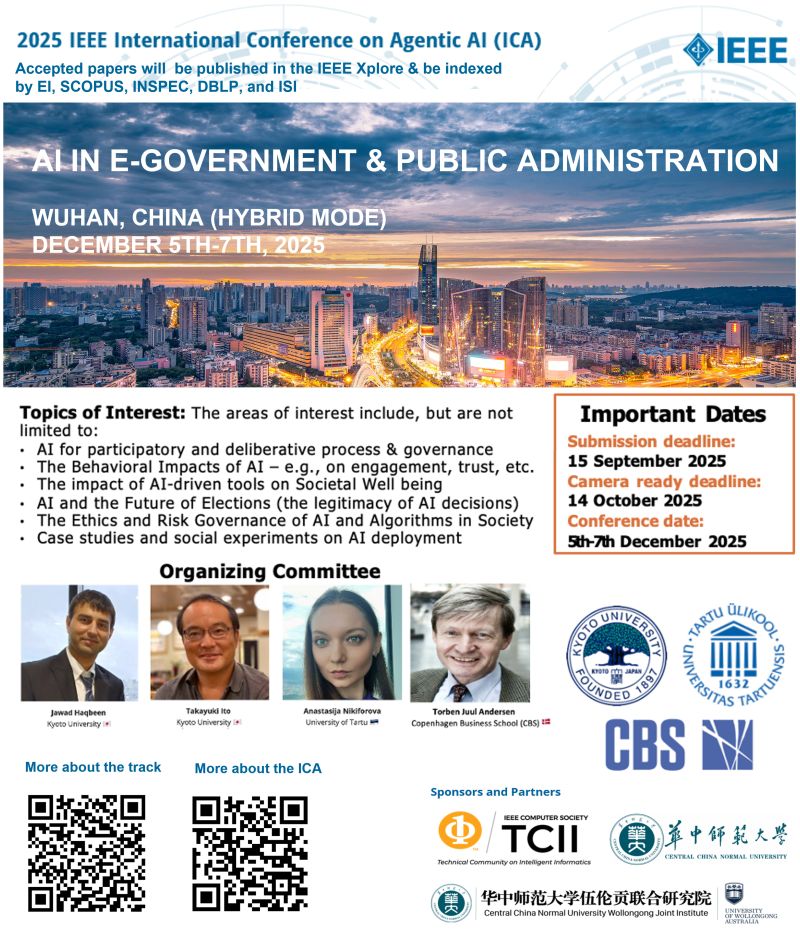
Our workshop series expands further with a dedicated Special Track on AI in e-Government & Public Administration at the IEEE International Conference on Agentic AI (ICA 2025), held in Wuhan, China.

Co-organized with Jawad Haqbeen, Takayuki Ito, and Torben Juul Andersen, this track examines how AI-driven tools are transforming public governance—from policy co-creation and civic engagement to service delivery and institutional decision-making.

Topics include:

  • AI for participatory and deliberative governance
  • AI’s impact on societal wellbeing
  • AI in public service delivery and policy design
  • Ethics and risk governance in public-sector AI
  • Case studies and experiments with deployed systems
  • Transparency, accountability, and responsible administration

Across IJCAI, PRICAI, and ICA, one theme is clear: AI’s role in democracy is neither predetermined nor neutral. It can support inclusion, transparency, and collective intelligence—or undermine trust, equity, and participation. The outcome depends on the choices we make now: the values we embed, the governance we build, and the communities we bring together.

Our Democracy & AI workshop series exists to advance this work—uniting technologists, policymakers, social scientists, designers, and ethicists in a shared mission: to ensure AI serves democracy, rather than the other way around.

Huge thanks to all speakers, awardees, participants, and co-organizers.
Onward to DemocrAI at PRICAI and ICA 2025!

Celebrating Our Contribution to the 50th Anniversary of Government Information Quarterly

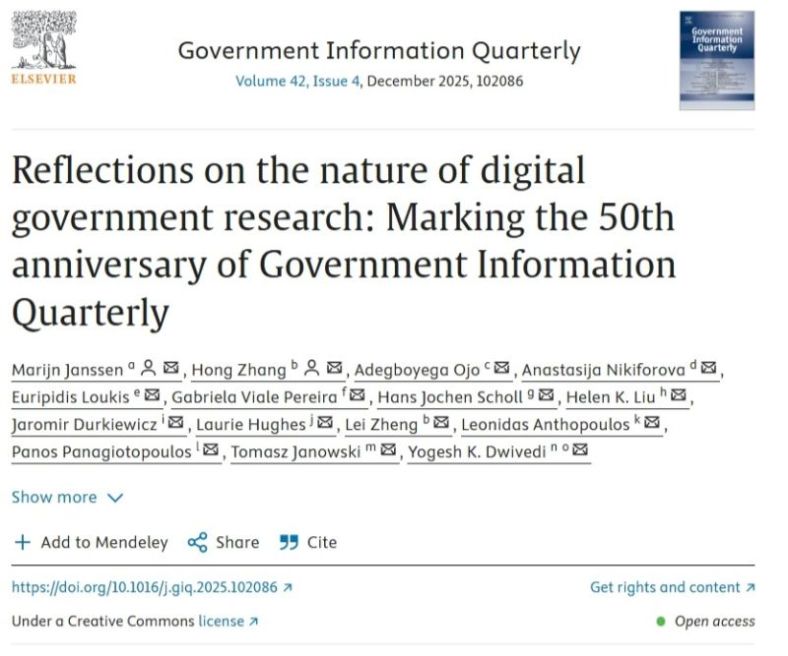
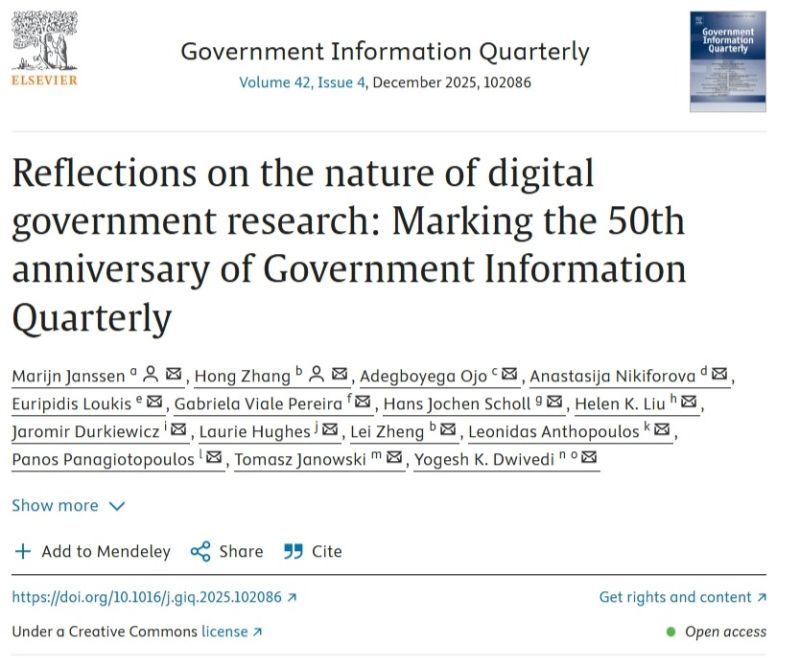
Marking a half-century of shaping the field, Government Information Quarterly (GIQ) celebrates 50 years as the leading journal in digital government research—and I am honored that our latest article, “Reflections on the Nature of Digital Government Research: Marking the 50th Anniversary of Government Information Quarterly,” forms part of this milestone issue constituting an editorial.

This collaborative piece brings together a group of scholars—Marijn Janssen, Hong Zhang, Adegboyega Ojo, Anastasija Nikiforova, Euripidis Loukis, Gabriela Viale Pereira, Hans J. Scholl, Helen Liu, Jaromir Durkiewicz, Laurie Hughes, Lei Zheng, Leonidas Anthopoulos, Panos Panagiotopoulos, Tomasz Janowski, and Yogesh K. Dwivedi—each offering a distinct perspective on how digital government research has evolved, diversified, and responded to societal and technological transformation.

A special thanks goes to Marijn Janssen, former Editor-in-Chief of GIQ, whose vision and coordination made this anniversary reflection possible.

Looking Back: Five Decades of Digital Government Research

Over 50 years, GIQ has chronicled—and often anticipated—the evolution of digital governance: from early computational systems to open government, data-driven innovation, smart cities, and the rise of AI.
Throughout these cycles, the journal has remained the field’s intellectual anchor, publishing research that tackles foundational public sector challenges while engaging with emerging technologies such as blockchain, quantum computing, IoT, AR/VR, and the Metaverse.

Several characteristics continue to define GIQ’s identity:

• Methodological and epistemological pluralism
GIQ’s hallmark is its openness to diverse paradigms, methods, and theoretical lenses. Rather than promoting a single theory of digital government, it invites multiple angles—qualitative, quantitative, mixed, conceptual, comparative—to analyze complex governance realities.

• “Blue-sky” thinking without hype
GIQ encourages forward-looking, innovative, and boundary-pushing ideas, while maintaining analytical discipline. This balance keeps the field visionary yet grounded.

• Impact rooted in both theory and practice
The journal has consistently insisted that strong methodology must lead to meaningful insights—advancing academic understanding while speaking directly to policymakers and practitioners.

• Clear communication to a broad audience
GIQ’s readership extends well beyond academia. With government, industry, and civil society looking to the journal for guidance, clarity and accessibility are essential. As Shakespeare famously said, “brevity is the soul of wit.”

What Our Anniversary Article Contributes

Our contribution synthesizes insights from leading experts to illuminate the nature, evolution, and future of digital government research.
Several overarching themes emerge:

  • epistemological pluralism and interdisciplinarity as fundamental characteristics of the field;
  • contextualized, value-driven, and practice-relevant research as the journal’s core strength;
  • digital transformation as a socio-technical phenomenon, where institutions, technology, data, governance models, and citizen expectations co-evolve;
  • the importance of studying both technology and context, avoiding the pitfalls of black-boxing either side of the equation;
  • GIQ’s role as a platform for blue-sky research, innovation, and rigorous theorization that remains relevant across countries and governance systems.

We dedicate this article to the late Professor Soon Ae Chun, former Co-Editor-in-Chief of GIQ.
Her leadership, scholarship, and unwavering commitment to quality and community have left an enduring mark on the field.

The 50-year anniversary of GIQ is more than a celebration. It is a reminder that the future of digital government research depends on openness: in methods, theories, communication, and imagination. As digital governance accelerates, the journal’s role as a bridge—between disciplines, between theory and practice, and between local realities and global insights—has never been more essential.