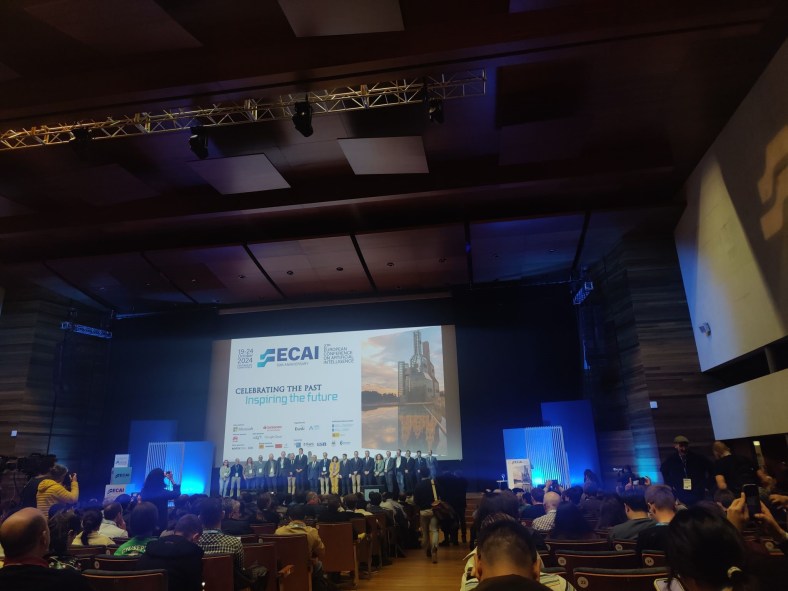

This October was one of the busiest yet most rewarding months of the year for me. Among several work trips, the highlight was attending the 27th European Conference on Artificial Intelligence (ECAI 2024) in Santiago de Compostela, Spain. Celebrating its 50th anniversary, ECAI remains Europe’s premier venue for AI research and innovation, bringing together thought leaders, researchers, and industry professionals from around the world.
This year’s theme, “Celebrating the Past, Inspiring the Future,” captured the spirit of ECAI’s half-century legacy while driving forward-looking discussions on the next era of artificial intelligence. With over 1,500 participants from 59 countries (so not so very European conference anymore, but rather a global event) and a packed schedule of more than 150 events, among which:
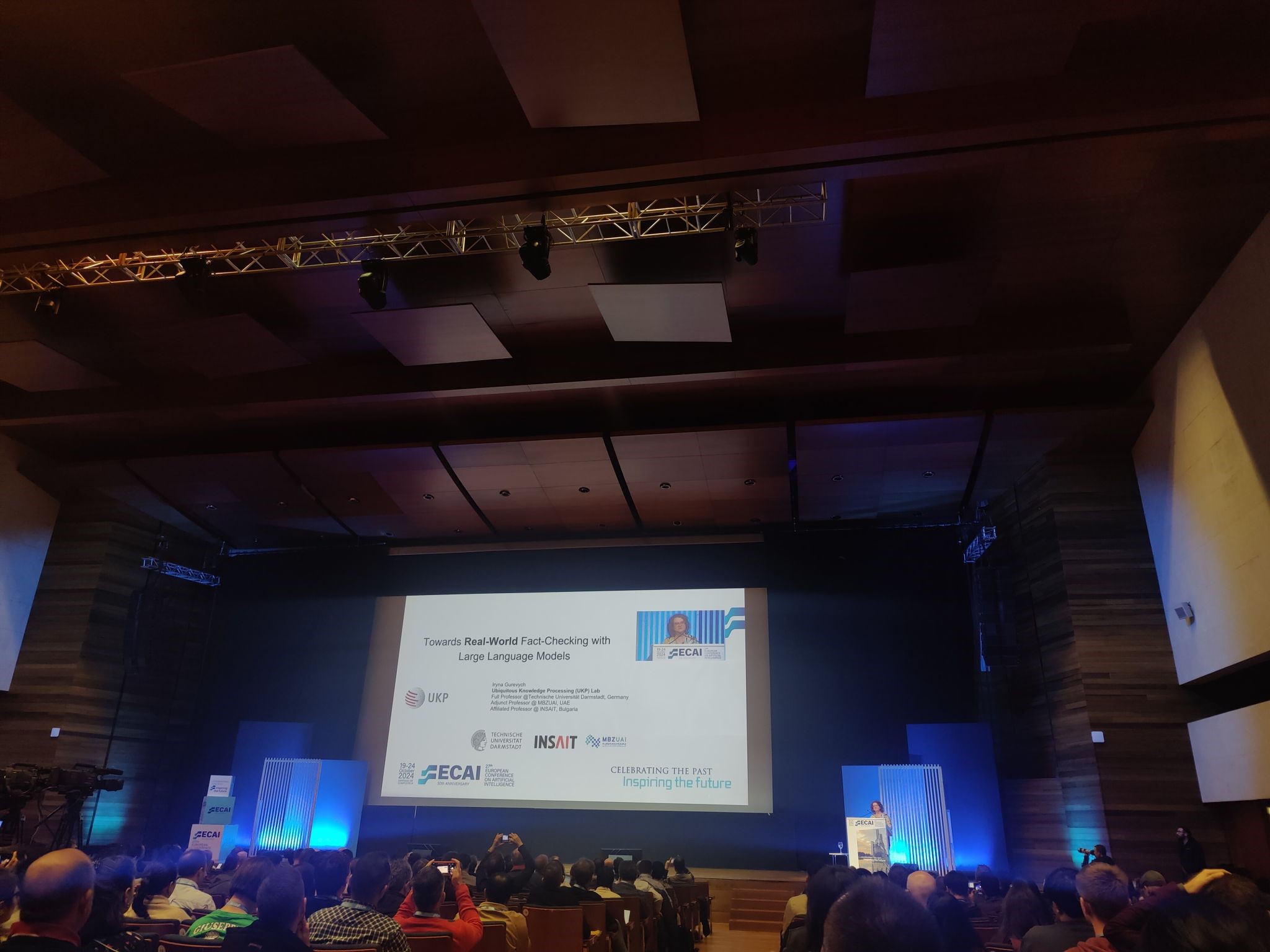
- “Towards Real-World Fact-Checking with Large Language Models” keynote talk by Iryna Gurevych, (Technische Universität Darmstadt), reflecting on advancements in using language models for verifying information in real time;
- “Robots (Still) Need Humans in the Loop,” keynote talk by Iolanda Leite (KTH Royal Institute of Technology), who underscored the essential role humans play in AI-driven robotics, even as systems grow more autonomous;
- “Economic Complexity: Using Machine Learning to Understand Economic Development” keynote talk by Cesar A. Hidalgo (Toulouse School of Economics & Corvinus University of Budapest) that examined how machine learning is transforming our understanding of economic trends and predictions.
These were accompanied with a range of panels, with a few sessions that stood out (my personal opinion though):
- Economic Impact of AI: Threats and Opportunities with Jeremy Rollison (Microsoft Corporation), David Autor (MIT), and Raquel Jorge Ricart (Elcano Royal Institute) on AI’s potential to reshape labor markets and economies around the world;
- AI Regulation: The European Scenario (Kilian Gross, Dr. Clara Neppel, IEEE, Beatriz Alvargonzalez Largo, European Commission, José Miguel Bello Villarino, ARC Centre of Excellence for Automated Decision-Making and Society), addressed regulatory considerations;
- 50th Anniversary Session on the History of AI in Europe paying tribute to AI’s history in Europe, with Luc Steels, Stefano Cerri, Fredrik Heintz, and Tony Cohn sharing reflections on past achievements and a “follow-up” on it in the Future of AI: The Next 50 Years with Fredrik Heintz, Iryna Gurevych, José Hernández-Orallo, Ann Nowe, Toby Walsh;
- Designing Ethical and Trustworthy AI Research Policies for Horizon Europe centered on ethical standards and trustworthy AI research practices within the EU’s Horizon program, led by Mihalis Kritikos from the European Commission;
- Funding your Scientific Research with the European Research Council (ERC) with Enrique Alba.




As part of this conference, I had pleasure of presenting a paper co-authored with my former student Jan-Erik Kalmus, based on his Master’s thesis, which I had the privilege of supervising. Our paper, “To Accept or Not to Accept? An IRT-TOE Framework to Understand Educators’ Resistance to Generative AI in Higher Education,” examined what barriers might prevent educators from adopting Generative AI tools in their classrooms? Since the public release of ChatGPT, there has been a lively debate about the potential benefits and challenges of integrating Generative AI in educational contexts. While the technology holds promise, it has also sparked concerns, particularly among educators. In the field of information systems, Technology Adoption models are often used to understand factors that encourage or inhibit the use of new technologies. However, many existing models focus primarily on acceptance drivers, often overlooking the unique barriers that educators face. This study seeks to fill that gap by developing a theoretical model specifically tailored to identify the barriers that may prevent educators—academic staff in particular—from integrating Generative AI into their teaching. Our approach builds on Innovation Resistance Theory, augmented by constructs from the Technology-Organization-Environment (TOE) framework. With the designed mixed-method measurement instrument, combining quantitative data with qualitative insights, to capture educators’ specific concerns around Generative AI adoption in higher education, our model has been applied in real-world settings, specifically focusing on Estonian higher education institutions. We examined whether academic staff at public universities in Estonia – often referred to as a “digital nation” – show reluctance toward Generative AI use in educational settings. Preliminary findings highlight several concerns unique to educators, which may shape how Generative AI is integrated into teaching practices.
A Heartfelt Thanks to ECAI’s Organizers – the European Association for Artificial Intelligence (EurAI), the Spanish Artificial Intelligence Society, CiTIUS (Research Centre on Intelligent Technologies), and, of course, the city of Santiago de Compostela for being such a welcoming place.



 Anastasija Nikiforova, PhD