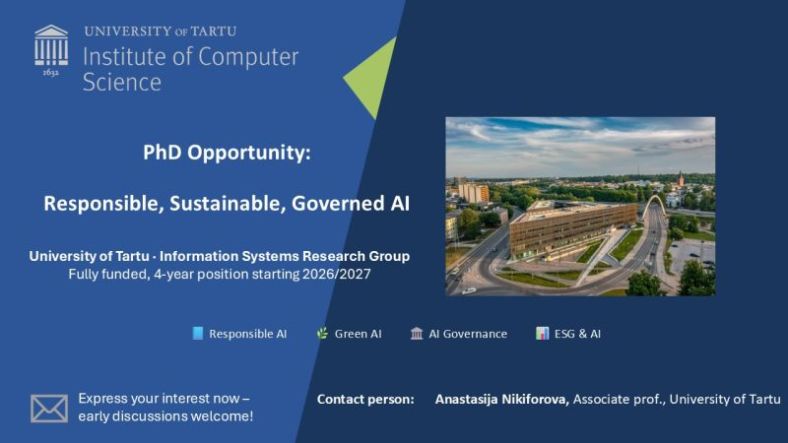
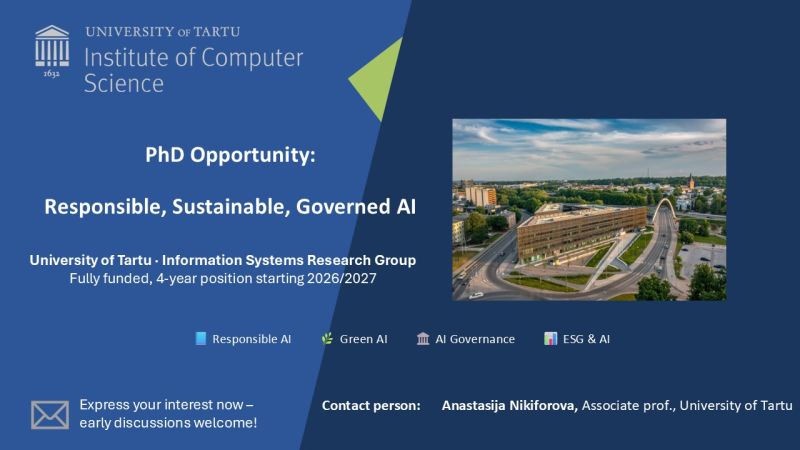
PhD Opportunity: Responsible & Sustainable AI, University of Tartu

We are planning to open fully funded 4-year PhD position(s) starting in 2026/2027 (University of Tartu · Information Systems Research Group), seeking ambitious, motivated candidates to explore the frontier of Responsible and Sustainable AI. To this end, we open the call for Expression of Interest.

This PhD program is ideal for those interested in:
🔹 Sustainable / Green AI & AI lifecycle sustainability
🔹 Organisational capability development for Sustainable AI
🔹 Responsible AI adoption & governance in organisational or public sector contexts
🔹 AI for trust, transparency, and organisational impact

Illustrative example topics include but are not limited to Sustainable / Green AI capability models, Green AI lifecycle & data ecosystem sustainability, Responsible GenAI adoption & governance, AI-enabled ESG reporting and impact assurance. Candidates, however, are welcome and are even encouraged to propose their own research angle within the scope of Responsible or Sustainable AI.

Who can apply?

  • Backgrounds: Information Systems, Digital Government, Sustainability, Management, Computer Science, Public Administration, or related fields
  • Experience with qualitative/quantitative research, mixed methods, or Design Science Research is a plus
  • Strong motivation and interest can compensate for limited experience

📄 How to express interest? Send a brief note including:

  1. CV
  2. 1–2 page research idea
  3. Transcript of records
  4. (Optional) Writing sample

📬 Email: anastasija.nikiforova@ut.ee. Subject line: EOI — PhD in Responsible/Sustainable AI and Information Systems

Why express interest now?

  • This is pre-application, not the formal call, but can strengthen your chances in a competitive pool (50+ applications per position).
  • Selected candidates may receive guidance on refining research ideas and preparing a strong application aligned with the Information Systems focus.

🌟 Join us at the University of Tartu Institute of Computer Science, among the top 1% of globally cited universities, to shape the future of responsible, sustainable, and trustworthy AI.

Green AI: ENFIELD Challenge & ECAI2025 Workshop

🔴🟢 Red or Green Pill? Which path will AI take?

Last month, we officially launched the Green AI Challenge, part of the Horizon Europe ENFIELD – AI Network of Excellence, and October saw a major step forward during an intensive research visit to the Know Center in Graz (Austria) —a hub of AI research and cross-sector collaboration. Working alongside Nicki Lisa Cole we advanced the conceptual and methodological foundations of our Green AI initiative, merging complementary perspectives into a promising framework for sustainable AI.

Why Green AI matters

AI is accelerating rapidly, but so are its environmental and societal side-effects – rising compute demands, energy-intensive models, and the broader ecological footprint of scaling AI. Policies, incentives, and institutional capacity are often lagging behind, creating a gap between AI adoption and responsible, sustainable practice.

The Green AI Challenge aims to understand how organizations across Europe approach Green AI, identifying struggles, gaps, and opportunities, and ultimately co-creating a validated framework for adoption that informs both policy and governance.

Community Call

We need insights from anyone working in AI, sustainability, digital transformation, public policy, or tech governance:

  • What perspectives on Green AI feel most critical today?
  • Where are the biggest gaps, risks, or untapped opportunities?
  • Examples of Green AI in practice (good or bad)?
  • Recommendations for interviews, readings, or collaborators?
  • Frameworks, metrics, or research to guide our work?

Your input will directly shape policy recommendations and adoption frameworks for a more sustainable, trustworthy AI future. Comment below or message us to contribute. Let’s choose the Green Pill together, as we also did with those who joined us earlier in October as part of ECAI2025 Green AI workshop.

Earlier last month, as part of the 28th European Conference on Artificial Intelligence (ECAI2025) in Bologna, together with Riccardo Cantini, Luca Ferragina, Davide Mario Longo, Simona Nisticò, Francesco Scarcello, Reza Shahbazian, Dipanwita Thakur, Irina Trubitsyna, and Giovanna Varricchio, we organized a workshop on environmentally responsible AI, where across three thematic tracks of Sustainability, Green AI, and Applications, 17 talks exploring pathways toward sustainable AI practice were delivered, with the special highlight of keynote talk delivered by Thomas Eiter on “The Bilateral AI approach for Green and Sustainable AI,” introducing a framework that integrates symbolic and subsymbolic methods to advance more efficient and Ecologically Responsible AI.

🌱 All in all, the path forward is ours to shape. By working together—researchers, policymakers, and practitioners—we can turn Green AI from a vision into practice. Let’s continue this journey being committed to sustainable, responsible AI. Let’s choose the Green Pill, together. 🟢

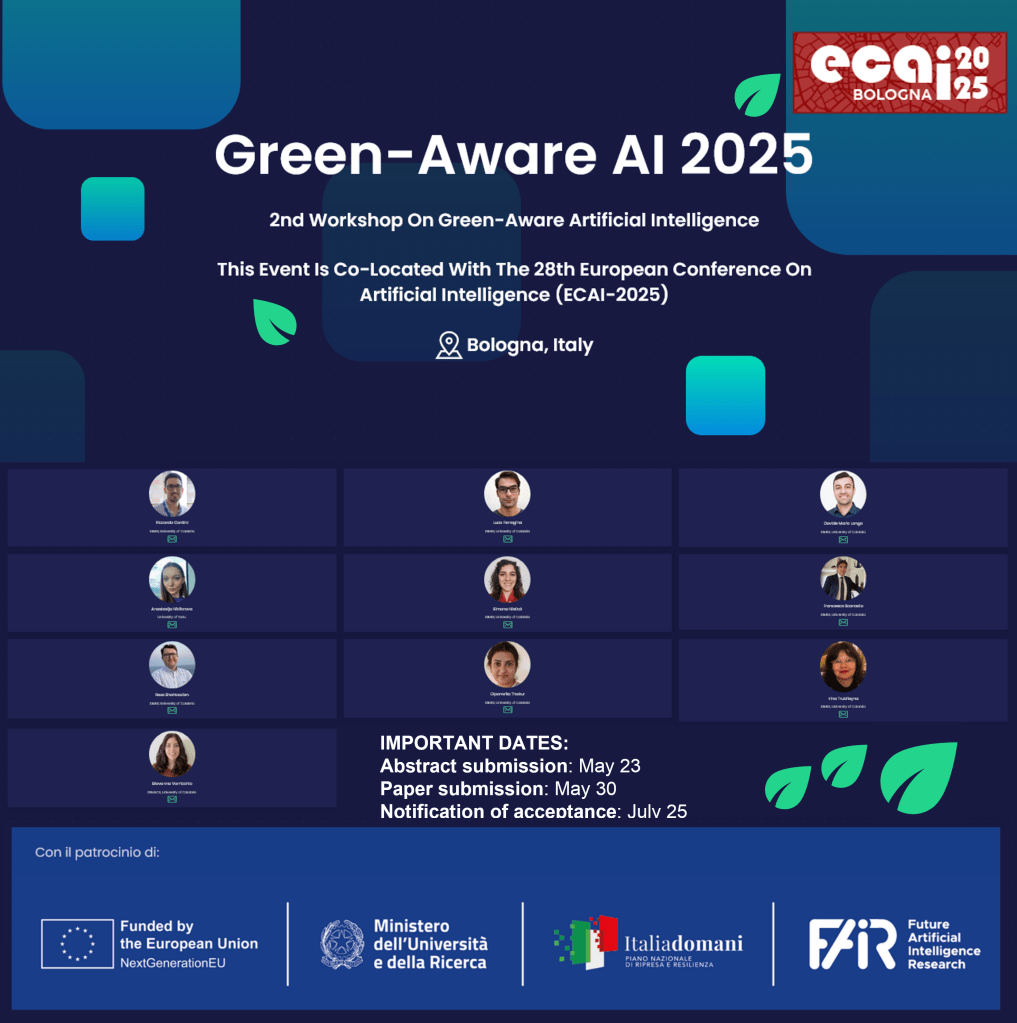
Green-Aware AI 2025 Workshop at ECAI2025

Join us – Riccardo Cantini, Luca Ferragina, Davide Mario Longo, Anastasija Nikiforova, Simona Nisticò, Francesco Scarcello, Reza Shahbazian, Dipanwita Thakur, Irina Trubitsyna, Giovanna Varricchio (University of Calabria & University of Tartu) – at the 2nd Workshop on Green-Aware Artificial Intelligence (Green-Aware AI 2025) to take place conjunction with the 28th European Conference on Artificial Intelligence (ECAI2025) in Bologna, Italy, October 25-30 to examine the sustainability challenges posed by widespread adoption of AI systems, particularly those powered by increasingly complex models, pushing toward responsible AI development and provide a timely response.

The widespread adoption of AI systems, particularly those powered by increasingly complex models, necessitates a critical examination of the sustainability challenges posed by this technological revolution. The call for green awareness in AI extends beyond energy efficiency—it encompasses the integration of sustainability principles into system design, theoretical modeling, and real-world applications.

Green-aware AI requires a multidisciplinary effort to ensure sustainability in its fullest sense, that is, where the green dimension is interpreted broadly, fostering the creation of inherently green-aware AI systems aligned with human-centered values. These systems should uphold sustainability principles such as transparency, accountability, safety, robustness, reliability, non-discrimination, eco-friendliness, interpretability, and fairness—principles reflected in the 17 Sustainable Development Goals (SDGs) defined by the United Nations. The ethical and sustainable advancement of AI systems faces diverse challenges across every stage, including architectural and framework design, algorithm conceptualization, user interaction, data collection, and deployment. This involves designing tools that are inherently green-aware or introducing mechanisms, such as incentives, to encourage agents in AI systems to adopt green-aware behaviors. This principle can be applied across various domains of AI, including but not limited to Algorithm Design, Fairness, Ethics, Game Theory and Economic Paradigms, Machine Learning, Multiagent Systems, and all their applications.

It is worthwhile noting that machine learning systems rank among the most energy-intensive computational applications, significantly impacting the environment through their substantial carbon emissions. Notable examples include the training of large-scale, cutting-edge AI models like those used in ChatGPT and AlphaFold. The creation of such systems demands vast resources, including high-performance computing infrastructure, extensive datasets, and specialized expertise. These requirements create barriers to the democratization of AI, limiting access to large organizations or well-funded entities while excluding smaller businesses, under-resourced institutions, and individuals. The lack of interpretability in AI systems further exacerbates these challenges, raising significant concerns about trustworthiness, accountability, and reliability. Such systems often function as black boxes, making it difficult to understand their underlying decision-making processes. This opaqueness can erode public trust and create barriers to holding developers accountable for harmful outcomes. Additionally, AI systems are prone to biases embedded in their training data and reinforced through user interactions, perpetuating discrimination and unfair treatment, disproportionately affecting marginalized and underrepresented groups.

By addressing these pressing challenges, the workshop aligns with the global push toward responsible AI development and provides a timely response to the environmental and social implications of AI technologies. The primary goal of this workshop is to foster discussions among scholars from diverse disciplines, facilitating the integration of technological advancements with environmental responsibility to drive progress toward a sustainable future. As such Green-Aware AI 2025 invites contributions around the following topics of interest (not limited to thm exclusively though):
💡Green-aware AI frameworks and applications;
💡AI methodologies for energy-efficient computing;
💡Human-centered and ethical AI design;
💡Reliable, transparent, interpretable, and explainable AI;
💡Trustworthy AI for resilient and adaptive systems;
💡Fairness in machine learning models and applications;
💡Impact of AI on underrepresented communities, bias mitigation, and exclusion studies (datasets and benchmarks);
💡Theoretical analysis of energy efficiency in AI systems;
💡Green and sustainable AI applications in environmental and social sciences, healthcare, smart cities, education, finance, and law;
💡Compression techniques and energy-aware training strategies for language models;
💡Approximate computing and efficient on-device learning;
💡Green-oriented models in game theory, economics, and computational social choice;
💡Green-awareness in multi-agent systems;
💡Security and privacy concerns in machine learning models.

Stay tuned about keynotes info on whom to come soon!

📆Important dates:
Abstract submission: May 23
Paper submission: May 30
Notification of acceptance: July 25
Camera-ready: July 31

Join us at Green-Aware AI to help facilitating the integration of technological advancements with environmental responsibility to drive progress toward a sustainable future.

Workshop is supported by the Future AI Research (FAIR), the Italian Ministry of Education, Universities and Research and Italia Domani.
Data for Policy 2025 Europe Edition

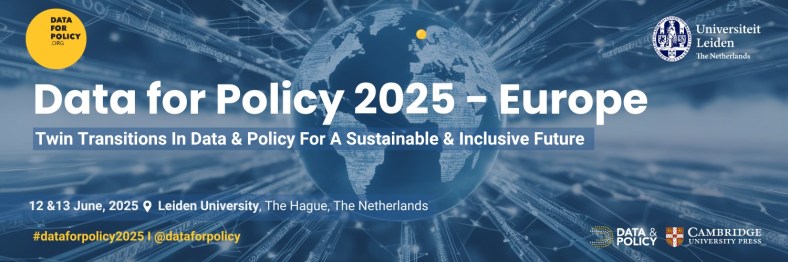
And we are back with the new edition of Data for Policy 2025 Conference, preparation to which are in full swing! And as part of these preparations, we 📣 Call for Special Tracks for Data for Policy 2025 Europe Edition to be submitted by 11 December, 2024, with the conference itself to be held on 12-13 June, 2025, at Leiden University, The Hague, Netherlands!

This time, the Data for Policy 2025 conference will run under the “Twin Transitions in Data and Policy for a Sustainable and Inclusive Future”.

Amidst global challenges, the “twin transition”—encompassing digital and green transformations—has garnered significant attention for its potential to reshape industrial ecosystems and influence social inequalities. However, in the scientific community and policy arena questions have been raised on whether green and digital transitions are mutually compatible or whether one transition can reduce or cancel out the other. Furthermore, we see sustainability as an integrative perspective that includes  environmental, social, economical and institutional sustainability.

Both public and private sectors are increasingly aligning their objectives towards digital innovation and sustainable practices 🌍. Governments are developing policies to guide these transitions, ensuring that technological advancements account for sustainability. Concurrently, substantial investments are being funneled into industries poised to drive this twin transition. Data lies at the heart of this transformation, empowering  policymakers to monitor progress in real-time, identify emerging trends, and design impactful and targeted strategies. From driving down carbon emissions to closing the digital divide, data-driven insights offer the actionable intelligence needed to tackle complex challenges and pave the way toward a more equitable, sustainable future. 

At this nexus, the theme of the European Data for Policy Conference is “Twin transitions in data and policy for a sustainable and inclusive future”, where we will delve into the implications of these transitions for governance, data usage, and policymaking 

With CFP to be launched in a month, now, we – Sarah Giest, Bram Klievnik (both local chairs), Leid Zejnilovic, Laura Zoboli, Anastasija Nikiforova – invite proposals for Special Tracks in two categories:

  • Research/Policy/Practitioner Tracks: These tracks should address how digital and green initiatives work together to overcome global challenges. Proposals should align with the conference theme, “Twin Transitions in Data and Policy for a Sustainable and Inclusive Future”.
  • Policy/Practitioner Tracks: We invite proposals from those focused on policy and real-world applications, addressing the broader Data for Policy theme.

Proposers are encouraged to consider region-specific challenges alongside the conference theme, which offers a framework but is open to all relevant Data for Policy topics.

🗓 Track Proposal Submission Deadline: 11 December, 2024
For more information on the call 👉 Data for Policy 2025 Conference – Europe Edition: Call for Special Tracks – Data for Policy, for more information on the conference 👉 Data for Policy 2025 Europe – Data for Policy

Accepted tracks will be part of the wider call for abstracts, full papers and panels, set to be released on 20 December, 2024, with Special Track chairs having the opportunity to propose an associated Special Collection in the Data & Policy journal published by Cambridge University Press & Assessment in due course. 

Keep an eye open on other regional editions taking place as part of the Data for Policy 2025 Conference Series.

AI for Open Data or Open Data for AI? An invited talk for BBDU Development Program «Artificial Intelligence for Sustainable Development»🎤

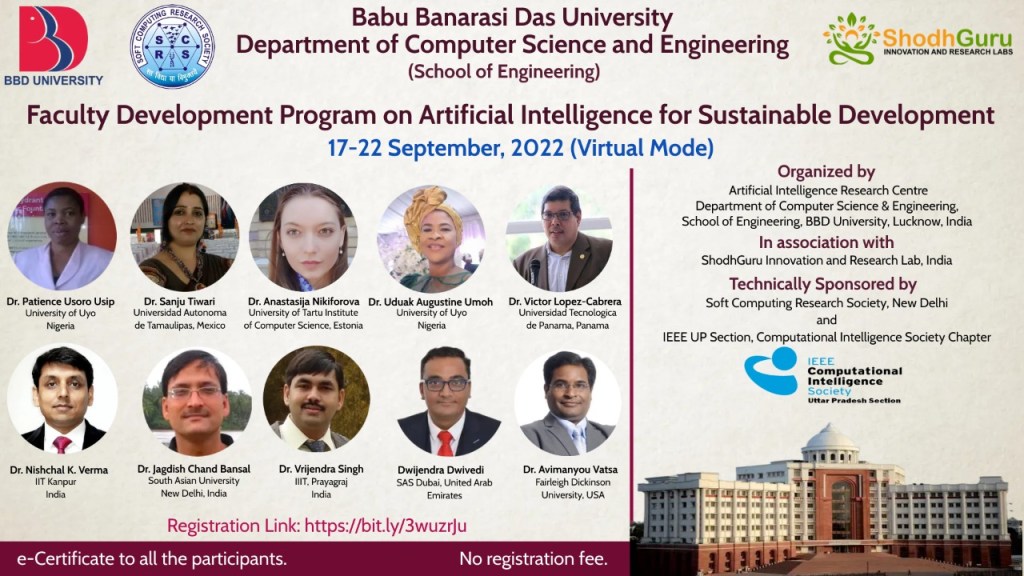
Recently I was honored to contribute to Babu Banarasi Das University (BBDU, Department of Computer Science and Engineering) Development Program «Artificial Intelligence for Sustainable Development» with the talk entitled “Artificial Intelligence for Open Data or Open Data for Artificial Intelligence?”. More precisely, this series of workshops is organized for the industry, i.e. representatives of industry, who want to get an insight on the current advances in various topic-related areas (AI in the sustainability context) from people representing research and academia, which is organized by AI Research Centre, Department of Computer Science & Engineering, Babu Banarasi Das University (India), ShodhGuru Research Labs, Soft Computing Research Society, IEEE UP Section, Computational Intelligence Society Chapter. My session, for instance, was attended by more than 130 attendees, which I consider to be a very good rate!


Regarding my talk, I was delighted to deliver in the last day of this event, being also a guest of honor for this event, when we speak about “Artificial Intelligence for Open Data or Open Data for Artificial Intelligence?” – in short, not OR but rather AND. In other words, AI for Open Data and Open Data for AI, where open data serves as a valuable asset for AI (of course, if a list of prerequisites is fulfilled), while AI defines new prerequisites for open data we should think of.

At the same time, although their combination is considered to play a transformational role in human society, and especially in prominent areas, as we discussed today, this “magic duo” is not always about “unicorns and ice creams“, where the current state-of-the-art suggests that open data my pose also certain risks.

Probably the most expressive example of such, I referred to, is an example, when based on easily obtainable open data on toxic molecules collected over the years, AI has managed to create 40,000 molecular associations potentially usable as biochemical weapons in just 6 hours. And while not all of them are actually usable, and the need to synthesize them still remains, some associations correspond to known chemical weapons with one even more toxic than the VX nerve gas, identified as a weapon of mass destruction by the United Nations.

So here comes a very interesting dilemma between openness as a philosophy and making data open, and threats it may pose, if used by a malevolent actor.

We also briefly touched a topic of risks associated with AI (although both perspectives of so-called cyber-pessimists and cyber-optimists in this regard were considered), open data, and their combination, along with the long list of benefits they can bring, including their contribution to the sustainability being in line with the general idea of this event.
And, of course, we could not ignore the topic of green AI and a strong need to consider FATE principles (Fairness, Accountability, Transparency & Explainability).

All in all, it was a very nice experience and the audience so curious and passionate of topics elaborated on within this 6-days long event with speakers from both continents Asia, Africa, America and Europe (represented by me! 🤓🤓🤓). Exceptional audience with so relevant questions leading to a lively and fruitful discussion being of interest for both participants and speakers. Glad to be part of it and get this experience!

This is just in a few words, although at some point I plan to extend this post with more details and thoughts.