Keynote at the 5th International Conference on Advanced Research Methods and Analytics (CARMA 2023)

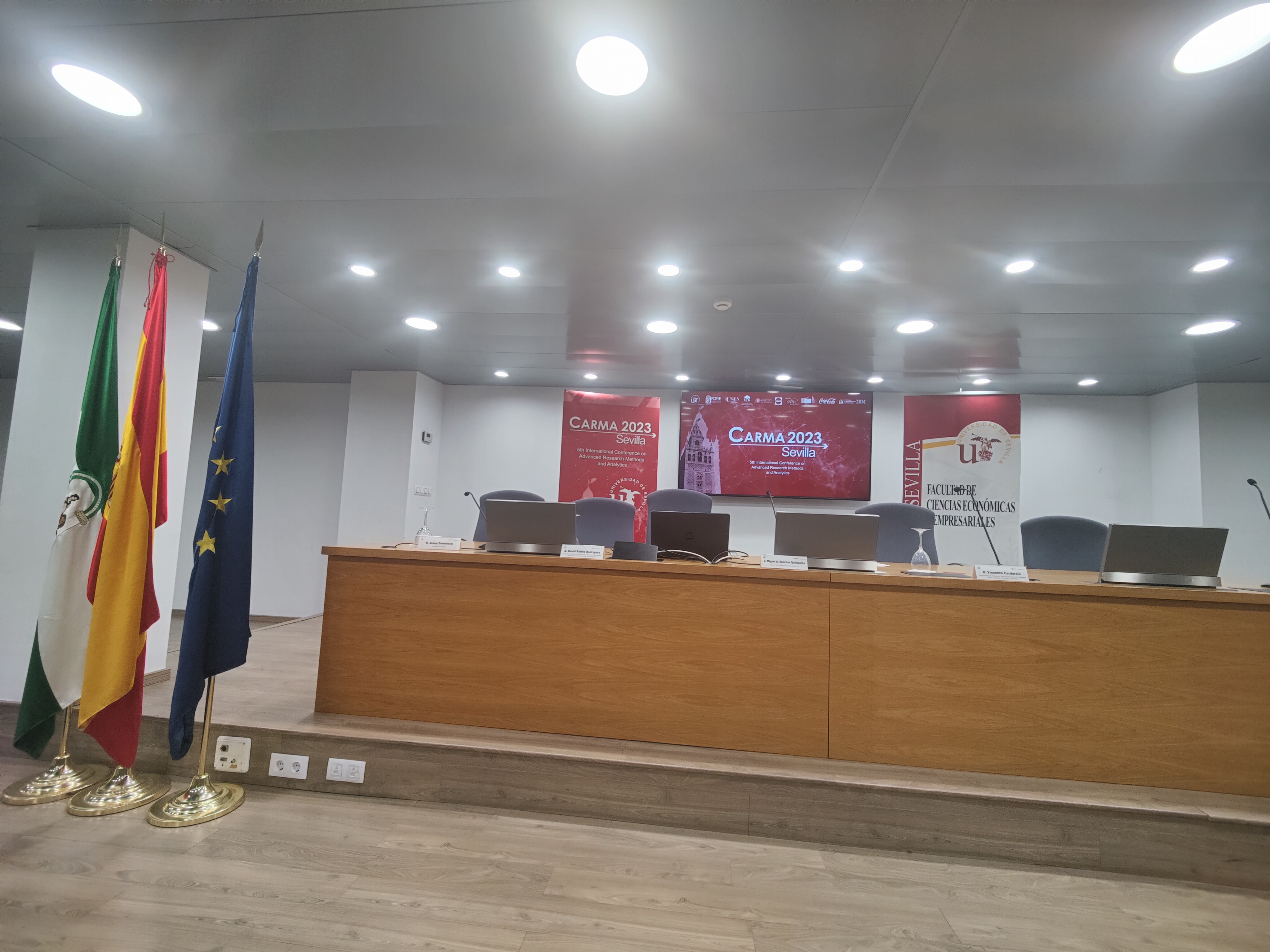
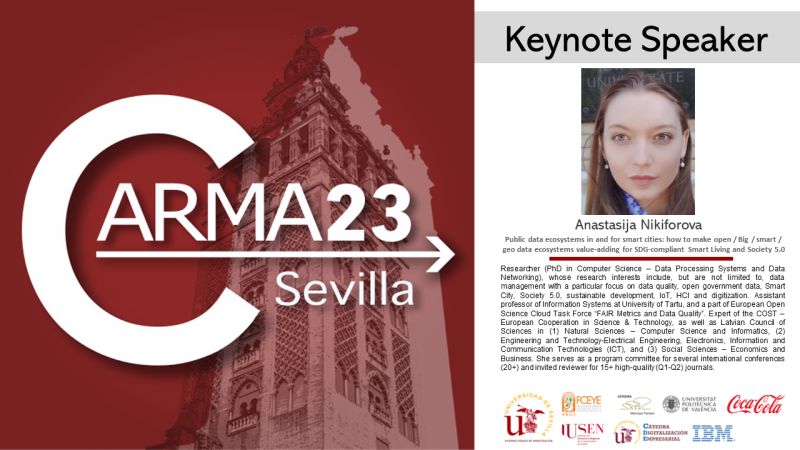
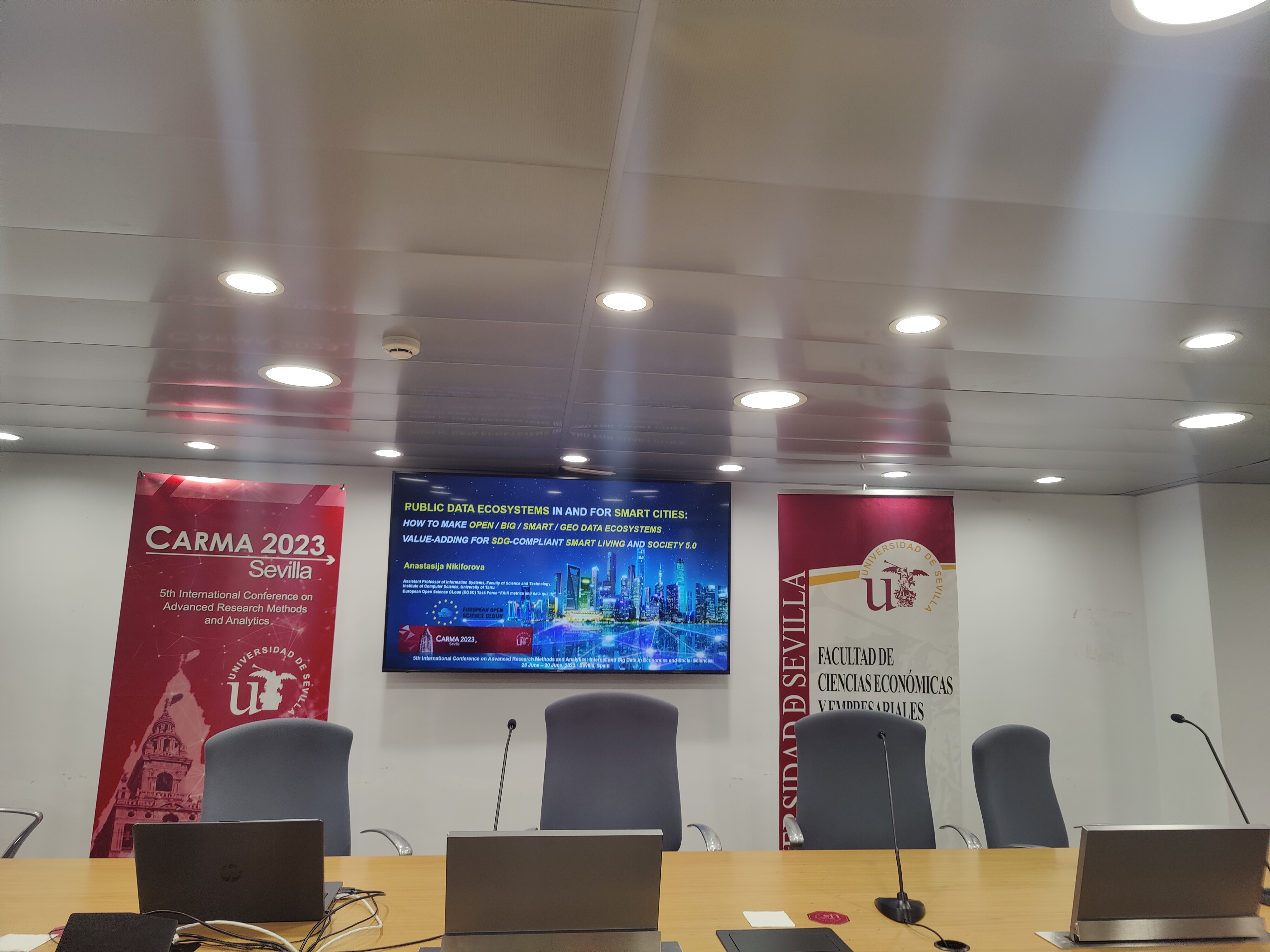
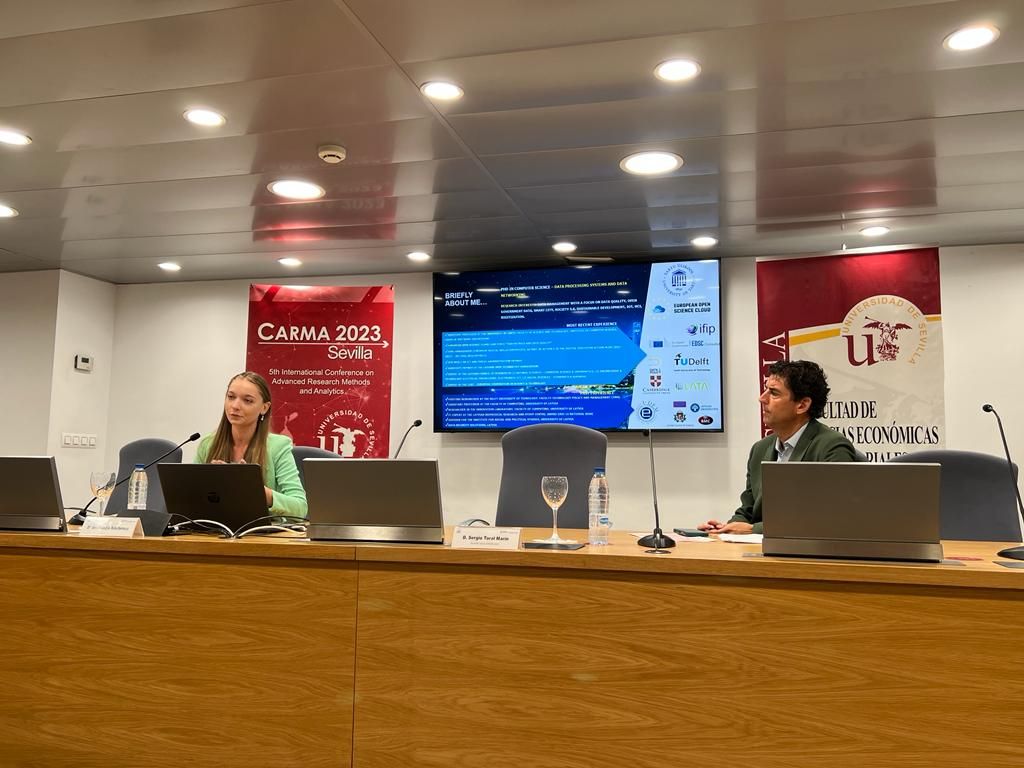
June 28 I had the honor to participate in the opening of CARMA2023 – 5th International Conference on Advanced Research Methods and Analytics “Internet and Big Data in Economics and Social Sciences” delivering my keynote “Public data ecosystems in and for smart cities: how to make open / Big / smart / geo data ecosystems value-adding for SDG-compliant Smart Living and Society 5.0?” in the spectacular city of Sevilla, Spain 🇪🇸 🇪🇸 🇪🇸. What a honor to open the conference, immediately after the inaugural speech by organizers and sponsors, including representatives of Joint Research Center, European Commission (JRC), who even mentioned the topics I covered in my keynote (not limited to them, of course) as those that make this conference an event to attend and to learn from!!!

In this talk, as the title suggests, I:

  • elaborated on the concepts of public /open data (incl. OGD), smart city and SDG and how are they related?
  • introduced the concept of Society 5.0 and how is it related to open data?
  • and finally, and more importantly, public/ open data ecosystem – what it is? what does it consist of?

I then dived into (1) data-related aspects of the public data ecosystem, i.e. what are the data-related prerequisites for a sustainable and resilient data ecosystem? (2) data portal / platforms as entry points and how to make it sufficiently attractive for the target audience? (3) stakeholder engagement – how to involve the target audience? what are the benefits of their involvement? and some more things.

Public data ecosystem part was built around our “Transparency of open data ecosystems in smart cities: Definition and assessment of the maturity of transparency in 22 smart cities“, with some references to other studies such us Transparency-by-design: What is the role of open data portals?, “Timeliness of Open Data in Open Government Data Portals Through Pandemic-related Data: A long data way from the publisher to the user“, “Open government data portal usability: A user-centred usability analysis of 41 open government data portals“, which were previously noticed by the Living Library that recommends studies they see as the “signal in the noise” and the Open Data Institute.

For the data, apart of almost “classical things”, I referred to the topic of “high-value datasets” and dived into a taxonomy we presented in “Towards High-Value Datasets determination for data-driven development: a systematic literature review” (also recommended by the Living Library as the “sound in the noise”), enriched by the results of my earlier study “Towards enrichment of the open government data: a stakeholder-centered determination of High-Value Data sets for Latvia” as well as results of two international workshops we organized.

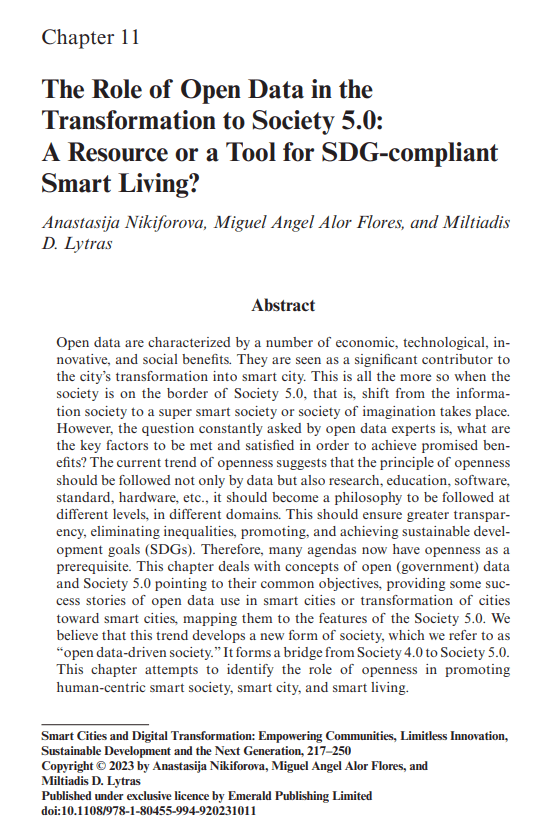
The part on the public / open data, smart city, SDG and Society 5.0 and how they are interrelated was, in turn, based on our Chapter “The Role of Open Data in Transforming the Society to Society 5.0: A Resource or a Tool for SDG-Compliant Smart Living?”, which was called by FIT Academy “a groundbreaking research”.

And for the engagement, it mostly was about the workshops, datathons, hackathons, data competitions, as we as a co-creation and how the co-creation ecosystem occurs, what are the prerequisites for this etc., incl. referencing to “Open data hackathon as a tool for increased engagement of Generation Z: to hack or not to hack?” and “The Role of Open Government Data and Co-creation in Crisis Management: Initial Conceptual Propositions from the COVID-19 Pandemic

CARMA is a forum for researchers and practitioners to exchange ideas and advances on how emerging research methods and sources are applied to different fields of social sciences as well as to discuss current and future challenges with main focus on the topics such as Internet and Big Data sources in economics and social sciences including Social media and public opinion mining, Web scraping, Google Trends and Search Engine data, Geospatial and mobile phone data, Open data and public data, Big Data methods in economics and social sciences such as Sentiment analysis, Internet econometrics, AI and Machine learning applications, Statistical learning, Information quality and assessment, Crowdsourcing, Natural Language processing, Explainability and interpretability, the applications of the above including but not limited to Politics and social media, Sustainability and development, Finance applications, Official statistics, Forecasting and nowcasting, Bibliometrics and sciencetometrics, Social and consumer behaviour, mobility patterns, eWOM and social media marketing, Labor market, Business analytics with social media, Advances in travel, tourism and leisure, Digital management, Marketing Intelligence analytics, Data governance, and Digital transition and global society, which, in turn, expects contributions in relation to Privacy and legal aspects, Electronic Government, Data Economy, Smart Cities, Industry adoption.
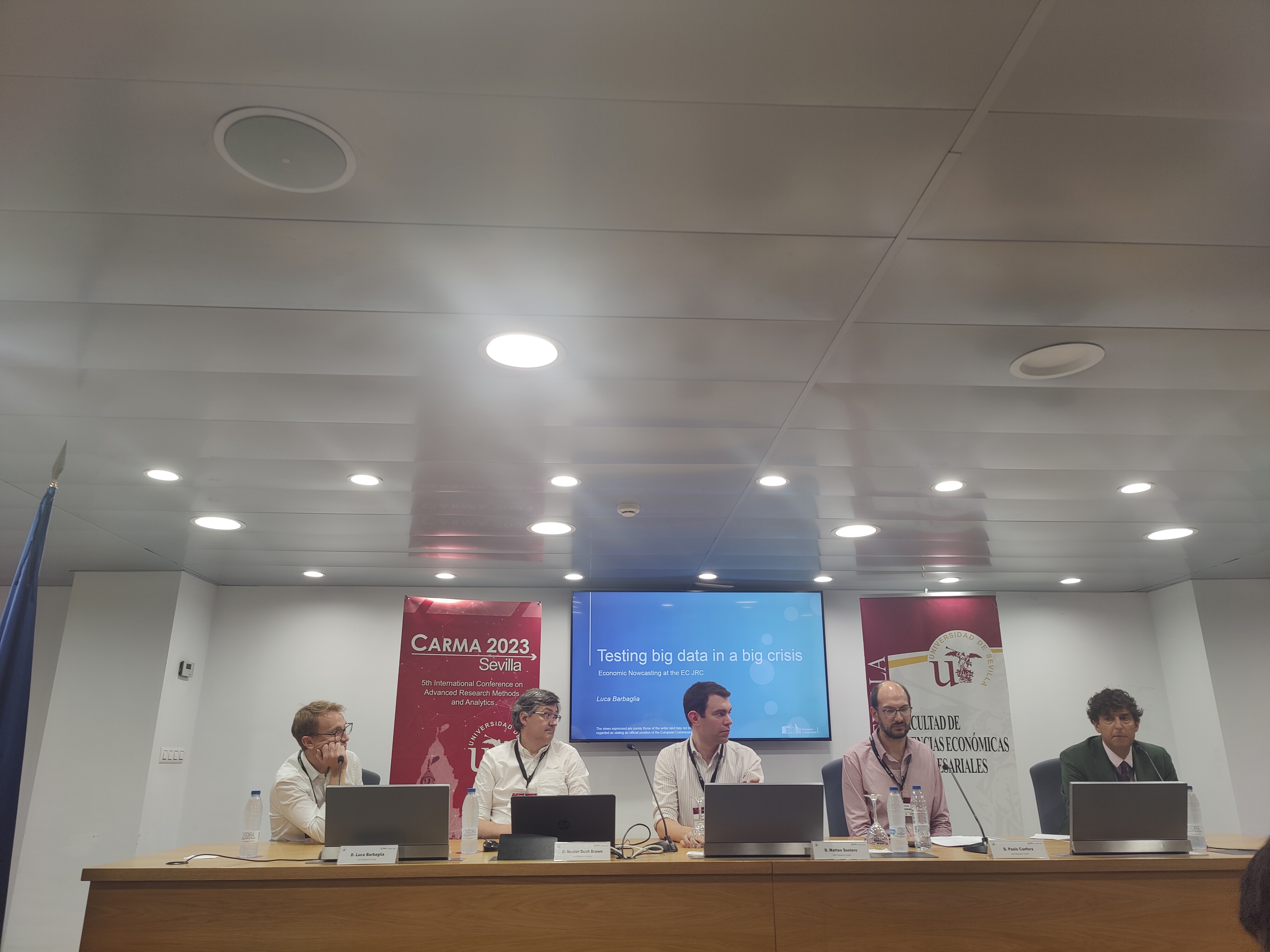
In addition to the regular sessions, poster session and two keynotes, a Special JRC session (EC) took place, during which Luca Barbaglia, Nestor Duch Brown, Matteo Sostero and Paolo Canfora presented projects they work on.

Great thanks goes to organizers and sponsors of CARMA2023 – Universidad de SevillaCátedra Metropol ParasolCátedra Digitalización Empresarial, IBMUniversitat Politècnica de ValènciaJoint Research Center – European Commission and Coca-Cola, who made this event a true success. Enjoyed this experience very much! Excellent venue! Great audience! ¡Muchas gracias!

References:

🔖🔖🔖NEW book chapter: The Role of Open Data in Transforming the Society to Society 5.0: A Resource or a Tool for SDG-Compliant Smart Living?


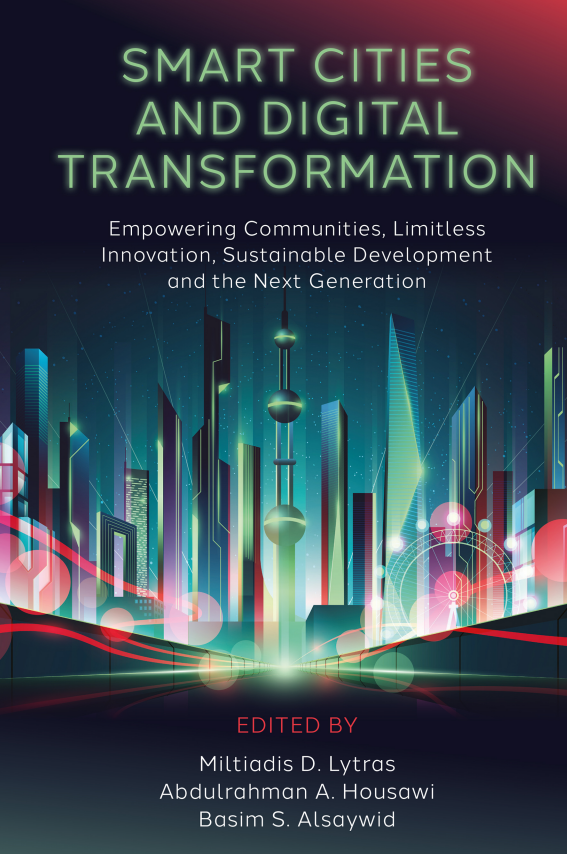
This time I am glad to announce that the Chapter “The Role of Open Data in Transforming the Society to Society 5.0: A Resource or a Tool for SDG-Compliant Smart Living?” (Nikiforova, Alor Flores, Lytras), which is a part of the book “Smart Cities and Digital Transformation: Empowering Communities, Limitless Innovation, Sustainable Development and the Next Generation“, is finally publicly available! This time indeed, finally, since the Chapter was ready and accepted in 2021, if I remember correctly…. so it took some time, but hopefully, it is like a wine 🍷🍷🍷 or cognac 🥃🥃🥃 – becoming better with the time! In fact, a several weeks after it appeared online, it was already included in FIT Academy recommended reading as part of “…five outstanding articles by top experts from around the world” referring to it as “a groundbreaking research” – thanks a lot for this!!!

It was a hard work, especially for the editors of the book, who indeed did a great job in adapting to the situation and taking care of us – authors – as much as possible! Kudos! 

So, almost traditionally a few words about the content or “what is it about?“. Today we all know that open data and open government data are characterized by a number of economic, environmental, technological, innovative, and social benefits. They are seen as a significant contributor to the city’s transformation into smart city. This is all the more so when the society is on the border of Society 5.0, that is, shift from the Information Society (Society 4.0) to a “super smart society” or “society of imagination” (Society 5.0) takes place. However, the question constantly asked by open data experts is, what are the key factors to be met and satisfied in order to achieve promised benefits? The current trend of openness suggests that the principle of openness should be followed not only by data but also research, education, software, standard, hardware, etc., it should become a philosophy to be followed at different levels, in different domains. This should ensure greater transparency, eliminating inequalities, promoting, and achieving sustainable development goals (SDGs). I.e., the openness in both, data, science, technology (software or hardware) is considered as one of the keys for meeting SDGs, while supporting some of them “by default” simultaneously (general principles of open data covered by Open Data Charter applicable to all data to perceive and treat it as open data) and domain, which the open data represents. This was also emphasized at the 76th session of the United Nations General Assembly, highlighting that the openness contributes to the attainment of the United Nations Sustainable Development Goals (SDGs). Therefore, many agendas (sustainable development strategies, action plans) now have openness as a prerequisite. This chapter deals with concepts of open (government) data and Society 5.0 pointing to their interconnection, i.e., common objectives, providing some success stories of open data use in smart cities or transformation of cities toward smart cities, mapping them to the features of the Society 5.0. We believe that this trend develops a new form of society, which we refer to as “open data-driven society.” It forms a bridge from Society 4.0 to Society 5.0. This chapter attempts to identify the role of openness in promoting human-centric smart society, smart city, and smart living, incl. identifying and elaborating on both determinants or prerequisites capable of promoting the development of the Society 5.0 by means of open data and barriers, which stakeholders of different types may face on the way towards sustainable smart city and super smart society

Sounds catchy? Hope so! If yes, read the chapter here or find its preprint here.

Citation

Nikiforova, A., Flores, M.A.A. and Lytras, M.D. (2023), “The Role of Open Data in Transforming the Society to Society 5.0: A Resource or a Tool for SDG-Compliant Smart Living?”, Lytras, M.D., Housawi, A.A. and Alsaywid, B.S. (Ed.) Smart Cities and Digital Transformation: Empowering Communities, Limitless Innovation, Sustainable Development and the Next Generation, Emerald Publishing Limited, Bingley, pp. 219-252. https://doi.org/10.1108/978-1-80455-994-920231011

Guest Lecture for the Federal University of Technology – Paraná (UTFPR) on Open Data Ecosystems in and for sustainable development of data-driven smart cities and Society 5.0

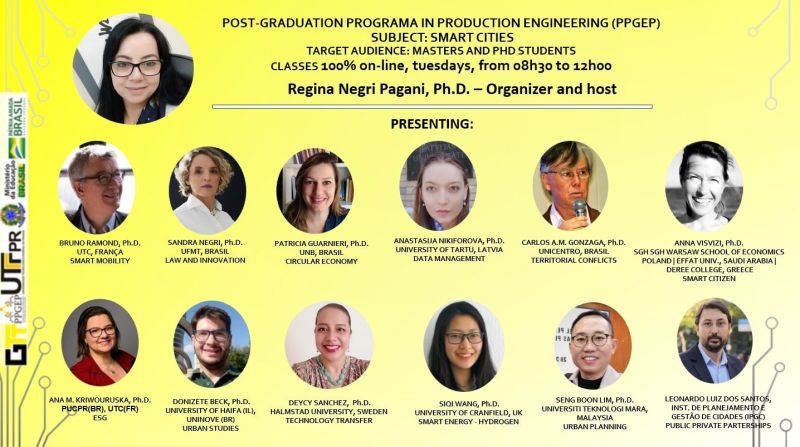
Today (May 16, 2023), I had a pleasure to deliver one more guest lecture for master and doctoral students of the Federal University of Technology – Paraná (Universidade Tecnológica Federal do Paraná (UTFPR)) as part of Smart Cities course delivered by prof. Regina Negri Pagani. This time the topic of my lecture was “Open Data Ecosystems in and for sustainable development of data-driven smart cities and Society 5.0”.

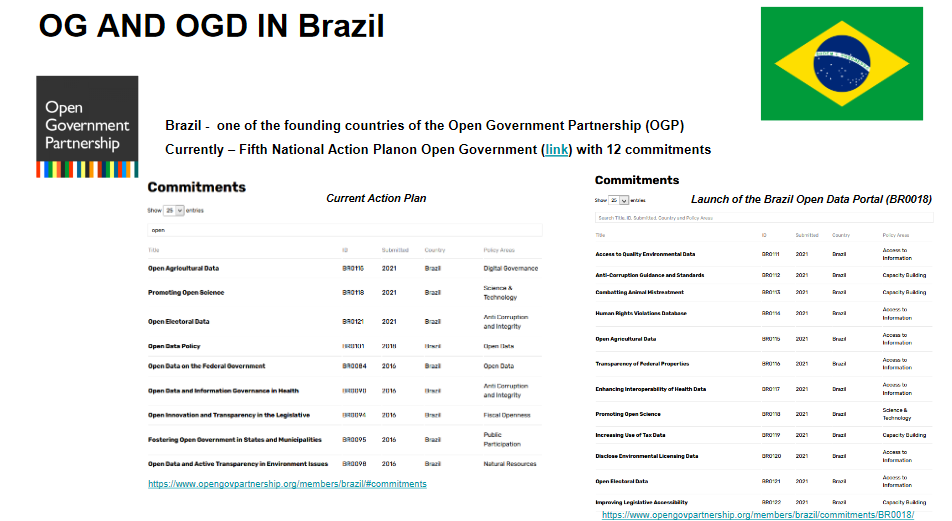
As part of this lecture we talked about open data and open government data (OGD) phenomena and how they evolved over years, what the open data ecosystem is and what constitutes it. I then tried to put it in the context of Brazil reflecting on the current state-of-the-art of open government and OGD in Brazil and its cities referring to both Open Government Partnership (Brazil was one of the the founding countries of OGP), existing OGD, transparency and central bank portals, studies that explored effects of predictors of citizens’ attitudes and intention to use OGD (*by de Souza, Ariel Antônio Conceição, Marcia Juliana d’Angelo, and Raimundo Nonato Lima Filho), factors influencing civil servant’s intention to disclose data (**by Fernando Kleiman, Sylvia J.T. Jansen, Sebastiaan Meijer, Marijn Janssen), as well as the relationship between transparency and open data initiatives in five Brazilian cities (identifying that they are not related for these five cities) (***by Araújo, Ana Carolina, Lucas Reis, and Rafael Cardoso Sampaio)

Then, presenting the concepts of Smart Cities and their “generations”, Sustainable Cities and Sustainable Smart Cities, as well as Society 5.0 (aka Super Smart Society and Society of imagination), I highlighted the overlaps and interweavings of the above and how the development of one contributes to the other, i.e. how interrelated they are and how complex this large ecosystem is.

And then, the remaining part of the lecture was focused around the topic of open data ecosystems starting with the current state of the art around the topic, i.e. different and similar definitions, components, characteristics etc., and finally the study we conducted some time ago with my colleagues from Czech Republic, Poland, Finland, Germany and Latvia, namely “Transparency of open data ecosystems in smart cities: Definition and assessment of the maturity of transparency in 22 smart cities“**** published in . Sustainable Cities and Society (Elsevier), in which we:

  • developed a benchmarking framework to assess the level of transparency of open data ecosystems in smart cities consisting of 36 features by adapting transparency-by-design framework for open data portals (*****by Lněnička and Nikiforova, 2021);
  • investigated smart city data portals’ compliance with the transparency requirements, where the developed framework has been applied to 34 portals representing 22 smart cities, allowing determination of the level of transparency maturity at general, individual, and group levels;
  • developed four-level transparency maturity model to allow the classification of the portal as developing, defined, managed, and integrated, thereby allowing to identify key issues to be transformed into corrective actions to be included into agenda and navigate to the set of more competitive portals;
  • ranked the portals concerned based on their transparency maturity, thereby allowing more successful portals to be identified in order to be used as an example for improving overall or feature-wised performance by providing recommendations for the identification and improvement of current maturity level and specific features;
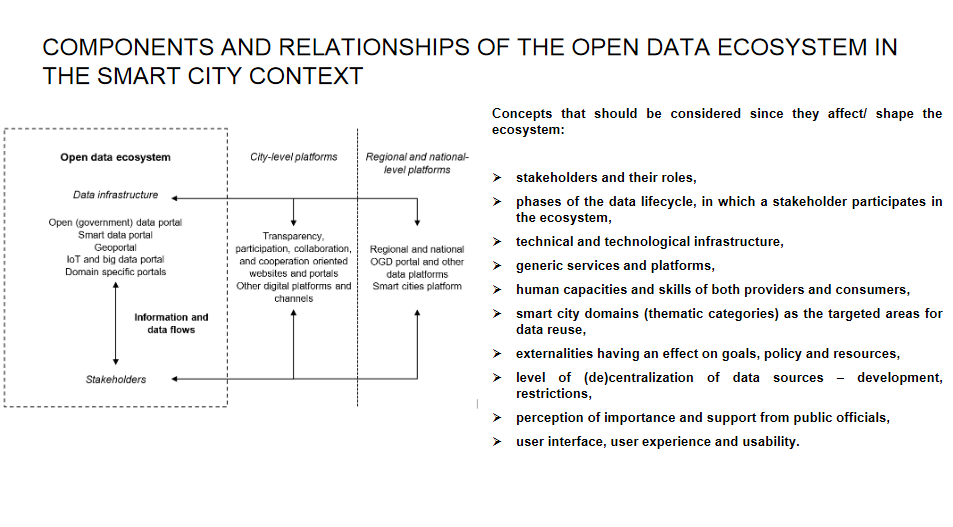
  • conceptualized an open data ecosystem in the context of a smart city (!!!) and determined its key components considering the data-centric and data-driven infrastructure and other components and relationships, using the system theory approach;
  • on the basis of the dominant components of data infrastructure, defined five types of current open data ecosystems (see below) thereby opening up a new horizon for research in the area of sustainable and socially resilient smart cities by means of open data and citizen-centered open smart city governance.

Our definition of open data ecosystem in the smart city context , established based on the knowledge and experience of the experts involved and observations made during the study is:


systematic efforts to integrate ICT and technologies into city life to deliver citizen-centric, better-quality services, solutions to city problems with open data published through the data-centric and data-driven infrastructure.”

However, the concepts that affect/shape the ecosystem are:

  • stakeholders and their roles,
  • phases of the data lifecycle, in which a stakeholder participates in the ecosystem,
  • technical and technological infrastructure,
  • generic services and platforms,
  • human capacities and skills of both providers and consumers,
  • smart city domains (thematic categories) as the targeted areas for data reuse,
  • externalities affecting goals, policy, and resources,
  • level of (de)centralization of data sources – development, restrictions,
  • perception of importance and support from public officials,
  • user interface, user experience, and usability.

As for the types of current open data ecosystems, we identified 5 types that are as follows:

  • type#1: the city’s OGD portal is the center of the data infrastructure, and all OGD, including those labeled as smart, are published and centralized through it. For this type of open data ecosystem, other websites that had previously provided open data or other services to access public sector information have been replaced by the OGD portal. The focus is on datasets, providing features to work with them, reuse them, and make all data requests transparent in one place;
  • type#2: this ecosystem also usually has the OGD portal as the central point, but other portals and platforms publish open data. The smart data portal and online city dashboards focusing on different dimensions such as transport, health, air quality, etc., are important components of this ecosystem;
  • type#3: a decentralized type of ecosystem that includes many components such as OGD portal, smart data portal, geodata portal, etc. However, it increases the ecosystem’s complexity, which is more difficult to manage and less usable for stakeholders
  • type#4: the smart city portal focused on projects and services is usually the center of this ecosystem, but it is not the priority to provide data and appropriate features to reuse them. Most services are developed by public sector organizations, research institutions, or businesses and provided to citizens;
  • type#5: apart from the city’s OGD portal, there are additional transparency-, participation-, collaboration-, and cooperation-oriented websites and portals to support the formation and improvement of relations between stakeholders. This type of ecosystem is focused on processes to improve open data reuse.

Sounds interesting? Read the article here and see other recommended articles below! 🙂

This was then wrapped up by emphasizing key overseen topics that are paid to little attention to, although being crucial for a sustainable public data ecosystem.

And I can only hope that this lecture was just a little bit as interesting as my dear colleague prof. Regina Negri Pagani characterized it! It is always pleasure to hear her feedback, as her comments are so gentle and inspiring! And there is nothing better than hear such wonderful and positive feedback and an immediate invitation for the next editions of this course, which will be my pleasure – this was the 2nd edition of the course, when I served as a guest lecture and will be definitely glad to make this yet another good tradition!

References:

*de Souza, Ariel Antônio Conceição, Marcia Juliana d’Angelo, and Raimundo Nonato Lima Filho. “Effects of Predictors of Citizens’ Attitudes and Intention to Use Open Government Data and Government 2.0.” Government Information Quarterly 39.2 (2022): 101663.

**Kleiman, F., Jansen, S. J., Meijer, S., & Janssen, M. (2023). Understanding civil servants’ intentions to open data: factors influencing behavior to disclose data. Information Technology & People.

***Araújo, Ana Carolina, Lucas Reis, and Rafael Cardoso Sampaio. “Do transparency and open data walk together? An analysis of initiatives in five Brazilian capitals.” Media Studies 7.14 (2016).

****Lnenicka, M., Nikiforova, A., Luterek, M., Azeroual, O., Ukpabi, D., Valtenbergs, V., & Machova, R. (2022). Transparency of open data ecosystems in smart cities: Definition and assessment of the maturity of transparency in 22 smart cities. Sustainable Cities and Society, 82, 103906.

*****Lnenicka, M., & Nikiforova, A. (2021). Transparency-by-design: What is the role of open data portals?. Telematics and Informatics, 61, 101605.

Some other studies you might be interested:

Rii Forum 2023 “Innovation 5.0: Navigating shocks and crises in uncertain times Technology-Business-Society” & a plenary debate “Advances in ICT & the Society”

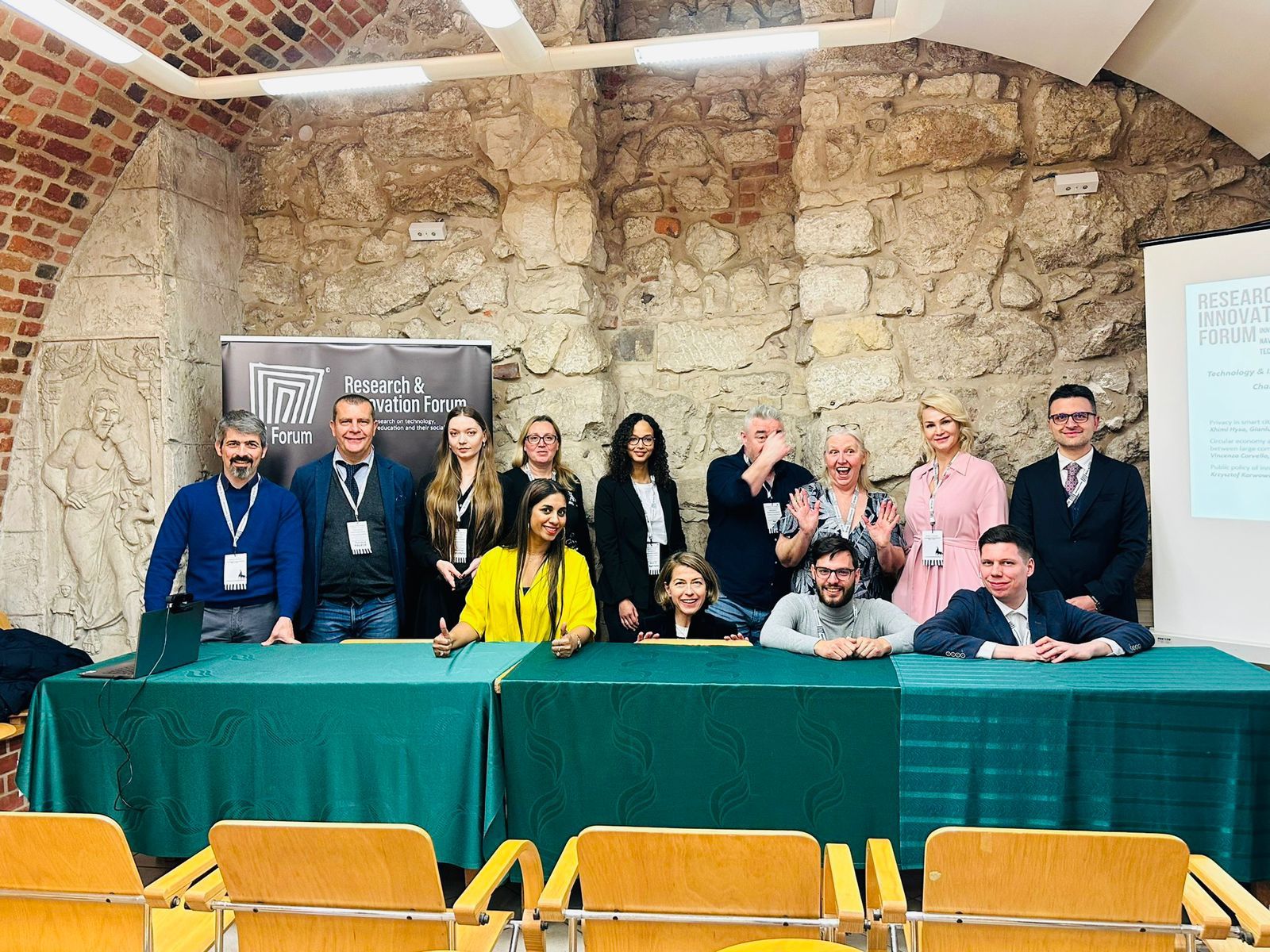
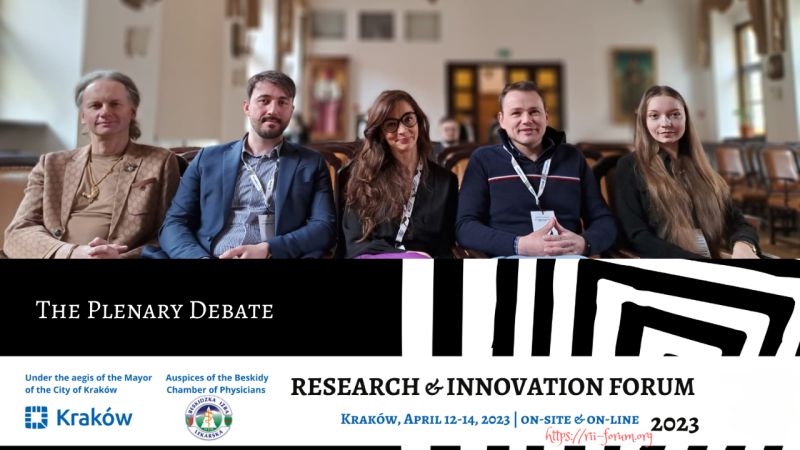
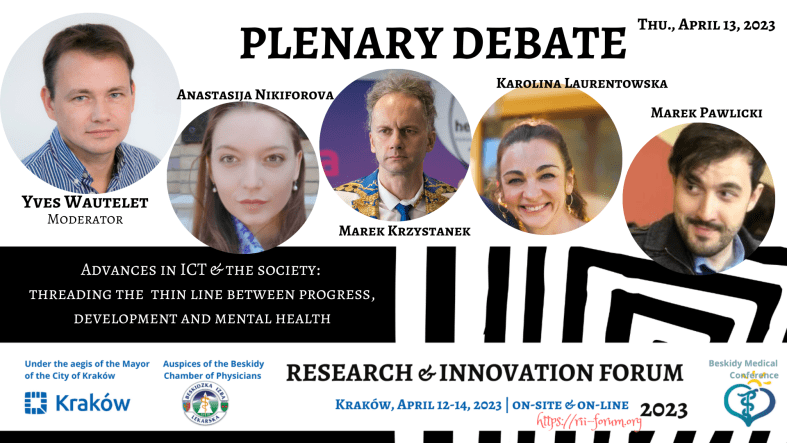
Last week, I had an unforgettable experience at the Research and Innovation Forum (RiiForum) on which I posted previously in Krakow, Poland, serving as plenary speaker and session chair. It was another great experience to have an absolutely amazing plenary session titled “Advances in ICT & the Society: threading the thin line between progress, development and mental health”, where we – Prof. Dr. Yves Wautelet, Prof. Dr. Marek Krzystanek, Karolina Laurentowska & Prof. Marek Pawlicki – discussed disruptive technologies in our professional lives in the past years, how they affected us and our colleagues, how they affect(ed) society and its specific groups, including their mental health, and general perception of technology, i.e. an enemy of humanity, or rather a friend and support, and how to make sure the second take place. And from this we have developed a discussion around AI, chatGPT, Metaverse, blockchain, even slightly touching on quantum computing. Of course, all this was placed in the context of democracy and freedoms / liberties. All in all, we approached the topic of governance and policy-making, which is too often reactive rather than proactive, which, in turn, leads to many negative consequences, as well as elaborated on the engineering practices. 

To sum up – emerging and disruptive technologies, Blockchain, AI, Metaverse, digital competencies, education, liberty, democracy, openness, engagement, metaverse, inclusivity, Industry 5.0, Society 5.0 – and it is not a list of buzzwords, but a list of topics we have managed to cover both plenary speakers and the audience and continued to talk about them during the whole conference. Rich enough, isn’t it?

And then the day did not end, continuing with several super insightful sessions, where, of course, one I enjoyed most is the one that I chaired. Three qualitative talks with further rich discussion after each thanks to an excellent audience, despite the fact this was the last session of the day (before the dinner), namely:

  • Privacy in smart cities using VOSviewer: a bibliometric analysis by Xhimi Hysa, Gianluca Maria Guazzo, Vilma Cekani, Pierangelo Rosati
  • Public policy of innovation in China by Krzysztof Karwowski, Anna Visvizi
  • How Human-Centric solutions and Artificial Intelligence meet smart cities in Industry 5.0 by Tamai Ramirez, Sandra Amador, Antonio Macia-Lillo, Higinio Mora
     

And the last, but not the least, Krakow surprised me lot (in a positive sense, of course) – it was my first time in Poland, and I am absolutely glad that it was on such a beautiful city as Krakow – the place with the rich history and culture! Thank you dear RiiForum2023 organizers – Anna Visvizi, Vincenzo Corvello, ORLANDO TROISI, Mara Grimaldi, Giovanni Baldi and everyone who was involved – it is always a pleasure to be a part of this community!


Rii Forum 2023 “Innovation 5.0: Navigating shocks and crises in uncertain times Technology-Business-Society” & a plenary debate “Advances in ICT & the Society”

This April the next edition of the Research and Innovation Forum (Rii Forum) on which I posted previously will take place. For those, who are not familiar with Rii Forum yet, it is an annual conference that brings together researchers, academics, and practitioners in conceptually sound inter- and multi-disciplinary, empirically driven debate on key issues influencing the dynamics of social interaction today. Such a wide scope makes it a great event for those who do not want to be limited to a particular area or research question and want to be aware of everything that happens in today’s dynamic and multidisciplinary world. This, in turn, allows you not only to see another perspectives and topics, but also reconsider your topic, revealing something new, i.e. taking a look on it from a different angle, which is exceptionally valuable!

Technology, innovation, and education, as well as issues and topics located at their intersection, define the key dimensions of all discussions held during the Rii Forum. In continuously fragile international and domestic contexts, characterized by shocks, crises, and uncertainty, the Rii Forum 2023 seeks to address the multifaceted question of how to navigate these shocks, crises and uncertainty and deliver value to our society. Thus, the topic of Rii Forum 2023 is “Innovation 5.0.: Navigating shocks and crises in uncertain times Technology – Business – Society” with seven tracks:

  • TRACK 1: Education in times of shocks, crises and uncertainty
  • TRACK 2: Smart cities and communities
  • TRACK 3: Big data, business and society: Managing the distributed risks and opportunities
  • TRACK 4: Management: Rethinking management in times of profound change
  • TRACK 5: Innovation, entrepreneurship, and innovation management in the era of Industry 5.0.
  • TRACK 6: ICT and the medicine and healthcare cluster
  • TRACK 7: Data-driven approaches & human resource management in the era of digitalization

As part of Rii Forum 2023 a plenary debate “Advances in ICT & the Society: threading the thin line between progress, development and mental health” will take place, where I was honored to be invited as one of four plenary speakers, particularly considering that according tot he invitation, the organizers see me as the person whose “expertise and your contribution to the academic debate make you one of the trendsetters in current debate on open data and data quality management”, as well as leading voice and influencer. The other three panel discussants are Prof. Dr. Marek Krzystanek, Karolina Laurentowska & Prof. Marek Pawlicki. Hope this will be an interactive, fruitful and productive discussion with further involvement of the audience!

Read more here and stay tuned for more information and reflections on the conference, in case you will not be able to attend it.