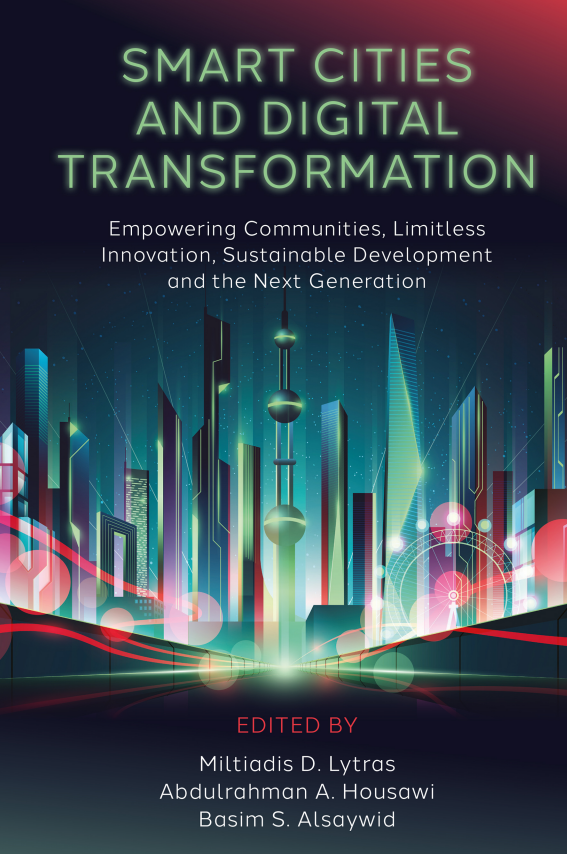
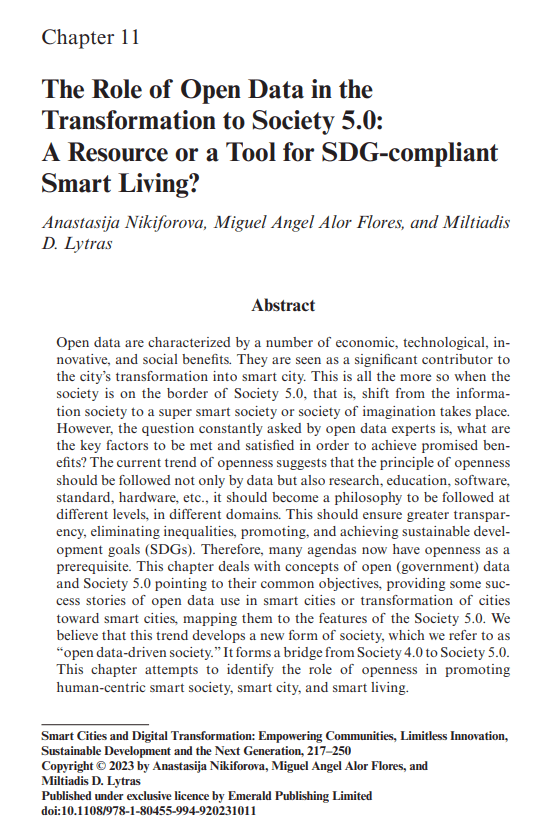
This time I am glad to announce that the Chapter “The Role of Open Data in Transforming the Society to Society 5.0: A Resource or a Tool for SDG-Compliant Smart Living?” (Nikiforova, Alor Flores, Lytras), which is a part of the book “Smart Cities and Digital Transformation: Empowering Communities, Limitless Innovation, Sustainable Development and the Next Generation“, is finally publicly available! This time indeed, finally, since the Chapter was ready and accepted in 2021, if I remember correctly…. so it took some time, but hopefully, it is like a wine 🍷🍷🍷 or cognac 🥃🥃🥃 – becoming better with the time! In fact, a several weeks after it appeared online, it was already included in FIT Academy recommended reading as part of “…five outstanding articles by top experts from around the world” referring to it as “a groundbreaking research” – thanks a lot for this!!!
It was a hard work, especially for the editors of the book, who indeed did a great job in adapting to the situation and taking care of us – authors – as much as possible! Kudos!
So, almost traditionally a few words about the content or “what is it about?“. Today we all know that open data and open government data are characterized by a number of economic, environmental, technological, innovative, and social benefits. They are seen as a significant contributor to the city’s transformation into smart city. This is all the more so when the society is on the border of Society 5.0, that is, shift from the Information Society (Society 4.0) to a “super smart society” or “society of imagination” (Society 5.0) takes place. However, the question constantly asked by open data experts is, what are the key factors to be met and satisfied in order to achieve promised benefits? The current trend of openness suggests that the principle of openness should be followed not only by data but also research, education, software, standard, hardware, etc., it should become a philosophy to be followed at different levels, in different domains. This should ensure greater transparency, eliminating inequalities, promoting, and achieving sustainable development goals (SDGs). I.e., the openness in both, data, science, technology (software or hardware) is considered as one of the keys for meeting SDGs, while supporting some of them “by default” simultaneously (general principles of open data covered by Open Data Charter applicable to all data to perceive and treat it as open data) and domain, which the open data represents. This was also emphasized at the 76th session of the United Nations General Assembly, highlighting that the openness contributes to the attainment of the United Nations Sustainable Development Goals (SDGs). Therefore, many agendas (sustainable development strategies, action plans) now have openness as a prerequisite. This chapter deals with concepts of open (government) data and Society 5.0 pointing to their interconnection, i.e., common objectives, providing some success stories of open data use in smart cities or transformation of cities toward smart cities, mapping them to the features of the Society 5.0. We believe that this trend develops a new form of society, which we refer to as “open data-driven society.” It forms a bridge from Society 4.0 to Society 5.0. This chapter attempts to identify the role of openness in promoting human-centric smart society, smart city, and smart living, incl. identifying and elaborating on both determinants or prerequisites capable of promoting the development of the Society 5.0 by means of open data and barriers, which stakeholders of different types may face on the way towards sustainable smart city and super smart society
Sounds catchy? Hope so! If yes, read the chapter here or find its preprint here.
Citation
Nikiforova, A., Flores, M.A.A. and Lytras, M.D. (2023), “The Role of Open Data in Transforming the Society to Society 5.0: A Resource or a Tool for SDG-Compliant Smart Living?”, Lytras, M.D., Housawi, A.A. and Alsaywid, B.S. (Ed.) Smart Cities and Digital Transformation: Empowering Communities, Limitless Innovation, Sustainable Development and the Next Generation, Emerald Publishing Limited, Bingley, pp. 219-252. https://doi.org/10.1108/978-1-80455-994-920231011
 Anastasija Nikiforova, PhD