DGO 2025 “Sustainable Public and Open Data Ecosystems for inclusive and innovative government” track

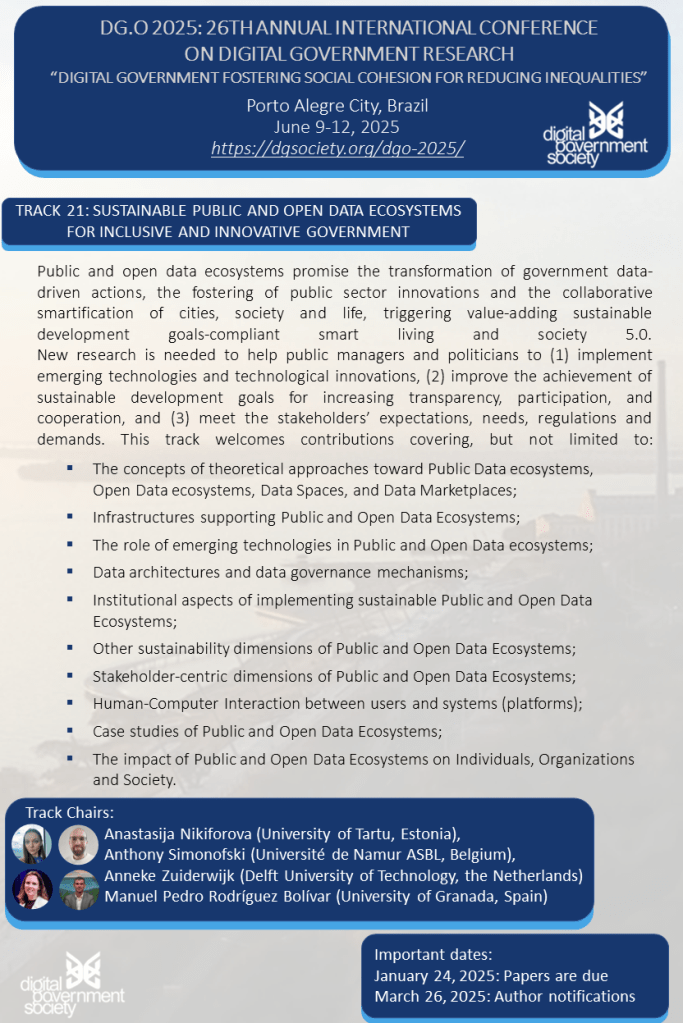
26th Annual International Conference on Digital Government Research (dg.o2025) is coming with continuation of the track we launched the last time – “Sustainable Public and Open Data Ecosystems for inclusive and innovative government” track (chairs: Anastasija Nikiforova (University of Tartu, Estonia), Anthony Simonofski (Université de Namur ASBL, Belgium), Anneke Zuiderwijk (Delft University of Technology, the Netherlands) & Manuel Pedro Rodríguez Bolívar (University of Granada, Spain)).

Briefly about the track… Today, the goal of an actor-centric public data ecosystem that would be sufficiently sustainable, resilient and fair, is defined as an approach capable of representing and keeping in balance the data interests of all actors[1], to bring expected value (both economic, social and environment) became central for public data ecosystems and other types of data infrastructures and data spaces[2] that are based on the concept of openness and data sharing among stakeholders. Public data and open (government) data ecosystems are seen as a political and socio-economic phenomenon that promise to benefit the economy, and increase transparency, efficiency, and quality of public services, including the transformation of government data-driven actions, stimulate public sector innovations in various areas of public life and promote civic engagement[3][4][5]. Having collaborative governance models in place is one of the prerequisites for a resilient and value-adding ecosystem, of which stakeholders are an inevitable element, making it necessary to ensure those ecosystems are stakeholder-oriented. These models are expected to support stakeholders/actors, who, however, may have different characteristics (incl. (open) data literacy and digital literacy), needs / demands and expectations (public sector, private sector, business, citizen) for public value creation and co-creation. Understanding, designing, and maintaining such an ecosystem is further complicated by the fact that both data, service and process quality must be ensured and kept maintained with a limited understanding of how the above are expected to be ensured even alone.

Recent research found that concepts affecting and shaping the ecosystem are: 1) stakeholders / actors and their roles, 2) phases of the data lifecycle, in which a stakeholder participates in the ecosystem, 3) technical and technological infrastructure, 4) generic services and platforms, 5) human capacities and skills of both providers and consumers, 6) smart city domains (thematic categories) as the targeted areas for data reuse, 7) externalities affecting goals, policy, and resources, 8) level of (de)centralization of data sources – development, restrictions, 9) perception of importance and support from public officials, and 10) user interface, user experience, and usability[6]. Moreover, these ecosystems same as its components are (co-)evolving over time[7] due to both internal and external factors. The latter – external factors – include technological developments. As such, the rapid development of emerging technologies such as big data, artificial intelligence (AI) is seen as a new trigger for public and open data development (AI for open data and open data for AI), machine learning (ML), federated learning (FL), internet of things (IoT), metaverse etc. provides new opportunities to improve these ecosystems in a disrupt way to be useful for collaborative governance models. Also, the link between Open Data Ecosystems and sustainable development goals (SDG) seems to be more relevant nowadays in their way to build more democratic cities based on government transparency, citizen participation, and citizen cooperation. Finally, higher expectations, needs and demands of businesses and citizens, derived from the implementation of B2G, C2G models, that influence and shape the design and development of these data environments, as well as expected to be affected, e.g., B2G in relation to which European Commission is taking regulatory action and is preparing the Data Act to set the rules and conditions, thereby changing the current voluntary model to a more mandatory data sharing. Current research suggests that these topics are of great importance to governments, as well as businesses and citizens, whose efforts should complement each other in order to enable effective data reuse and value co-creation

As such, as public and open data ecosystems promise the transformation of government data-driven actions, the fostering of public sector innovations and the collaborative smartification of cities, society and life, triggering value-adding sustainable development goals-compliant smart living and Society 5.0. New research is needed to help public managers and politicians for (1) implementing emerging technologies and technological innovations, (2) improving the achievement of sustainable development goals for increasing transparency, participation, and cooperation, and (3) meeting the stakeholders’ expectations, needs, regulations and demands.

As such, this track welcomes contributions covering, but not limited to:

  • The concepts of theoretical approaches toward Public Data ecosystems, Open Data ecosystems, Data Spaces, and Data Marketplaces;
  • Infrastructures supporting Public and Open Data Ecosystems;
  • The role of emerging technologies in Public and Open Data ecosystems (incl. but not limited to AI, Generative AI, LLM, NLP, cloud computing, green computing, Metaverse  etc.);
  • Data architectures and data governance mechanisms;
  • Institutional aspects of implementing sustainable Public and Open Data Ecosystems;
  • Other sustainability dimensions of Public and Open Data Ecosystems;
  • Stakeholder-centric dimensions of Public and Open Data Ecosystems;
  • Human-Computer Interaction between users and systems (platforms);
  • Case studies of Public and Open Data Ecosystems, incl. but not limited to Local Government Level Data Ecosystems, e.g., Smart Cities Data Ecosystems;
  • The impact of Public and Open Data Ecosystems on Individuals, Organizations and Society.
The track welcomes both contributions covering the current state-of-the-art of public data ecosystems (what components constitute them, what are the relationships between these components, what makes an ecosystem resilient and sustainable), incl. individual case studies reflecting best or bad practices, as well as those addressing how these ecosystems can be transformed into more sustainable ecosystems that will “fuel” or “smartify” society (Information Society aka Society 4.0 to Super Smart Society aka Society 5.0 transition), cities and various areas of life.

The track is very aligned with the conference theme of DGO 2025, namely: Digital government fostering social cohesion for reducing inequalities. As mentioned in the theme description, “It focuses on strong social bonds in civic society, with responsive democracy and impartial law enforcement aiming at collaboratively addressing latent social conflicts. It involves building shared values in communities facing common challenges in an attempt to reduce disparities by increasing citizens’ feeling of belonging to a community and their engagement.” Public and open data ecosystems can be considered as environments that contribute to the above. Open data is aimed at reducing inequalities, open platforms constitute environments where data providers and data users find each other and collaborate and co-create to develop services and products useful for society, i.e., addressing their needs and tackling challenges society faces. While digital technologies enable the development of public and open data ecosystems, the adoption of such ecosystems has been fragmented. For instance, Van Loenen et al. (2021)[8] found that open data ecosystems “often do not balance open data supply and demand, exclude specific user groups and domains, are linear, and lack skill-training” (p. 2), which reduces their value-generation and sustainability.

Is your research related to any of the above topics? Then do not wait – submit!

🗓️🗓️🗓️Important Dates:

January 24, 2025: Papers, workshops, tutorials, and panels are due
March 26, 2025: Author notifications (papers, workshops, tutorials, panels)


[1] Calzati, S., & van Loenen, B. (2023). A fourth way to the digital transformation: The data republic as a fair data ecosystem. Data & Policy, 5, e21.

[2] Lnenicka, M., Nikiforova, A., Luterek, M., Milic, P., Rudmark, D., Neumaier, S., … & Rodríguez Bolívar, M. P. (2023). Understanding the development of public data ecosystems: from a conceptual model to a six-generation model of the evolution of public data ecosystems. Available at SSRN 4831881.

[3] Nikiforova, A., Rizun, N., Ciesielska, M., Alexopoulos, C., Miletič, A.(2023). Towards High-Value Datasets determination for data-driven development: a systematic literature review. In: Lindgren,I., Csáki, C., Kalampokis, E., Janssen, M.,, Viale Pereira,G.,Virkar, S., Tambouris, E., Zuiderwijk, A.Electronic Government. EGOV 2023. Lecture Notes in Computer Science. Springer, Cham

[4] Kassen, M. (2020). Open data and its peers: understanding promising harbingers from Nordic Europe. Aslib Journal of Information Management, 72(5), 765-785.

[5] Santos-Hermosa, G., Quarati, A., Loría-Soriano, E., & Raffaghelli, J. E. (2023). Why Does Open Data Get Underused? A Focus on the Role of (Open) Data Literacy. In Data Cultures in Higher Education: Emergent Practices and the Challenge Ahead (pp. 145-177). Cham: Springer International Publishing.

[6] Lnenicka, M., Nikiforova, A., Luterek, M., Azeroual, O., Ukpabi, D., Valtenbergs, V., & Machova, R. (2022). Transparency of open data ecosystems in smart cities: Definition and assessment of the maturity of transparency in 22 smart cities. Sustainable Cities and Society, 82, 103906.

[7] Nikiforova, A., Lnenicka, M., Milić, P., Luterek, M., & Rodríguez Bolívar, M. P. (2024, August). From the evolution of public data ecosystems to the evolving horizons of the forward-looking intelligent public data ecosystem empowered by emerging technologies. In International Conference on Electronic Government (pp. 402-418). Cham: Springer Nature Switzerland.

[8] Loenen, B. van, Zuiderwijk, A., Vancauwenberghe, G., Lopez-Pellicer, F. J., Mulder, I., Alexopoulos, C., … & Flores, C. C. (2021). Towards value-creating and sustainable open data ecosystems: A comparative case study and a research agenda. JeDEM-eJournal of eDemocracy and Open Government, 13(2), 1-27.

The United Nations University EGOV’s repository platform and five of my articles it recommends 📖📚🧐

Recently, the United Nations University announced the launch of the United Nations University EGOV’s repository platform – a centralized hub of specialized repositories tackling global challenges, which is dedicated to two topics – EGOV for Emergencies that provides a set of content on innovations in digital governance for emergency response, and Data for EGOV is the repository intended “to supports policymakers, decision-makers, researchers, and the community interested in digitally transforming the public sector through emerging technologies and data. The repository combines diverse academic documents, use cases, rankings, best practices, standards, benchmarking, portals, datasets, and pilot projects to support open data, quality and purpose of open data, application of data techniques analytics in the public sector, and making cities smarter. This repository results from the “INOV.EGOV-Digital Governance Innovation for Inclusive, Resilient and Sustainable Societies” project on the role of open data and data science technologies in the digital transformation of State and Public Administration institutions“. The latter, recommends 286 reading materials (reports, articles, standards etc.) I find to be very relevant for the above described, and highly recommend to surf through. However, what made me specially happy while browsing this collection, is the fact that five of these reading materials are articles (co-)authored by me. Therefore, considering that not always I keep track of what I conducted in past, let me use this opportunity to reflect on those studies, in case you had not came across them previously, as well as to refresh mine memories (some of them dated back to times, when I worked on my PhD thesis).

By the way, every article is accompanied with tags that enrich keywords by which that article was described by authors, with a particular attention being paid to main topics, incl. “data analytics”, “smart city”, “open data”, “sustainability” etc., where for “the latter”sustainability”, tagging based on the compliance with a specific Sustainable Development Goal (SDG) takes place, thereby allowing to filter out relevant articles by a specific SDG or find out what SDG does your article contributes, where although while conducting research I kept in mind some of those I find my research more suited with, for one of them (the last one in the list) I was pretty surprised to see that it is very SDGs-compliant, being compliant with 11 SDGs (SDG-2, SDG-3, SDG-6, SDG-7, SDG-9, SDG-11, SDG-13, SDG-14, SDG-15).

So, back to those studies that the United Nations University recommends…

A multi-perspective knowledge-driven approach for analysis of the demand side of the Open Government Data portal, which proposes a multi-perspective approach where an OGD portal is analyzed from (1) citizens’ perspective, (2) users’ perspective, (3) experts’ perspective, and (4) state of the art. By considering these perspectives, we can define how to improve the portal in question by focusing on its demand side. In view of the complexity of the analysis, we look for ways to simplify it by reusing data and knowledge on the subject, thereby proposing a knowledge-driven analysis that supports the idea under OGD – their reuse. Latvian open data portal is used as an example demonstrating how this analysis should be carried out, validating the proposed approach at the same time. We are aiming to find (1) the level of the citizens’ awareness of the portal existence and its quality by means of the simple survey, (2) the key challenges that may negatively affect users’ experience identified in the course of the usability analysis carried out by both users and experts, (3) combine these results with those already known from the external sources. These data serve as an input, while the output is the assessment of the current situation allowing defining corrective actions. Since the debates on the Latvian OGD portal serving as the use-case appear more frequently, this study also brings significant benefit at national level.

Transparency of open data ecosystems in smart cities: Definition and assessment of the maturity of transparency in 22 smart cities, which focuses on the issue of the transparency maturity of open data ecosystems seen as the key for the development and maintenance of sustainable, citizen-centered, and socially resilient smart cities. This study inspects smart cities’ data portals and assesses their compliance with transparency requirements for open (government) data. The expert assessment of 34 portals representing 22 smart cities, with 36 features, allowed us to rank them and determine their level of transparency maturity according to four predefined levels of maturity – developing, defined, managed, and integrated. In addition, recommendations for identifying and improving the current maturity level and specific features have been provided. An open data ecosystem in the smart city context has been conceptualized, and its key components were determined. Our definition considers the components of the data-centric and data-driven infrastructure using the systems theory approach. We have defined five predominant types of current open data ecosystems based on prevailing data infrastructure components. The results of this study should contribute to the improvement of current data ecosystems and build sustainable, transparent, citizen-centered, and socially resilient open data-driven smart cities.

Smarter open government data for society 5.0: Are your open data smart enough? in which, considering the fact that the open (government) data initiative as well as users’ intent for open (government) data are changing continuously and today, in line with IoT and smart city trends, real-time data and sensor-generated data have higher interest for users that are considered to be one of the crucial drivers for the sustainable economy, and might have an impact on ICT innovation and become a creativity bridge in developing a new ecosystem in Industry 4.0 and Society 5.0, the paper examines 51 OGD portals on the presence of the relevant data and their suitability for further reuse, by analyzing their machine-readability, currency or frequency of updates, the ability to submit request/comment/complaint/suggestion and their visibility to other users, and the ability to assess the value of these data assessed by others, i.e., rating, reuse, comments, etc., which is usually considered to be a very time-consuming and complex task, and therefore rarely conducted. The analysis leads to the conclusion that although many OGD portals and data publishers are working hard to make open data a useful tool moving towards Industry 4.0 and Society 5.0, many portals do not even respect the principles of open data, such as machine-readability. Moreover, according to the lists of most competitive countries by topic, there are no leaders who provide their users with excellent data and service, therefore there is room for improvements for all portals. The paper shows that open data, particularly those published and updated in time, are provided in machine-readable format and support to their users, attract audience interest and are used to develop solutions that benefit the entire society (the case in France, Spain, Cyprus, the Netherlands, Taiwan, Austria, Switzerland, etc.). Thus, the publication of open data should be done not only because it is a modern trend, but also because it incentivizes scientists, researchers and enthusiasts to reuse the data by transforming it into knowledge and value, providing solutions, improving the world, and moving towards Society 5.0 or the super smart society.

Definition and evaluation of data quality: User-oriented data object-driven approach to data quality assessment proposes a data object-driven approach to data quality evaluation. This user-oriented solution is based on 3 main components: data object, data quality specification and the process of data quality measuring. These components are defined by 3 graphical DSLs, that are easy enough even for non-IT experts. The approach ensures data quality analysis depending on the use-case. Developed approach allows analysing quality of “third-party” data. The proposed solution is applied to open data sets. The result of approbation of the proposed approach demonstrated that open data have numerous data quality issues. There are also underlined common data quality problems detected not only in Latvian open data but also in open data of 3 European countries – Estonia, Norway, the United Kingdom. I.e., none of the very simple or intuitive and even obvious use cases in which the values of the primary parameters were analysed were satisfied by any Company Register. However, the Estonian and Norwegian Registers can be used to identify any company by its name and registration number, since only they have passed quality checks of the relevant fields.

Open Data Hackathon as a Tool for Increased Engagement of Generation Z: To Hack or Not to Hack? examines the role of open data hackathons, known as a form of civic innovation in which participants representing citizens can point out existing problems or social needs and propose a solution, in OGD initiative. Given the high social, technical, and economic potential of open government data (OGD), the concept of open data hackathons is becoming popular around the world. This concept has become popular in Latvia with the annual hackathons organised for a specific cluster of citizens – Generation Z. Contrary to the general opinion, the organizer suggests that the main goal of open data hackathons to raise an awareness of OGD has been achieved, and there has been a debate about the need to continue them. This study presents the latest findings on the role of open data hackathons and the benefits that they can bring to both the society, participants, and government. First, a systematic literature review is carried out to establish a knowledge base. Then, empirical research of 4 case studies of open data hackathons for Generation Z participants held between 2018 and 2021 in Latvia is conducted to understand which ideas dominated and what were the main results of these events for the OGD initiative. It demonstrates that, despite the widespread belief that young people are indifferent to current societal and natural problems, the ideas developed correspond to current situation and are aimed at solving them, revealing aspects for improvement in both the provision of data, infrastructure, culture, and government- related areas.

More to come, and let’s keep track of updates in this repository! Do not also to check other works in both the repository, as well as more work of mine you can find here.

📢📢📢New Article “Towards High-Value Datasets determination for data-driven development: a systematic literature review” is recommended by The Living Library!

Our new article titled “Towards High-Value Datasets determination for data-driven development: a systematic literature review” (Nikiforova A., Rizun N., Ciesielska M., Alexopoulos C., Miletič A.) is now available at arXiv with supplementary data published at Zenodo and waiting for your read! Moreover, this is not only my recommendation – The Living Library has included it in their collection, which as you can remember from my posts on another paper that was also recommended by them for the reading, seeks to provide actionable knowledge on governance innovation, informing and inspiring policymakers, practitioners, technologists, and researchers working at the intersection of governance, innovation, and technology in a timely, digestible and comprehensive manner, identifying the signal in the noiseby curating research, best practices, points of view, new tools, and developments.

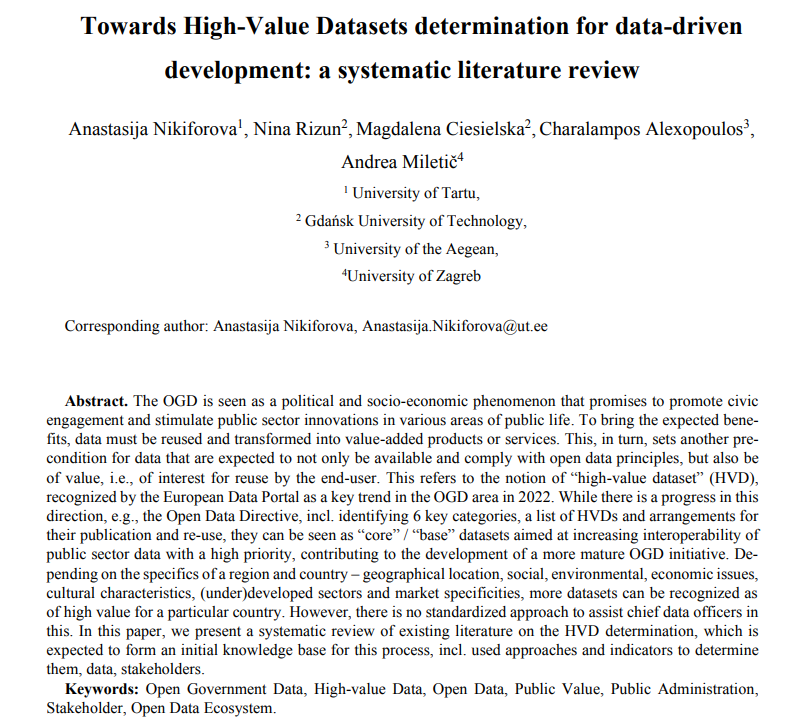
The OGD is seen as a political and socio-economic phenomenon that promises to promote civic engagement and stimulate public sector innovations in various areas of public life. However, to bring the expected benefits, data must be reused and transformed into value-added products or services. This, in turn, sets another precondition for data that are expected to not only be available and comply with open data principles, but also be of value, i.e., of interest for reuse by the end-user. This refers to the notion of ‘high-value dataset’ (HVD). HVD are defined as datasets whose re-use is expected to create the most value for society, the economy, and the environment, contributing to the creation of “value-added services, applications and new, high-quality and decent jobs, and of the number of potential beneficiaries of the value-added services and applications based on those datasets (Directive, 2019). HVD was recognized by the European Data Portal as a key trend in the OGD area in 2022, which is not included in the annual Open Data Maturity Report.

There has been some progress in this area over the last years, which refers to a list of initiatives and studies carried out by several organizations and communities, where at the European level, probably most notable progress has been made by the European Commission in the Open Data Directive (originally Public Sector Information Directive (PSI Directive), i.e. Directive (EU) 2019/1024 of the European Parliament and of the Council of 20 June 2019 on open data and the re-use of public sector information, according to which there are six thematic data categories of HVD – (1) geospatial, (2) earth observation and environment, (3) meteorological, (4) statistics, (5) companies and company ownership, (6) mobility data are considered as of high value. Further, a list of specific HVDs and the arrangements for their publication was developed and made available as “Commission Implementing Regulation (EU) 2023/138 of 21 December 2022 laying down a list of specific high-value datasets and the arrangements for their publication and re-use” (Commission, 2023) that can be seen as seeking for greater harmonization and interoperability of public sector data and data sharing across EU countries with reference to specific datasets, their granularity, key attributes, geographic coverage, requirements for their re-use, including licence (Creative Commons BY 4.0, any equivalent, or less restrictive open licence), specific format where appropriate, frequency of updates and timeliness, availability in machine-readable format, accessibility via API and bulk download, supported with metadata describing the data within the scope of the INSPIRE data themes that shall contain specific minimum set of the required metadata elements, description of the data structure and semantics, the use of controlled vocabularies and taxonomies (if relevant) etc. In addition, the Semantic Interoperability Community (SEMIC) is constantly hosting webinars on DCAT-AP (Data Catalogue Vocabulary Application Profile) for HVD to discuss with OGD portal owners, OGD publishers and enthusiasts the best approaches to use DCAT-AP to describe HVD and ensure their further findability, accessibility, and reusability.

In other words while it can be seen that progress has been made in this area, an examination of the above documents reveals that these datasets rather form a list of “mandatory” or “open by default”, sometimes also referred to as “base” or “core” datasets, aiming at open data interoperability with a high level of priority and a relatively equal level of value for most countries, which contributed to the development and promotion of a more mature open data ecosystem and OGD initiative. Depending on the specifics of a region and country – geographical location, social, current environment, social, economic issues, culture, ethnicity, likelihood of crises and / or catastrophes, (under)developed industries/ sectors and market specificities, and development trajectories, i.e., priorities. Depending on the above, more datasets can be recognized as having high value within a particular country or region (Utamachant & Anutariya, 2018; Huyer & Blank, 2020; Nikiforova, 2021). For example, meteorological data describing sea level rise can be of great value in the Netherlands as it has a strong impact on citizens and businesses as more than 1/3 of the country is below sea level, however, the same data will be less valuable for less affected to countries, such as Italy and France (Huyer & Blank, 2020). We believe that additional factors such as ongoing smart cities initiatives, as well as the Sustainable Development Goals, the current state of countries and cities in relation to their implementation and established priorities affect this list as well.

We find it is important to support the identification of country specific HVD that, in turn, could increase user interest ]by transforming data into innovative solution and services. Although this fact is recognized by countries and some local and regional efforts, mostly undertaken by governments with little support from the scientific and academia community, they are mainly faced with problems in the form of delays in their development or complete failure, or ending up with some set of HVD, but little information about how this was actually done. These ad-hoc attempts remain closed and not reusable, which is contrary to both the general OGD philosophy and the HVD-centric philosophy that is expected to be standardized. Most of them are ex-post or a combination of the ex-ante and ex-post, making the process of identifying them more resource-intensive, with an effect only visible after potentially valuable datasets have been discovered, published, and kept maintained, with the need for further evaluation of their impact, which is a resource-consuming task. All in all, it is considered that there is no standardized approach to assisting chief data officers in identifying HVDs, resulting in a failure in consistent identification and maintenance of HVDs.

Thus, we refer to this topic. As you can now from my blog it is not the first attempt we take. The very first activity related to this topic was taken by me back in 2019, where I studied this topic in Latvian settings, i.e. a stakeholder-centered determination of High-Value Data sets for Latvia was done as a response for the call made by the national OGD initiative, whose results were submitted to the holders of Latvia’s open data portal (Ministry of Environmental Protection and Regional Development) and used to prepare external reports submitted to Publications Office of the European Union). Later, several countries joined my study, namely, Poland, Greece, Croatia and Peru, and together with the colleagues we conducted several workshops that took place as part of international conferences, on which I posted before here and here.

This time, we conducted more theoretical study seeking for establishing a rich knowledge base for determining HVD, while the validation of identified indicators (as part of this study and derived from government reports) is expected to take place during the workshops with open (government) data and / or e-government experts. All in all, we focused on identifying all efforts taken with the reference to this topic. In other words, the objective was to examine how HVD determination has been reflected in the literature over the years and what has been found by these studies to date, incl. the indicators used in them, involved stakeholders, data-related aspects, and frameworks, which was done by conducting a Systematic Literature Review with the following research questions (RQ) defined to achieve the set objective:

  • (RQ1) how is the value of the open government data perceived / defined? In which contexts has the topic of HVD been investigated by previous research (e.g., research disciplines, countries)? Are local efforts being made at the country levels to identify the datasets that provide the most value to stakeholders of the local open data ecosystem?
  • (RQ1.1) How the high-value data are defined, if this definition differs from the definition introduced in the PSI /OD Directive,
  • (RQ1.2) What datasets are considered to be of higher value in terms of data nature, data type, data format, data dynamism?
  • (RQ2) What indicators are used to determine high-value datasets? How can these indicators be classified? Can they be measured? And whether this can be done (semi-)automatically?
  • (RQ3) Whether there is a framework for determining country specific HVD? In other words, is it possible to determine what datasets are of particular value and interest for their further reuse and value creation, taking into account the specificities of the country under consideration, e.g., culture, geography, ethnicity, likelihood of crises and/or catastrophes.

Although neither OGD, nor the importance of the value of data are new topics, scholarly publications dedicated to the topic of HVD are still very limited. This points out the limited body of knowledge on this topic, thereby making this study unique and constituting a call for action. Nevertheless, during this study, we have established some knowledge based on HVD determination-related aspects, including several definitions of HVD, data-related aspects, stakeholders, some indicators and approaches that can now be used as a basis for establishing a discussion of what a framework for determining HVD should look like, which, along with the input we received from a series of international workshops with open (government) data experts, covering more indicators and approaches found to be used in practice, could enrich the common understanding of the goal, thereby contributing to the next open data wave (van Loenen & Šalamon, 2022).

Sounds interesting? Want to know more? Read the article -> here! Please cite the paper as: Nikiforova, A., Rizun, N., Ciesielska, M., Alexopoulos, C., Miletič, A. (2023). Towards High-Value Datasets determination for data-driven development: a systematic literature review. In: Lindgren, I., Csáki, C., Kalampokis, E., Janssen, M.,, Viale Pereira, G., Virkar, S., Tambouris, E., Zuiderwijk, A. Electronic Government. EGOV 2023. Lecture Notes in Computer Science. Springer, Cham

References

  • Nikiforova, A. (2021, October). Towards enrichment of the open government data: a stakeholder-centered determination of High-Value Data sets for Latvia. In Proceedings of the 14th International Conference on Theory and Practice of Electronic Governance (pp. 367-372).
  • Directive (EU) 2019/1024 of the European Parliament and of the Council of 20 June 2019 on open data and the re-use of public sector information (recast)
  • Commission Implementing Regulation (EU) 2023/138 of 21 December 2022 laying down a list of specific high-value datasets and the arrangements for their publication and re-use
  • Huyer, E., Blank, M. (2020). Analytical Report 15: High-value datasets: understanding the perspective of data providers. Publications Office of the European Union, 2020 doi:10.2830/363773
  • Utamachant, P., & Anutariya, C. (2018, July). An analysis of high-value datasets: a case study of Thailand’s open government data. In 2018 15th international joint conference on computer science and software engineering (JCSSE) (pp. 1-6). IEEE
  • van Loenen, B., & Šalamon, D. (2022). Trends and Prospects of Opening Data in Problem Driven Societies. Interdisciplinary Description of Complex Systems: INDECS, 20(2), II-IV