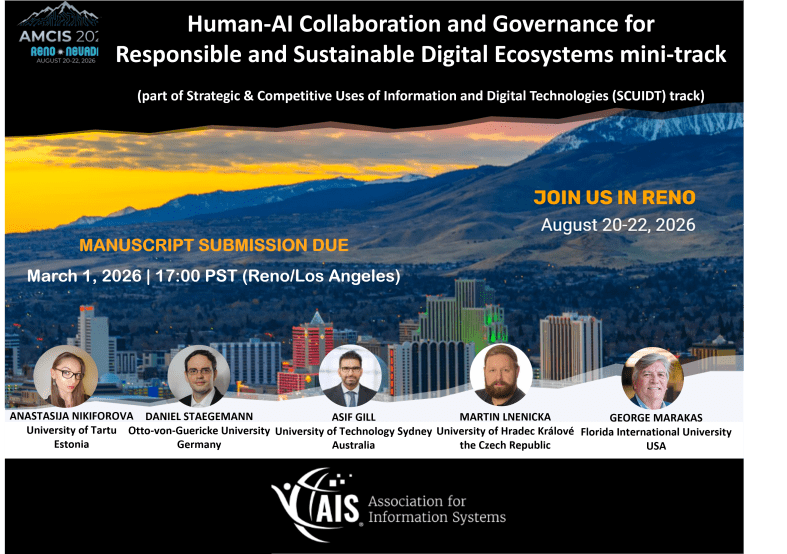
AMCIS2026 Human–AI Collaboration and Governance for Responsible and Sustainable Digital Ecosystems mini-track

As digital transformation accelerates, the convergence of AI, data governance, and ecosystem thinking is reshaping how organizations create strategic value, build competitiveness, and sustain innovation advantage. Digital and data ecosystems are increasingly complex, spanning cloud, edge, and decentralized architectures such as data meshes and lakehouses, raising critical questions of trustworthiness, responsibility, and sustainability in AI integration.

This AMCIS2026 mini-track (by Association of Information Systems (AIS)) explores how AI, including increasingly agentic systems, acts as both a strategic enabler and active participant in digital and data ecosystems, enhancing governance, augmenting and automating decision-making, and transforming how organizations create value, while raising important governance, ethical, and human-agency considerations. We invite research examining how these ecosystems can remain responsible, resilient, and sustainable, while enhancing organizational agility, competitiveness, and long-term strategic performance across sectors such as government, healthcare, finance, manufacturing, and education.

The track bridges perspectives from information systems, data science, AI governance, and sustainability research to understand how the strategic and responsible design and management of AI-driven data ecosystems can support long-term value creation, competitiveness, and societal transformation. We invite interdisciplinary contributions from fields such as computer science, management science, data science, process science, decision science, organizational design, policy-making, complexity, behavioral economics, and the social sciences. Submissions may include conceptual, design science, empirical, theoretical, or case-based studies, including literature reviews.

Topics of interest include but are not limited to:

  • AI for governance, accountability, and trustworthiness in digital and data ecosystems;
  • human–AI collaboration and delegation, human-in-the-loop and hybrid governance;
  • responsible, sustainable, and strategically aligned management of AI-augmented data ecosystems, including Green AI;
  • governance and data management in emerging architectures (e.g., data mesh, data lakehouse), including data quality, transparency, and explainability;
  • transition from centralized to decentralized data architectures – organizational and design challenges;
  • ethical, interoperable, observable, and explainable AI in connected and cross-sectoral data ecosystems;
  • co-evolution of digital and data ecosystem components;
  • coopetition between digital and data ecosystems;
  • resilience, sustainability, and long-term governance of digital infrastructures;
  • socio-technical, organizational, and policy approaches to trustworthy and responsible data ecosystems;
  • emerging technologies (e.g., blockchain, edge computing, generative AI, digital twins, IoT, AR/VR) shaping responsible, sustainable, and energy- or resource-efficient strategic ecosystem innovation;
  • empirical studies and sectoral case analyses (e.g., healthcare, finance, government, education) on evolving AI-driven ecosystems;
  • design science, conceptual, and interdisciplinary frameworks for responsible, sustainable, and strategically effective data ecosystem innovation.

This mini-track will serve as a platform for interdisciplinary dialogue on the critical role of responsible, sustainable, and strategically oriented digital and data ecosystems in driving competitive and societal innovation. Researchers and practitioners are invited to share insights, theoretical perspectives, and empirical findings in this rapidly evolving domain.

📌 Submission Deadline: March 1, 2026
📍 Venue: AMCIS 2026 — Reno, Nevada (August 20–22)

Mini-Track Chairs

Anastasija Nikiforova – University of Tartu, Estonia
Daniel Staegemann – Otto von Guericke University Magdeburg, Germany
Asif Gill – University of Technology Sydney, Australia
Martin Lnenicka – University of Hradec Králové, Czech Republic
George Marakas – Florida International University, USA
Read more and submit papers via AMCIS2026 website.

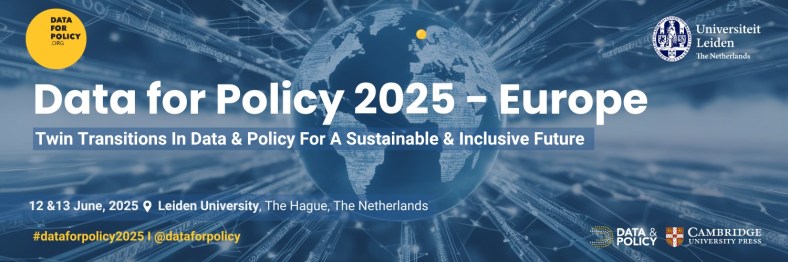
Data for Policy 2025 Europe Edition

And we are back with the new edition of Data for Policy 2025 Conference, preparation to which are in full swing! And as part of these preparations, we 📣 Call for Special Tracks for Data for Policy 2025 Europe Edition to be submitted by 11 December, 2024, with the conference itself to be held on 12-13 June, 2025, at Leiden University, The Hague, Netherlands!

This time, the Data for Policy 2025 conference will run under the “Twin Transitions in Data and Policy for a Sustainable and Inclusive Future”.

Amidst global challenges, the “twin transition”—encompassing digital and green transformations—has garnered significant attention for its potential to reshape industrial ecosystems and influence social inequalities. However, in the scientific community and policy arena questions have been raised on whether green and digital transitions are mutually compatible or whether one transition can reduce or cancel out the other. Furthermore, we see sustainability as an integrative perspective that includes  environmental, social, economical and institutional sustainability.

Both public and private sectors are increasingly aligning their objectives towards digital innovation and sustainable practices 🌍. Governments are developing policies to guide these transitions, ensuring that technological advancements account for sustainability. Concurrently, substantial investments are being funneled into industries poised to drive this twin transition. Data lies at the heart of this transformation, empowering  policymakers to monitor progress in real-time, identify emerging trends, and design impactful and targeted strategies. From driving down carbon emissions to closing the digital divide, data-driven insights offer the actionable intelligence needed to tackle complex challenges and pave the way toward a more equitable, sustainable future. 

At this nexus, the theme of the European Data for Policy Conference is “Twin transitions in data and policy for a sustainable and inclusive future”, where we will delve into the implications of these transitions for governance, data usage, and policymaking 

With CFP to be launched in a month, now, we – Sarah Giest, Bram Klievnik (both local chairs), Leid Zejnilovic, Laura Zoboli, Anastasija Nikiforova – invite proposals for Special Tracks in two categories:

  • Research/Policy/Practitioner Tracks: These tracks should address how digital and green initiatives work together to overcome global challenges. Proposals should align with the conference theme, “Twin Transitions in Data and Policy for a Sustainable and Inclusive Future”.
  • Policy/Practitioner Tracks: We invite proposals from those focused on policy and real-world applications, addressing the broader Data for Policy theme.

Proposers are encouraged to consider region-specific challenges alongside the conference theme, which offers a framework but is open to all relevant Data for Policy topics.

🗓 Track Proposal Submission Deadline: 11 December, 2024
For more information on the call 👉 Data for Policy 2025 Conference – Europe Edition: Call for Special Tracks – Data for Policy, for more information on the conference 👉 Data for Policy 2025 Europe – Data for Policy

Accepted tracks will be part of the wider call for abstracts, full papers and panels, set to be released on 20 December, 2024, with Special Track chairs having the opportunity to propose an associated Special Collection in the Data & Policy journal published by Cambridge University Press & Assessment in due course. 

Keep an eye open on other regional editions taking place as part of the Data for Policy 2025 Conference Series.

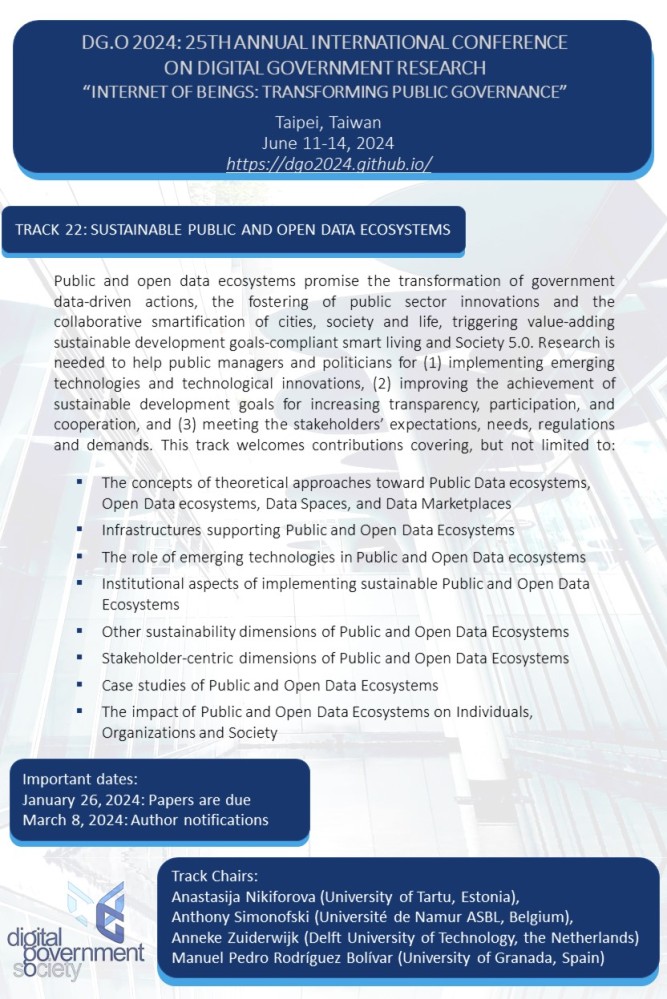
CFP for a new dg.o2024 SUSTAINABLE PUBLIC AND OPEN DATA ECOSYSTEMS track

25th Annual International Conference on Digital Government Research (dg.o2024) is coming with the revised list of tracks, where the special attention I invite you to draw to is a new track “Sustainable Public and Open Data Ecosystems” (chairs: Anastasija Nikiforova (University of Tartu, Estonia), Anthony Simonofski (Université de Namur ASBL, Belgium), Anneke Zuiderwijk (Delft University of Technology, the Netherlands) & Manuel Pedro Rodríguez Bolívar (University of Granada, Spain)).

Briefly about the track… Public and open data ecosystems promise the transformation of government data-driven actions, the fostering of public sector innovations and the collaborative smartification of cities, society and life, triggering value-adding sustainable development goals-compliant smart living and society 5.0 (Nikiforova, 2021, Nikiforova et al., 2023). Recent research found that concepts affecting and shaping the ecosystem are: 1) stakeholders / actors and their roles, 2) phases of the data lifecycle, in which a stakeholder participates in the ecosystem, 3) technical and technological infrastructure, 4) generic services and platforms, 5) human capacities and skills of both providers and consumers, 6) smart city domains (thematic categories) as the targeted areas for data reuse, 7) externalities affecting goals, policy, and resources, 8) level of (de)centralization of data sources – development, restrictions, 9) perception of importance and support from public officials, and 10) user interface, user experience, and usability (Lnenicka et al., 2021). The body of knowledge in the above areas (not to say about putting them all together) is very limited. New research is needed to help public managers and politicians for (1) implementing emerging technologies and technological innovations, (2) improving the achievement of sustainable development goals for increasing transparency, participation, and cooperation, and (3) meeting the stakeholders’ expectations, needs, regulations and demands.

This track welcomes contributions covering, but not limited to:

💡 The concepts of theoretical approaches toward Public Data ecosystems, Open Data ecosystems, Data Spaces, and Data Marketplaces;

💡Infrastructures supporting Public and Open Data Ecosystems;

💡The role of emerging technologies in Public and Open Data ecosystems;

💡Institutional aspects of implementing sustainable Public and Open Data Ecosystems;

💡Other sustainability dimensions of Public and Open Data Ecosystems;

💡Stakeholder-centric dimensions of Public and Open Data Ecosystems;

💡Case studies of Public and Open Data Ecosystems;

💡The impact of Public and Open Data Ecosystems on Individuals, Organizations and Society.

The track welcomes both contributions covering the current state-of-the-art of public data ecosystems (what components constitute them, what are the relationships between these components, what makes an ecosystem resilient and sustainable), incl. individual case studies reflecting best or bad practices, as well as those addressing how these ecosystems can be transformed into more sustainable ecosystems that will “fuel” or “smartify” society (Information Society aka Society 4.0 to Super Smart Society aka Society 5.0 transition), cities and various areas of life.

The track is very in line with the conference theme of DGO 2024, namely: Internet of Beings – Transforming Public Governance, where, “the Internet of Beings focuses on digital technologies that enable integration, people-centric, and creation of open platforms for collaborative multi-user to co-create services and products” (as mentioned in the theme description). Public and open data ecosystems can be considered as such open platforms, where data providers and data users find each other and collaborate and co-create to develop services and products useful for society. While digital technologies enable the development of public and open data ecosystems, the adoption of such ecosystems has been fragmented.

Is your research related to any of the above topics? Then do not wait – submit!

🗓️🗓️🗓️Important Dates:

January 26, 2024: Papers, workshops, tutorials, and panels are due
Feb 1, 2021: Application deadline for doctoral colloquium
March 8, 2024: Author notifications (papers, workshops, tutorials, panels)

References:

Nikiforova, A. (2021). Smarter open government data for society 5.0: are your open data smart enough?. Sensors, 21(15), 5204.

Nikiforova, A., Flores, M. A. A., & Lytras, M. D. (2023). The role of open data in transforming the society to Society 5.0: a resource or a tool for SDG-compliant Smart Living?. In Smart Cities and Digital Transformation: Empowering Communities, Limitless Innovation, Sustainable Development and the Next Generation (pp. 219-252). Emerald Publishing Limited.

Lnenicka, M., Nikiforova, A., Luterek, M., Azeroual, O., Ukpabi, D., Valtenbergs, V., & Machova, R. (2022). Transparency of open data ecosystems in smart cities: Definition and assessment of the maturity of transparency in 22 smart cities. Sustainable Cities and Society, 82, 103906.