Rii Forum 2023 “Innovation 5.0: Navigating shocks and crises in uncertain times Technology-Business-Society” & a plenary debate “Advances in ICT & the Society”

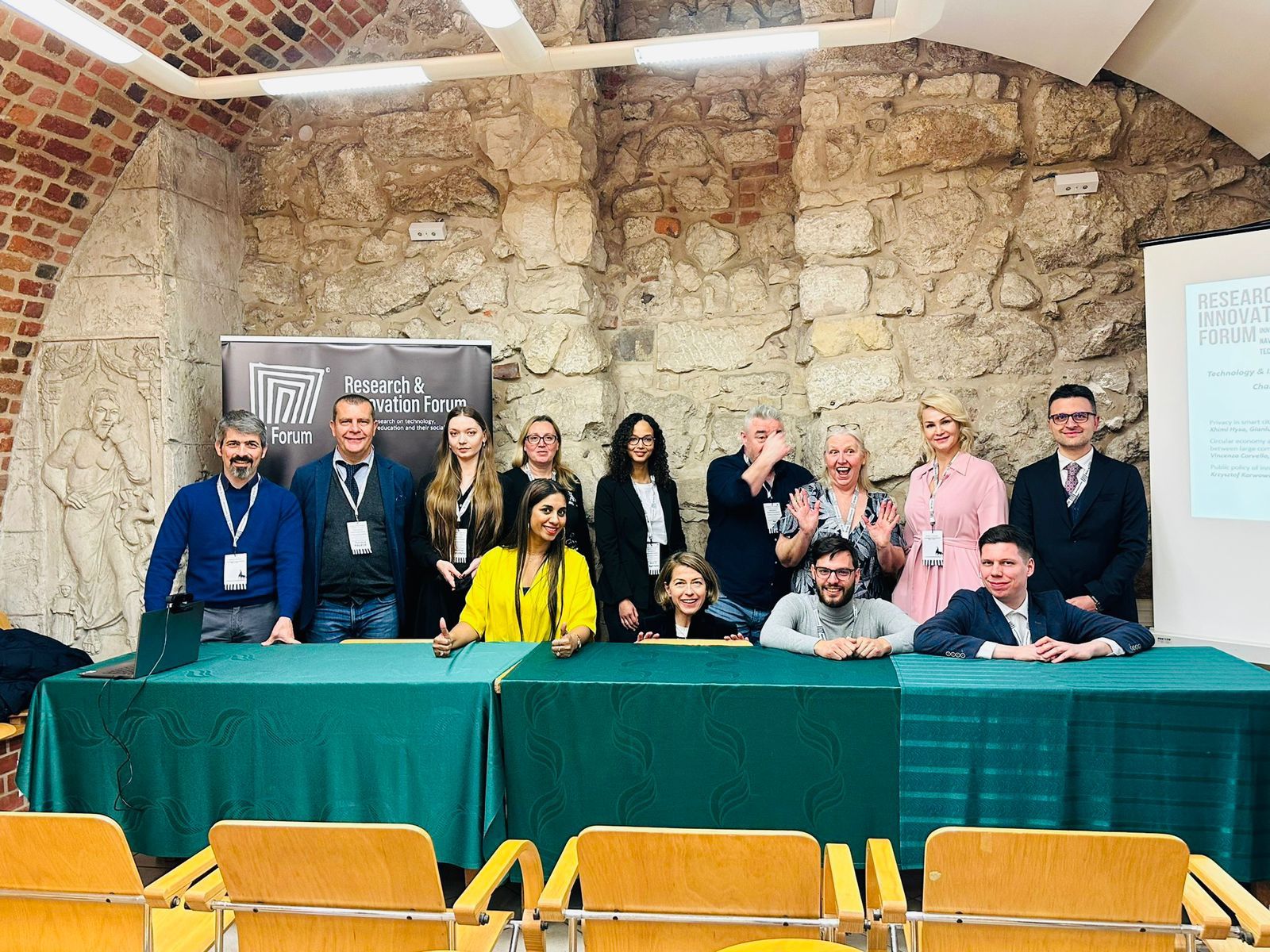
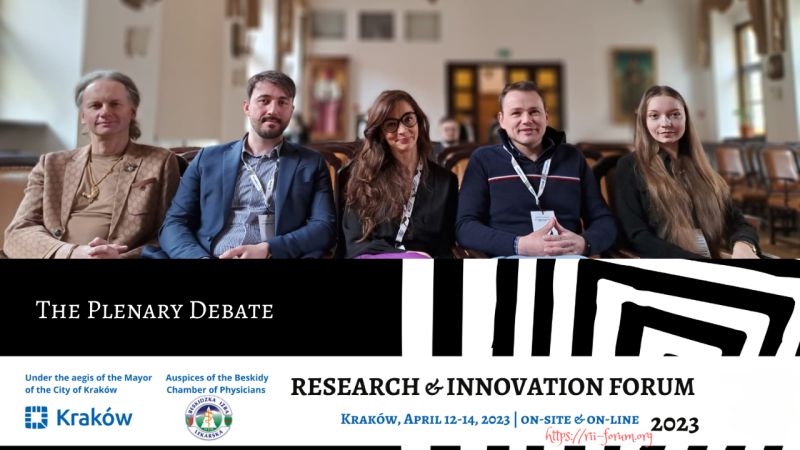
Last week, I had an unforgettable experience at the Research and Innovation Forum (RiiForum) on which I posted previously in Krakow, Poland, serving as plenary speaker and session chair. It was another great experience to have an absolutely amazing plenary session titled “Advances in ICT & the Society: threading the thin line between progress, development and mental health”, where we – Prof. Dr. Yves Wautelet, Prof. Dr. Marek Krzystanek, Karolina Laurentowska & Prof. Marek Pawlicki – discussed disruptive technologies in our professional lives in the past years, how they affected us and our colleagues, how they affect(ed) society and its specific groups, including their mental health, and general perception of technology, i.e. an enemy of humanity, or rather a friend and support, and how to make sure the second take place. And from this we have developed a discussion around AI, chatGPT, Metaverse, blockchain, even slightly touching on quantum computing. Of course, all this was placed in the context of democracy and freedoms / liberties. All in all, we approached the topic of governance and policy-making, which is too often reactive rather than proactive, which, in turn, leads to many negative consequences, as well as elaborated on the engineering practices. 

To sum up – emerging and disruptive technologies, Blockchain, AI, Metaverse, digital competencies, education, liberty, democracy, openness, engagement, metaverse, inclusivity, Industry 5.0, Society 5.0 – and it is not a list of buzzwords, but a list of topics we have managed to cover both plenary speakers and the audience and continued to talk about them during the whole conference. Rich enough, isn’t it?

And then the day did not end, continuing with several super insightful sessions, where, of course, one I enjoyed most is the one that I chaired. Three qualitative talks with further rich discussion after each thanks to an excellent audience, despite the fact this was the last session of the day (before the dinner), namely:

  • Privacy in smart cities using VOSviewer: a bibliometric analysis by Xhimi Hysa, Gianluca Maria Guazzo, Vilma Cekani, Pierangelo Rosati
  • Public policy of innovation in China by Krzysztof Karwowski, Anna Visvizi
  • How Human-Centric solutions and Artificial Intelligence meet smart cities in Industry 5.0 by Tamai Ramirez, Sandra Amador, Antonio Macia-Lillo, Higinio Mora
     

And the last, but not the least, Krakow surprised me lot (in a positive sense, of course) – it was my first time in Poland, and I am absolutely glad that it was on such a beautiful city as Krakow – the place with the rich history and culture! Thank you dear RiiForum2023 organizers – Anna Visvizi, Vincenzo Corvello, ORLANDO TROISI, Mara Grimaldi, Giovanni Baldi and everyone who was involved – it is always a pleasure to be a part of this community!


Participate in the European Digital Skills Certificate (EDSC) feasibility study!

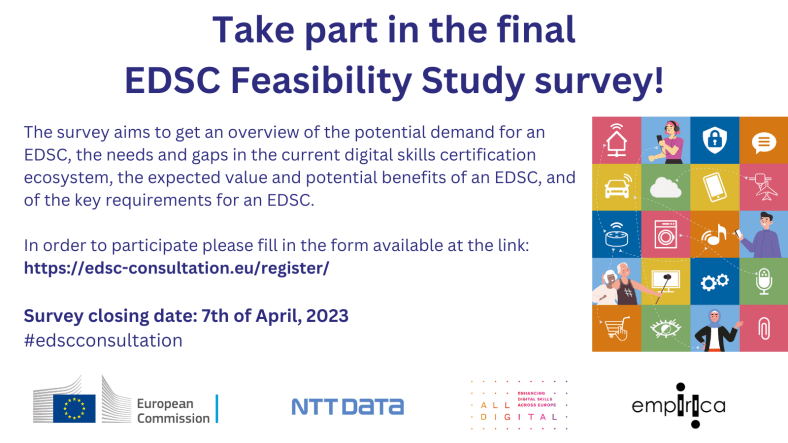
📣📣📣 This is a short post to let you know that we have reached the most important phase of the consultation process for the European Digital Skills Certificate (#EDSC) feasibility study, and on behalf of EDSC – as EDSC Ambassador – I sincerely invite Public authorities, Policy makers, Education & Training providers working in the fields of education, digitalisation, and employment, and to education and training providers at the national, regional and/or local level to participate in this last survey.

🎯🎯🎯This survey aims to get an overview of the potential demand for an EDSC, the needs and gaps in the current digital skills certification ecosystem, the expected value and potential benefits of an EDSC, and of the key requirements for an EDSC. 


The European Commission’s Directorate-General for Employment, Social Affairs and Inclusion has initiated Action 9 of the Digital Education Action Plan (DEAP 2021-2017), that is, to develop a European Digital Skills Certificate (EDSC) that may be recognised and accepted by governments, employers, and other stakeholders across Europe. This would allow Europeans to indicate their level of digital competences, corresponding to the Digital Competence Framework (DigComp) proficiency levels.

In order to participate, you have to first register. If you are not yet registered, please fill in the form available at the link: https://edsc-consultation.eu/register/ 

The survey takes around 30 minutes,  and it will be open until the 7th of April 2023

Thank you in advance for taking the time to complete the questionnaire! 

Editorial Board Member of Data & Policy (Cambridge University Press)

Since July 2022, I am elected by Syndicate of Cambridge University Press as an Editorial Board Member of the Cambridge University Journal Data & Policy. Data & Policy is a peer-reviewed, open access venue dedicated to the potential of data science to address important policy challenges. For more information about the goal and vision of the journal, read the Editorial Data & Policy: A new venue to study and explore policy–data interaction by Stefaan G. Verhulst, Zeynep Engin, and Jon Crowcroft. More precisely, I act as an Area Editor of “Focus on Data-driven Transformations in Policy and Governance” area (with a proud short name “Area 1“). This Area focuses on the high-level vision for philosophy, ideation, formulation and implementation of new approaches leading to paradigm shifts, innovation and efficiency gains in collective decision making processes. Topics include, but are not limited to:

  • Data-driven innovation in public, private and voluntary sector governance and policy-making at all levels (international; national and local): applications for real-time management, future planning, and rethinking/reframing governance and policy-making in the digital era;
  • Data and evidence-based policy-making;
  • Government-private sector-citizen interactions: data and digital power dynamics, asymmetry of information; democracy, public opinion and deliberation; citizen services;
  • Interactions between human, institutional and algorithmic decision-making processes, psychology and behaviour of decision-making;
  • Global policy-making: global existential debates on utilizing data-driven innovation with impact beyond individual institutions and states;
  • Socio-technical and cyber-physical systems, and their policy and governance implications.

The remaining areas represent more specifically the current applications, methodologies, strategies which underpin the broad aims of Data & Policy‘s vision: Area 2 “Data Technologies and Analytics for Policy and Governance“, Area 3 “Policy Frameworks, Governance and Management of Data-driven Innovations“, Area 4 “Ethics, Equity and Trust in Policy Data Interactions“, Area 5 “Algorithmic Governance“, Area 6 “Data to Tackle Global Issues and Dynamic Societal Threats“.

Editorial committees of Data & Policy (Area 1)

For the types of submission we are interested in, they are four:

  • Research articles that use rigorous methods that investigate how data science can inform or impact policy by, for example, improving situation analysis, predictions, public service design, and/or the legitimacy and/or effectiveness of policy making. Published research articles are typically reviewed by three peer reviewers: two assessing the academic or methodological rigour of the paper; and one providing an interdisciplinary or policy-specific perspective. (Approx 8,000 words in length).
  • Commentaries are shorter articles that discuss and/or problematize an issue relevant to the Data & Policy scope. Commentaries are typically reviewed by two peer reviewers. (Approx 4,000 words in length).
  • Translational articles are focused on the transfer of knowledge from research to practice and from practice to research. See our guide to writing translational papers. (Approx 6,000 words in length).
  • Replication studies examine previously published research, whether in Data & Policy or elsewhere, and report on an attempt to replicate findings.

Read more about Data & Policy and consider submitting your contribution!

Moreover, as a part of this journal, we (Data & Policy community) organize a hybrid physical-virtual format, with one-day, in-person conferences held in three regions: Asia (Hong Kong), America (Seattle) and Europe (Brussels). “Data for Policy: Ecosystems of innovation and virtual-physical interactions” conference I sincerely recommend you to consider and preferably to attend! While this is already the seventh edition of the conference, I take part in its organization for the first year, thus am especially excited and interested in its success!

Data for policy, Area Editors

In addition to its six established Standard Tracks, and reflecting its three-regions model this year, the Data for Policy 2022 conference highlights “Ecosystems of innovation and virtual-physical interactions” as its theme. Distinct geopolitical and virtual-physical ecosystems are emerging as everyday operations and important socio-economic decisions are increasingly outsourced to digital systems. For example, the US’s open market approach empowering multinational digital corporations contrasts with greater central government control in the Chinese digital ecosystem, and radically differs from Europe’s priority on individual rights, personal privacy and digital sovereignty. Other localised ecosystems are emerging around national priorities: India focuses on the domestic economy, and Russia prioritises public and national security. The Global South remains underrepresented in the global debate. The developmental trajectory for the different ecosystems will shape future governance models, democratic values, and the provision of citizen services. In an envisioned ‘metaverse’ future, boundaries between physical and virtual spaces will become even more blurred, further underlining the need to scrutinise and challenge the various systems of governance.

The Data for Policy conference series is the premier global forum for multiple disciplinary and cross-sector discussions around the theories, applications and implications of data science innovation in governance and the public sector. Its associated journal, Data & Policy, published by Cambridge University Press has quickly established itself as a major venue for publishing research in the field of data-policy interactions. Data for Policy is a non-profit initiative, registered as a community interest company in the UK, supported by sustainer partners Cambridge University Press, the Alan Turing Institute and the Office for National Statistics.

Read more about Data for Policy and become a part of it!