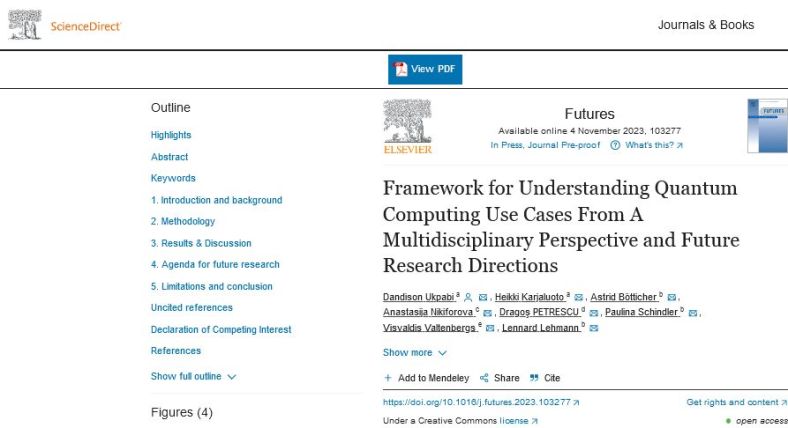
📢📜New paper alert! Framework for understanding quantum computing use cases from a multidisciplinary perspective and future research directions

This post is dedicated to theFramework for understanding quantum computing use cases from a multidisciplinary perspective and future research directions” (Ukpabi, D.C., Karjaluoto, H., Botticher, A., Nikiforova, A., Petrescu, D.I., Schindler, P., Valtenbergs, V., Lehmann, L.) paper that just has been published in Futures journal (Elsevier, Q1 in both (1) Business and International Management, (2) Development, (3) Sociology and Political Science) in an open access.

Recently, there has been increasing awareness of the tremendous opportunities inherent in quantum computing. It is expected that the speed and efficiency of quantum computing will significantly impact the Internet of Things, cryptography, finance, and marketing. Accordingly, there has been increased quantum computing research funding from national and regional governments and private firms. However, critical concerns regarding legal, political, and business-related policies germane to quantum computing adoption exist. Therefore, recently a call for a framework from an interdisciplinary perspective has been made to help an understanding the potential impact of quantum computing on society, which is vital to improve strategic planning and management by governments and other stakeholders. The lack of such a framework is due to the fact that quantum computing per se is a highly technical domain, hence most of the existing studies focus heavily on the technical aspects of quantum computing. In contrast, our study highlights its practical and social uses cases, which are needed for the increased interest of governments. More specifically, our study took this call and offered a preliminary version of a framework for understanding the social, economic and political use cases of quantum computing, as well as identified possible areas of market disruption and offer empirically based recommendations that are critical for forecasting, planning, and strategically positioning QCs for accelerated diffusion, incl. definition of 52 Research Questions that will be critical for the adoption of quantum computing.


To this end, we conducted a gray literature research, whose outputs were structured in accordance with Dwivedi et al. (2021) that embodies environment, users, & application areas. We then validated through the discussing the findings with the quantum computing community at QWorld Quantum Science Days 2023 (QSD 2023) (on which I posted before 👉 here).

In short:

  • the hottest application areas are 🔥🔥🔥 business & finance, renewable energy, medicine & pharmaceuticals, & manufacturing 🔥🔥🔥;
  • at the level of environment – ecosystem, security, jurisprudence, institutional change & geopolitics;
  • users – customers, firms, countries or governments, to be more precise, with the reference to both national and local governments.

We then dived into these areas, and come up with the most popular & promising & overlooked topics, and as the very end-result, define 52 research questions, i.e., very specific things that are expected to be covered in the future to understand the current state-of-the-art, as well as transformations needed at various levels. The insights offered by various contributors from diverse disciplines – business, information systems, quantum computing, political science, and law offer a broad-based view of the potential of quantum computing to different aspects of our technological, economic, and social development. This framework is intended to help in identifying possible areas of market disruption offering empirically based recommendations that are critical for forecasting, planning, and strategically positioning prior to quantum computing emergence.

This is a truly a “happy end!” for the consortia that we built ~3 years ago – with Germany, Spain, Finland, Romania, and Latvia – while working on a project proposal to CHANSE call “Transformations: Social and Cultural Dynamics in the Digital Age”. We went there much far beyond my expectations, i.e. in fact, we were notified that this time we will not be granted the funding for the project at the very last stage, having gone through all those intermediate evaluation rounds, which were already fascinating news (at least for me). While working on the proposal and building our network, we conducted a preliminary analysis of the area, which then, regardless of the output of the application, we decided to continue and bring to at least some logical end. We like our result so decided to make it publicly available.

All in all, this is our warm welcome to read the paper -> here

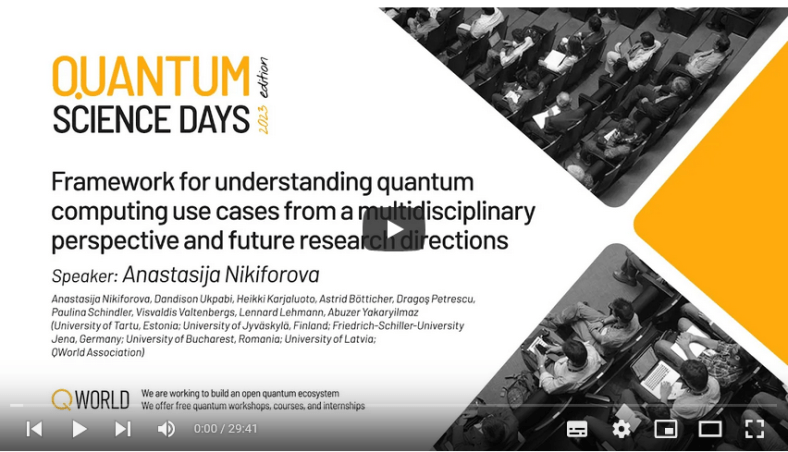
And just in case you prefer a condensed version, you can just watch the video of the talk I delivered at QWorld Quantum Science Days 2023 (QSD 2023) 👇

References:

Dandison Ukpabi, Heikki Karjaluoto, Astrid Bötticher, Anastasija Nikiforova, Dragoş PETRESCU, Paulina Schindler, Visvaldis Valtenbergs, Lennard Lehmann, Framework for Understanding Quantum Computing Use Cases From A Multidisciplinary Perspective and Future Research Directions, Futures, 2023, 103277, ISSN 0016-3287, https://doi.org/10.1016/j.futures.2023.103277.

Dwivedi, Y. K., Ismagilova, E., Hughes, D. L., Carlson, J., Filieri, R., Jacobson, J., … & Wang, Y. (2021). Setting the future of digital and social media marketing research: Perspectives and research propositions. International Journal of Information Management, 59, 102168.
💬💬💬 Contributed talk for QWorld Quantum Science Days 2023 (QSD 2023)

In the very last days of May 2023, I had yet another experience – I delivered a contributed talk at QWorld Quantum Science Days 2023 (QSD 2023) titled “Framework for understanding quantum computing use cases from a multidisciplinary perspective and future research directions” (Ukpabi, D.C., Karjaluoto, H., Botticher, A., Nikiforova, A., Petrescu, D.I., Schindler, P., Valtenbergs, V., Lehmann, L., & Yakaryılmaz, A), which, in fact, is based on the paper we made publicly available some time ago and developed it even earlier when together with Germany, Spain, Finland, Romania, and Latvia we built a consortia and submitted a project proposal to CHANSE call “Transformations: Social and Cultural Dynamics in the Digital Age”. We went there much far beyond my expectations, i.e. in fact, we were notified that this time we will not be granted the funding for the project at the very last stage, having gone through all those intermediate evaluation rounds, which were already fascinating news (at least for me). While working on the proposal and building our network, we conducted a preliminary analysis of the area, which then, regardless of the output of the application, we decided to continue and bring to at least some logical end. We like our result so decided to make it publicly available. And now, a few years from that, we submitted our work to QWorld Quantum Science Days 2023 (QSD 2023) and were accepted. It was a big surprise, and I, as the person delegated by our team to present our study, delivered this talk, where I finally familiarized the audience with our findings. What was my surprise when my talk, which followed immediately after the keynote “Let’s talk about Quantum; Societal readiness through science communication research” delivered on behalf of Quantum DELTA NL by Julia Cramer, was in the very similar direction? It is also worth mentioning a very interesting coincidence that while the keynote elaborated on the DELTA that stands for five major quantum hubs, namely Delft, Eindhoven, Leiden, Twente, Amsterdam, I was preparing the last things for my presentation located in the Delta building – it is the name of the building my office is located in. In both cases, no connection with COVID-19 😀

🤔 What is the paper about?

There has been increasing awareness of the tremendous opportunities inherent in quantum computing. It is expected that the speed and efficiency of quantum computing will significantly impact the Internet of Things, cryptography, finance, and marketing. Accordingly, there has been increased quantum computing research funding from national and regional governments and private firms. However, ❗❗❗ critical concerns regarding legal, political, and business-related policies germane to quantum computing adoption exist ❗❗❗

Since this is an emerging and highly technical domain, most of the existing studies focus heavily on the technical aspects of quantum computing. In contrast, our study highlights its practical and social uses cases, which are needed for the increased interest of governments. More specifically, our study offers a multidisciplinary review of quantum computing, drawing on the expertise of scholars from a wide range of disciplines whose insights coalesce into a framework that simplifies the understanding of quantum computing, identifies possible areas of market disruption and offer empirically based recommendations that are critical for forecasting, planning, and strategically positioning QCs for accelerated diffusion.

"Framework for understanding quantum computing use cases from a multidisciplinary perspective and future research directions" (Ukpabi, D.C., Karjaluoto, H., Botticher, A., Nikiforova, A., Petrescu, D.I., Schindler, P., Valtenbergs, V., Lehmann, L., & Yakaryılmaz, A)

To this end, we conducted a gray literature research, whose outputs were then structured in accordance with Dwivedi et al., 2021 (Dwivedi et al. (2021). Setting the future of digital and social media marketing research: Perspectives and research propositions. International Journal of Information Management, 59, 102168), which embodies three broad areas—environment, users, and application areas—and the dominant sub-themes presented in figure below. We found that for application areas, business and finance, renewable energy, medicine & pharmaceuticals, and manufacturing are now the hottest. While for environment, we found subdomains such as ecosystem, security, jurisprudence, institutional change & geopolitics. And for the users, nothing surprising – as typically, customers, firms, countries. We then dive into each of those areas, as well as later come up with the most popular topics, the most promising, and overlooked.

Sounds interesting? Read the paper here, find slides here, watch video here.

Quantum Science Days is an annual, international, and virtual scientific conference organized by QWorld (Association) to provide opportunities to the quantum community to present and discuss their research results at all levels (from short projects to thesis work to research publications), and to get to know each other. The third edition (QSD2023) included 7 invited speakers, 10 thematic talks on “Building an Open Quantum Ecosystem”, 31 contributed talks, an industrial demo session by Classiq, and a career talk on quantum. QSD2023 was sponsored by Unitary Fund & Classiq and supported by Latvian Quantum Initiative.

Qworld

Editorial Board Member of Data & Policy (Cambridge University Press)

Since July 2022, I am elected by Syndicate of Cambridge University Press as an Editorial Board Member of the Cambridge University Journal Data & Policy. Data & Policy is a peer-reviewed, open access venue dedicated to the potential of data science to address important policy challenges. For more information about the goal and vision of the journal, read the Editorial Data & Policy: A new venue to study and explore policy–data interaction by Stefaan G. Verhulst, Zeynep Engin, and Jon Crowcroft. More precisely, I act as an Area Editor of “Focus on Data-driven Transformations in Policy and Governance” area (with a proud short name “Area 1“). This Area focuses on the high-level vision for philosophy, ideation, formulation and implementation of new approaches leading to paradigm shifts, innovation and efficiency gains in collective decision making processes. Topics include, but are not limited to:

  • Data-driven innovation in public, private and voluntary sector governance and policy-making at all levels (international; national and local): applications for real-time management, future planning, and rethinking/reframing governance and policy-making in the digital era;
  • Data and evidence-based policy-making;
  • Government-private sector-citizen interactions: data and digital power dynamics, asymmetry of information; democracy, public opinion and deliberation; citizen services;
  • Interactions between human, institutional and algorithmic decision-making processes, psychology and behaviour of decision-making;
  • Global policy-making: global existential debates on utilizing data-driven innovation with impact beyond individual institutions and states;
  • Socio-technical and cyber-physical systems, and their policy and governance implications.

The remaining areas represent more specifically the current applications, methodologies, strategies which underpin the broad aims of Data & Policy‘s vision: Area 2 “Data Technologies and Analytics for Policy and Governance“, Area 3 “Policy Frameworks, Governance and Management of Data-driven Innovations“, Area 4 “Ethics, Equity and Trust in Policy Data Interactions“, Area 5 “Algorithmic Governance“, Area 6 “Data to Tackle Global Issues and Dynamic Societal Threats“.

Editorial committees of Data & Policy (Area 1)

For the types of submission we are interested in, they are four:

  • Research articles that use rigorous methods that investigate how data science can inform or impact policy by, for example, improving situation analysis, predictions, public service design, and/or the legitimacy and/or effectiveness of policy making. Published research articles are typically reviewed by three peer reviewers: two assessing the academic or methodological rigour of the paper; and one providing an interdisciplinary or policy-specific perspective. (Approx 8,000 words in length).
  • Commentaries are shorter articles that discuss and/or problematize an issue relevant to the Data & Policy scope. Commentaries are typically reviewed by two peer reviewers. (Approx 4,000 words in length).
  • Translational articles are focused on the transfer of knowledge from research to practice and from practice to research. See our guide to writing translational papers. (Approx 6,000 words in length).
  • Replication studies examine previously published research, whether in Data & Policy or elsewhere, and report on an attempt to replicate findings.

Read more about Data & Policy and consider submitting your contribution!

Moreover, as a part of this journal, we (Data & Policy community) organize a hybrid physical-virtual format, with one-day, in-person conferences held in three regions: Asia (Hong Kong), America (Seattle) and Europe (Brussels). “Data for Policy: Ecosystems of innovation and virtual-physical interactions” conference I sincerely recommend you to consider and preferably to attend! While this is already the seventh edition of the conference, I take part in its organization for the first year, thus am especially excited and interested in its success!

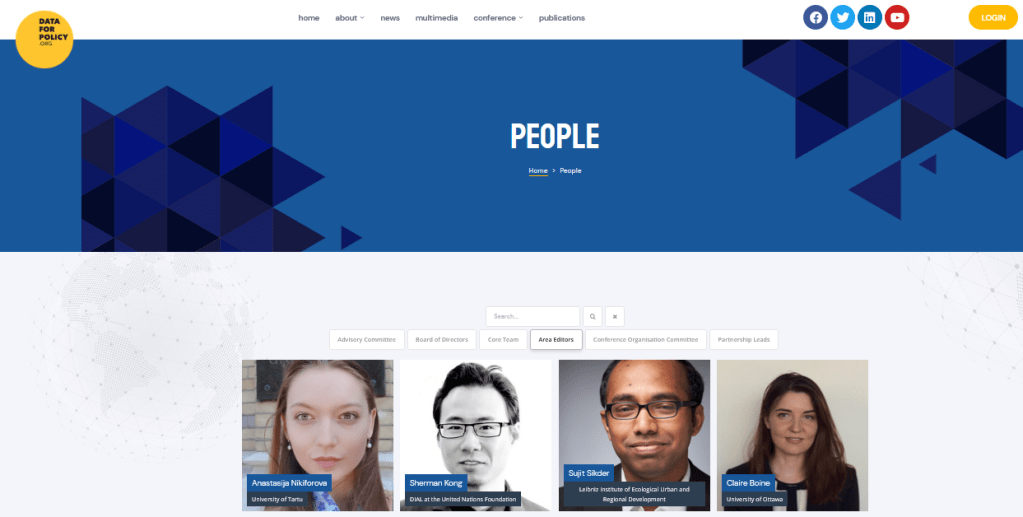
Data for policy, Area Editors

In addition to its six established Standard Tracks, and reflecting its three-regions model this year, the Data for Policy 2022 conference highlights “Ecosystems of innovation and virtual-physical interactions” as its theme. Distinct geopolitical and virtual-physical ecosystems are emerging as everyday operations and important socio-economic decisions are increasingly outsourced to digital systems. For example, the US’s open market approach empowering multinational digital corporations contrasts with greater central government control in the Chinese digital ecosystem, and radically differs from Europe’s priority on individual rights, personal privacy and digital sovereignty. Other localised ecosystems are emerging around national priorities: India focuses on the domestic economy, and Russia prioritises public and national security. The Global South remains underrepresented in the global debate. The developmental trajectory for the different ecosystems will shape future governance models, democratic values, and the provision of citizen services. In an envisioned ‘metaverse’ future, boundaries between physical and virtual spaces will become even more blurred, further underlining the need to scrutinise and challenge the various systems of governance.

The Data for Policy conference series is the premier global forum for multiple disciplinary and cross-sector discussions around the theories, applications and implications of data science innovation in governance and the public sector. Its associated journal, Data & Policy, published by Cambridge University Press has quickly established itself as a major venue for publishing research in the field of data-policy interactions. Data for Policy is a non-profit initiative, registered as a community interest company in the UK, supported by sustainer partners Cambridge University Press, the Alan Turing Institute and the Office for National Statistics.

Read more about Data for Policy and become a part of it!