
Tag open data platform

📢✍️🗞️New paper alert! “Sustainable open data ecosystems in smart cities: A platform theory-based analysis of 19 European cities”, Cities (Elsevier)
With this post I would like to introduce our new paper entitled “Sustainable open data ecosystems in smart cities: A platform theory-based analysis of 19 European cities” (authors: M. Lnenicka, A. Nikiforova, A. Clarinval, M. Luterek, D. Rudmark, S. Neumaier, K. Kević, M. P. R. Bolívar) that has been just published in Cities journal (Elsevier, Q1).
Smart cities aim to enhance citizens’ lives, urban services, and sustainability, with open data playing a crucial role in this development. Cities generate vast data that, if properly utilized within an open data ecosystem, can improve citizens’ lives and foster sustainability. Central to this ecosystem is the platform, which enables data collection, storage, processing, and sharing. Understanding modern Open Data Ecosystems is pivotal for sustainable urban development and governance, promoting collaboration and civic engagement. In this study, we aimed to identify key components shaping these efforts by conducting a platform theory-based multi-country comparative study of 19 🇪🇺 European cities across 8 countries – Austria 🇦🇹, Belgium 🇧🇪, Croatia 🇭🇷, Czech Republic 🇨🇿, Latvia 🇱🇻, Poland 🇵🇱, Sweden 🇸🇪. Considering both managerial and organizational, political and institutional, as well as information and technological contexts, drawing on both primary and secondary data, we:
- 🔎🧐🔍identify 50 patterns that influence and shape sustainable Open Data Ecosystems and their platforms, i.e., Open Data Platform Ecosystems. We applied a cluster analysis to identify similarities between groups of patterns that influence and shape open (government) data efforts in smart cities.
- 🔎🧐🔍explore the relationships between platforms and other Open Data Platform Ecosystems’ components by developing a respective model, and identifying internal platforms and other components that we classified into four categories, (a) data and information disclosure platforms such as open data portals, transparency portals, and official city websites, (b) thematic city development platforms focused on the subject of information such as smart city and smart projects platforms, participation platforms, citizen reporting or accountability platforms, crowdfunding platforms for local projects, startup platforms, etc., (c) specific data format disclosure platforms, and (d) content of information focused platforms, i.e., domain-specific platforms focused on data visualizations and storytelling, which include but are not limited to smart data portals, IoT and big data portals etc. In addition, we identify four OGD strategies used in the strategic planning of the city;
- 🔎🧐🔍 empirically validate the conceptual findings of five types of Open Data Platform Ecosystems presented in the literature, redefining them from the conceptual to real-life implementation of the respective components in 19 cities with further description of how they contribute to the maturity concept of a sustainable ODE and respective platforms;
- 🔎🧐🔍 considering the experience gained during the study and external pressures and environments that shape or influence Open Data Platform Ecosystems, based predominantly on best practices or pain points for Open Data Ecosystems in the sampled smart cities, we define 12 recommendations for policy planning and urban governance of more sustainable Open Data Ecosystems.
And this is just a short overview of our contributions. Sounds interesting? Read the article here!
In case of interest, cite this paper as:
- M. Lnenicka, A. Nikiforova, A. Clarinval, M. Luterek, D. Rudmark, S. Neumaier, K. Kević, M. P. R. Bolívar, Sustainable open data ecosystems in smart cities: A platform theory-based analysis of 19 European cities, Cities, Volume 148, 2024, 104851, ISSN 0264-2751, https://doi.org/10.1016/j.cities.2024.104851
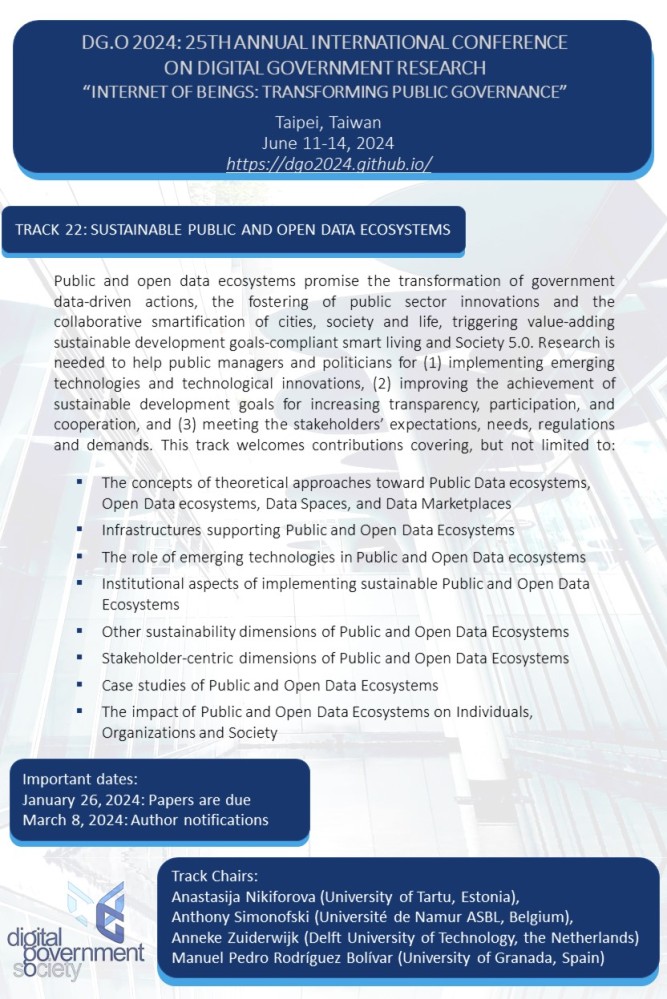
CFP for a new dg.o2024 SUSTAINABLE PUBLIC AND OPEN DATA ECOSYSTEMS track
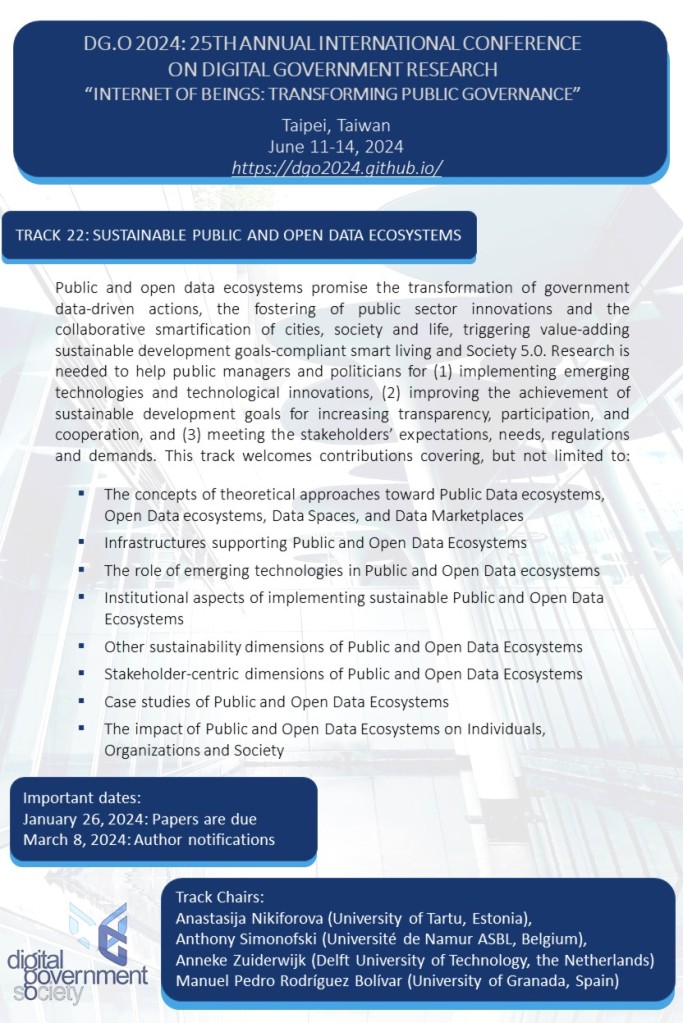
25th Annual International Conference on Digital Government Research (dg.o2024) is coming with the revised list of tracks, where the special attention I invite you to draw to is a new track “Sustainable Public and Open Data Ecosystems” (chairs: Anastasija Nikiforova (University of Tartu, Estonia), Anthony Simonofski (Université de Namur ASBL, Belgium), Anneke Zuiderwijk (Delft University of Technology, the Netherlands) & Manuel Pedro Rodríguez Bolívar (University of Granada, Spain)).
Briefly about the track… Public and open data ecosystems promise the transformation of government data-driven actions, the fostering of public sector innovations and the collaborative smartification of cities, society and life, triggering value-adding sustainable development goals-compliant smart living and society 5.0 (Nikiforova, 2021, Nikiforova et al., 2023). Recent research found that concepts affecting and shaping the ecosystem are: 1) stakeholders / actors and their roles, 2) phases of the data lifecycle, in which a stakeholder participates in the ecosystem, 3) technical and technological infrastructure, 4) generic services and platforms, 5) human capacities and skills of both providers and consumers, 6) smart city domains (thematic categories) as the targeted areas for data reuse, 7) externalities affecting goals, policy, and resources, 8) level of (de)centralization of data sources – development, restrictions, 9) perception of importance and support from public officials, and 10) user interface, user experience, and usability (Lnenicka et al., 2021). The body of knowledge in the above areas (not to say about putting them all together) is very limited. New research is needed to help public managers and politicians for (1) implementing emerging technologies and technological innovations, (2) improving the achievement of sustainable development goals for increasing transparency, participation, and cooperation, and (3) meeting the stakeholders’ expectations, needs, regulations and demands.
This track welcomes contributions covering, but not limited to:
💡 The concepts of theoretical approaches toward Public Data ecosystems, Open Data ecosystems, Data Spaces, and Data Marketplaces;
💡Infrastructures supporting Public and Open Data Ecosystems;
💡The role of emerging technologies in Public and Open Data ecosystems;
💡Institutional aspects of implementing sustainable Public and Open Data Ecosystems;
💡Other sustainability dimensions of Public and Open Data Ecosystems;
💡Stakeholder-centric dimensions of Public and Open Data Ecosystems;
💡Case studies of Public and Open Data Ecosystems;
💡The impact of Public and Open Data Ecosystems on Individuals, Organizations and Society.
The track welcomes both contributions covering the current state-of-the-art of public data ecosystems (what components constitute them, what are the relationships between these components, what makes an ecosystem resilient and sustainable), incl. individual case studies reflecting best or bad practices, as well as those addressing how these ecosystems can be transformed into more sustainable ecosystems that will “fuel” or “smartify” society (Information Society aka Society 4.0 to Super Smart Society aka Society 5.0 transition), cities and various areas of life.
The track is very in line with the conference theme of DGO 2024, namely: Internet of Beings – Transforming Public Governance, where, “the Internet of Beings focuses on digital technologies that enable integration, people-centric, and creation of open platforms for collaborative multi-user to co-create services and products” (as mentioned in the theme description). Public and open data ecosystems can be considered as such open platforms, where data providers and data users find each other and collaborate and co-create to develop services and products useful for society. While digital technologies enable the development of public and open data ecosystems, the adoption of such ecosystems has been fragmented.
Is your research related to any of the above topics? Then do not wait – submit!
🗓️🗓️🗓️Important Dates:
January 26, 2024: Papers, workshops, tutorials, and panels are due
Feb 1, 2021: Application deadline for doctoral colloquium
March 8, 2024: Author notifications (papers, workshops, tutorials, panels)
References:
Nikiforova, A. (2021). Smarter open government data for society 5.0: are your open data smart enough?. Sensors, 21(15), 5204.
Nikiforova, A., Flores, M. A. A., & Lytras, M. D. (2023). The role of open data in transforming the society to Society 5.0: a resource or a tool for SDG-compliant Smart Living?. In Smart Cities and Digital Transformation: Empowering Communities, Limitless Innovation, Sustainable Development and the Next Generation (pp. 219-252). Emerald Publishing Limited.
Lnenicka, M., Nikiforova, A., Luterek, M., Azeroual, O., Ukpabi, D., Valtenbergs, V., & Machova, R. (2022). Transparency of open data ecosystems in smart cities: Definition and assessment of the maturity of transparency in 22 smart cities. Sustainable Cities and Society, 82, 103906.
 Anastasija Nikiforova, PhD