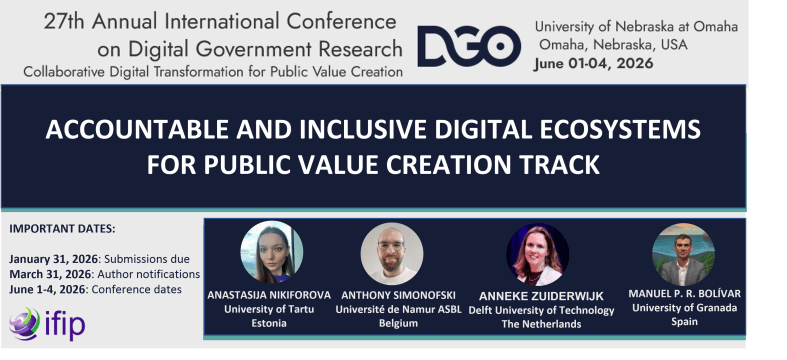

Call for Papers is now open for our track “Accountable and Inclusive Digital Ecosystems for Public Value Creation” at the 27th Annual International Conference on Digital Government Research (dg.o 2026). The conference will take place June 2–5, 2026, at the University of Nebraska at Omaha, USA.
This track continues and expands the work we initiated in 2024 and 2025 on public and open data ecosystems. Responding to new technological and societal realities, we broaden the focus this year toward AI-enabled, interoperable, sustainable, and human-centered digital ecosystems—their design, governance, and impact on public value creation.
Why this track? Why now?
Digital ecosystems are undergoing profound transformation. Emerging technologies—AI (including generative AI), interoperable data spaces, IoT, cloud–edge infrastructures, and new governance frameworks—now form the backbone of digital public action. These technologies unlock unprecedented opportunities for insight generation, collaboration, transparency, and service co-creation across sectors.
Yet they also introduce new challenges: ethics, accountability, trust, digital literacy, and inclusion. As governments and organizations navigate this shift, we need research that bridges technical innovation, institutional capacity, and societal expectations.
Our track provides a space for this conversation.
What the track explores
We invite contributions that examine the conceptual, technical, institutional, and societal dimensions of digital and data ecosystems, with an emphasis on accountability, sustainability, inclusivity, and public value.
Topics of interest include (but are not limited to):
- Ethical and accountable AI, data governance, algorithmic transparency, privacy, security
- Interoperability and trust frameworks, identity infrastructures, standards, reference architectures
- AI, Generative AI, LLMs, NLP, IoT/cloud/edge integration, green computing, Metaverse applications
- Human–AI interaction, explainability, accessibility, inclusion in digital public services
- Stakeholder engagement, empowerment, co-creation, digital literacy, data sovereignty
- Institutional and organizational mechanisms for ecosystem governance and sustainable management
- Open, public, and cross-sector data ecosystems, including data spaces and platform ecosystems
- Social, economic, and environmental sustainability and other public value dimensions
- Case studies from cities, communities, public-sector organizations, and multi-stakeholder collaborations
- Impact assessments of digital ecosystems on individuals, organizations, and society
Connection to the dg.o 2026 theme
The conference theme—Collaborative Digital Transformation for Public Value Creation—aligns perfectly with our track’s purpose.
Digital ecosystems represent socio-technical infrastructures where governance, technology, and societal needs intersect. Understanding how to make these ecosystems accountable, inclusive, and sustainable is essential for collaborative digital transformation and for delivering tangible societal outcomes.
Track chairs
- Anastasija Nikiforova, University of Tartu (Estonia)
- Anthony Simonofski, Université de Namur (Belgium)
- Anneke Zuiderwijk – van Eijk, Delft University of Technology (Netherlands)
- Manuel Pedro Rodríguez Bolívar, Universidad de Granada (Spain)
Together, we bring perspectives from digital government, data governance, public administration, information systems, and socio-technical ecosystem design.
Submission details
Full CFP and submission guidelines are available here:
🔗 https://dgsociety.org/dgo-2026/
We look forward to receiving your submissions and to advancing the conversation on how accountable, inclusive, and sustainable digital ecosystems can drive the next generation of public value creation.
If you have questions about fit or ideas you’d like to discuss, feel free to reach out.






 Anastasija Nikiforova, PhD