IJCAI2025 Workshop on Democracy and AI (DemocrAI 2025) workshop

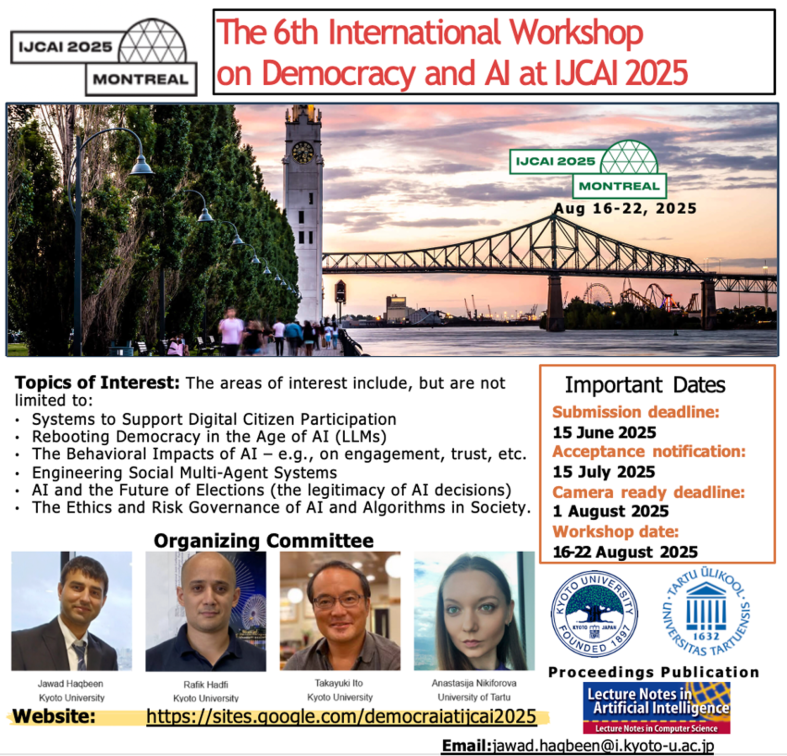
Join us – Jawad Haqbeen, Rafik Hadfi, Takayuki Ito, Anastasija Nikiforova (Kyoto University & University of Tartu) – at the 6th International Workshop on Democracy and AI (DemocrAI 2025) to take place conjunction with the 34th International Joint Conference on Artificial Intelligence (IJCAI 2025) in Montreal (Canada), August 16-22 to examine opportunities and risks associated with AI in democratic contexts.

Recent technical advances in machine learning, natural language processing, and multi-agent systems have greatly expanded the use of artificial intelligence (AI) applications in our daily lives. AI-driven systems are transforming the way we process, monitor, and manage data and services, offering innovative solutions for evidence-based policy planning and decision management. AI offers enormous potential to boost efficiency and improve decision-making by processing large amounts of data. For example, AI-assisted conversational chatbots can help strengthen democratic processes by delivering better public services, customizing services for citizens, facilitating engagement with large groups, connecting their ideas and fostering social participation. However, alongside these benefits, AI may pose risks to individuals, organizations, and society as a whole. One significant concern is that machines lack accountability while generating information and can make decisions that fundamentally affect the lives of ordinary citizens by generating (mis)information. The focus of this workshop will be on both the current and potential uses of AI in society.

This workshop welcomes research on the intersection of AI and democracy, focusing on, but are not limited to:

  • Systems to Support Digital Citizen Participation
  • Tools to Support Decision-Making Process
  • The behavioral impacts of AI – e.g., on civic motivation & engagement, trust, etc.
  • The impact of AI on planning & policy development
  • The role of Societal factors in the implementation of AI
  • Rebooting Democracy in the Age of AI
  • AI and the Future of Wellbeing
  • AI in governance and public participation 
  • AI and the Future of Elections (the legitimacy of algorithmic decisions)
  • The ethics and risk governance of AI and algorithms in society
  • Transparency, Accountability, and Ethical Issues in Artificial Intelligence

Important dates:

  • Paper submission deadline: June 15, 2025
  • Notification of acceptance: July 15, 2025
  • Camera ready submission: August 1, 2025
  • Workshop Date: August 16-22, 2025

Join us at IJCAI 2025 to help shape the future of AI for democratic governance.
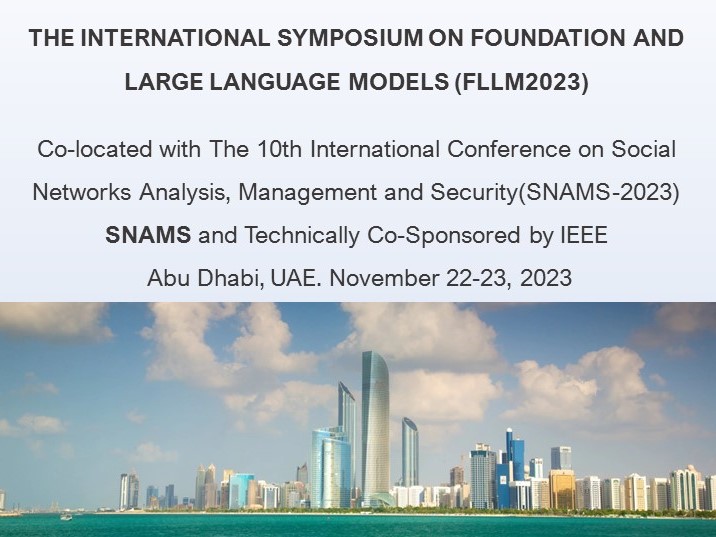
CFP for The International Symposium on Foundation and Large Language Models (FLLM2023)

On behalf of the organizers of the The International Symposium on Foundation and Large Language Models (FLLM2023) co-located with The 10th International Conference on Social Networks Analysis, Management and Security(SNAMS-2023), I am inviting everyone, who is conducting research in this area, to consider submitting the paper to it. Hurry up as the deadline for submitting the paper is October 28! 📢📢📢

Call for Papers:

With the emergence of foundation models (FMs) and and Large Language Models (LLMs) that are trained on large amounts of data at scale and adaptable to a wide range of downstream applications, Artificial intelligence is experiencing a paradigm revolution. BERT, T5, ChatGPT, GPT-4, Falcon 180B, Codex, DALL-E, Whisper, and CLIP are now the foundation for new applications ranging from computer vision to protein sequence study and from speech recognition to coding. Earlier models had a reputation of starting from scratch with each new challenge. The capacity to experiment with, examine, and comprehend the capabilities and potentials of next-generation FMs is critical to undertaking this research and guiding its path. Nevertheless, these models are currently inaccessible as the resources required to train these models are highly concentrated in industry, and even the assets (data, code) required to replicate their training are frequently not released due to their demand in the real-time industry. At the moment, mostly large tech companies such as OpenAI, Google, Facebook, and Baidu can afford to construct FMs and LLMS. Despite the expected widely publicized use of FMs and LLMS, we still lack a comprehensive knowledge of how they operate, why they underperform, and what they are even capable of because of their emerging global qualities. To deal with these problems, we believe that much critical research on FMs and LLMS would necessitate extensive multidisciplinary collaboration, given their essentially social and technical structure.The International Symposium on Foundation and Large Language Models (FLLM) addresses the architectures, applications, challenges, approaches, and future directions. We invite the submission of original papers on all topics related to FLLMs, with special interest in but not limited to:

💡Architectures and Systems

  • Transformers and Attention
  • Bidirectional Encoding
  • Autoregressive Models
  • Prompt Engineering
  • Fine-tuning

💡Challenges

  • Hallucination
  • Cost of Creation and Training
  • Energy and Sustainability Issues
  • integration
  • Safety and Trustworthiness
  • Interpretability
  • Fairness
  • Social Impact

💡Future Directions

  • Generative AI
  • Explainability
  • Federated Learning for FLLM
  • Data Augmentation

💡Natural Language Processing Applications

  • Generation
  • Summarization
  • Rewrite
  • Search
  • Question Answering
  • Language Comprehension and Complex Reasoning
  • Clustering and Classification

💡Applications

  • Natural Language Processing
  • Communication Systems
  • Security and Privacy
  • Image Processing and Computer Vision
  • Life Sciences
  • Financial Systems

Read more here and join our team in Abu Dhabi, UAE. November 22-23, 2023!

The International Open Data Day and my role of Keynote Speaker for the 5th International Conference on Advanced Research Methods and Analytics (CARMA 2023) 🎤🎤🎤

This post is dedicated to two very pleasant events for me, namely the international Open Data Day 🎉🍾🥂, and the announcement of the keynote talk that I was kindly invited to deliver at the 5th International Conference on Advanced Research Methods and Analytics (CARMA) organized and sponsored by Universidad de Sevilla, Cátedra Metropol Parasol, Cátedra Digitalización Empresarial, IBM, Universitat Politècnica de València, Joint Research Center – European Commission and 🥁 🥁 🥁 Coca-Cola – what a delicious conference!🍸🍸🍸

CARMA is a forum for researchers and practitioners to exchange ideas and advances on how emerging research methods and sources are applied to different fields of social sciences as well as to discuss current and future challenges with main focus on the topics such as Internet and Big Data sources in economics and social sciences including Social media and public opinion mining, Web scraping, Google Trends and Search Engine data, Geospatial and mobile phone data, Open data and public data, Big Data methods in economics and social sciences such as Sentiment analysis, Internet econometrics, AI and Machine learning applications, Statistical learning, Information quality and assessment, Crowdsourcing, Natural Language processing, Explainability and interpretability, the applications of the above including but not limited to Politics and social media, Sustainability and development, Finance applications, Official statistics, Forecasting and nowcasting, Bibliometrics and sciencetometrics, Social and consumer behaviour, mobility patterns, eWOM and social media marketing, Labor market, Business analytics with social media, Advances in travel, tourism and leisure, Digital management, Marketing Intelligence analytics, Data governance, and Digital transition and global society, which, in turn, expects contributions in relation to Privacy and legal aspects, Electronic Government, Data Economy, Smart Cities, Industry adoption.

And as almost each and every conference, CARMA expects to have keynotes, which are two – Patrick Mikalef, who will talk about Responsible AI and Big Data Analytics, and me, whose keynote talk will be devoted to the topics I studied in recent years titled “Public data ecosystems in and for smart cities: how to make open / Big / smart / geo data ecosystems value-adding for SDG-compliant Smart Living and Society 5.0?” Sounds interesting? (I hope so) Stay tuned to know more! And return back, since I plan to reflect on the content of both talks and the conference in general.

The CARMA 2023 conference will be held on 28 June – 30 June 2023 in the University of Seville.

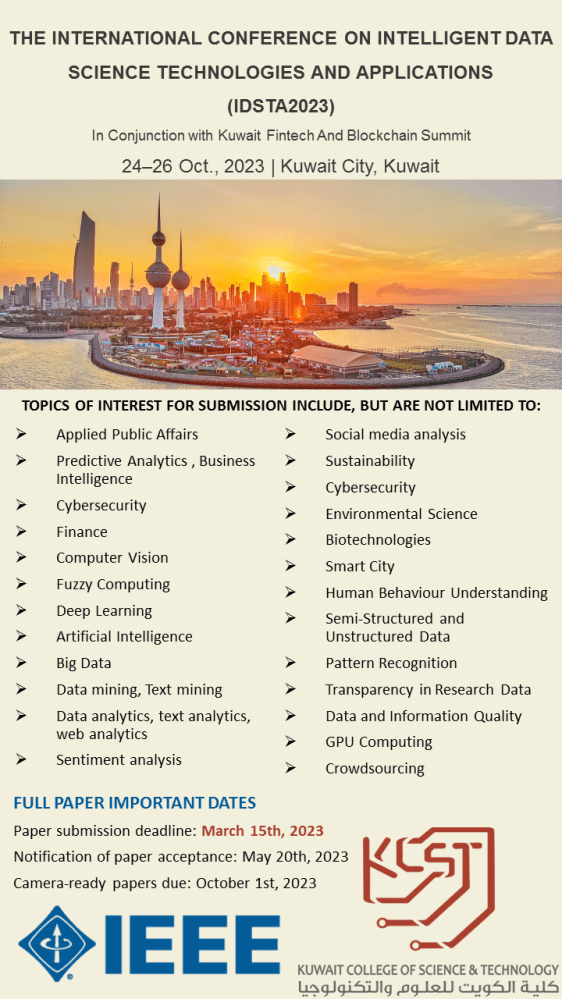
CFP: The International Conference on Intelligent Data Science Technologies and Applications (IDSTA2023)

On behalf of the organizers and as a publicity chair, I sincerely invite you to consider submitting the results of your recent research to The International Conference on Intelligent Data Science Technologies and Applications (IDSTA2023), which will be held in conjunction Kuwait Fintech and Blockchain Summit.

Huge amount of data is being generated and transmitted everyday. To be able to deal with this data, extract useful information from it, store it, transmit it, and represent it, intelligent technologies and applications are needed. The International Conference on Intelligent Data Science Technologies and Applications (IDSTA) is a peer reviewed conference, whose objective is to advance the Data Science field by giving an opportunity for researchers, engineers, and practitioners to present their latest findings in the field. It will also invite key persons in the field to share their current knowledge and their future expectations for the field. Topics of interest for submission include, but are not limited to:

💡Applied Public Affairs, incl. but not limited to Campaign Management, Mass Communication Politics, Political Analysis, Survey Sampling
💡Business Analytics, incl. but not limited to Stock Market Analysis, Predictive Analytics, Business Intelligence
💡Finance, incl. but not limited to Risk Management, Algorithmic Trading, Fraud Detection, Financial Analysis
💡Computer Science, incl. but not limited to Database Management Systems, Scientific Computing, Computer Vision, Fuzzy Computing, Feature Selection, Neural Networks, Deep Learning, Meta-Learning, Process Mining, Artificial Intelligence, Data Mining, Big Data, Web Analytics, Text Mining, Natural Language Processing, Sentiment Analysis, Social Media Analysis, Data Fusion, Performance Analysis and Evaluation, Evolutionary Computing and Optimization, Hybrid Methods, Granular Computing, Recommender Systems, Data Visualization, Predictive Maintenance, Internet of Things (IoT), Web Scraping
💡Sustainability, incl. but not limited to Datasets on Sustainability, Sustainability Modeling, Energy Sustainability, Water Sustainability, Environmental Sustainability, Risk Analysis
💡Cybersecurity, incl. but not limited to Data Privacy and Security, Network Security, Communication Security, Cryptography, Fraud Detection, Blockchain
💡Environmental Science, incl. but not limited to GIS, Climatographic, Remote Sensing, Spatial Data Analysis, Weather Prediction and Tracking,
💡Biotechnologies, incl. but not limited to Gnome Analysis, Drug Discovery and Screening and Side Effect Analysis, Structural and Folding Pattern, Disease Discovery and Classification, Bioinformatics, Next-Gen Sequencing
💡Smart City, incl. but not limited to City Data Management, Smart Traffic, Surveillance, Location-Based Services, Robotics
💡Human Behaviour Understanding
💡Semi-Structured and Unstructured Data
💡Pattern Recognition
💡Transparency in Research Data
💡Data and Information Quality
💡GPU Computing
💡Crowdsourcing


🗓️🗓️🗓️ IMPORTANT DATES

  • Paper submission:  March 15, 2023  
  • Acceptance notification:  May 20th, 2023
  • Full paper camera-ready submission: October 1st, 2023
    Conference Dates: October 24-26, 2023

All papers that are accepted, registered, and presented in IDSTA2023 and the workshops co-located with it will be submitted to IEEEXplore for possible publication. 
For any inquiries, contact intelligenttechorg@gmail.com.

Submit the paper and meet our team in Kuwait in October, 2023!
 

With best wishes,

IDSTA2023 organizers

First International Electronic Governance with Emerging Technologies Conference (EGETC)

As the general co-chair of the First International Conference in Electronic Governance with Emerging Technologies (EGETC-2022), I sincerely invite you to consider your participation as authors and presenters or the attendees in this event.

First International Electronic Governance with Emerging Technologies Conference

Over the last decade, the importance of emerging technologies in government and public administrations has grown significantly. The growing demand for services that better meet changing user expectations for responsiveness and personalization, coupled with higher expectations of the role of government in the digital age, calls for a technologically mature public sector. There are many new emerging technologies serving as enablers to new forms of governance and novel applications in traditional governance functions, which role has been witnessed across various domains, including healthcare, medicine, education, tourism, and industry etc.. 

The aim of the First International Conference in Electronic Governance with Emerging Technologies (EGETC-2022) is to provide a forum for academics, scholars, and practitioners from academia and industry to share and exchange the recent developments in the domain of eGovernment and governance of digital organizations to shed light on the emerging research trends and their applications. 

Topics of interest include, but not limited to:

  • Intelligent systems for coordination in crisis emergency management
  • Distributed ledgers and Blockchains: governance, decentralized autonomous organizations (DAO)
  • Machine Learning (ML), Artificial Intelligence (AI) and Big Data management for Public Sector
  • Privacy, security and legal Informatics – AI and Law
  • Open Data, Open Government Data: transparency, trust, public participation, co-creation and Open Innovation
  • Digital transformation and Society 5.0
  • Linked Data, Linked Open Data (LOD)
  • Semantic E-government applications
  • Public Sector Knowledge Representation
  • Decision Support Systems (DSS) in Digital Governance
  • Natural Language Processing (NLP)
  • Cloud Computing
  • Bots, Automation agents, Self-learning systems 
  • Cryptocurrencies and incentive mechanism design
  • Multimedia and multilingual systems

It is particularly important that, in order to ensure the widest possible participation of communities, despite the availability of funding, the conference does not foresee any charges. I.e. both authors and presenters, and attendees/ listeners are welcome without registration fees.

First International Electronic Governance with Emerging Technologies  Conference (author: Anastasija Nikiforova)

In addition to the great team of organizers and members of the program committee, which has a rich list of outstanding experts, participants of this event will have an opportunity to enjoy the keynote speeches by Prof. Marijn Janssen – Full Professor in ICT & Governance at TU Delft, Netherlands, Dr. B K Murthy, CEO – Innovation and Technology Foundation, IIT Bhilai, Prof. Luis Martinez – Full Professor, University of Jaén, Jaén Spain. More information on their talk will follow…

Accepted papers presented at the EGETC2022 will be published in the proceeding published by Springer in Lecture Notes in Computer Science series (approval pending…). A short list of best papers will be invited for a post-conference publication in Government Information Quarterly (GIQ), Elsevier, Q1, Cite Score: 11.6, Impact Factor: 7.279 and Technological Forecasting and Social Change, An International Journal, Elsevier, Q1, Cite Score: 12.1, Impact Factor: 8.593.

If you are interested in submitting your paper, add to your calendar the submission date – May 30, while the event will take place during September 12-14, 2022.

Due to the unpredictability of the current situation in the light of pandemic, we expect to have a hybrid event, i.e. both online and on-site participation will be possible. For the later mode, we will be very glad to meet participants, who will be able to attend the event physically, in peaceful and spectacular city of Tamaulipas, Mexico in mid-September, 2022. Hope to meet you there!!!