
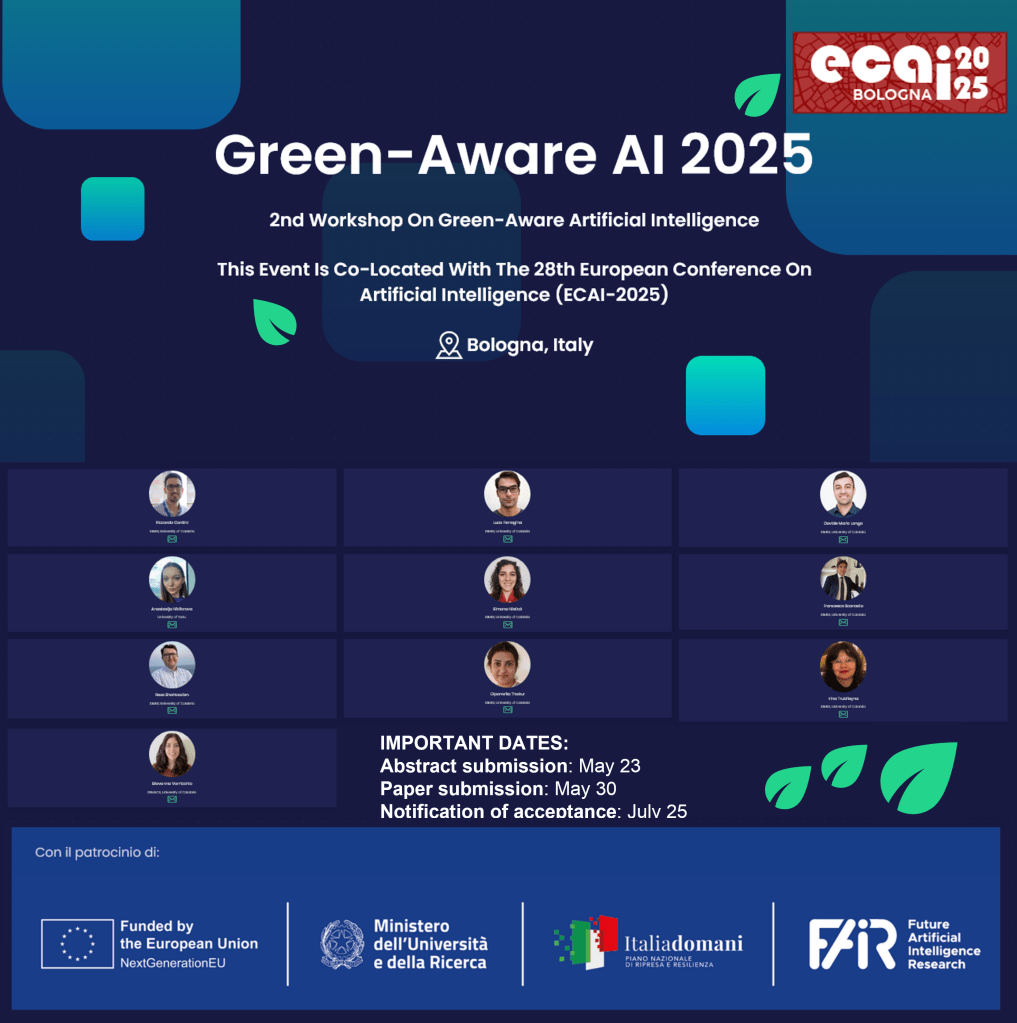
Join us – Riccardo Cantini, Luca Ferragina, Davide Mario Longo, Anastasija Nikiforova, Simona Nisticò, Francesco Scarcello, Reza Shahbazian, Dipanwita Thakur, Irina Trubitsyna, Giovanna Varricchio (University of Calabria & University of Tartu) – at the 2nd Workshop on Green-Aware Artificial Intelligence (Green-Aware AI 2025) to take place conjunction with the 28th European Conference on Artificial Intelligence (ECAI2025) in Bologna, Italy, October 25-30 to examine the sustainability challenges posed by widespread adoption of AI systems, particularly those powered by increasingly complex models, pushing toward responsible AI development and provide a timely response.
The widespread adoption of AI systems, particularly those powered by increasingly complex models, necessitates a critical examination of the sustainability challenges posed by this technological revolution. The call for green awareness in AI extends beyond energy efficiency—it encompasses the integration of sustainability principles into system design, theoretical modeling, and real-world applications.
Green-aware AI requires a multidisciplinary effort to ensure sustainability in its fullest sense, that is, where the green dimension is interpreted broadly, fostering the creation of inherently green-aware AI systems aligned with human-centered values. These systems should uphold sustainability principles such as transparency, accountability, safety, robustness, reliability, non-discrimination, eco-friendliness, interpretability, and fairness—principles reflected in the 17 Sustainable Development Goals (SDGs) defined by the United Nations. The ethical and sustainable advancement of AI systems faces diverse challenges across every stage, including architectural and framework design, algorithm conceptualization, user interaction, data collection, and deployment. This involves designing tools that are inherently green-aware or introducing mechanisms, such as incentives, to encourage agents in AI systems to adopt green-aware behaviors. This principle can be applied across various domains of AI, including but not limited to Algorithm Design, Fairness, Ethics, Game Theory and Economic Paradigms, Machine Learning, Multiagent Systems, and all their applications.
It is worthwhile noting that machine learning systems rank among the most energy-intensive computational applications, significantly impacting the environment through their substantial carbon emissions. Notable examples include the training of large-scale, cutting-edge AI models like those used in ChatGPT and AlphaFold. The creation of such systems demands vast resources, including high-performance computing infrastructure, extensive datasets, and specialized expertise. These requirements create barriers to the democratization of AI, limiting access to large organizations or well-funded entities while excluding smaller businesses, under-resourced institutions, and individuals. The lack of interpretability in AI systems further exacerbates these challenges, raising significant concerns about trustworthiness, accountability, and reliability. Such systems often function as black boxes, making it difficult to understand their underlying decision-making processes. This opaqueness can erode public trust and create barriers to holding developers accountable for harmful outcomes. Additionally, AI systems are prone to biases embedded in their training data and reinforced through user interactions, perpetuating discrimination and unfair treatment, disproportionately affecting marginalized and underrepresented groups.
By addressing these pressing challenges, the workshop aligns with the global push toward responsible AI development and provides a timely response to the environmental and social implications of AI technologies. The primary goal of this workshop is to foster discussions among scholars from diverse disciplines, facilitating the integration of technological advancements with environmental responsibility to drive progress toward a sustainable future. As such Green-Aware AI 2025 invites contributions around the following topics of interest (not limited to thm exclusively though):
💡Green-aware AI frameworks and applications;
💡AI methodologies for energy-efficient computing;
💡Human-centered and ethical AI design;
💡Reliable, transparent, interpretable, and explainable AI;
💡Trustworthy AI for resilient and adaptive systems;
💡Fairness in machine learning models and applications;
💡Impact of AI on underrepresented communities, bias mitigation, and exclusion studies (datasets and benchmarks);
💡Theoretical analysis of energy efficiency in AI systems;
💡Green and sustainable AI applications in environmental and social sciences, healthcare, smart cities, education, finance, and law;
💡Compression techniques and energy-aware training strategies for language models;
💡Approximate computing and efficient on-device learning;
💡Green-oriented models in game theory, economics, and computational social choice;
💡Green-awareness in multi-agent systems;
💡Security and privacy concerns in machine learning models.
Stay tuned about keynotes info on whom to come soon!
📆Important dates:
Abstract submission: May 23
Paper submission: May 30
Notification of acceptance: July 25
Camera-ready: July 31
Join us at Green-Aware AI to help facilitating the integration of technological advancements with environmental responsibility to drive progress toward a sustainable future.
Workshop is supported by the Future AI Research (FAIR), the Italian Ministry of Education, Universities and Research and Italia Domani.
 Anastasija Nikiforova, PhD