Celebrating Our Contribution to the 50th Anniversary of Government Information Quarterly

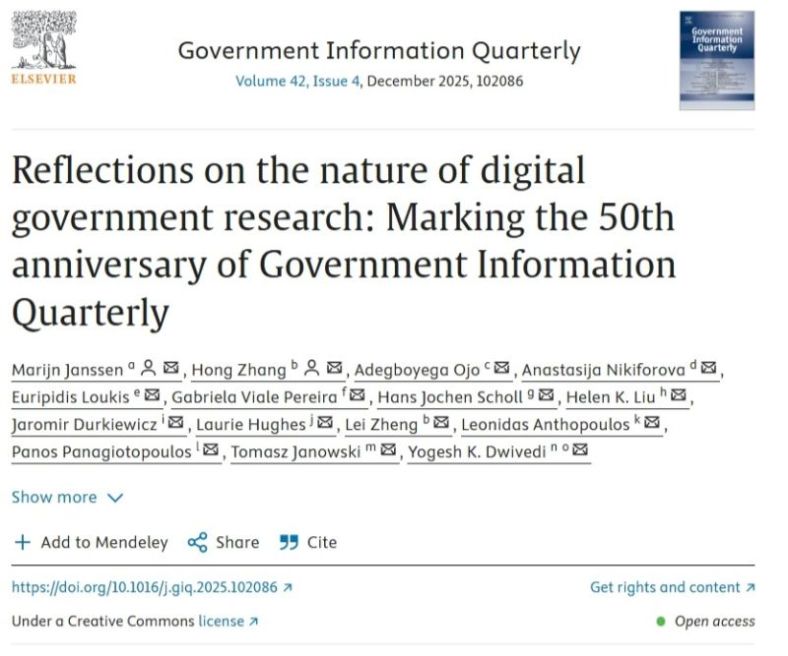
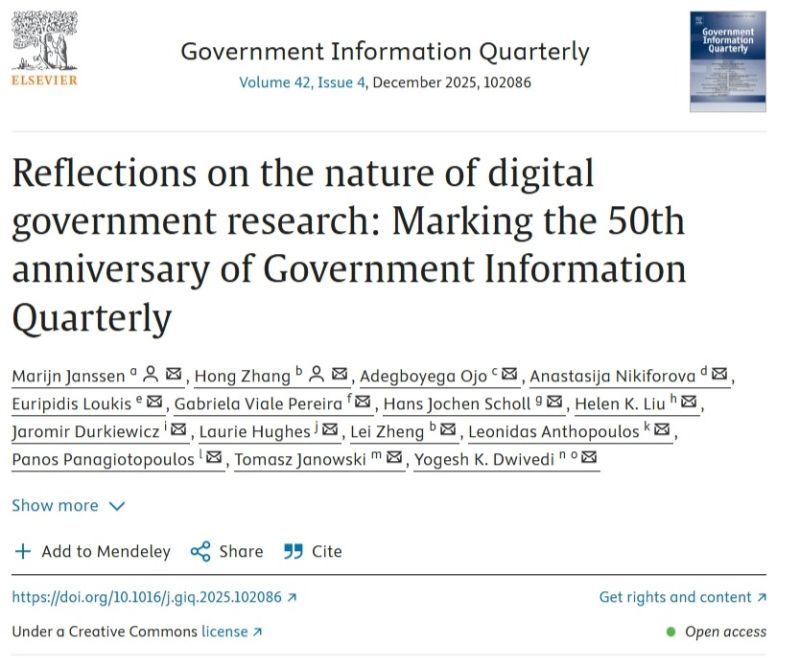
Marking a half-century of shaping the field, Government Information Quarterly (GIQ) celebrates 50 years as the leading journal in digital government research—and I am honored that our latest article, “Reflections on the Nature of Digital Government Research: Marking the 50th Anniversary of Government Information Quarterly,” forms part of this milestone issue constituting an editorial.

This collaborative piece brings together a group of scholars—Marijn Janssen, Hong Zhang, Adegboyega Ojo, Anastasija Nikiforova, Euripidis Loukis, Gabriela Viale Pereira, Hans J. Scholl, Helen Liu, Jaromir Durkiewicz, Laurie Hughes, Lei Zheng, Leonidas Anthopoulos, Panos Panagiotopoulos, Tomasz Janowski, and Yogesh K. Dwivedi—each offering a distinct perspective on how digital government research has evolved, diversified, and responded to societal and technological transformation.

A special thanks goes to Marijn Janssen, former Editor-in-Chief of GIQ, whose vision and coordination made this anniversary reflection possible.

Looking Back: Five Decades of Digital Government Research

Over 50 years, GIQ has chronicled—and often anticipated—the evolution of digital governance: from early computational systems to open government, data-driven innovation, smart cities, and the rise of AI.
Throughout these cycles, the journal has remained the field’s intellectual anchor, publishing research that tackles foundational public sector challenges while engaging with emerging technologies such as blockchain, quantum computing, IoT, AR/VR, and the Metaverse.

Several characteristics continue to define GIQ’s identity:

• Methodological and epistemological pluralism
GIQ’s hallmark is its openness to diverse paradigms, methods, and theoretical lenses. Rather than promoting a single theory of digital government, it invites multiple angles—qualitative, quantitative, mixed, conceptual, comparative—to analyze complex governance realities.

• “Blue-sky” thinking without hype
GIQ encourages forward-looking, innovative, and boundary-pushing ideas, while maintaining analytical discipline. This balance keeps the field visionary yet grounded.

• Impact rooted in both theory and practice
The journal has consistently insisted that strong methodology must lead to meaningful insights—advancing academic understanding while speaking directly to policymakers and practitioners.

• Clear communication to a broad audience
GIQ’s readership extends well beyond academia. With government, industry, and civil society looking to the journal for guidance, clarity and accessibility are essential. As Shakespeare famously said, “brevity is the soul of wit.”

What Our Anniversary Article Contributes

Our contribution synthesizes insights from leading experts to illuminate the nature, evolution, and future of digital government research.
Several overarching themes emerge:

  • epistemological pluralism and interdisciplinarity as fundamental characteristics of the field;
  • contextualized, value-driven, and practice-relevant research as the journal’s core strength;
  • digital transformation as a socio-technical phenomenon, where institutions, technology, data, governance models, and citizen expectations co-evolve;
  • the importance of studying both technology and context, avoiding the pitfalls of black-boxing either side of the equation;
  • GIQ’s role as a platform for blue-sky research, innovation, and rigorous theorization that remains relevant across countries and governance systems.

We dedicate this article to the late Professor Soon Ae Chun, former Co-Editor-in-Chief of GIQ.
Her leadership, scholarship, and unwavering commitment to quality and community have left an enduring mark on the field.

The 50-year anniversary of GIQ is more than a celebration. It is a reminder that the future of digital government research depends on openness: in methods, theories, communication, and imagination. As digital governance accelerates, the journal’s role as a bridge—between disciplines, between theory and practice, and between local realities and global insights—has never been more essential.

Editorial Board Member of International Journal of Information Management (IJIM)

As of February 2024, I am an Editorial Board Member of the probably the most prestigious journal in my area – International Journal of Information Management (IJIM) (SJR Q1, ABDC: A*, IF 21), which focuses on high quality papers that address contemporary issues for all those involved in information management and which make a contribution to advancing information management theory and practice.

The International Journal of Information Management is an international, peer-reviewed journal which aims to bring its readers the very best analysis and discussion in the developing field of information management, which topics include: aspects of information management in learning organisations, health care (patients as well health workers and managers), business intelligence, security in organizations, social interactions and community development, knowledge management, information design and delivery, information for health care, Information for knowledge creation, legal and regulatory issues, IS-enabled innovations in information, content and knowledge management, philosophical and methodological approaches to information management research, new and emerging agendas for information research and reflective accounts of professional practice.

While it is already a great honor to become part of this journal, it is even more honorable considering that I am the first representative of Estonia, as well as Baltic Countries in general (Estonia, Latvia – my home country, and Lithuania). I look forward to contributing to the continuous success of this journal and Information Management and Information Systems areas in general.

Read more about the journal on its official webpage.

Editorial Board Member of Data & Policy (Cambridge University Press)

Since July 2022, I am elected by Syndicate of Cambridge University Press as an Editorial Board Member of the Cambridge University Journal Data & Policy. Data & Policy is a peer-reviewed, open access venue dedicated to the potential of data science to address important policy challenges. For more information about the goal and vision of the journal, read the Editorial Data & Policy: A new venue to study and explore policy–data interaction by Stefaan G. Verhulst, Zeynep Engin, and Jon Crowcroft. More precisely, I act as an Area Editor of “Focus on Data-driven Transformations in Policy and Governance” area (with a proud short name “Area 1“). This Area focuses on the high-level vision for philosophy, ideation, formulation and implementation of new approaches leading to paradigm shifts, innovation and efficiency gains in collective decision making processes. Topics include, but are not limited to:

  • Data-driven innovation in public, private and voluntary sector governance and policy-making at all levels (international; national and local): applications for real-time management, future planning, and rethinking/reframing governance and policy-making in the digital era;
  • Data and evidence-based policy-making;
  • Government-private sector-citizen interactions: data and digital power dynamics, asymmetry of information; democracy, public opinion and deliberation; citizen services;
  • Interactions between human, institutional and algorithmic decision-making processes, psychology and behaviour of decision-making;
  • Global policy-making: global existential debates on utilizing data-driven innovation with impact beyond individual institutions and states;
  • Socio-technical and cyber-physical systems, and their policy and governance implications.

The remaining areas represent more specifically the current applications, methodologies, strategies which underpin the broad aims of Data & Policy‘s vision: Area 2 “Data Technologies and Analytics for Policy and Governance“, Area 3 “Policy Frameworks, Governance and Management of Data-driven Innovations“, Area 4 “Ethics, Equity and Trust in Policy Data Interactions“, Area 5 “Algorithmic Governance“, Area 6 “Data to Tackle Global Issues and Dynamic Societal Threats“.

Editorial committees of Data & Policy (Area 1)

For the types of submission we are interested in, they are four:

  • Research articles that use rigorous methods that investigate how data science can inform or impact policy by, for example, improving situation analysis, predictions, public service design, and/or the legitimacy and/or effectiveness of policy making. Published research articles are typically reviewed by three peer reviewers: two assessing the academic or methodological rigour of the paper; and one providing an interdisciplinary or policy-specific perspective. (Approx 8,000 words in length).
  • Commentaries are shorter articles that discuss and/or problematize an issue relevant to the Data & Policy scope. Commentaries are typically reviewed by two peer reviewers. (Approx 4,000 words in length).
  • Translational articles are focused on the transfer of knowledge from research to practice and from practice to research. See our guide to writing translational papers. (Approx 6,000 words in length).
  • Replication studies examine previously published research, whether in Data & Policy or elsewhere, and report on an attempt to replicate findings.

Read more about Data & Policy and consider submitting your contribution!

Moreover, as a part of this journal, we (Data & Policy community) organize a hybrid physical-virtual format, with one-day, in-person conferences held in three regions: Asia (Hong Kong), America (Seattle) and Europe (Brussels). “Data for Policy: Ecosystems of innovation and virtual-physical interactions” conference I sincerely recommend you to consider and preferably to attend! While this is already the seventh edition of the conference, I take part in its organization for the first year, thus am especially excited and interested in its success!

Data for policy, Area Editors

In addition to its six established Standard Tracks, and reflecting its three-regions model this year, the Data for Policy 2022 conference highlights “Ecosystems of innovation and virtual-physical interactions” as its theme. Distinct geopolitical and virtual-physical ecosystems are emerging as everyday operations and important socio-economic decisions are increasingly outsourced to digital systems. For example, the US’s open market approach empowering multinational digital corporations contrasts with greater central government control in the Chinese digital ecosystem, and radically differs from Europe’s priority on individual rights, personal privacy and digital sovereignty. Other localised ecosystems are emerging around national priorities: India focuses on the domestic economy, and Russia prioritises public and national security. The Global South remains underrepresented in the global debate. The developmental trajectory for the different ecosystems will shape future governance models, democratic values, and the provision of citizen services. In an envisioned ‘metaverse’ future, boundaries between physical and virtual spaces will become even more blurred, further underlining the need to scrutinise and challenge the various systems of governance.

The Data for Policy conference series is the premier global forum for multiple disciplinary and cross-sector discussions around the theories, applications and implications of data science innovation in governance and the public sector. Its associated journal, Data & Policy, published by Cambridge University Press has quickly established itself as a major venue for publishing research in the field of data-policy interactions. Data for Policy is a non-profit initiative, registered as a community interest company in the UK, supported by sustainer partners Cambridge University Press, the Alan Turing Institute and the Office for National Statistics.

Read more about Data for Policy and become a part of it!

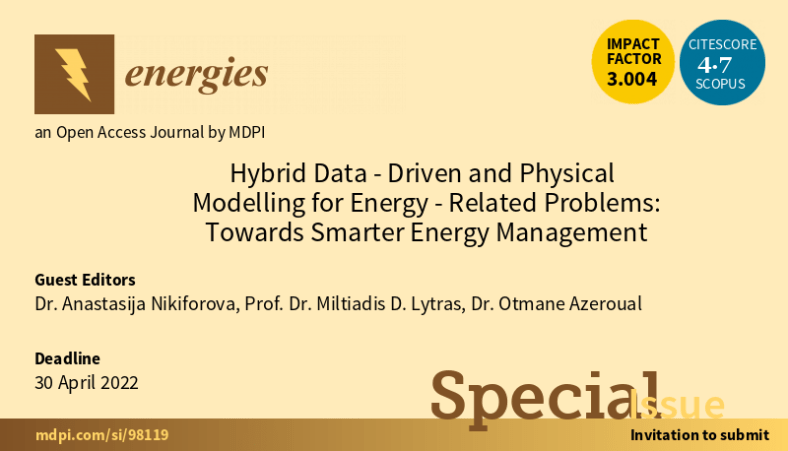
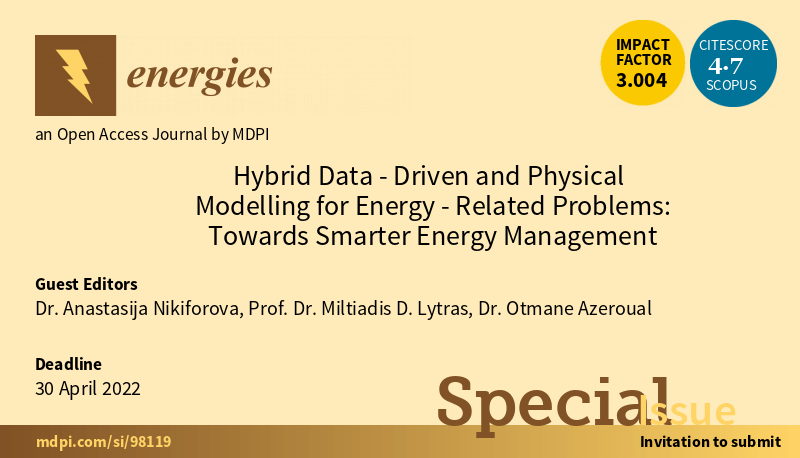
First paper in my Special Issue “Hybrid Data-Driven and Physical Modelling for Energy-Related Problems: Towards Smarter Energy Management”

As an academic editor of the Special Issue “Hybrid Data-Driven and Physical Modelling for Energy-Related Problems: Towards Smarter Energy Management” (Energies MDPI, Impact Factor:3.004 (2020); 5-Year Impact Factor: 3.085 (2020)), I am glad to announce that the first article has been published!

This very special for me issue belongs to the section “A8: Artificial Intelligence and Smart Energy” and it seeking for the latest research on advances in the field covering both data-related topics and next-generation power electronic techniques and their applications. All papers accepted for their publishing are published in an Open Access, thereby significantly contributing to the visibility of these papers, and are submitted for their indexation in both Scopus and Web of Science in addition to other databases. The journal also falls in Q1 (Cite Score, Control and Optimization).

Topics of interest for this Special Issue include, but are not limited to:

  • energy management systems
  • data-driven approaches to energy-related issues
  • advances in energy analytic, including open data on energy, its benefits, re-uses and impact
  • Big Data management in the context of energy data
  • machine learning (ML) techniques
  • physical modelling for energy-related problems
  • disruptive technology of renewable energy
  • blockchain for Internet of energy management
  • the role of the “energy” within the context of Industry 4.0 and Sustainable Goals
  • energy data management in the context of the internet of things (IoT)
  • energy data management via distributed systems
  • smart grid and microgrid
  • sustainable electrical energy systems
  • hybrid and electric vehicle.

This Special Issue is of articular importance, given that energy-related issues are becoming more and more relevant today, including the topic of disruptive technologies, where renewable energy is referred to as one of the 12 most significant disruptive technologies. The topic is no longer limited to energy production/generation and storage and supply as a source of energy; it is becoming broader, including the close links with the electrification of transport, including electric vehicles (smart and green transportation), industrial automation, energy storage systems, data storage and data management systems. With both being very common, and at the same time disruptive and new, energy-related issues relate to both the adaptation of well-known foundations for recent trends and the optimization of the methods and techniques already used, as well as introducing completely new methods and developing new applications, thereby promoting open innovation and smarter living.

Special Issue “Hybrid Data-Driven and Physical Modelling for Energy-Related Problems: Towards Smarter Energy Management”


The first paper accepted for its publishing in the SI is entitled “Machine Learning Schemes for Anomaly Detection in Solar Power Plants” and is authored by Mariam Ibrahim (German Jordanian University), Ahmad Alsheikh (Deggendorf Institute of Technology), Feras M. Awaysheh (University of Tartu Institute of Computer Science) and Mohammad Dahman Alshehri (Taif University). The paper deals with the anomaly detection in photovoltaic (PV) systems by evaluating the performance of different machine learning schemes – AutoEncoder Long Short-Term Memory (AE-LSTM), Facebook-Prophet, and Isolation Forest – and applying them to detect anomalies on photovoltaic components. These models allow the authors to identify the PV system’s healthy and abnormal actual behaviors. The results provide clear insights to make an informed decision, especially with experimental trade-offs for such a complex solution space. The issue explored is all the more topical considering the rapid industrial growth in solar energy, which gains an increasing interest in renewable power from smart grids and plants.

I am very glad and honored to be an academic editor of both this issue (together with my colleagues from Germany and Greece) and this paper in particular.

Special Issue, Academic Editor

Looking forward further submissions (particular focus on advances in the field covering both data-related topics and next-generation power electronic techniques and their applications)!!!