Call for Papers: Accountable and Inclusive Digital Ecosystems for Public Value Creation — dg.o 2026

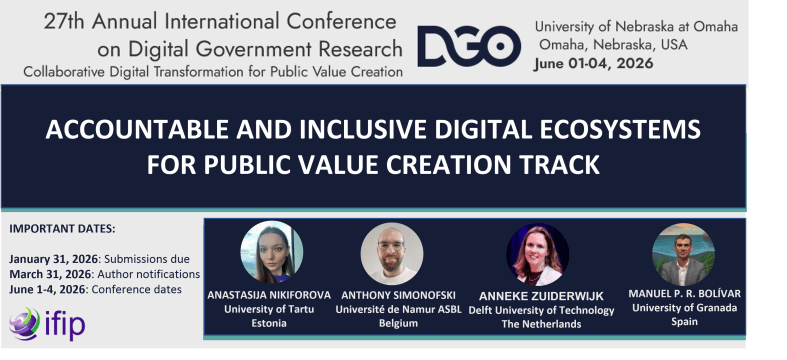
Call for Papers is now open for our track “Accountable and Inclusive Digital Ecosystems for Public Value Creation” at the 27th Annual International Conference on Digital Government Research (dg.o 2026). The conference will take place June 2–5, 2026, at the University of Nebraska at Omaha, USA.

This track continues and expands the work we initiated in 2024 and 2025 on public and open data ecosystems. Responding to new technological and societal realities, we broaden the focus this year toward AI-enabled, interoperable, sustainable, and human-centered digital ecosystems—their design, governance, and impact on public value creation.

Why this track? Why now?

Digital ecosystems are undergoing profound transformation. Emerging technologies—AI (including generative AI), interoperable data spaces, IoT, cloud–edge infrastructures, and new governance frameworks—now form the backbone of digital public action. These technologies unlock unprecedented opportunities for insight generation, collaboration, transparency, and service co-creation across sectors.

Yet they also introduce new challenges: ethics, accountability, trust, digital literacy, and inclusion. As governments and organizations navigate this shift, we need research that bridges technical innovation, institutional capacity, and societal expectations.

Our track provides a space for this conversation.

What the track explores

We invite contributions that examine the conceptual, technical, institutional, and societal dimensions of digital and data ecosystems, with an emphasis on accountability, sustainability, inclusivity, and public value.

Topics of interest include (but are not limited to):

  • Ethical and accountable AI, data governance, algorithmic transparency, privacy, security
  • Interoperability and trust frameworks, identity infrastructures, standards, reference architectures
  • AI, Generative AI, LLMs, NLP, IoT/cloud/edge integration, green computing, Metaverse applications
  • Human–AI interaction, explainability, accessibility, inclusion in digital public services
  • Stakeholder engagement, empowerment, co-creation, digital literacy, data sovereignty
  • Institutional and organizational mechanisms for ecosystem governance and sustainable management
  • Open, public, and cross-sector data ecosystems, including data spaces and platform ecosystems
  • Social, economic, and environmental sustainability and other public value dimensions
  • Case studies from cities, communities, public-sector organizations, and multi-stakeholder collaborations
  • Impact assessments of digital ecosystems on individuals, organizations, and society

Connection to the dg.o 2026 theme

The conference theme—Collaborative Digital Transformation for Public Value Creation—aligns perfectly with our track’s purpose.
Digital ecosystems represent socio-technical infrastructures where governance, technology, and societal needs intersect. Understanding how to make these ecosystems accountable, inclusive, and sustainable is essential for collaborative digital transformation and for delivering tangible societal outcomes.

Track chairs

  • Anastasija Nikiforova, University of Tartu (Estonia)
  • Anthony Simonofski, Université de Namur (Belgium)
  • Anneke Zuiderwijk – van Eijk, Delft University of Technology (Netherlands)
  • Manuel Pedro Rodríguez Bolívar, Universidad de Granada (Spain)

Together, we bring perspectives from digital government, data governance, public administration, information systems, and socio-technical ecosystem design.

Submission details

Full CFP and submission guidelines are available here:
🔗 https://dgsociety.org/dgo-2026/

We look forward to receiving your submissions and to advancing the conversation on how accountable, inclusive, and sustainable digital ecosystems can drive the next generation of public value creation.

If you have questions about fit or ideas you’d like to discuss, feel free to reach out.

CFP for Special Issue in IEEE Transactions on Technology & Society: Trustworthy Data Ecosystems for Digital Societies

IEEE Transactions on Technology & Society launches the new Special Issue on the “Trustworthy Data Ecosystems for Digital Societies“, edited by Asif Gill, Anastasija Nikiforova, Ina M. Sebastian, Martin Lnenicka, Anushri Gupta. On behalf of the editors of this SI, I sincerely invite you to consider submitting your work to it.

Key topics surround intersection of data ecosystem and AI topics, i.e., AI in and for trustworthy data ecosystems, and include, but are not limited to:

  • Impact of trustworthy data ecosystem on digital societies at the local, national and global levels
  • Conceptualization of trustworthy data ecosystems domains and characteristics for digital societies
  • Data trust regulations, polices, strategies and standards
  • Trustworthy data ecosystem infrastructure as a social construct
  • Trustworthy data ecosystem architecture, interfaces, methodologies, orchestration, patterns, solutions, and technology platforms
  • System and data quality, governance, security, privacy, protection, and safety
  • Data linking, interoperability, sharing and observability

Read more in the below CFP or here.

Our – EOSC TF “FAIR Metrics and Data Quality” paper “Towards a data quality framework for EOSC” is released!🍷🍷🍷

I am glad to announce the release of “Towards a data quality framework for EOSC” document, which we have been hard at work on hard for several months as the Data Quality subgroup of the “FAIR Metrics and Data Quality” Task Force European Open ScienceCloud (EOSC) Association) – Carlo Lacagnina, Romain David, Anastasija Nikiforova, Mari Elisa Kuusniemi, Cinzia Cappiello, Oliver Biehlmaier, Louise Wright, Chris Schubert, Andrea Bertino, Hannes Thiemann, Richard Dennis.

This document explains basic concepts to build a solid basis for a mutual understanding of data quality in a multidisciplinary environment such as EOSC. These range from the difference between quality control, assurance, and management to categories of quality dimensions, as well as typical approaches and workflows to curate and disseminate dataset quality information, minimum requirements, indicators, certification, and vocabulary. These concepts are explored considering the importance of evaluating resources carefully when deciding the sophistication of the quality assessments. Human resources, technology capabilities, and capacity-building plans constrain the design of sustainable solutions. Distilling the knowledge accumulated in this Task Force, we extracted cross-domain commonalities (each TF member brings his / her own experience and knowledge – we all represent different domains and therefore try to make our contributions domain-agnostic, but at the same time considering every nuance that our specialism can bring and what deserves to be heard by others), as well as lessons learned, and challenges.

The resulting main recommendations are:

  1. Data quality assessment needs standards; unfortunately, not all communities have agreed on standards, so EOSC should assist and push each community to agree on community standards to guarantee the FAIR exchange of research data. Although we extracted a few examples highlighting this gap, the current situation requires a more detailed and systematic evaluation in each community. Establishing a quality management function can help in this direction because the process can identify which standard already in use by some initiatives can be enforced as a general requirement for that community. We recommend that EOSC considers taking the opportunity to encourage communities to reach a consensus in using their standards.
  2. Data in EOSC need to be served with enough information for the user to understand how to read and correctly interpret the dataset, what restrictions are in place to use it, and what processes participate in its production. EOSC should ensure that the dataset is structured and documented in a way that can be (re)used and understood. Quality assessments in EOSC should not be concerned with checking the soundness of the data content. Aspects like uncertainty are also important to properly (re)use a dataset. Still, these aspects must be evaluated outside the EOSC ecosystem, which only checks that evidence about data content assessments is available. Following stakeholders’ expectations, we recommend that EOSC is equipped with essential data quality management, i.e., it should perform tasks like controlling the availability of basic metadata and documentation and performing basic metadata compliance checks. The EOSC quality management should not change data but point to deficiencies that the data provider or producer can address.
  3. Errors found by the curators or users need to be rectified by the data producer/provider. If not possible, errors need to be documented. Improving data quality as close to the source (i.e., producer or provider) as possible is highly recommended. Quality assessments conducted in EOSC should be shown first to the data provider to give a chance to improve the data and then to the users.
  4. User engagement is necessary to understand the user requirements (needs, expectations, etc.); it may or may not be part of a quality management function. Determining and evaluating stakeholder needs is not a one-time requirement but a continuous and collaborative part of the service delivery process.
  5. It is recommended to develop a proof-of-concept quality function performing basic quality assessments tailored to the EOSC needs (e.g., data reliability and usability). These assessments can also support rewarding research teams most committed to providing FAIR datasets. The proof-of-concept function cannot be a theoretical conceptualization of what is preferable in terms of quality. Still, it must be constrained by the reality of dealing with an enormous amount of data within a reasonable time and workforce.
  6. Data quality is a concern for all stakeholders, detailed further in this document. The quality assessments must be a multi-actor process between the data provider, EOSC, and users, potentially extended to other actors in the long run. The resulting content of quality assessments should be captured in structured, human- and machine-readable, and standard-based formats. Dataset information must be easily comparable across similar products, which calls for providing homogeneous quality information.
  7. A number of requirements valid for all datasets in EOSC (and beyond) and specific aspects of a maturity matrix gauging the maturity of a community when dealing with quality have been defined. Further refinement will be necessary for the future, and specific standards to follow will need to be identified.

We sincerely invite you to take a look at this very concise 76-pages long overview of the topic and look forward to your recommendations / suggestions / feedback – we hope to provide you with the opportunity to communicate the above conveniently very soon, so take your time to read, while we are making our last preparations 📖 🍷📖🍷📖🍷 But make sure you have a glass of wine at the time of reading it, as this will make sense at some point of reading, i.e. when we compare data quality with wine quality with reference to both flavour type and intensity (intrinsic quality), brand, packaging (extrinsic quality)… but no more teasers and bon appetite! 🍷🍷🍷
The document can be found in an Open Access here.

We also want to acknowledge the contribution and input of colleagues from several European institutions, the EOSC Association and several external-to-TF stakeholders who gave feedback based on their own experience, and the TF Support Officer Paola Ronzino, as well as to our colleagues – Sarah Stryeck and Raed Al-Zoubi, and the last but not the list – to all respondents and everyone involved.

ONE Conference 2022: why to attend and how to meet me there?

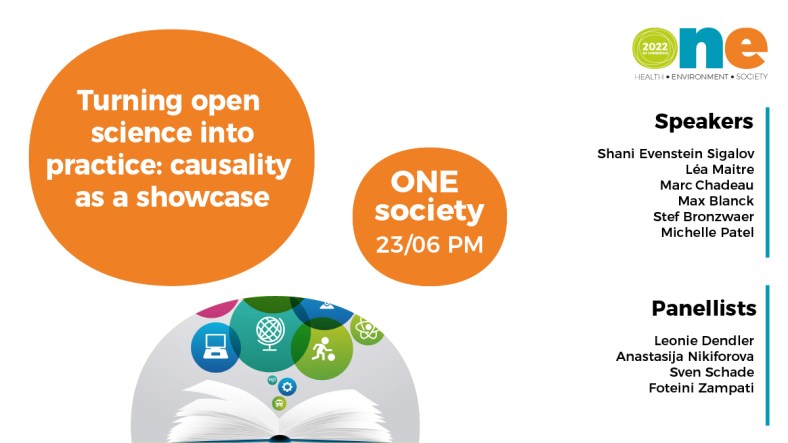
The ONE Conference 2022 (Health, Environment, Society) – a four-day event happening in Brussels and online, is coming! Register and meet me there ️(Brussels & online, 21-24 June) as one of panelists of the “Turning open science into practice: causality as a showcase” thematic session as part of “ONE society” thematic track.

ONE Conference 2022 provides its attendees with a series of break-out sessions grouped in four thematic tracks – ONE Life, ONE Planet, ONE Society and MANY Ways. The sessions are complemented by side events and networking opportunities for both in-person and online participants, where some side events, in the form of workshops, will take place before the formal start of the conference.

The ONE Conference 2022 is co-organised by EFSA and its European sister agencies – the European Centre for Disease Prevention and Control [ECDC], the European Chemicals Agency [ECHA], the European Environment Agency [EEA] and the European Medicines Agency [EMA] and the European Commission’s Joint Research Centre (JRC), with the ambition of embracing a ONE Health and ONE Society approaches.

Briefly about the above mentioned thematic tracks:

  • the ONE Society sessions will put the societal dimension of food safety and its ecosystem in the spotlight: from the role of society in policy making, to collaboration and partnerships right through to bringing research closer to policy. Dolors Montserrat from the European Parliament’s ENVI Committee will speak on the panel addressing citizens’ participation in EU decision-making, while former Dutch Minister Gerda Verburg from the Scaling up Nutrition (SUN) Movement features in the session on collaboration among actors in the food safety field. Michael Catchpole, Chief Scientist of the European Centre for Disease Prevention and Control (ECDC), will moderate the discussion on how ENVI agencies can work together to support research and bridge the gap between research and policy. Meanwhile, Shani Evenstein Sigalov, member of the Wikimedia Foundation and lecturer at the University of Tel Aviv, will share her views on opening up regulatory science.
  • the ONE Life sessions will focus on the questions on how to ensure safe, healthy and sustainable food, where Francesco Branca (Director of the Department of Nutrition and Food Safety of the World Health Organization (WHO)) will share his views on how to define healthy diets within sustainability boundaries as part of a session on sustainability and food security. Matias Zurbrigen (Head of the Institute of Synthetic Biology of the University of Dusseldorf) will consider safety aspects relating to new food production approaches such as synthetic biology as part of a session on innovative foods. Meanwhile, Ilaria Capua from the University of Florida, will focus on the post-pandemic environment and the concept of Circular Health as part of a discussion on improving our understanding of infectious diseases. How to ensure safety assessments keep pace with the emergence of new diseases will also be discussed. Luisa Peixe, professor at the University of Porto and member of EFSA’s Panel on Biological Hazards, will discuss the growing challenge of antimicrobial resistance (AMR) focussing on the link to food-producing environments.
  • the ONE Planet sessions will focus on the environmental dimension of food safety and sustainability, where Serenella Sala from the Joint Research Centre (JRC) of the European Commission is among the experts who will share their views on how to develop a framework for sustainability assessments to measure progress made towards environmental goals. Annette Aldrich from the Swiss Federal Office for the Environment (FOEN), an expert in ecotoxicology and member of EFSA’s Panel on Plant Protection Products and their Residues, will explain why a paradigm shift is needed in the environmental risk assessment of pesticides. Helen Elizabeth Roy from the UK Centre for Ecology & Hydrology will feature in discussions on plant protection in the face of globalisation, particularly how global trade and climate change will affect plant pests, invasive species and diseases. Meanwhile, Linda Keeling, professor of Animal Welfare at the Swedish University of Agricultural Sciences (SLU), will speak about the links between animal welfare and the UN Sustainable Development Goals (SDGs) in a session dedicated to improving animal welfare and reducing environmental impacts in relation to animal-sourced food.
  • the MANY WAYS sessions will cover topics ranging from Artificial Intelligence (AI) to new approach methodologies (NAMs), where Raluca Crisan, founder and CTO of the testing platform ETIQ AI, will speak in the session related to integrating AI technology and big data in food safety. Chris Gennings, professor at the Icahn School of Medicine at Mount Sinai, will discuss how the risk assessment of combined exposure to multiple chemicals can be developed. The session on new approach methodologies (NAMs) moderated by Maurice Whelan, head of the EU Reference Laboratory for alternatives to animal testing at the Joint Research Centre (JRC), will explore opportunities for moving beyond animal testing to in vitro and in silico approaches. The session on Endocrine Disruptors (EDs) will feature Andreas Kortenkamp, professor at Brunel University, who will deliver a talk on the science behind the identification of endocrine disruptors for humans and non-target organisms. The session will also look at benefits of shifting to a more integrated assessment for chemicals as a whole. Sangeeta Khare from the National Center for Toxicological Research of the US Food and Drug Administration will address risk assessment criteria for gastrointestinal toxicity induced by xenobiotics as part of a session on the microbiome. The session will examine the evidence base connecting the microbiome, chemicals and human health.
  • the closing plenary to wrap up the four-day programme will reflect on the outcomes of the thematic (break-out) sessions. The discussion will also address how the One Health principles could help advance food safety assessments, and how more integrated, cross-sectoral and collaborative health assessments could inform policies shaping the transition towards more sustainable food systems. Sandra Gallina, the European Commission’s Director-General for Health and Food Safety, will outline the EU’s policy vision for the transition towards more sustainable and resilient food systems. Bernhard Url, EFSA’s Executive Director, will bring the conference to a close with some concluding remarks.

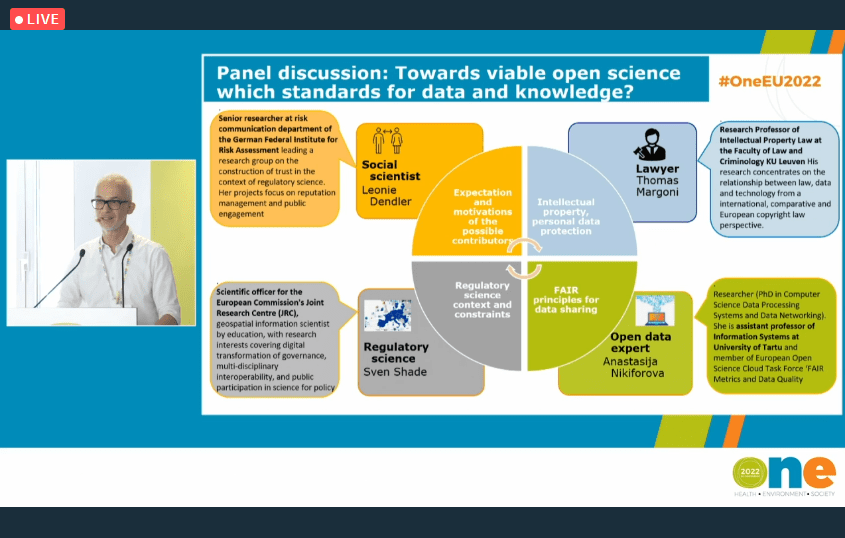
But let’s take a step back to the session “ONE society” thematic track I emphasized before and Turning open science into practice: causality as a showcase thematic session, in which I am involved as one of four panelists, invited to share my experience on the data quality, open science and open data questions in both academia and industry with the reference to the European Open Science Cloud I represent (Task Force “FAIR metrics and data quality”) and my previous experience working as IT-expert at the Latvian Biomedical Research and Study Centre, BBMRI-ERIC Latvian National Node. This session is devoted to the open science movement resulted in the demand for transparent and accessible-to-all scientific processes. Open science promotes and supports research collaboration and co-creation, including public participation in the scientific process via crowdsourcing data, methods, computational capacity and scientific knowledge. The adoption of a more participatory approach offers new opportunities to regulatory science organizations. It helps them extend the pool of data, expertise and knowledge from which to draw, thus accelerating their preparedness to address complex questions. It can also help in enhancing the public understanding of science, and in finally reducing citizens’ scepticism. An open science approach also poses challenges, including the need to monitor the accuracy and reliability of open data as well as their possible misuse. The session will offer an opportunity for sharing experiences on obstacles, benefits and the feasibility of adopting open science approaches in the context of regulatory science. The showcase example will focus on causality, i.e. the relationship between a cause and an effect. With larger availability of open access data, including those gathered using high-throughput techniques, unprecedented options for deeper insights into causality have emerged. Using causality as an illustrative example, the session intends to advance the discussion on how the principles of open science can be routinely implemented in the scientific activities performed by the European institutions. The guiding questions are: Can institutions benefit from open data and the open science movement, and if so, how? can participatory science accelerate finding solutions to quantitatively integrate heterogeneous sources to address causality? In other words, Whether and how open data currently available can be used to address the assessment of causal association between an agent and an effect in the regulatory domain? What are possible benefits and challenges from their use? How to guarantee that data and knowledge generated by an open science approach are accurate and reliable enough for use by regulatory science organisations? Which concrete actions need to be put in place to implement open science principles in the context of regulatory science? How to revise the legal framework to address new challenges related to personal data protection and intellectual property right? Although I am sure we will define many more questions to be asked and answered – hopefully answered 🙂

To sum up, this thematic session intends to advance the discussion on how the principles of open science can be routinely implemented in the scientific activities performed by the European Agencies/Institutions. Causality will be discussed as a case study topic, which, in fact, is among the most challenging questions which EU institutions are required to answer. 

All in all, it seems that the session should be incredibly interesting with many perspectives covered by its participants, with the coordinator of this session – Laura Martino, session contributors – Federica Barrucci, Claudia Cascio, Laura Ciccolallo, Marios Georgiadis, Giovanni Iacono, Yannick Spill both representing European Food Safety Authority (EFSA), and panelists – me – Anastasija Nikiforova representing both the EOSC European Open Science Cloud Task Force ‘FAIR metrics and data quality’ and University of Tartu, Institute of Computer Science, Leonie Dendler from the German Federal Institute for Risk Assessment (BfR), Sven Schade representing Joint Research Centre (JRC), Foteini Zampati.


Read more about the event here.

Looking forward this event, fruitful discussions, great talks and decisions on how to make this world better!!!