EGOV2025 – IFIP EGOV-CeDEM-EPART 2025 & our Emerging Issues and Innovations Track

Are you focusing on new topics emerging in the field of ICT and public sector, incl. public-private ecosystems? Then it is time to start preparing your submission for EGOV2025 – IFIP EGOV-CeDEM-EPART Emerging Issues and Innovations Track, which this time we chair in the updated form, welcoming A. Paula Rodriguez Müller on the board with us – Francesco Mureddu (The Lisbon Council, Belgium)and myself – Anastasija Nikiforova (Tartu University, Estonia)).

EGOV2025 – IFIP EGOV-CeDEM-EPART is one of the most recognized conference in e-Government, ICT and public administration and related topics, which this year will be hosted in Belgium, in the heart of Europe, by University for Continuing Education Krems, Austria. This year, IFIP EGOV 2025 is dedicated to the broader areas of e-Government and e-Democracy, which include facets like Digital Government, e-Participation, Open Government,  Smart Government, AI government, GovTech, Algoritmic Governance, and related topics to digitalization and government.

Innovation and application of emerging technologies are now more and more in the thinking of governments at all levels. While it would be easy to consider the public sector as being less flexible or slow in adoption, presentations at recent EGOV conferences proved that one should not come to such a conclusion too easily. Upcoming technologies, innovative organizational solutions, or new avenues of public sector involvement in the public sector are becoming more commonplace along with the potential challenges and issues these bring. Policymakers and public sector officials are now expected to embrace change, consider digital transformation, or improve governance practices. At the same time, public sector researchers are also influenced by new views, methods, tools, and techniques. The goal of this track is to provide a platform for the discussion of new ideas, issues, problems, and solutions entering the public sphere. Ideas that are emerging but might not fit other conference tracks are also welcome. Focus may include, but are not limited to:

  • Looking ahead into social innovation;
  • Future studies, the future of government, policy-making and democracy;
  • The future of digital governance;
  • Public values in transforming the government;
  • The role of government in smart cities (incl. smart sustainable cities) and sustainable living;
  • The role of the public sector in Human-Centered Society (Society 5.0);
  • New trends in public sector research such as Metaverse, Cityverse, Large Language Models (LLMs), generative AI and its implementations such as chatGPT, Claude, ChatSonic, Poe – benefits, risks, adoption and resistance to its adoption by the public sector and citizens;
  • Government in the Virtual Worlds and Web 4.0;
  • Decentralized Autonomous Organizations (DAOs), smart contracts and blockchain;
  • New technologies for automated decision-making and their policy implications;
  • Public sector use and regulation of AI, genAI, Industry 4.0, Industry 5.0, and the Internet of Things (IoT);
  • Digital Humanism (responsible and ethical integration of technology into society, ensuring that human values and dignity are prioritized in the development and use of digital tools and innovations);
  • The role of the public sector in competitiveness and tech sovereignty;
  • Global challenges that go beyond nation states (such as migration, climate change etc.) and which require international collaboration of individual governments;
  • Preparing for the policy challenges of future technologies;
  • Regulating misinformation;
  • Digital transformation in public sector contexts;
  • Self-Service Structures for Inclusion;
  • Public-private sector collaboration and integration;
  • GovTech initiatives and innovations;
  • Latest trends in co-creation and service delivery;
  • Online public community building;
  • Upcoming issues of eVoting / internet voting including application of digital signatures in the public sector;
  • Discussion of new research methods that have not been applied in this context;
  • Application of role theory in the analysis of public sector functions and processes;
  • Forward looking insights from case studies – let it be successful or failed experiments.
  • Utilization of digital billboards;
  • Public sector use and regulation of Fintech innovations;
  • Theoretical and practical approaches to experimentation and sandboxing in the public sector.Future studies, the future of government, policy-making and democracy

Stay tuned, more info to come!
Data for Policy 2025 Europe Edition

And we are back with the new edition of Data for Policy 2025 Conference, preparation to which are in full swing! And as part of these preparations, we 📣 Call for Special Tracks for Data for Policy 2025 Europe Edition to be submitted by 11 December, 2024, with the conference itself to be held on 12-13 June, 2025, at Leiden University, The Hague, Netherlands!

This time, the Data for Policy 2025 conference will run under the “Twin Transitions in Data and Policy for a Sustainable and Inclusive Future”.

Amidst global challenges, the “twin transition”—encompassing digital and green transformations—has garnered significant attention for its potential to reshape industrial ecosystems and influence social inequalities. However, in the scientific community and policy arena questions have been raised on whether green and digital transitions are mutually compatible or whether one transition can reduce or cancel out the other. Furthermore, we see sustainability as an integrative perspective that includes  environmental, social, economical and institutional sustainability.

Both public and private sectors are increasingly aligning their objectives towards digital innovation and sustainable practices 🌍. Governments are developing policies to guide these transitions, ensuring that technological advancements account for sustainability. Concurrently, substantial investments are being funneled into industries poised to drive this twin transition. Data lies at the heart of this transformation, empowering  policymakers to monitor progress in real-time, identify emerging trends, and design impactful and targeted strategies. From driving down carbon emissions to closing the digital divide, data-driven insights offer the actionable intelligence needed to tackle complex challenges and pave the way toward a more equitable, sustainable future. 

At this nexus, the theme of the European Data for Policy Conference is “Twin transitions in data and policy for a sustainable and inclusive future”, where we will delve into the implications of these transitions for governance, data usage, and policymaking 

With CFP to be launched in a month, now, we – Sarah Giest, Bram Klievnik (both local chairs), Leid Zejnilovic, Laura Zoboli, Anastasija Nikiforova – invite proposals for Special Tracks in two categories:

  • Research/Policy/Practitioner Tracks: These tracks should address how digital and green initiatives work together to overcome global challenges. Proposals should align with the conference theme, “Twin Transitions in Data and Policy for a Sustainable and Inclusive Future”.
  • Policy/Practitioner Tracks: We invite proposals from those focused on policy and real-world applications, addressing the broader Data for Policy theme.

Proposers are encouraged to consider region-specific challenges alongside the conference theme, which offers a framework but is open to all relevant Data for Policy topics.

🗓 Track Proposal Submission Deadline: 11 December, 2024
For more information on the call 👉 Data for Policy 2025 Conference – Europe Edition: Call for Special Tracks – Data for Policy, for more information on the conference 👉 Data for Policy 2025 Europe – Data for Policy

Accepted tracks will be part of the wider call for abstracts, full papers and panels, set to be released on 20 December, 2024, with Special Track chairs having the opportunity to propose an associated Special Collection in the Data & Policy journal published by Cambridge University Press & Assessment in due course. 

Keep an eye open on other regional editions taking place as part of the Data for Policy 2025 Conference Series.

27th European Conference on Artificial Intelligence (ECAI 2024): Celebrating the past, inspiring the future

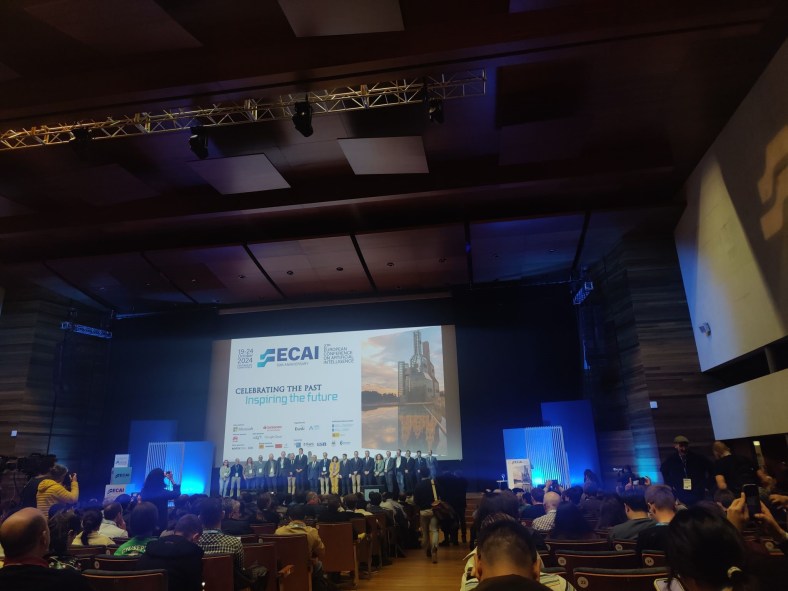
This October was one of the busiest yet most rewarding months of the year for me. Among several work trips, the highlight was attending the 27th European Conference on Artificial Intelligence (ECAI 2024) in Santiago de Compostela, Spain. Celebrating its 50th anniversary, ECAI remains Europe’s premier venue for AI research and innovation, bringing together thought leaders, researchers, and industry professionals from around the world.

This year’s theme, “Celebrating the Past, Inspiring the Future,” captured the spirit of ECAI’s half-century legacy while driving forward-looking discussions on the next era of artificial intelligence. With over 1,500 participants from 59 countries (so not so very European conference anymore, but rather a global event) and a packed schedule of more than 150 events, among which:

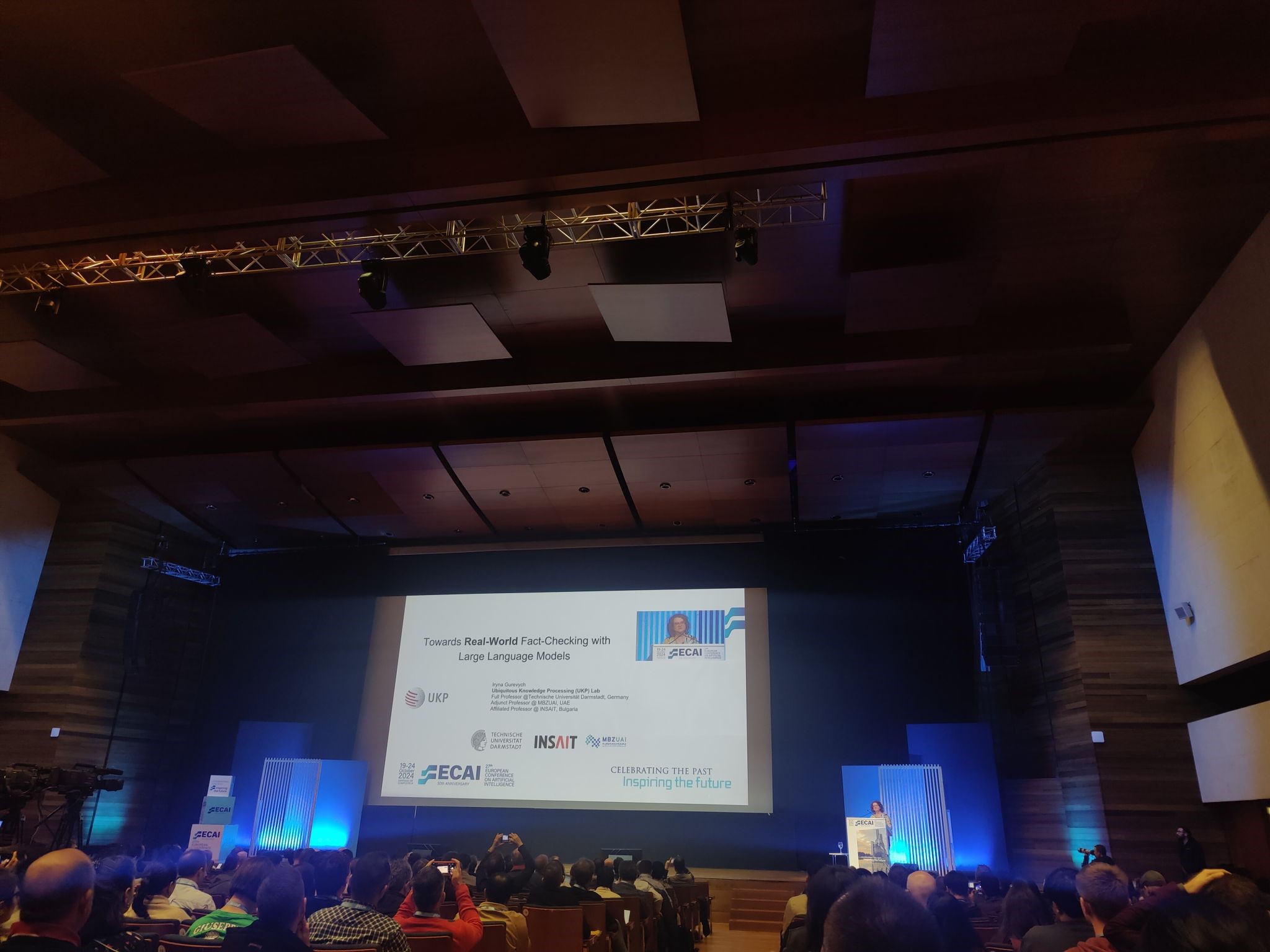
  • “Towards Real-World Fact-Checking with Large Language Models” keynote talk by Iryna Gurevych, (Technische Universität Darmstadt), reflecting on advancements in using language models for verifying information in real time;
  • “Robots (Still) Need Humans in the Loop,” keynote talk by Iolanda Leite (KTH Royal Institute of Technology), who underscored the essential role humans play in AI-driven robotics, even as systems grow more autonomous;
  • “Economic Complexity: Using Machine Learning to Understand Economic Development” keynote talk by Cesar A. Hidalgo (Toulouse School of Economics & Corvinus University of Budapest) that examined how machine learning is transforming our understanding of economic trends and predictions.

These were accompanied with a range of panels, with a few sessions that stood out (my personal opinion though):

  • Economic Impact of AI: Threats and Opportunities with Jeremy Rollison (Microsoft Corporation), David Autor (MIT), and Raquel Jorge Ricart (Elcano Royal Institute) on AI’s potential to reshape labor markets and economies around the world;
  • AI Regulation: The European Scenario (Kilian Gross, Dr. Clara Neppel, IEEE, Beatriz Alvargonzalez Largo, European Commission, José Miguel Bello Villarino, ARC Centre of Excellence for Automated Decision-Making and Society), addressed regulatory considerations;
  • 50th Anniversary Session on the History of AI in Europe paying tribute to AI’s history in Europe, with Luc Steels, Stefano Cerri, Fredrik Heintz, and Tony Cohn sharing reflections on past achievements and a “follow-up” on it in the Future of AI: The Next 50 Years with Fredrik Heintz, Iryna Gurevych, José Hernández-Orallo, Ann Nowe, Toby Walsh;
  • Designing Ethical and Trustworthy AI Research Policies for Horizon Europe centered on ethical standards and trustworthy AI research practices within the EU’s Horizon program, led by Mihalis Kritikos from the European Commission;
  • Funding your Scientific Research with the European Research Council (ERC) with Enrique Alba.

As part of this conference, I had pleasure of presenting a paper co-authored with my former student Jan-Erik Kalmus, based on his Master’s thesis, which I had the privilege of supervising. Our paper, To Accept or Not to Accept? An IRT-TOE Framework to Understand Educators’ Resistance to Generative AI in Higher Education,” examined what barriers might prevent educators from adopting Generative AI tools in their classrooms? Since the public release of ChatGPT, there has been a lively debate about the potential benefits and challenges of integrating Generative AI in educational contexts. While the technology holds promise, it has also sparked concerns, particularly among educators. In the field of information systems, Technology Adoption models are often used to understand factors that encourage or inhibit the use of new technologies. However, many existing models focus primarily on acceptance drivers, often overlooking the unique barriers that educators face. This study seeks to fill that gap by developing a theoretical model specifically tailored to identify the barriers that may prevent educators—academic staff in particular—from integrating Generative AI into their teaching. Our approach builds on Innovation Resistance Theory, augmented by constructs from the Technology-Organization-Environment (TOE) framework. With the designed mixed-method measurement instrument, combining quantitative data with qualitative insights, to capture educators’ specific concerns around Generative AI adoption in higher education, our model has been applied in real-world settings, specifically focusing on Estonian higher education institutions. We examined whether academic staff at public universities in Estonia – often referred to as a “digital nation” – show reluctance toward Generative AI use in educational settings. Preliminary findings highlight several concerns unique to educators, which may shape how Generative AI is integrated into teaching practices.

A Heartfelt Thanks to ECAI’s Organizers – the European Association for Artificial Intelligence (EurAI), the Spanish Artificial Intelligence Society, CiTIUS (Research Centre on Intelligent Technologies), and, of course, the city of Santiago de Compostela for being such a welcoming place.

Guest Lecture for the Federal University of Technology – Paraná (UTFPR) on “Unlocking the symbiotic relationship of Artificial Intelligence, Data Intelligence, Collaborative Intelligence, and Embodied Intelligence for innovative urban planning and governance of Smart Cities”

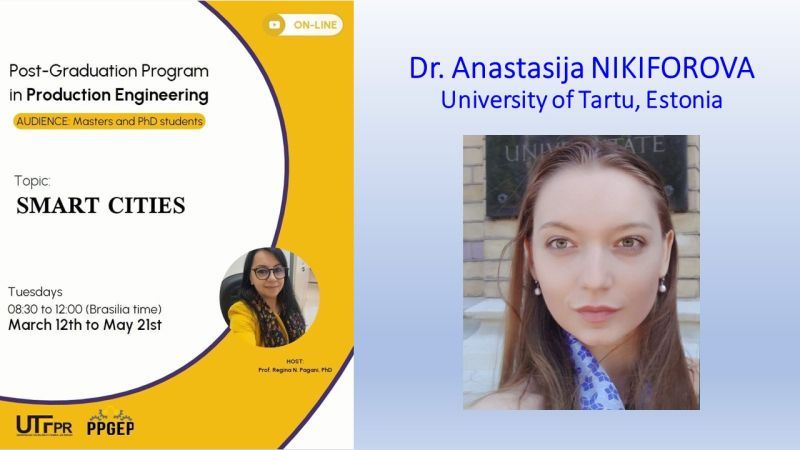
This May, I had a pleasure to deliver one more guest lecture for master and doctoral students of the Federal University of Technology – Paraná (Universidade Tecnológica Federal do Paraná (UTFPR)) as part of Smart Cities course delivered by prof. Regina Negri Pagani. This time the topic of my lecture was “Unlocking the symbiotic relationship of Artificial Intelligence, Data Intelligence, Collaborative Intelligence, and Embodied Intelligence for innovative urban planning and governance of Smart Cities”.

In the pursuit of enhancing the efficiency and effectiveness of Artificial Intelligence, it is imperative to explore synergies with other form of intelligence, such Data Intelligence and Collaborative intelligence. These forms of intelligence (along with Embodied Intelligence) constitute a new transformative paradigm of intelligence proposed by Verhulst et al. (2021) that offers potential for increased added value when synergized. However, their synergy requires understanding and harnessing the symbiotic relationship between these intelligences. The reimagination of decision making and problem-solving processes, is essential to unlock this symbiotic potential fostering more meaningful, but at the very same time more sustainable AI utilization. In other words, AI itself brings a certain value that can be (and must be) increased through integration with other forms of Intelligence. This, in turn, has a list of preconditions / prerequisites that must be satisfied by the above – Artificial, Data, Collaborative, and Embodied Intelligence – components. These prerequisites are diverse in nature and span both the artifacts in question, such as AI, data (type, format, quality, value, availability, accessibility, incl. openness), stakeholders’ skills and literacies, but also management and organizational aspects. In other words, each form of Intelligence influences the others, making it crucial to explore their interconnections. This talk endeavoured to uncover this intricate web of relationships between the three forms of intelligence, taking a step towards a more meaningful and intelligent approach to decision making and problem solving.

As part of this talk we referred to the theory of multiple intelligences by Howard Gardner presented in his famous book “Frames of Mind: A Theory of Multiple Intelligences”. Then, we referred to the above mentioned intelligence paradigm proposed by Stefaan G. Verhulst, Peter Martey Addo, Dominik Baumann, Juliet Mcmurren, Andrew Young, Andrew J. Zahuranec in “Emerging Uses of Technology for Development: A New Intelligence Paradigm“. Then, we finally turned to the actual discussion on the symbiotic relationship of Artificial Intelligence, Data Intelligence, Embodied Intelligence, Collaborative Intelligence, and Generative AI uncovering this intricate web of relationships between these forms of intelligence, putting the above into several contexts with a focus on public & public and open data ecosystems. The later topics, in turn, covered some of my previous research (such as “Sustainable open data ecosystems in smart cities: A platform theory-based analysis of 19 European cities, ” “Identifying patterns and recommendations of and for sustainable open data initiatives: A benchmarking-driven analysis of open government data initiatives among European countries“, “Transparency of open data ecosystems in smart cities: Definition and assessment of the maturity of transparency in 22 smart cities etc.). As such, we tried to indicate future avenues in the light of changing paradigms (or need for such) for intelligences, data ecosystems, mechanisms for citizen engagement & processes (incl., but not limited to data governance & data quality management) accompanying these ecosystems


This followed up by the fruitful discussion with the participants of the course that I enjoyed very much. I can only hope that this lecture was just a little bit as interesting as my dear Regina characterized it! There is nothing better than hear an immediate invitation for the next editions of this course – will be glad to continue this tradition!