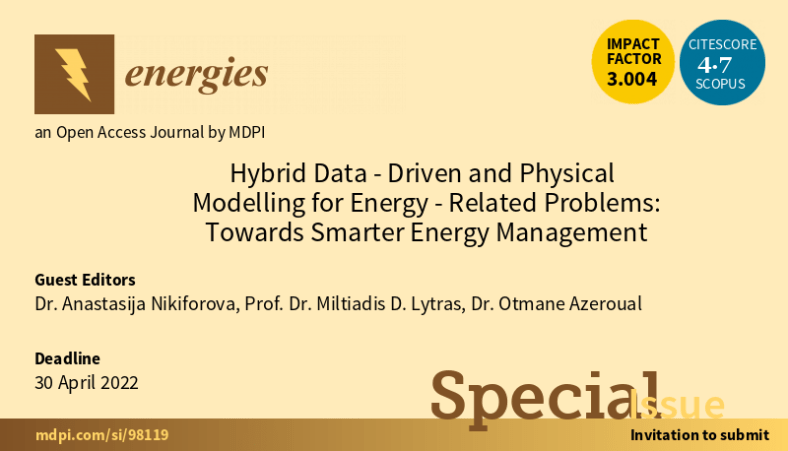
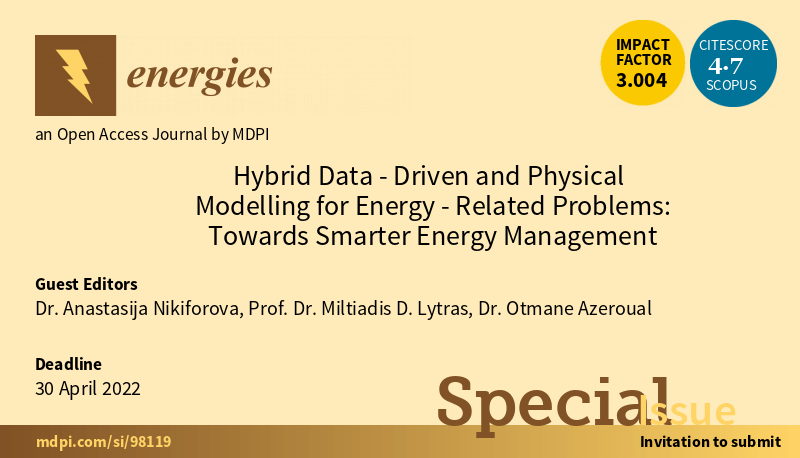
As an academic editor of the Special Issue “Hybrid Data-Driven and Physical Modelling for Energy-Related Problems: Towards Smarter Energy Management” (Energies MDPI, Impact Factor:3.004 (2020); 5-Year Impact Factor: 3.085 (2020)), I am glad to announce that the first article has been published!
This very special for me issue belongs to the section “A8: Artificial Intelligence and Smart Energy” and it seeking for the latest research on advances in the field covering both data-related topics and next-generation power electronic techniques and their applications. All papers accepted for their publishing are published in an Open Access, thereby significantly contributing to the visibility of these papers, and are submitted for their indexation in both Scopus and Web of Science in addition to other databases. The journal also falls in Q1 (Cite Score, Control and Optimization).
Topics of interest for this Special Issue include, but are not limited to:
- energy management systems
- data-driven approaches to energy-related issues
- advances in energy analytic, including open data on energy, its benefits, re-uses and impact
- Big Data management in the context of energy data
- machine learning (ML) techniques
- physical modelling for energy-related problems
- disruptive technology of renewable energy
- blockchain for Internet of energy management
- the role of the “energy” within the context of Industry 4.0 and Sustainable Goals
- energy data management in the context of the internet of things (IoT)
- energy data management via distributed systems
- smart grid and microgrid
- sustainable electrical energy systems
- hybrid and electric vehicle.
This Special Issue is of articular importance, given that energy-related issues are becoming more and more relevant today, including the topic of disruptive technologies, where renewable energy is referred to as one of the 12 most significant disruptive technologies. The topic is no longer limited to energy production/generation and storage and supply as a source of energy; it is becoming broader, including the close links with the electrification of transport, including electric vehicles (smart and green transportation), industrial automation, energy storage systems, data storage and data management systems. With both being very common, and at the same time disruptive and new, energy-related issues relate to both the adaptation of well-known foundations for recent trends and the optimization of the methods and techniques already used, as well as introducing completely new methods and developing new applications, thereby promoting open innovation and smarter living.
The first paper accepted for its publishing in the SI is entitled “Machine Learning Schemes for Anomaly Detection in Solar Power Plants” and is authored by Mariam Ibrahim (German Jordanian University), Ahmad Alsheikh (Deggendorf Institute of Technology), Feras M. Awaysheh (University of Tartu Institute of Computer Science) and Mohammad Dahman Alshehri (Taif University). The paper deals with the anomaly detection in photovoltaic (PV) systems by evaluating the performance of different machine learning schemes – AutoEncoder Long Short-Term Memory (AE-LSTM), Facebook-Prophet, and Isolation Forest – and applying them to detect anomalies on photovoltaic components. These models allow the authors to identify the PV system’s healthy and abnormal actual behaviors. The results provide clear insights to make an informed decision, especially with experimental trade-offs for such a complex solution space. The issue explored is all the more topical considering the rapid industrial growth in solar energy, which gains an increasing interest in renewable power from smart grids and plants.
I am very glad and honored to be an academic editor of both this issue (together with my colleagues from Germany and Greece) and this paper in particular.

Looking forward further submissions (particular focus on advances in the field covering both data-related topics and next-generation power electronic techniques and their applications)!!!

 Anastasija Nikiforova, PhD