EGOV2025 – IFIP EGOV-CeDEM-EPART 2025 & our Emerging Issues and Innovations Track

Are you focusing on new topics emerging in the field of ICT and public sector, incl. public-private ecosystems? Then it is time to start preparing your submission for EGOV2025 – IFIP EGOV-CeDEM-EPART Emerging Issues and Innovations Track, which this time we chair in the updated form, welcoming A. Paula Rodriguez Müller on the board with us – Francesco Mureddu (The Lisbon Council, Belgium)and myself – Anastasija Nikiforova (Tartu University, Estonia)).

EGOV2025 – IFIP EGOV-CeDEM-EPART is one of the most recognized conference in e-Government, ICT and public administration and related topics, which this year will be hosted in Belgium, in the heart of Europe, by University for Continuing Education Krems, Austria. This year, IFIP EGOV 2025 is dedicated to the broader areas of e-Government and e-Democracy, which include facets like Digital Government, e-Participation, Open Government,  Smart Government, AI government, GovTech, Algoritmic Governance, and related topics to digitalization and government.

Innovation and application of emerging technologies are now more and more in the thinking of governments at all levels. While it would be easy to consider the public sector as being less flexible or slow in adoption, presentations at recent EGOV conferences proved that one should not come to such a conclusion too easily. Upcoming technologies, innovative organizational solutions, or new avenues of public sector involvement in the public sector are becoming more commonplace along with the potential challenges and issues these bring. Policymakers and public sector officials are now expected to embrace change, consider digital transformation, or improve governance practices. At the same time, public sector researchers are also influenced by new views, methods, tools, and techniques. The goal of this track is to provide a platform for the discussion of new ideas, issues, problems, and solutions entering the public sphere. Ideas that are emerging but might not fit other conference tracks are also welcome. Focus may include, but are not limited to:

  • Looking ahead into social innovation;
  • Future studies, the future of government, policy-making and democracy;
  • The future of digital governance;
  • Public values in transforming the government;
  • The role of government in smart cities (incl. smart sustainable cities) and sustainable living;
  • The role of the public sector in Human-Centered Society (Society 5.0);
  • New trends in public sector research such as Metaverse, Cityverse, Large Language Models (LLMs), generative AI and its implementations such as chatGPT, Claude, ChatSonic, Poe – benefits, risks, adoption and resistance to its adoption by the public sector and citizens;
  • Government in the Virtual Worlds and Web 4.0;
  • Decentralized Autonomous Organizations (DAOs), smart contracts and blockchain;
  • New technologies for automated decision-making and their policy implications;
  • Public sector use and regulation of AI, genAI, Industry 4.0, Industry 5.0, and the Internet of Things (IoT);
  • Digital Humanism (responsible and ethical integration of technology into society, ensuring that human values and dignity are prioritized in the development and use of digital tools and innovations);
  • The role of the public sector in competitiveness and tech sovereignty;
  • Global challenges that go beyond nation states (such as migration, climate change etc.) and which require international collaboration of individual governments;
  • Preparing for the policy challenges of future technologies;
  • Regulating misinformation;
  • Digital transformation in public sector contexts;
  • Self-Service Structures for Inclusion;
  • Public-private sector collaboration and integration;
  • GovTech initiatives and innovations;
  • Latest trends in co-creation and service delivery;
  • Online public community building;
  • Upcoming issues of eVoting / internet voting including application of digital signatures in the public sector;
  • Discussion of new research methods that have not been applied in this context;
  • Application of role theory in the analysis of public sector functions and processes;
  • Forward looking insights from case studies – let it be successful or failed experiments.
  • Utilization of digital billboards;
  • Public sector use and regulation of Fintech innovations;
  • Theoretical and practical approaches to experimentation and sandboxing in the public sector.Future studies, the future of government, policy-making and democracy

Stay tuned, more info to come!

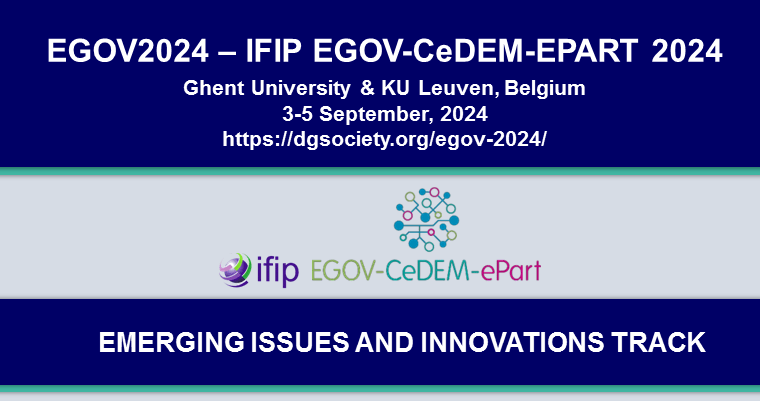
EGOV2024 – IFIP EGOV-CeDEM-EPART 2024 & our Emerging Issues and Innovations Track

Are you focusing on new topics emerging in the field of ICT and public sector, incl. public-private ecosystems? Then it is time to start preparing your submission for EGOV2023 – IFIP EGOV-CeDEM-EPART Emerging Issues and Innovations Track (chairs: Anastasija Nikiforova, Marijn Janssen, Francesco Mureddu).

EGOV2023 – IFIP EGOV-CeDEM-EPART is one of the most recognized conference in e-Government, ICT and public administration and related topics, which this year will be hosted in Belgium, in the heart of Europe, by Ghent University and KU Leuven – both top 100 universities.

 Innovation and application of emerging technologies is now more and more in the thinking of Governments at all levels. While it would be easy to consider the public sector as being less flexible or slow in adoption, presentations at recent EGOV-CeDEM-ePart conferences proved that one should not come to such a conclusion too easily. Upcoming technologies, innovative organizational solutions, or new avenues of involvement in public sector activities seem to be more commonplace – along with the potential issues and challenges that come with such endeavours. Policy-makers and public sector officials are now expected to embrace change, consider digital transformation, or improve governance practices. At the same time, public sector researchers are also influenced by new views, methods, tools and techniques.

🎯The goal of this track is to provide a platform for the discussion of new ideas, issues, problems, and solutions, that keep entering the public sphere. Ideas that are emerging but might not fit other conference tracks are also welcome. Focus may include but is not limited to:

  • 💡 Looking ahead into social innovation
  • 💡Future studies, the future of government, policy-making and democracy
  • 💡New trends in public sector research such as Metaverse, Large Language Models (LLMs), generative AI and its implementations such as chatGPT, Claude, ChatSonic, Poe – benefits, risks, adoption and resistance to its adoption by the public sector and citizens;
  • 💡Global challenges that go beyond nation states (such as migration, climate change etc.) and which require international collaboration of individual governments;
  • 💡Digital transformation in public sector context;
  • 💡The future of digital governance;
  • 💡Public values in transforming the government;
  • 💡The role of government in smart cities (incl. smart sustainable cities) and sustainable living;
  • 💡The role of the public sector in Human-Centered Society known as Society 5.0;
  • 💡Government in the metaverse;
  • 💡Self-Service Structures for Inclusion;
  • 💡Public-private sector collaboration and integration;
  • 💡Decentralized Autonomous Organizations (DAOs), smart contracts and blockchain;
  • 💡Preparing for the policy challenges of future technologies;
  • 💡Regulating misinformation;
  • 💡New technologies for automated decision-making;
  • 💡The future public sector use and regulation of latest AI or genAI solutions;
  • 💡Public use as well as regulations of industry 4.0 and Industry 5.0 and the Internet of Things (IoT);
  • 💡The relationships of governments and Fintech;
  • 💡Upcoming issues of eVoting / internet voting including application of digital signatures in the public sector;
  • 💡Online public community building;
  • 💡Utilization of digital billboards;
  • 💡Latest trends in co-creation and service delivery;
  • 💡Discussion of new research methods that have not been applied in this context;
  • 💡Application of role theory in the analysis of public sector functions and processes;
  • 💡Forward looking insights from case studies – let it be successful or failed experiments.

Track Chairs

  • Anastasija Nikiforova, Tartu University, Estonia
  • Marijn Janssen, Delft University of Technology, the Netherlands
  • Francesco Mureddu, The Lisbon Council, Belgium

This time International Federation for Information Processing (IFIP) EGOV-CeDEM-EPART will be hosted by KU Leuven and Ghent University, September 2024, while the deadline for submitting your paper is set to March, 2024.

Stay tuned, more info to come!

CFP for The IEEE International Conference on Intelligent Computing, Communication, Networking and Services (ICCNS2023)

On behalf of the organizers (Technical Program Chair, Steering Committee, and finally publicity chair) of the IEEE International Conference on Intelligent Computing, Communication, Networking and Services (ICCNS2023), I am inviting everyone, who is conducting research in this area, to consider submitting the paper to it.

Call for Papers:

New advancements in wireless communication systems such as Fifth-Generation (5G), Beyond Fifth-Generation (B5G), and Sixth-Generation (6G) networks will allow for new and unprecedented services to be made available for users with nearly unlimited capacity. These services will be the core driver for future digital transformation of our cities and communities. This will be accompanied by a ubiquitous deployment of Internet of Things (IoT) infrastructure and supported by computing capacity that will be available at the edge of the network and in the cloud. This computing infrastructure will handle the processing of data generated by users and services. Such a complex and diverse system will require the applications running on the computing/networking infrastructure to be Intelligent, efficient and sustainable. Additionally, the infrastructure will require smart control and automation systems to integrate and manage its different components. Artificial Intelligence (AI) and its applications will play a significant role in the design, deployment, automation, and management of future services. This will include applications that will be running on the edge and on cloud servers, networking applications to handle the flow of data between the users and the computing system, and intelligent automation and management software operating on the system. The International Conference on Intelligent Computing, Networking, and Services is aiming to provide an opportunity to present state of the art research in the intersections of Computing, Networking, and Services that are supported by Artificial Intelligence.

Submission Link: https://easychair.org/conferences/?conf=iccns2023

Researchers from both the industry and academia are encouraged to submit their original research contributions in all major areas, which include, but are not limited to the following main tracks:

💡Track 1: Artificial Intelligence Fundamentals

  • Artificial Intelligent Systems
  • Artificial Intelligent Theory
  • Artificial Intelligent applications in Computers and Communications
  • Artificial Intelligent and Robotics Technologies
  • Artificial Intelligent and cloud computing
  • Artificial Intelligent for Economic paradigms and game theory
  • Machine and Deep Learning of Knowledge
  • Artificial Intelligent based Distributed Knowledge and Processing
  • Artificial Intelligent for Human-Robot Interactions

💡Track 2: Intelligent Internet of Things and Cyber-Physical Systems

  • Intelligent IoT Applications and Services
  • Intelligent security for the Internet of Things and cyber-physical systems
  • Intelligent Internet of Things architectures and protocols
  • Intelligent Cyber Physical Systems (CPS)
  • Blockchain-based application in Intelligent Manufacturing: Industrial Internet of Things,
  • Blockchain and Secure Critical Infrastructure with Industry 4.0
  • Intelligent manufacture and management
  • Consensus and mining algorithms suited for resource-limited IoTs
  • Blockchain-based Controlled mobility and QoS
  • Blockchain-based energy optimization techniques in WSN
  • Blockchain-based Software defined networks

💡Track 3: Edge Intelligence and Federated Learning

  • Distributed and federated machine learning in edge computing
  • Theory and Applications of Edge Intelligence
  • Middleware and runtime systems for Edge Intelligence
  • Programming models compliant with Edge Intelligence
  • Scheduling and resource management for Edge Intelligence
  • Data allocation and application placement strategies for Edge Intelligence
  • Osmotic computing with edge continuum, Microservices and MicroData architectures
  • ML/AI models and algorithms for load balancing
  • Theory and Applications of federated learning
  • Federated learning and privacy-preserving large-scale data analytics
  • MLOps and ML pipelines at edge computing
  • Transfer learning, interactive learning, and Reinforcement Learning for edge computing
  • Modeling and simulation of EI and edge-to-cloud environments
  • Security, privacy, trust, and provenance issues in edge computing
  • Distributed consensus and blockchains at edge architecture
  • Blockchain networking for Edge Computing Architecture
  • Blockchain technology for Edge Computing Security
  • Blockchain-based access controls for Edge-to-cloud continuum
  • Blockchain-enabled solutions for Cloud and Edge/Fog IoT systems
  • Forensic Data Analytics compliant with Edge Intelligence

💡Track 4: Intelligent Networking in Beyond 5G (B5G) and 6G Wireless Communication

  • Intelligent Networking in Beyond 5G/6G Network Architectures
  • large-scale Internet of Things in B5G/6G
  • Vehicular networks in B5G/6G
  • Blockchain with lightweight computation
  • Service and applications for vehicular clouds in B5G/6G
  • Future internet architectures for B5G/6G
  • Intelligent networking services
  • Emerging networks in B5G/6G
  • Byzantine-tolerant FL
  • Churn-tolerant FL
  • FL for NGN and 6G
  • B5G/6G based IoT healthcare systems

💡Track 5: Intelligent Big Data Management and Processing

  • Intelligent Data Fusion
  • Intelligent Analytics and Data mining
  • Intelligent Distributed data management
  • Distributed transaction for blockchain
  • Intelligent Data Science and Data Engineering
  • Protocols for management and processing of data

💡Track 6: Intelligent Security and Privacy

  • Authentication and authorization
  • Applications of blockchain technologies in digital forensic
  • Privacy technologies
  • Blockchain-based threat intelligence and threat analytics techniques
  • Blockchain-based open-source tools
  • Forensics readiness of blockchain technologies
  • Blockchain Attacks on Existing Systems
  • Blockchain Consensus Algorithms
  • Blockchain-based Intrusion Detection/Prevention
  • Security and Privacy in Blockchain and Critical Infrastructure
  • Attacks on Blockchain and Critical Infrastructure
  • Blockchain and Secure Critical Infrastructure with Smart Grid

💡Track 7: Blockchain Research & Applications for Intelligent Networks and Services

  • State-of-the-art of the Blockchain technology and cybersecurity
  • Blockchain-based security solutions of smart cities infrastructures
  • Blockchain in connected and autonomous vehicles (CAV) and ITS)
  • Blockchain Technologies and Methodologies
  • Recent development and emerging trends Blockchain
  • New models, practical solutions and technological advances related to Blockchain
  • Theory of Blockchain in Cybersecurity
  • Applications of blockchain technologies in computer & hardware security
  • Implementation challenges facing blockchain technologies
  • Blockchain in social networking
  • Performance metric design, modeling and evaluation of blockchain systems
  • Network and computing optimization in blockchains
  • Experimental prototyping and testbeds for blockchains
  • Blockchain networking for Edge Computing Architecture
  • Blockchain technology for Edge Computing Security
  • Blockchain-based access controls for Edge-to-cloud continuum
  • Blockchain-enabled solutions for Cloud and Edge/Fog IoT systems
  • Forensic Data Analytics compliant with Edge Intelligence

Two workshops are scheduled to take place as part of ICCNS that you cannot miss, namely:

🗓️🗓️🗓️ IMPORTANT DATES

  • Full paper submission: April 21st, 2023 (Firm and Final)
  • Full paper acceptance notification: May 6th, 2023
  • Full paper camera-ready submission: May 20th, 2023

For any inquiries, please contact: intelligenttechorg@gmail.com.

Submit the paper and meet our team in Valencia in June, 2023!
 

With best wishes,

ICCNS2023 organizers

“Emerging issues and innovations” track as part of IFIP EGOV-CeDEM-EPART 2023 is open for submissions!

On behalf of the co-chair of “Emerging issues and innovations” track I sincerely invite everyone whose research focuses on new topics emerging in the field of ICT and public sector, including public-private ecosystems, to submit their work to this track, which is part of EGOV2023 – IFIP EGOV-CeDEM-EPART – one of the most recognized conference in e-Government, ICT and public administration and related topics!

The annual IFIP EGOV2023 will be hosted 5-7 September 2023 in Budapest by the Corvinus University of Budapest, Hungary. The conference focuses on e-Government, Digital Government, Open Government, Smart Government, GovTech, eParticipation and e-Democracy, and related topics like social media, digital transformation, Digital society, artificial intelligence, policy information, policy informatics, smart cities, and social innovation. Several types of submissions are possible, including completed research, ongoing research, reflections & viewpoints, posters, and workshops. The conference consists of 10 tracks:

  • General E-Government and E-Governance Track
  • General e-Democracy & e-Participation track
  • ICT and Sustainable Development Goals Track
  • Digital Society Track
  • AI, Data Analytics & Automated Decision Making Track
  • Smart Cities (Government, Districts, Communities & Regions) Track
  • Open data: social and technical aspects Track
  • Emerging Issues and Innovations Track
  • Digital and Social Media Track
  • Legal Informatics

And while the conference consists of 10 tracks you will definitely find relevant, my personal recommendation is “Emerging issues and innovations” track (chairs: Marijn Janssen, Anastasija Nikiforova, Dr. Csaba Csaki, Francesco Mureddu).


🎯🎯🎯 “Emerging issues and innovations” track focuses on new topics emerging in the field of ICT and public sector, including public-private ecosystems. Topics of interest include but are not limited to:
💡Looking ahead into Social innovation
💡The future of government, policy making and democracy
💡Global challenges that go beyond nation states (such as migration, climate change etc.) and require international collaboration of individual governments
💡Digital transformation in public sector context
💡The future of digital governance
💡Public values in transforming the government
💡The role of government in eCities and sustainable living
💡The role of the public sector in Human Centered Society
💡Self Service Structures for Inclusion
💡Public-private sector collaboration and integration;
💡Decentralized Autonomous Organizations (DAO), smart contracts and blockchain
💡Preparing for the policy challenges of future technologies;
💡Regulating misinformation
💡New technologies for automated decision-making
💡The future public sector use and regulation of latest AI solutions;
💡Public use as well as regulations of industry 4.0 and the internet of things
💡The relationships of governments and Fintech
💡Upcoming issues of eVoting including application of digital signatures in the public sector
💡Online public community building
💡Utilization of digital billboards
💡Latest trends in co-creation and service delivery
💡Forward looking insights from case studies – let it be successful or failed experiments.
 

🗓️🗓️🗓️ IMPORTANT DATES
Deadline for submissions: 31 March 2023
PhD Colloquium deadline for submissions: 1 May 2023
Poster submission deadline: 20 May 2023
PhD Colloquium: 4 September 2023
Conference: 5-7 September 2023

Do not miss 3 days of discussions around e-Government, Digital Government, Open Government, Smart Government, GovTech, eParticipation and e-Democracy, and related topics like social media, digital transformation, Digital society, artificial intelligence, policy information, policy informatics, smart cities, and social innovation. Mark your calendar – 31 March 2023 for submitting your paper, and 5-7 September 2023 for attending the conference!

The conference is organized by the IFIP 8.5 Working group (WG8.5) and the Digital Government Society (DGS). The aim of WG 8.5 is to improve the quality of e-government information systems at international, national, regional and local levels. The WG8.5 emphasis is on interdisciplinary approaches for information systems in public administration. DGS is a global, multi-disciplinary organization of scholars and practitioners interested in the development and impacts of digital government. Read more here.