CFP for The International Symposium on Foundation and Large Language Models (FLLM2023)

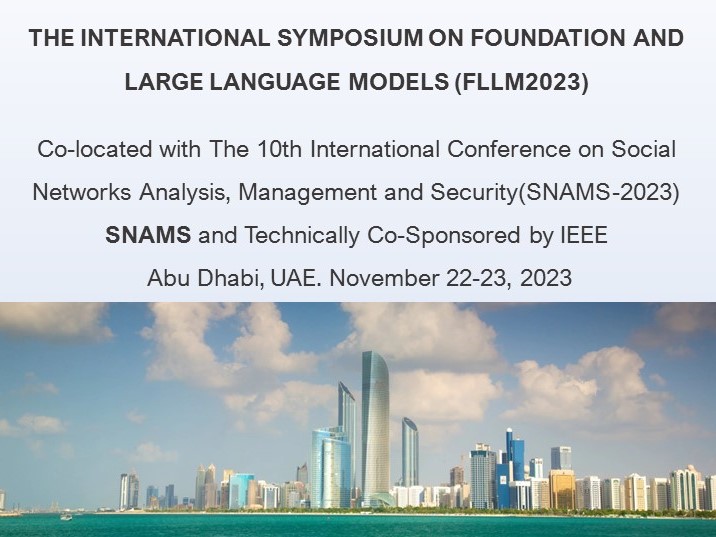
On behalf of the organizers of the The International Symposium on Foundation and Large Language Models (FLLM2023) co-located with The 10th International Conference on Social Networks Analysis, Management and Security(SNAMS-2023), I am inviting everyone, who is conducting research in this area, to consider submitting the paper to it. Hurry up as the deadline for submitting the paper is October 28! 📢📢📢

Call for Papers:

With the emergence of foundation models (FMs) and and Large Language Models (LLMs) that are trained on large amounts of data at scale and adaptable to a wide range of downstream applications, Artificial intelligence is experiencing a paradigm revolution. BERT, T5, ChatGPT, GPT-4, Falcon 180B, Codex, DALL-E, Whisper, and CLIP are now the foundation for new applications ranging from computer vision to protein sequence study and from speech recognition to coding. Earlier models had a reputation of starting from scratch with each new challenge. The capacity to experiment with, examine, and comprehend the capabilities and potentials of next-generation FMs is critical to undertaking this research and guiding its path. Nevertheless, these models are currently inaccessible as the resources required to train these models are highly concentrated in industry, and even the assets (data, code) required to replicate their training are frequently not released due to their demand in the real-time industry. At the moment, mostly large tech companies such as OpenAI, Google, Facebook, and Baidu can afford to construct FMs and LLMS. Despite the expected widely publicized use of FMs and LLMS, we still lack a comprehensive knowledge of how they operate, why they underperform, and what they are even capable of because of their emerging global qualities. To deal with these problems, we believe that much critical research on FMs and LLMS would necessitate extensive multidisciplinary collaboration, given their essentially social and technical structure.The International Symposium on Foundation and Large Language Models (FLLM) addresses the architectures, applications, challenges, approaches, and future directions. We invite the submission of original papers on all topics related to FLLMs, with special interest in but not limited to:

💡Architectures and Systems

  • Transformers and Attention
  • Bidirectional Encoding
  • Autoregressive Models
  • Prompt Engineering
  • Fine-tuning

💡Challenges

  • Hallucination
  • Cost of Creation and Training
  • Energy and Sustainability Issues
  • integration
  • Safety and Trustworthiness
  • Interpretability
  • Fairness
  • Social Impact

💡Future Directions

  • Generative AI
  • Explainability
  • Federated Learning for FLLM
  • Data Augmentation

💡Natural Language Processing Applications

  • Generation
  • Summarization
  • Rewrite
  • Search
  • Question Answering
  • Language Comprehension and Complex Reasoning
  • Clustering and Classification

💡Applications

  • Natural Language Processing
  • Communication Systems
  • Security and Privacy
  • Image Processing and Computer Vision
  • Life Sciences
  • Financial Systems

Read more here and join our team in Abu Dhabi, UAE. November 22-23, 2023!

International conference on the Intelligent Data Science (IDSTA2021): one conference – a ton of impressions

This November I had another great experience – participation in one of my favorite conferences – International conference on the Intelligent Data Science (IDSTA2021) collocated with Blockchain Computing and Applications (BCCA). Unfortunately, due to the pandemics we were not able to meet each other in person in Tartu, Estonia – a local organizer of this edition. But the organization was still perfect from their side. I was super delighted to serve a publicity chair for this conference for the second time (I mean IDSTA2020 and IDSTA2021).

IDSTA2021
Source: IDSTA2021

In short – 2 days (November 15-16), 50+ talks delivered by very skilled, experienced and knowledgeable researchers ready to establish and develop discussions around their topics during 13 sessions, 4 incredible keynotes delivered by Tarik Taleb, Omer Rana, Helen (Eleni) Karatza, Srijith Rajamohan, Ph.D.. Very lively discussions, insightful presentations and great environment!

Apart of serving as a publicity chair, I act as a reviewer, so I am a part of Program Committee, the session chair (for 2 sessions) and the (co-)author and presenter of two papers. One conference – 5 roles 😀 And what is even cooler is that my efforts have been also noticed by organisers and listed in Message from the General Chairs – it is always pleasant to notice you have been mentioned as a person, who contributed and whose contribution and efforts have been really highly evaluated.

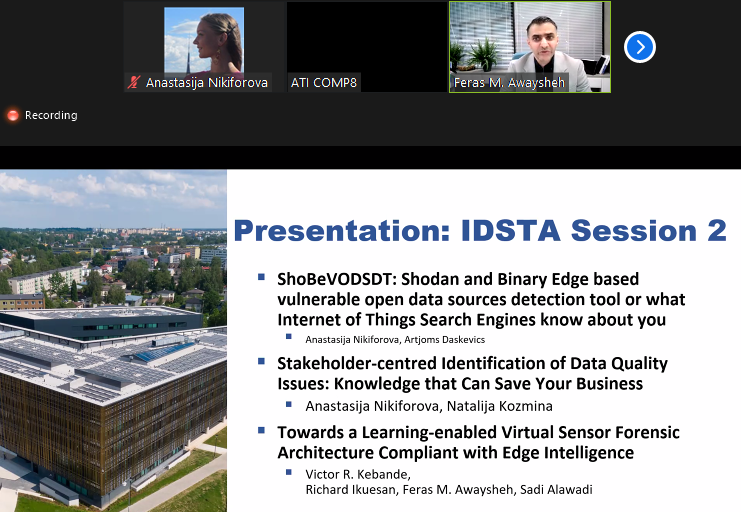
Very briefly on my talks :

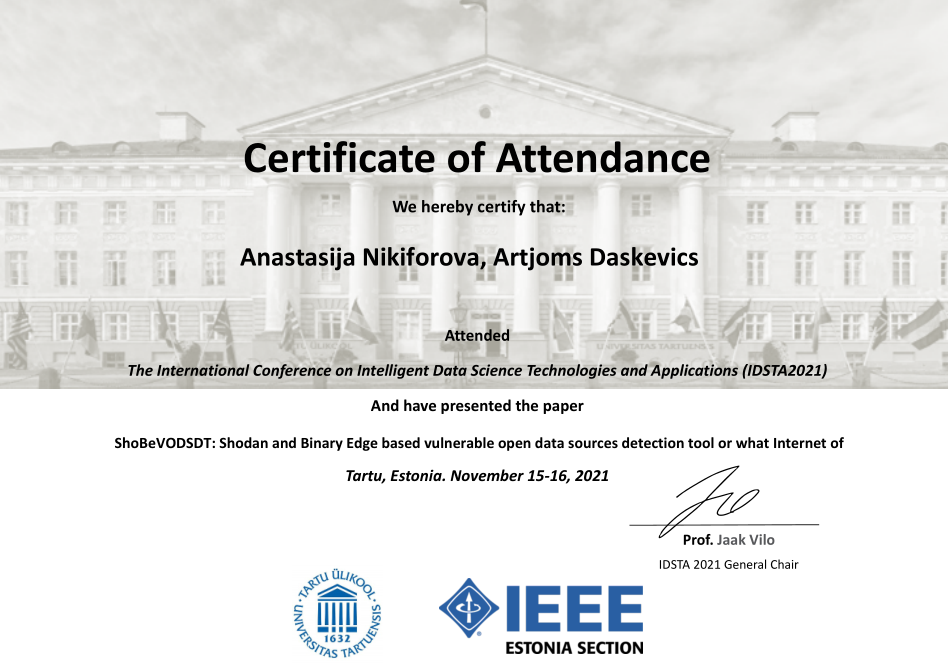
  • ShoBeVODSDT: Shodan and Binary Edge based vulnerable open data sources detection tool or what Internet of Things Search Engines know about you” (authored by Artjoms Daskevics and Anastasija Nikiforova) devoted to the study, which proposes a tool for non-intrusive testing of open data sources for detecting their vulnerabilities, called ShoBeVODSDT. It supports the identification of vulnerabilities at early security assessment stages and does not require the implementation of active and possibly disruptive techniques. ShoBeVODSDT uses two IoTSE (Internet of Things Search Engines) – Shodan and Binary Edge – by extending their features with the advanced capabilities built in it. It allows inspecting 8 predefined data sources, representing both rational databases, NoSQL databases and data stores – MySQL, PostgreSQL, MongoDB, Redis, Elasticsearch, CouchDB, Cassandra and Memcached – on their vulnerabilities and their extent. Our observation shows that security features built into the database allow to protect against unauthorized access, but there are databases with low security features, where it is possible to connect to nearly all IP addresses by retrieving information from them. Even more, in some cases the databases, which do not use security mechanisms, have been already compromised.
  • Stakeholder-centred Identification of Data Quality Issues: Knowledge that Can Save Your Business” (authored by Anastasija Nikiforova and Natalija Kozmina), in scope of which (1) we perform a literature analysis to compile a list of the most commonly occurring data quality issues, (2) considering the diversity and quantity of different data quality requirements and/or dimensions, we reduce the list of defects after running a brainstorming session followed by DELPHI analysis involving 12 experts, (3) the resulting list of defects is validated by 30 users with advanced data quality knowledge by means of applying the data quality analysis to real-world data that are freely accessible to all stakeholders (specifically, a pool of 30 open data sets). This leads us to the list of key data quality issues, which may be of advantage to the data holder and the data user giving both a higher level of confidence that the data are error-free and can be used without causing financial losses for business. These requirements, however, are expected to be used as input of the specification for the web-based data quality analysis tool to be developed.

Great event, great people, great emotions and impressions! Thank you, IDSTA2021 and your supportive and super-friendly team!