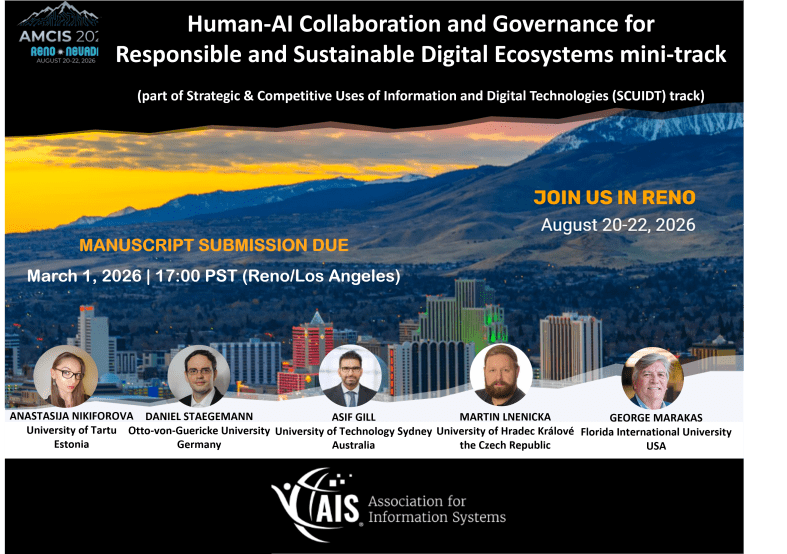
AMCIS2026 Human–AI Collaboration and Governance for Responsible and Sustainable Digital Ecosystems mini-track

As digital transformation accelerates, the convergence of AI, data governance, and ecosystem thinking is reshaping how organizations create strategic value, build competitiveness, and sustain innovation advantage. Digital and data ecosystems are increasingly complex, spanning cloud, edge, and decentralized architectures such as data meshes and lakehouses, raising critical questions of trustworthiness, responsibility, and sustainability in AI integration.

This AMCIS2026 mini-track (by Association of Information Systems (AIS)) explores how AI, including increasingly agentic systems, acts as both a strategic enabler and active participant in digital and data ecosystems, enhancing governance, augmenting and automating decision-making, and transforming how organizations create value, while raising important governance, ethical, and human-agency considerations. We invite research examining how these ecosystems can remain responsible, resilient, and sustainable, while enhancing organizational agility, competitiveness, and long-term strategic performance across sectors such as government, healthcare, finance, manufacturing, and education.

The track bridges perspectives from information systems, data science, AI governance, and sustainability research to understand how the strategic and responsible design and management of AI-driven data ecosystems can support long-term value creation, competitiveness, and societal transformation. We invite interdisciplinary contributions from fields such as computer science, management science, data science, process science, decision science, organizational design, policy-making, complexity, behavioral economics, and the social sciences. Submissions may include conceptual, design science, empirical, theoretical, or case-based studies, including literature reviews.

Topics of interest include but are not limited to:

  • AI for governance, accountability, and trustworthiness in digital and data ecosystems;
  • human–AI collaboration and delegation, human-in-the-loop and hybrid governance;
  • responsible, sustainable, and strategically aligned management of AI-augmented data ecosystems, including Green AI;
  • governance and data management in emerging architectures (e.g., data mesh, data lakehouse), including data quality, transparency, and explainability;
  • transition from centralized to decentralized data architectures – organizational and design challenges;
  • ethical, interoperable, observable, and explainable AI in connected and cross-sectoral data ecosystems;
  • co-evolution of digital and data ecosystem components;
  • coopetition between digital and data ecosystems;
  • resilience, sustainability, and long-term governance of digital infrastructures;
  • socio-technical, organizational, and policy approaches to trustworthy and responsible data ecosystems;
  • emerging technologies (e.g., blockchain, edge computing, generative AI, digital twins, IoT, AR/VR) shaping responsible, sustainable, and energy- or resource-efficient strategic ecosystem innovation;
  • empirical studies and sectoral case analyses (e.g., healthcare, finance, government, education) on evolving AI-driven ecosystems;
  • design science, conceptual, and interdisciplinary frameworks for responsible, sustainable, and strategically effective data ecosystem innovation.

This mini-track will serve as a platform for interdisciplinary dialogue on the critical role of responsible, sustainable, and strategically oriented digital and data ecosystems in driving competitive and societal innovation. Researchers and practitioners are invited to share insights, theoretical perspectives, and empirical findings in this rapidly evolving domain.

📌 Submission Deadline: March 1, 2026
📍 Venue: AMCIS 2026 — Reno, Nevada (August 20–22)

Mini-Track Chairs

Anastasija Nikiforova – University of Tartu, Estonia
Daniel Staegemann – Otto von Guericke University Magdeburg, Germany
Asif Gill – University of Technology Sydney, Australia
Martin Lnenicka – University of Hradec Králové, Czech Republic
George Marakas – Florida International University, USA
Read more and submit papers via AMCIS2026 website.

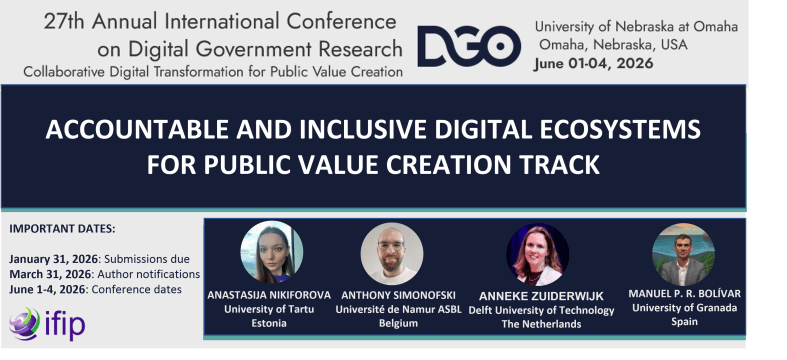
Call for Papers: Accountable and Inclusive Digital Ecosystems for Public Value Creation — dg.o 2026

Call for Papers is now open for our track “Accountable and Inclusive Digital Ecosystems for Public Value Creation” at the 27th Annual International Conference on Digital Government Research (dg.o 2026). The conference will take place June 2–5, 2026, at the University of Nebraska at Omaha, USA.

This track continues and expands the work we initiated in 2024 and 2025 on public and open data ecosystems. Responding to new technological and societal realities, we broaden the focus this year toward AI-enabled, interoperable, sustainable, and human-centered digital ecosystems—their design, governance, and impact on public value creation.

Why this track? Why now?

Digital ecosystems are undergoing profound transformation. Emerging technologies—AI (including generative AI), interoperable data spaces, IoT, cloud–edge infrastructures, and new governance frameworks—now form the backbone of digital public action. These technologies unlock unprecedented opportunities for insight generation, collaboration, transparency, and service co-creation across sectors.

Yet they also introduce new challenges: ethics, accountability, trust, digital literacy, and inclusion. As governments and organizations navigate this shift, we need research that bridges technical innovation, institutional capacity, and societal expectations.

Our track provides a space for this conversation.

What the track explores

We invite contributions that examine the conceptual, technical, institutional, and societal dimensions of digital and data ecosystems, with an emphasis on accountability, sustainability, inclusivity, and public value.

Topics of interest include (but are not limited to):

  • Ethical and accountable AI, data governance, algorithmic transparency, privacy, security
  • Interoperability and trust frameworks, identity infrastructures, standards, reference architectures
  • AI, Generative AI, LLMs, NLP, IoT/cloud/edge integration, green computing, Metaverse applications
  • Human–AI interaction, explainability, accessibility, inclusion in digital public services
  • Stakeholder engagement, empowerment, co-creation, digital literacy, data sovereignty
  • Institutional and organizational mechanisms for ecosystem governance and sustainable management
  • Open, public, and cross-sector data ecosystems, including data spaces and platform ecosystems
  • Social, economic, and environmental sustainability and other public value dimensions
  • Case studies from cities, communities, public-sector organizations, and multi-stakeholder collaborations
  • Impact assessments of digital ecosystems on individuals, organizations, and society

Connection to the dg.o 2026 theme

The conference theme—Collaborative Digital Transformation for Public Value Creation—aligns perfectly with our track’s purpose.
Digital ecosystems represent socio-technical infrastructures where governance, technology, and societal needs intersect. Understanding how to make these ecosystems accountable, inclusive, and sustainable is essential for collaborative digital transformation and for delivering tangible societal outcomes.

Track chairs

  • Anastasija Nikiforova, University of Tartu (Estonia)
  • Anthony Simonofski, Université de Namur (Belgium)
  • Anneke Zuiderwijk – van Eijk, Delft University of Technology (Netherlands)
  • Manuel Pedro Rodríguez Bolívar, Universidad de Granada (Spain)

Together, we bring perspectives from digital government, data governance, public administration, information systems, and socio-technical ecosystem design.

Submission details

Full CFP and submission guidelines are available here:
🔗 https://dgsociety.org/dgo-2026/

We look forward to receiving your submissions and to advancing the conversation on how accountable, inclusive, and sustainable digital ecosystems can drive the next generation of public value creation.

If you have questions about fit or ideas you’d like to discuss, feel free to reach out.