
At Data for Policy CIC 2025 in The Hague, themed “Twin Transition in Data and Policy for a Sustainable and Inclusive Future,” we explored how emerging technologies—especially AI—and diverse data sources can support accountable, inclusive, and sustainable policymaking.
Across several full days of sessions, the event brought together transdisciplinary researchers, policy practitioners, and technology experts. Notable contributions included:
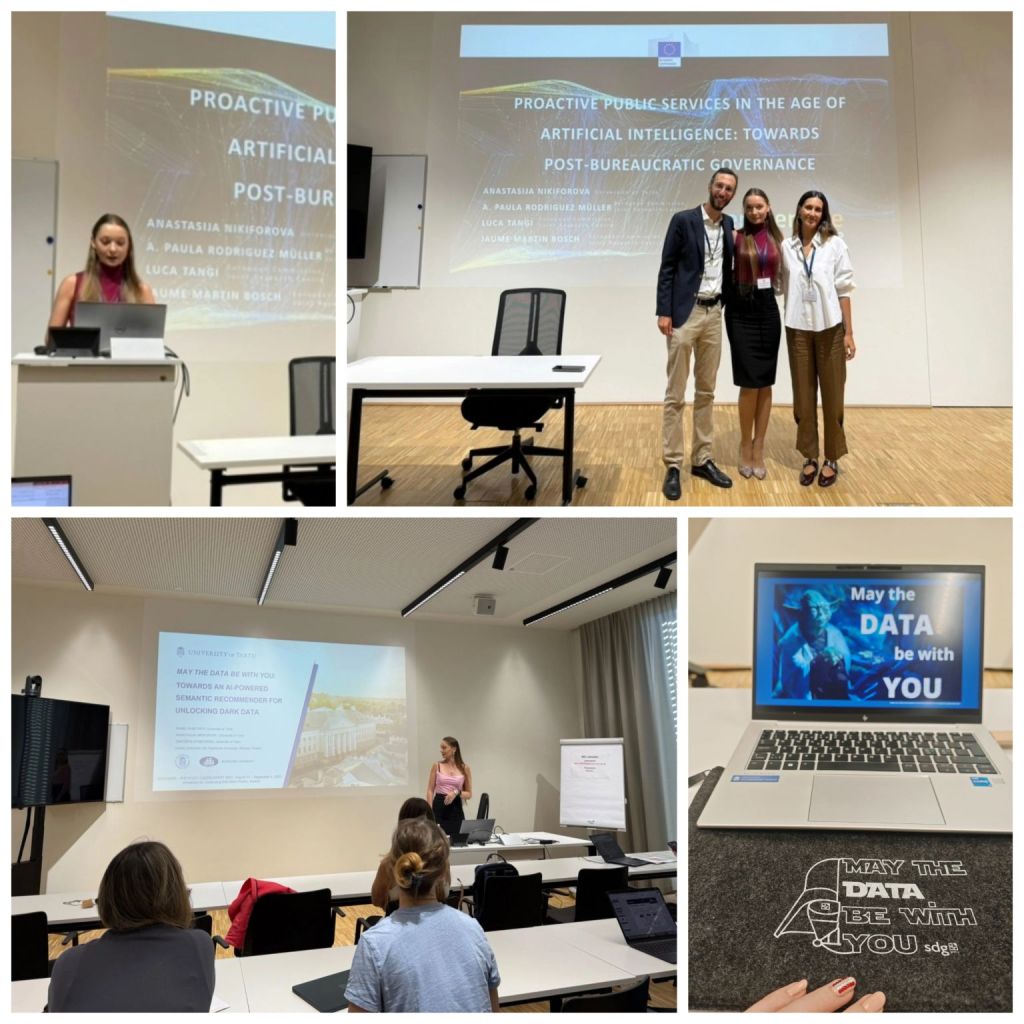
- Research presentations – “Proactive-by-Design: The Future of Governance Beyond Bureaucracy?,” on the study we conduct with Paula Rodriguez Müller & Luca Tangi (European Commission JRC) and “The Data Agency Awakens: A New Era for Official Statistics” we prepared with Luca Di Gennaro Splendore
- Panel on National Data Strategies in Europe: Learning from and for the Dutch Data Strategy, which I joined the conversation as a panelists, along with Tim Faber (Ministry of Interior & Kingdom Relations), Anne Fleur van Veenstra, Iryna Susha, Adrianna Michałowicz (chaired by Devin Diran & Thijmen van Gend)
- finally, the paanel on Responsible AI and Data Science Revolutions: Implications for Public Benefit Research and Policy Making that I was honored to chair, with panelists representing Smart Data Foundry and the Joseph Rowntree Foundation (JRF), joined by Magdalena Getler, Oliver Berry, and Rosario Piazza.
Our discussion highlighted the immense potential of AI and data, but also the responsibilities that come with it. Key insights included:
- Balancing optimism and realism: AI is transformative, but its adoption requires grounded, practical experience. It can support public benefit—if managed carefully;
- Data quality over quantity: More data isn’t always better. Governance, documentation, bias mitigation, and transparency are essential for AI-readiness;
- Embedding public trust: High-sensitivity contexts, such as health or finance, demand proportionality, oversight, and systems designed for inclusivity;
- Human-in-the-loop mechanisms: Ensuring AI reflects human values and context is critical, even when those values are evolving;
- Task-appropriate AI: Not every problem requires a large language model; careful alignment between technology and purpose is essential;
- Data literacy for all: Understanding AI’s limitations and risks is as important as technical infrastructure;
- Triangulating perspectives: Combining structured/unstructured and qualitative/quantitative data helps address bias, power imbalances, and complexity;
- Sustainable and inclusive systems: Scalable infrastructure alone is insufficient; AI governance and operational design must prioritize long-term societal benefit.
As Amara’s Law reminds us: “We tend to overestimate the effect of a technology in the short run and underestimate it in the long run.” Our discussion echoed this sentiment: AI’s potential is enormous, but realizing it for public benefit requires careful design, governance, and collaboration.
The overarching theme through all days (beyond above) was clear: AI and data are not neutral tools. Their value for public policy depends on human-centered design, responsible governance, and active societal engagement. Tools alone won’t deliver public benefit—they must be operationalized thoughtfully, with attention to ethics, context, and inclusion.





Huge thanks to Sarah Giest, Bram Klievink, Zeynep Engin, and all participating institutions—Leiden University, TNO Vector, Cambridge University Press & Assessment, and The Hague Centre for Digital Governance—for creating the space for meaningful dialogue in such a rich, collaborative environment.
The CIC 2025 conversations reminded us: building a truly responsible, inclusive, resilient, and sustainable AI ecosystem is not just a technical challenge—it is a societal mission and each and every of us is part of it.




























 Anastasija Nikiforova, PhD