DGO 2025 “Sustainable Public and Open Data Ecosystems for inclusive and innovative government” track

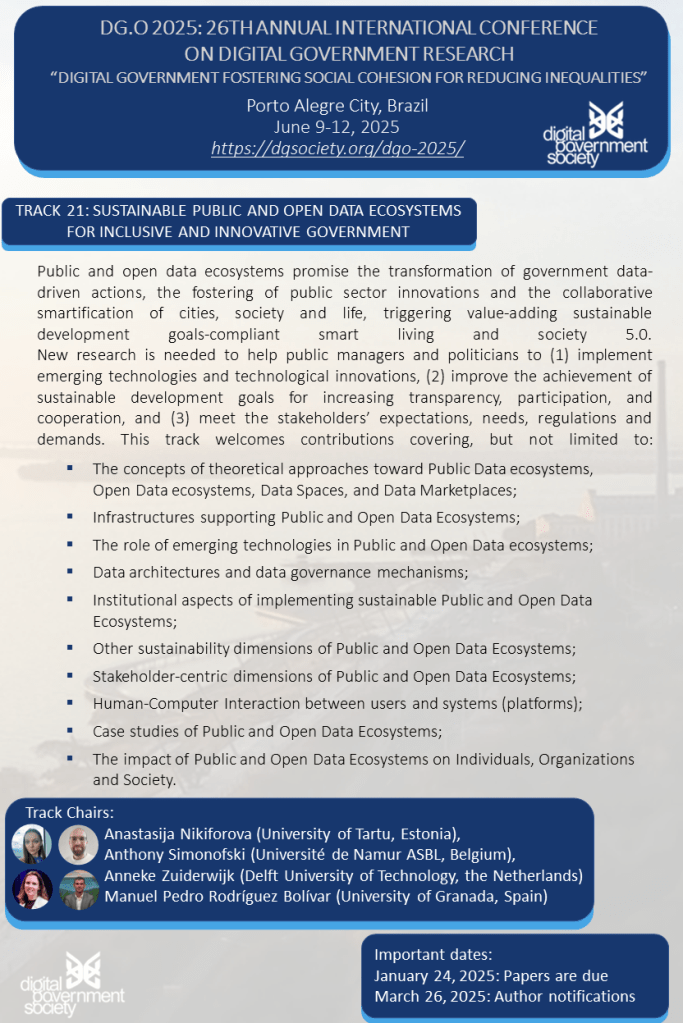
26th Annual International Conference on Digital Government Research (dg.o2025) is coming with continuation of the track we launched the last time – “Sustainable Public and Open Data Ecosystems for inclusive and innovative government” track (chairs: Anastasija Nikiforova (University of Tartu, Estonia), Anthony Simonofski (Université de Namur ASBL, Belgium), Anneke Zuiderwijk (Delft University of Technology, the Netherlands) & Manuel Pedro Rodríguez Bolívar (University of Granada, Spain)).

Briefly about the track… Today, the goal of an actor-centric public data ecosystem that would be sufficiently sustainable, resilient and fair, is defined as an approach capable of representing and keeping in balance the data interests of all actors[1], to bring expected value (both economic, social and environment) became central for public data ecosystems and other types of data infrastructures and data spaces[2] that are based on the concept of openness and data sharing among stakeholders. Public data and open (government) data ecosystems are seen as a political and socio-economic phenomenon that promise to benefit the economy, and increase transparency, efficiency, and quality of public services, including the transformation of government data-driven actions, stimulate public sector innovations in various areas of public life and promote civic engagement[3][4][5]. Having collaborative governance models in place is one of the prerequisites for a resilient and value-adding ecosystem, of which stakeholders are an inevitable element, making it necessary to ensure those ecosystems are stakeholder-oriented. These models are expected to support stakeholders/actors, who, however, may have different characteristics (incl. (open) data literacy and digital literacy), needs / demands and expectations (public sector, private sector, business, citizen) for public value creation and co-creation. Understanding, designing, and maintaining such an ecosystem is further complicated by the fact that both data, service and process quality must be ensured and kept maintained with a limited understanding of how the above are expected to be ensured even alone.

Recent research found that concepts affecting and shaping the ecosystem are: 1) stakeholders / actors and their roles, 2) phases of the data lifecycle, in which a stakeholder participates in the ecosystem, 3) technical and technological infrastructure, 4) generic services and platforms, 5) human capacities and skills of both providers and consumers, 6) smart city domains (thematic categories) as the targeted areas for data reuse, 7) externalities affecting goals, policy, and resources, 8) level of (de)centralization of data sources – development, restrictions, 9) perception of importance and support from public officials, and 10) user interface, user experience, and usability[6]. Moreover, these ecosystems same as its components are (co-)evolving over time[7] due to both internal and external factors. The latter – external factors – include technological developments. As such, the rapid development of emerging technologies such as big data, artificial intelligence (AI) is seen as a new trigger for public and open data development (AI for open data and open data for AI), machine learning (ML), federated learning (FL), internet of things (IoT), metaverse etc. provides new opportunities to improve these ecosystems in a disrupt way to be useful for collaborative governance models. Also, the link between Open Data Ecosystems and sustainable development goals (SDG) seems to be more relevant nowadays in their way to build more democratic cities based on government transparency, citizen participation, and citizen cooperation. Finally, higher expectations, needs and demands of businesses and citizens, derived from the implementation of B2G, C2G models, that influence and shape the design and development of these data environments, as well as expected to be affected, e.g., B2G in relation to which European Commission is taking regulatory action and is preparing the Data Act to set the rules and conditions, thereby changing the current voluntary model to a more mandatory data sharing. Current research suggests that these topics are of great importance to governments, as well as businesses and citizens, whose efforts should complement each other in order to enable effective data reuse and value co-creation

As such, as public and open data ecosystems promise the transformation of government data-driven actions, the fostering of public sector innovations and the collaborative smartification of cities, society and life, triggering value-adding sustainable development goals-compliant smart living and Society 5.0. New research is needed to help public managers and politicians for (1) implementing emerging technologies and technological innovations, (2) improving the achievement of sustainable development goals for increasing transparency, participation, and cooperation, and (3) meeting the stakeholders’ expectations, needs, regulations and demands.

As such, this track welcomes contributions covering, but not limited to:

  • The concepts of theoretical approaches toward Public Data ecosystems, Open Data ecosystems, Data Spaces, and Data Marketplaces;
  • Infrastructures supporting Public and Open Data Ecosystems;
  • The role of emerging technologies in Public and Open Data ecosystems (incl. but not limited to AI, Generative AI, LLM, NLP, cloud computing, green computing, Metaverse  etc.);
  • Data architectures and data governance mechanisms;
  • Institutional aspects of implementing sustainable Public and Open Data Ecosystems;
  • Other sustainability dimensions of Public and Open Data Ecosystems;
  • Stakeholder-centric dimensions of Public and Open Data Ecosystems;
  • Human-Computer Interaction between users and systems (platforms);
  • Case studies of Public and Open Data Ecosystems, incl. but not limited to Local Government Level Data Ecosystems, e.g., Smart Cities Data Ecosystems;
  • The impact of Public and Open Data Ecosystems on Individuals, Organizations and Society.
The track welcomes both contributions covering the current state-of-the-art of public data ecosystems (what components constitute them, what are the relationships between these components, what makes an ecosystem resilient and sustainable), incl. individual case studies reflecting best or bad practices, as well as those addressing how these ecosystems can be transformed into more sustainable ecosystems that will “fuel” or “smartify” society (Information Society aka Society 4.0 to Super Smart Society aka Society 5.0 transition), cities and various areas of life.

The track is very aligned with the conference theme of DGO 2025, namely: Digital government fostering social cohesion for reducing inequalities. As mentioned in the theme description, “It focuses on strong social bonds in civic society, with responsive democracy and impartial law enforcement aiming at collaboratively addressing latent social conflicts. It involves building shared values in communities facing common challenges in an attempt to reduce disparities by increasing citizens’ feeling of belonging to a community and their engagement.” Public and open data ecosystems can be considered as environments that contribute to the above. Open data is aimed at reducing inequalities, open platforms constitute environments where data providers and data users find each other and collaborate and co-create to develop services and products useful for society, i.e., addressing their needs and tackling challenges society faces. While digital technologies enable the development of public and open data ecosystems, the adoption of such ecosystems has been fragmented. For instance, Van Loenen et al. (2021)[8] found that open data ecosystems “often do not balance open data supply and demand, exclude specific user groups and domains, are linear, and lack skill-training” (p. 2), which reduces their value-generation and sustainability.

Is your research related to any of the above topics? Then do not wait – submit!

🗓️🗓️🗓️Important Dates:

January 24, 2025: Papers, workshops, tutorials, and panels are due
March 26, 2025: Author notifications (papers, workshops, tutorials, panels)


[1] Calzati, S., & van Loenen, B. (2023). A fourth way to the digital transformation: The data republic as a fair data ecosystem. Data & Policy, 5, e21.

[2] Lnenicka, M., Nikiforova, A., Luterek, M., Milic, P., Rudmark, D., Neumaier, S., … & Rodríguez Bolívar, M. P. (2023). Understanding the development of public data ecosystems: from a conceptual model to a six-generation model of the evolution of public data ecosystems. Available at SSRN 4831881.

[3] Nikiforova, A., Rizun, N., Ciesielska, M., Alexopoulos, C., Miletič, A.(2023). Towards High-Value Datasets determination for data-driven development: a systematic literature review. In: Lindgren,I., Csáki, C., Kalampokis, E., Janssen, M.,, Viale Pereira,G.,Virkar, S., Tambouris, E., Zuiderwijk, A.Electronic Government. EGOV 2023. Lecture Notes in Computer Science. Springer, Cham

[4] Kassen, M. (2020). Open data and its peers: understanding promising harbingers from Nordic Europe. Aslib Journal of Information Management, 72(5), 765-785.

[5] Santos-Hermosa, G., Quarati, A., Loría-Soriano, E., & Raffaghelli, J. E. (2023). Why Does Open Data Get Underused? A Focus on the Role of (Open) Data Literacy. In Data Cultures in Higher Education: Emergent Practices and the Challenge Ahead (pp. 145-177). Cham: Springer International Publishing.

[6] Lnenicka, M., Nikiforova, A., Luterek, M., Azeroual, O., Ukpabi, D., Valtenbergs, V., & Machova, R. (2022). Transparency of open data ecosystems in smart cities: Definition and assessment of the maturity of transparency in 22 smart cities. Sustainable Cities and Society, 82, 103906.

[7] Nikiforova, A., Lnenicka, M., Milić, P., Luterek, M., & Rodríguez Bolívar, M. P. (2024, August). From the evolution of public data ecosystems to the evolving horizons of the forward-looking intelligent public data ecosystem empowered by emerging technologies. In International Conference on Electronic Government (pp. 402-418). Cham: Springer Nature Switzerland.

[8] Loenen, B. van, Zuiderwijk, A., Vancauwenberghe, G., Lopez-Pellicer, F. J., Mulder, I., Alexopoulos, C., … & Flores, C. C. (2021). Towards value-creating and sustainable open data ecosystems: A comparative case study and a research agenda. JeDEM-eJournal of eDemocracy and Open Government, 13(2), 1-27.
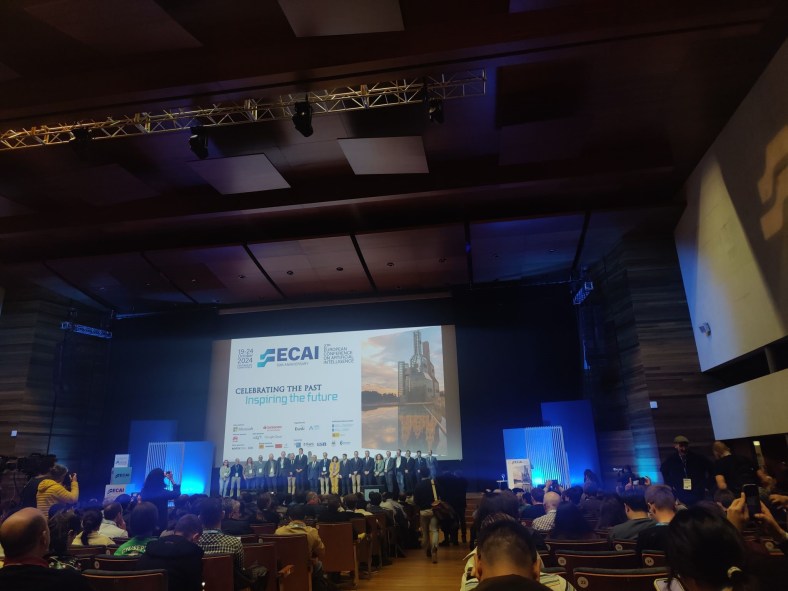
27th European Conference on Artificial Intelligence (ECAI 2024): Celebrating the past, inspiring the future

This October was one of the busiest yet most rewarding months of the year for me. Among several work trips, the highlight was attending the 27th European Conference on Artificial Intelligence (ECAI 2024) in Santiago de Compostela, Spain. Celebrating its 50th anniversary, ECAI remains Europe’s premier venue for AI research and innovation, bringing together thought leaders, researchers, and industry professionals from around the world.

This year’s theme, “Celebrating the Past, Inspiring the Future,” captured the spirit of ECAI’s half-century legacy while driving forward-looking discussions on the next era of artificial intelligence. With over 1,500 participants from 59 countries (so not so very European conference anymore, but rather a global event) and a packed schedule of more than 150 events, among which:

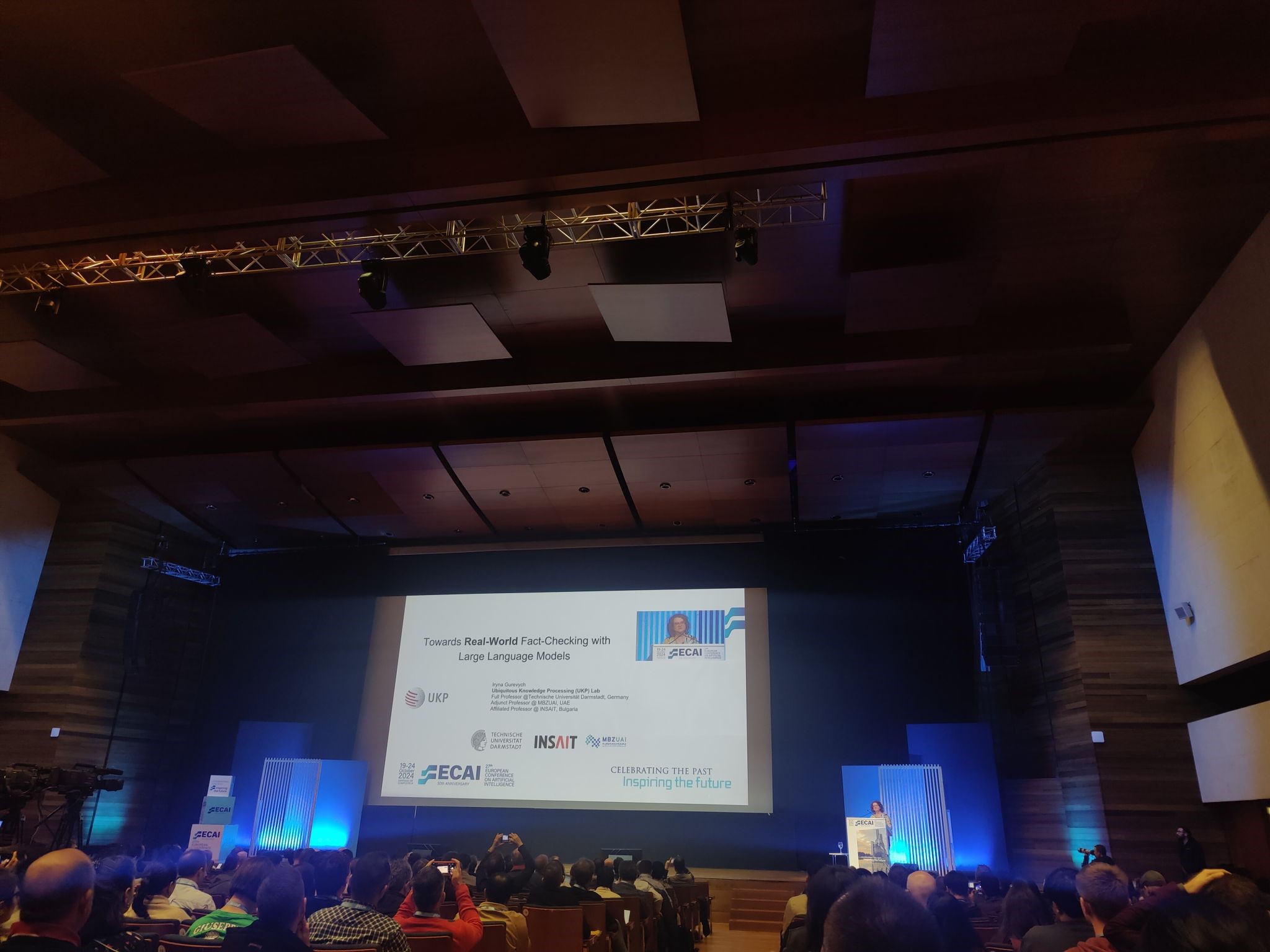
  • “Towards Real-World Fact-Checking with Large Language Models” keynote talk by Iryna Gurevych, (Technische Universität Darmstadt), reflecting on advancements in using language models for verifying information in real time;
  • “Robots (Still) Need Humans in the Loop,” keynote talk by Iolanda Leite (KTH Royal Institute of Technology), who underscored the essential role humans play in AI-driven robotics, even as systems grow more autonomous;
  • “Economic Complexity: Using Machine Learning to Understand Economic Development” keynote talk by Cesar A. Hidalgo (Toulouse School of Economics & Corvinus University of Budapest) that examined how machine learning is transforming our understanding of economic trends and predictions.

These were accompanied with a range of panels, with a few sessions that stood out (my personal opinion though):

  • Economic Impact of AI: Threats and Opportunities with Jeremy Rollison (Microsoft Corporation), David Autor (MIT), and Raquel Jorge Ricart (Elcano Royal Institute) on AI’s potential to reshape labor markets and economies around the world;
  • AI Regulation: The European Scenario (Kilian Gross, Dr. Clara Neppel, IEEE, Beatriz Alvargonzalez Largo, European Commission, José Miguel Bello Villarino, ARC Centre of Excellence for Automated Decision-Making and Society), addressed regulatory considerations;
  • 50th Anniversary Session on the History of AI in Europe paying tribute to AI’s history in Europe, with Luc Steels, Stefano Cerri, Fredrik Heintz, and Tony Cohn sharing reflections on past achievements and a “follow-up” on it in the Future of AI: The Next 50 Years with Fredrik Heintz, Iryna Gurevych, José Hernández-Orallo, Ann Nowe, Toby Walsh;
  • Designing Ethical and Trustworthy AI Research Policies for Horizon Europe centered on ethical standards and trustworthy AI research practices within the EU’s Horizon program, led by Mihalis Kritikos from the European Commission;
  • Funding your Scientific Research with the European Research Council (ERC) with Enrique Alba.

As part of this conference, I had pleasure of presenting a paper co-authored with my former student Jan-Erik Kalmus, based on his Master’s thesis, which I had the privilege of supervising. Our paper, To Accept or Not to Accept? An IRT-TOE Framework to Understand Educators’ Resistance to Generative AI in Higher Education,” examined what barriers might prevent educators from adopting Generative AI tools in their classrooms? Since the public release of ChatGPT, there has been a lively debate about the potential benefits and challenges of integrating Generative AI in educational contexts. While the technology holds promise, it has also sparked concerns, particularly among educators. In the field of information systems, Technology Adoption models are often used to understand factors that encourage or inhibit the use of new technologies. However, many existing models focus primarily on acceptance drivers, often overlooking the unique barriers that educators face. This study seeks to fill that gap by developing a theoretical model specifically tailored to identify the barriers that may prevent educators—academic staff in particular—from integrating Generative AI into their teaching. Our approach builds on Innovation Resistance Theory, augmented by constructs from the Technology-Organization-Environment (TOE) framework. With the designed mixed-method measurement instrument, combining quantitative data with qualitative insights, to capture educators’ specific concerns around Generative AI adoption in higher education, our model has been applied in real-world settings, specifically focusing on Estonian higher education institutions. We examined whether academic staff at public universities in Estonia – often referred to as a “digital nation” – show reluctance toward Generative AI use in educational settings. Preliminary findings highlight several concerns unique to educators, which may shape how Generative AI is integrated into teaching practices.

A Heartfelt Thanks to ECAI’s Organizers – the European Association for Artificial Intelligence (EurAI), the Spanish Artificial Intelligence Society, CiTIUS (Research Centre on Intelligent Technologies), and, of course, the city of Santiago de Compostela for being such a welcoming place.

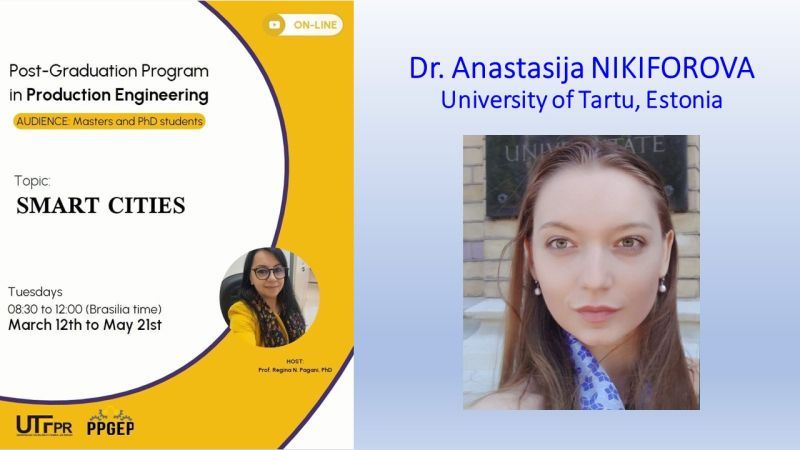
Guest Lecture for the Federal University of Technology – Paraná (UTFPR) on “Unlocking the symbiotic relationship of Artificial Intelligence, Data Intelligence, Collaborative Intelligence, and Embodied Intelligence for innovative urban planning and governance of Smart Cities”

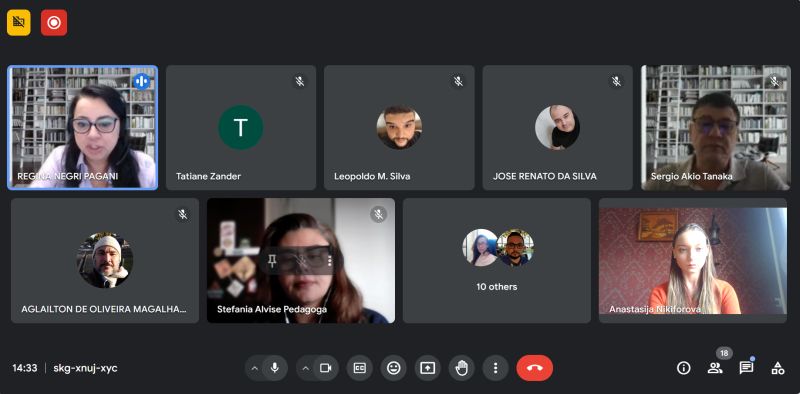
This May, I had a pleasure to deliver one more guest lecture for master and doctoral students of the Federal University of Technology – Paraná (Universidade Tecnológica Federal do Paraná (UTFPR)) as part of Smart Cities course delivered by prof. Regina Negri Pagani. This time the topic of my lecture was “Unlocking the symbiotic relationship of Artificial Intelligence, Data Intelligence, Collaborative Intelligence, and Embodied Intelligence for innovative urban planning and governance of Smart Cities”.

In the pursuit of enhancing the efficiency and effectiveness of Artificial Intelligence, it is imperative to explore synergies with other form of intelligence, such Data Intelligence and Collaborative intelligence. These forms of intelligence (along with Embodied Intelligence) constitute a new transformative paradigm of intelligence proposed by Verhulst et al. (2021) that offers potential for increased added value when synergized. However, their synergy requires understanding and harnessing the symbiotic relationship between these intelligences. The reimagination of decision making and problem-solving processes, is essential to unlock this symbiotic potential fostering more meaningful, but at the very same time more sustainable AI utilization. In other words, AI itself brings a certain value that can be (and must be) increased through integration with other forms of Intelligence. This, in turn, has a list of preconditions / prerequisites that must be satisfied by the above – Artificial, Data, Collaborative, and Embodied Intelligence – components. These prerequisites are diverse in nature and span both the artifacts in question, such as AI, data (type, format, quality, value, availability, accessibility, incl. openness), stakeholders’ skills and literacies, but also management and organizational aspects. In other words, each form of Intelligence influences the others, making it crucial to explore their interconnections. This talk endeavoured to uncover this intricate web of relationships between the three forms of intelligence, taking a step towards a more meaningful and intelligent approach to decision making and problem solving.

As part of this talk we referred to the theory of multiple intelligences by Howard Gardner presented in his famous book “Frames of Mind: A Theory of Multiple Intelligences”. Then, we referred to the above mentioned intelligence paradigm proposed by Stefaan G. Verhulst, Peter Martey Addo, Dominik Baumann, Juliet Mcmurren, Andrew Young, Andrew J. Zahuranec in “Emerging Uses of Technology for Development: A New Intelligence Paradigm“. Then, we finally turned to the actual discussion on the symbiotic relationship of Artificial Intelligence, Data Intelligence, Embodied Intelligence, Collaborative Intelligence, and Generative AI uncovering this intricate web of relationships between these forms of intelligence, putting the above into several contexts with a focus on public & public and open data ecosystems. The later topics, in turn, covered some of my previous research (such as “Sustainable open data ecosystems in smart cities: A platform theory-based analysis of 19 European cities, ” “Identifying patterns and recommendations of and for sustainable open data initiatives: A benchmarking-driven analysis of open government data initiatives among European countries“, “Transparency of open data ecosystems in smart cities: Definition and assessment of the maturity of transparency in 22 smart cities etc.). As such, we tried to indicate future avenues in the light of changing paradigms (or need for such) for intelligences, data ecosystems, mechanisms for citizen engagement & processes (incl., but not limited to data governance & data quality management) accompanying these ecosystems


This followed up by the fruitful discussion with the participants of the course that I enjoyed very much. I can only hope that this lecture was just a little bit as interesting as my dear Regina characterized it! There is nothing better than hear an immediate invitation for the next editions of this course – will be glad to continue this tradition!

Generative AI Role in Shaping the Future of Open Data Ecosystems: Synergies amidst Paradoxes

The role of Generative AI is the subject for debates in almost every domain today, and the open data (ecosystem) domain is no exception. Here’s my two cents on this with the blog post “Generative AI Role in Shaping the Future of Open Data Ecosystems: Synergies amidst Paradoxes”.
In this blog post, I present some personal observations and predictions on how Generative AI will stop open “data winter” or even give an impetus to the “data spring” the call for what has been made recently. While these steps may be many and different, one obvious element that could affect the current state of affairs is Artificial Intelligence, particularly in the form of Generative AI. Along with this “forecast” and high-level discussion that is expected to be made more in-depth and likely evidence-based (since, together with my colleagues and students, we are already working in this direction), some paradoxes are mentioned among this symbiotic relationship between Generative AI and open data (ecosystem)…