
Our new paper, “Theorizing the evolution of public data ecosystems: An empirically grounded multi-generational model and future research agenda”, has been published in Government Information Quarterly. This publication marks the conclusion of a long-running research journey—one so rich that it produced four papers along the way—and brings together years of reflection on how public data systems emerge, evolve, and transform.
Several months ago, in my invited blogpost for Data Studies (“In Open Data We Trust? Busting the Myth, Rethinking Value in the Age of GenAI”), I reflected on the promises and limitations of open data. Despite its early optimism and democratic ideals, open data has produced uneven results in practice. This tension reinforced what I had been observing for years: open data alone is no longer sufficient. Instead, what increasingly matters is the broader, more adaptive configuration of Public Data Ecosystems (PDEs)—dynamic, evolving socio-technical systems shaped by institutions, technologies, infrastructures, actors, risks, and societal needs. That earlier blogpost unexpectedly provided the final spark of motivation to bring this paper across the finish line.
Why Public Data Ecosystems?
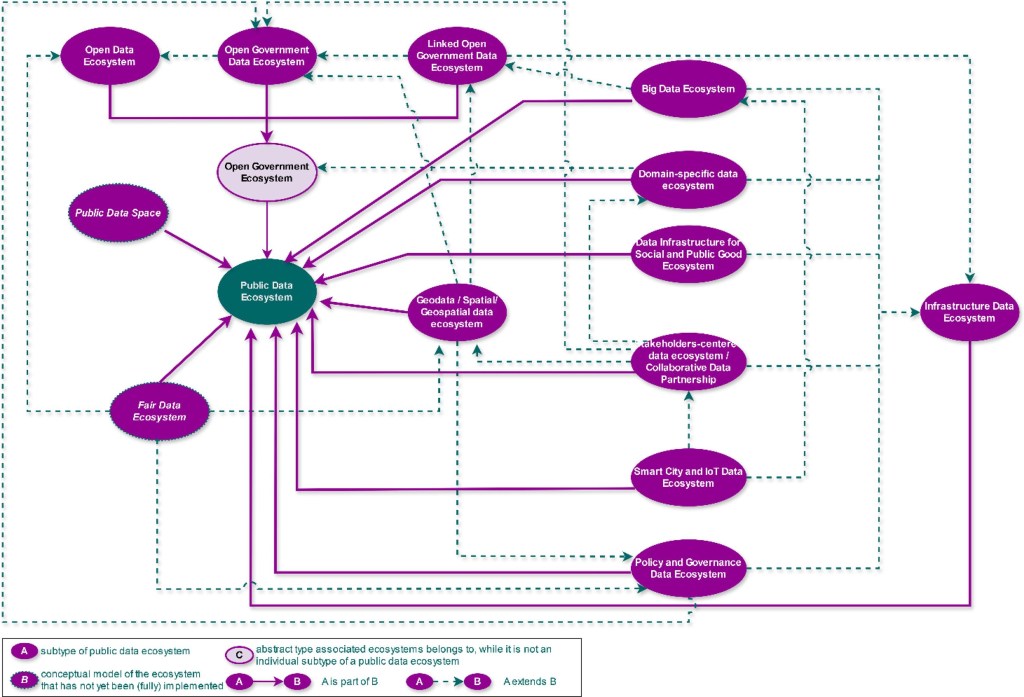
PDEs extend far beyond traditional open government data. They include geospatial data infrastructures, IoT-driven ecosystems, domain-specific environments, and federated data spaces with varying access models (see typology of PDEs in figure below and this piece). What binds them is not openness but their co-evolution—the way actors, data types, governance models, and technologies reshape each other over time.
This has become particularly salient with the rise of AI, generative AI, and large language models. These technologies challenge existing assumptions about data availability, quality, reuse, and governance. PDEs are no longer static infrastructures – they are living systems, with the above being now not only mere components but active actors who shape these systems.
In this study, we:
- theorize PDEs as multi-generational, evolving socio-technical systems, shaped by institutional, technological, and contextual dynamics;
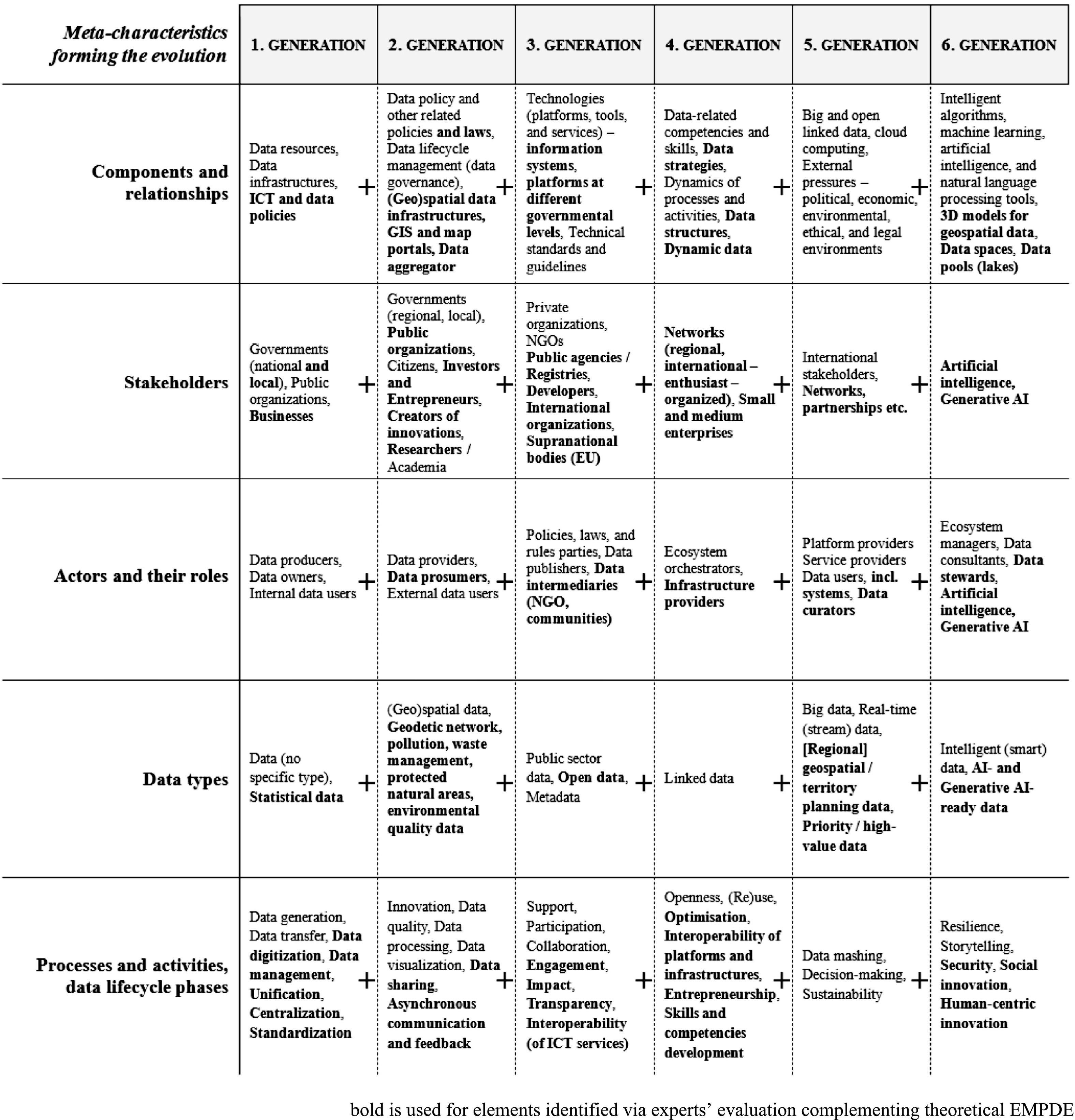
- refine the Evolutionary Model of PDEs (EMPDE) using empirical evidence from five European countries;
- introduce new attributes that capture overlooked dynamics and emerging realities;
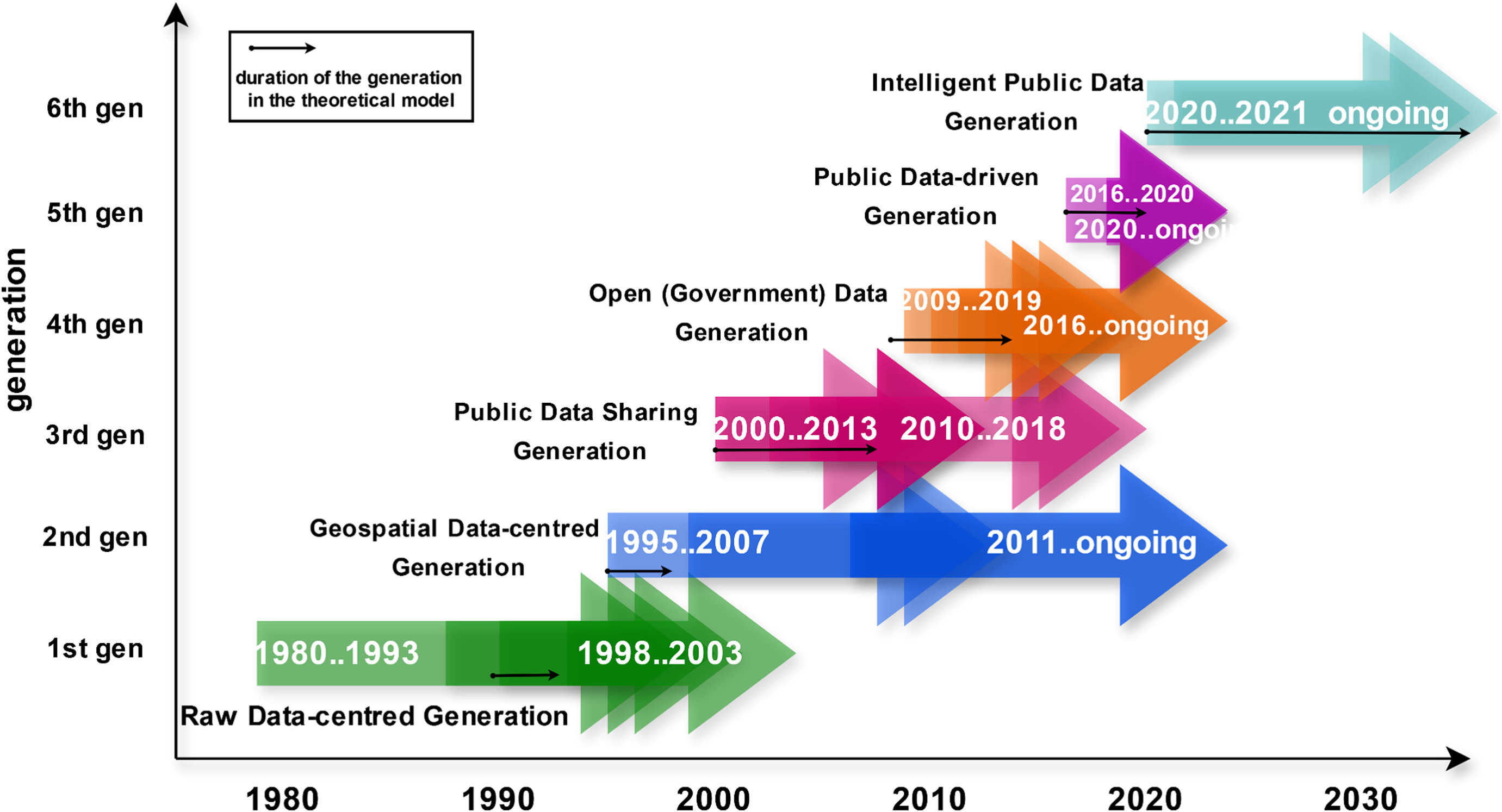
- describe the rise of a sixth, forward-looking generation propelled by emerging technologies—including AI, LLMs, and other data-driven innovations;
- propose a research agenda with 17 directions to guide the development of sustainable, resilient, and intelligent PDEs.
Rather than validating the original EMPDE model that we proposed earlier (see this and this pieces), we treated it as a heuristic tool—an analytical lens—to explore how PDEs actually evolve in practice. This approach allowed us to identify theoretical gaps, generational ambiguities, and emerging patterns that refine the model’s structure. This helped us to reveal several important shifts:
- PDE evolution is not strictly linear; some countries move fluidly across “generations”;
- emerging technologies are reshaping governance logics faster than institutions can adapt;
- new attributes—such as ecosystem intelligence, risk-mediated openness, or cross-domain interoperability—are now essential;
- the sixth generation represents a paradigm shift, in which AI not only consumes data but co-determines which data becomes valuable, usable, and governable.
Understanding PDEs as evolving systems has implications for:
- policy makers, who must govern increasingly complex data landscapes;
- public sector organizations, whose operations increasingly depend on cross-domain data flows;
- researchers, who need frameworks that capture temporal, socio-technical, and institutional dynamics;
- technology developers, who must navigate the interplay between AI capabilities and data governance constraints.
The refined EMPDE model and the proposed research agenda aim to support these communities in building sustainable, resilient, and intelligent data ecosystems—ones capable of adapting to rapid technological and societal change.
This paper is the result of a our -now already long enough- collaboration with Martin Lněnička, Mariusz Luterek, Petar Milic, and Manuel Pedro Rodríguez Bolívar. Special thanks to Marijn Janssen, whose editorial guidance and sharp comments significantly improved the paper.
And sincere thanks to Aleksi Aaltonen and Marta Stelmaszak Rosa, whose invitation to write the Data Studies blogpost provided the unexpected inspiration to finalize this study.
Read more
If you’re interested in PDEs, data governance, AI, or socio-technical systems, I’d love to hear your thoughts. This area is evolving quickly—and so are the ecosystems we rely on.
 Anastasija Nikiforova, PhD