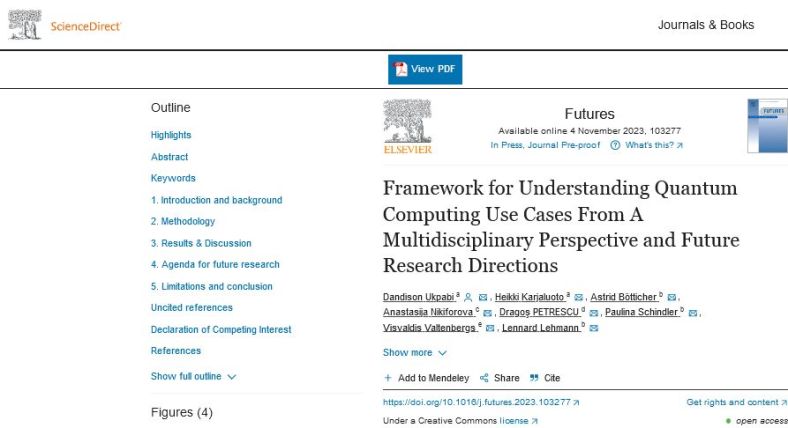
This post is dedicated to the “Framework for understanding quantum computing use cases from a multidisciplinary perspective and future research directions” (Ukpabi, D.C., Karjaluoto, H., Botticher, A., Nikiforova, A., Petrescu, D.I., Schindler, P., Valtenbergs, V., Lehmann, L.) paper that just has been published in Futures journal (Elsevier, Q1 in both (1) Business and International Management, (2) Development, (3) Sociology and Political Science) in an open access.

Recently, there has been increasing awareness of the tremendous opportunities inherent in quantum computing. It is expected that the speed and efficiency of quantum computing will significantly impact the Internet of Things, cryptography, finance, and marketing. Accordingly, there has been increased quantum computing research funding from national and regional governments and private firms. However, critical concerns regarding legal, political, and business-related policies germane to quantum computing adoption exist. Therefore, recently a call for a framework from an interdisciplinary perspective has been made to help an understanding the potential impact of quantum computing on society, which is vital to improve strategic planning and management by governments and other stakeholders. The lack of such a framework is due to the fact that quantum computing per se is a highly technical domain, hence most of the existing studies focus heavily on the technical aspects of quantum computing. In contrast, our study highlights its practical and social uses cases, which are needed for the increased interest of governments. More specifically, our study took this call and offered a preliminary version of a framework for understanding the social, economic and political use cases of quantum computing, as well as identified possible areas of market disruption and offer empirically based recommendations that are critical for forecasting, planning, and strategically positioning QCs for accelerated diffusion, incl. definition of 52 Research Questions that will be critical for the adoption of quantum computing.
To this end, we conducted a gray literature research, whose outputs were structured in accordance with Dwivedi et al. (2021) that embodies environment, users, & application areas. We then validated through the discussing the findings with the quantum computing community at QWorld Quantum Science Days 2023 (QSD 2023) (on which I posted before 👉 here).
In short:
- the hottest application areas are 🔥🔥🔥 business & finance, renewable energy, medicine & pharmaceuticals, & manufacturing 🔥🔥🔥;
- at the level of environment – ecosystem, security, jurisprudence, institutional change & geopolitics;
- users – customers, firms, countries or governments, to be more precise, with the reference to both national and local governments.

We then dived into these areas, and come up with the most popular & promising & overlooked topics, and as the very end-result, define 52 research questions, i.e., very specific things that are expected to be covered in the future to understand the current state-of-the-art, as well as transformations needed at various levels. The insights offered by various contributors from diverse disciplines – business, information systems, quantum computing, political science, and law offer a broad-based view of the potential of quantum computing to different aspects of our technological, economic, and social development. This framework is intended to help in identifying possible areas of market disruption offering empirically based recommendations that are critical for forecasting, planning, and strategically positioning prior to quantum computing emergence.
This is a truly a “happy end!” for the consortia that we built ~3 years ago – with Germany, Spain, Finland, Romania, and Latvia – while working on a project proposal to CHANSE call “Transformations: Social and Cultural Dynamics in the Digital Age”. We went there much far beyond my expectations, i.e. in fact, we were notified that this time we will not be granted the funding for the project at the very last stage, having gone through all those intermediate evaluation rounds, which were already fascinating news (at least for me). While working on the proposal and building our network, we conducted a preliminary analysis of the area, which then, regardless of the output of the application, we decided to continue and bring to at least some logical end. We like our result so decided to make it publicly available.
All in all, this is our warm welcome to read the paper -> here
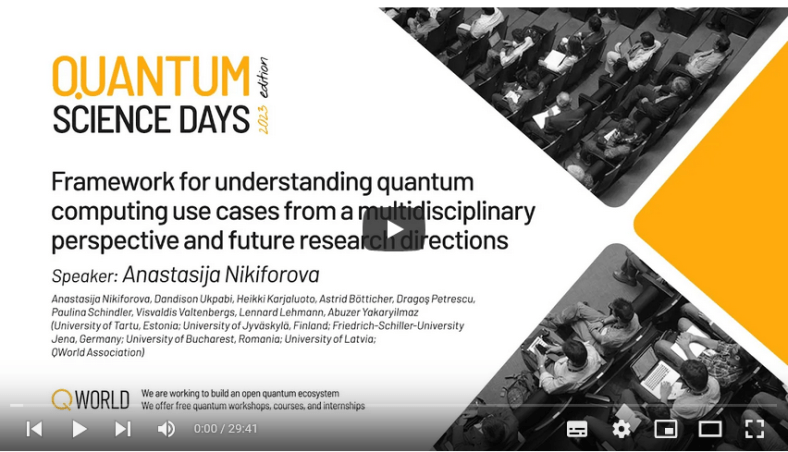
And just in case you prefer a condensed version, you can just watch the video of the talk I delivered at QWorld Quantum Science Days 2023 (QSD 2023) 👇
References:
Dandison Ukpabi, Heikki Karjaluoto, Astrid Bötticher, Anastasija Nikiforova, Dragoş PETRESCU, Paulina Schindler, Visvaldis Valtenbergs, Lennard Lehmann, Framework for Understanding Quantum Computing Use Cases From A Multidisciplinary Perspective and Future Research Directions, Futures, 2023, 103277, ISSN 0016-3287, https://doi.org/10.1016/j.futures.2023.103277.
Dwivedi, Y. K., Ismagilova, E., Hughes, D. L., Carlson, J., Filieri, R., Jacobson, J., … & Wang, Y. (2021). Setting the future of digital and social media marketing research: Perspectives and research propositions. International Journal of Information Management, 59, 102168.








 Anastasija Nikiforova, PhD