The International Conference on Intelligent Metaverse Technologies & Applications (iMeta) and the 8th IEEE International Conference on Fog and Mobile Edge Computing (FMEC) in Tartu

This year we – University of Tartu, Institute of Computer Science – have a pleasure to host FMEC2023, taking place in conjunction with iMETA, where iMETA, as you can assume, is associated with the metaverse (more precisely, the International Conference on Intelligent Metaverse Technologies & Applications), while FMEC – for the The Eighth IEEE International Conference on Fog and Mobile Edge Computing.

FMEC 2023 conference aims to investigate the opportunities and requirements for Mobile Edge Computing dominance, and seeks for novel contributions that help mitigating Mobile Edge Computing challenges. That is, the objective of FMEC 2023 is to provide a forum for scientists, engineers, and researchers to discuss and exchange new ideas, novel results and experience on all aspects of Fog and Mobile Edge Computing (FMEC) covering one of its major areas, which include, but not limited to the following tracks:

  • Track 1: Fog and Mobile Edge Computing fuels Smart Mobility
  • Track 2: Edge-Cloud Continuum and Networking
  • Track 3: Industrial Fog and Mobile Edge Computing Applications
  • Track 4: Trustworthy AI for Edge and Fog Computing
  • Track 5: Security and privacy in Fog and Mobile Edge Computing
  • Track 6: Decentralized Data Management and Streaming Systems in FMEC
  • Track 7: FMEC General Track

iMETA conference, in turn, aims to provide attendees with comprehensive understanding of the communication, computing, and system requirements of the metaverse. Through keynote speeches, panel discussions, and presentations, attendees had the opportunity to engage with experts and learn about the latest developments and future trends in the field, covering areas such as:

  • AI
  • Security and Privacy
  • Networking and Communications
  • Systems and Computing
  • Multimedia and Computer Vision
  • Immersive Technologies and Services
  • Storage and Processing

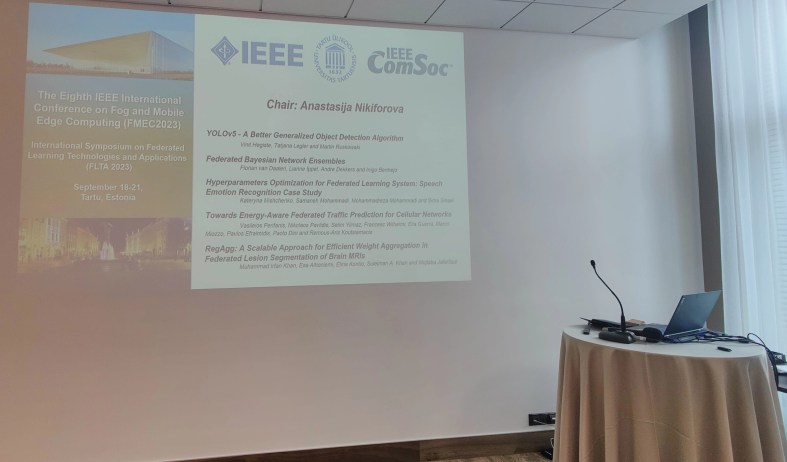
As part of these conferences, I had the pleasure of chairing one of the sessions, where the room was carefully selected by the organizers to make me feel as I would be at home – we were located in the so-called Baltic rooms of VSpa conference center, i.e., Estonia, Lithuania, and Latvia, so guess which room the session took place in? Bingo, Latvia! All in all, 5 talks were delivered:

  • Federated Object Detection for Quality Inspection in Shared Production by Vinit Hegiste
  • Federated Bayesian Network Ensembles by Florian van Daalen
  • Hyperparameters Optimization for Federated Learning System: Speech Emotion Recognition Case Study by Mohammadreza Mohammadi
  • Towards Energy-Aware Federated Traffic Prediction for Cellular Networks by Vasileios Perifanis
  • RegAgg: A Scalable Approach for Efficient Weight Aggregation in Federated Lesion Segmentation of Brain MRIs by Muhammad Irfan Khan, Esa Alhoniemi, Elina Kontio, Suleiman A. Khan and Mojtaba Jafaritadi

Each of the above was followed by a very lively discussion, which continued also after the session. This, in turn, was followed by an insightful keynote delivered by Mérouane Debbah on “Immersive Media and Massive Twinning: Advancing Towards the Metaverse”.

Also, thanks to our colleagues from EEVR (Estonian VR and AR Association), I briefly went to my school times and chemistry lessons having a bit of fun – good point, I’ve always loved them (nerd and weirdo, I know…).

Thanks to the entire FMEC and iMETA organizing team!

CFP for The IEEE International Conference on Intelligent Computing, Communication, Networking and Services (ICCNS2023)

On behalf of the organizers (Technical Program Chair, Steering Committee, and finally publicity chair) of the IEEE International Conference on Intelligent Computing, Communication, Networking and Services (ICCNS2023), I am inviting everyone, who is conducting research in this area, to consider submitting the paper to it.

Call for Papers:

New advancements in wireless communication systems such as Fifth-Generation (5G), Beyond Fifth-Generation (B5G), and Sixth-Generation (6G) networks will allow for new and unprecedented services to be made available for users with nearly unlimited capacity. These services will be the core driver for future digital transformation of our cities and communities. This will be accompanied by a ubiquitous deployment of Internet of Things (IoT) infrastructure and supported by computing capacity that will be available at the edge of the network and in the cloud. This computing infrastructure will handle the processing of data generated by users and services. Such a complex and diverse system will require the applications running on the computing/networking infrastructure to be Intelligent, efficient and sustainable. Additionally, the infrastructure will require smart control and automation systems to integrate and manage its different components. Artificial Intelligence (AI) and its applications will play a significant role in the design, deployment, automation, and management of future services. This will include applications that will be running on the edge and on cloud servers, networking applications to handle the flow of data between the users and the computing system, and intelligent automation and management software operating on the system. The International Conference on Intelligent Computing, Networking, and Services is aiming to provide an opportunity to present state of the art research in the intersections of Computing, Networking, and Services that are supported by Artificial Intelligence.

Submission Link: https://easychair.org/conferences/?conf=iccns2023

Researchers from both the industry and academia are encouraged to submit their original research contributions in all major areas, which include, but are not limited to the following main tracks:

💡Track 1: Artificial Intelligence Fundamentals

  • Artificial Intelligent Systems
  • Artificial Intelligent Theory
  • Artificial Intelligent applications in Computers and Communications
  • Artificial Intelligent and Robotics Technologies
  • Artificial Intelligent and cloud computing
  • Artificial Intelligent for Economic paradigms and game theory
  • Machine and Deep Learning of Knowledge
  • Artificial Intelligent based Distributed Knowledge and Processing
  • Artificial Intelligent for Human-Robot Interactions

💡Track 2: Intelligent Internet of Things and Cyber-Physical Systems

  • Intelligent IoT Applications and Services
  • Intelligent security for the Internet of Things and cyber-physical systems
  • Intelligent Internet of Things architectures and protocols
  • Intelligent Cyber Physical Systems (CPS)
  • Blockchain-based application in Intelligent Manufacturing: Industrial Internet of Things,
  • Blockchain and Secure Critical Infrastructure with Industry 4.0
  • Intelligent manufacture and management
  • Consensus and mining algorithms suited for resource-limited IoTs
  • Blockchain-based Controlled mobility and QoS
  • Blockchain-based energy optimization techniques in WSN
  • Blockchain-based Software defined networks

💡Track 3: Edge Intelligence and Federated Learning

  • Distributed and federated machine learning in edge computing
  • Theory and Applications of Edge Intelligence
  • Middleware and runtime systems for Edge Intelligence
  • Programming models compliant with Edge Intelligence
  • Scheduling and resource management for Edge Intelligence
  • Data allocation and application placement strategies for Edge Intelligence
  • Osmotic computing with edge continuum, Microservices and MicroData architectures
  • ML/AI models and algorithms for load balancing
  • Theory and Applications of federated learning
  • Federated learning and privacy-preserving large-scale data analytics
  • MLOps and ML pipelines at edge computing
  • Transfer learning, interactive learning, and Reinforcement Learning for edge computing
  • Modeling and simulation of EI and edge-to-cloud environments
  • Security, privacy, trust, and provenance issues in edge computing
  • Distributed consensus and blockchains at edge architecture
  • Blockchain networking for Edge Computing Architecture
  • Blockchain technology for Edge Computing Security
  • Blockchain-based access controls for Edge-to-cloud continuum
  • Blockchain-enabled solutions for Cloud and Edge/Fog IoT systems
  • Forensic Data Analytics compliant with Edge Intelligence

💡Track 4: Intelligent Networking in Beyond 5G (B5G) and 6G Wireless Communication

  • Intelligent Networking in Beyond 5G/6G Network Architectures
  • large-scale Internet of Things in B5G/6G
  • Vehicular networks in B5G/6G
  • Blockchain with lightweight computation
  • Service and applications for vehicular clouds in B5G/6G
  • Future internet architectures for B5G/6G
  • Intelligent networking services
  • Emerging networks in B5G/6G
  • Byzantine-tolerant FL
  • Churn-tolerant FL
  • FL for NGN and 6G
  • B5G/6G based IoT healthcare systems

💡Track 5: Intelligent Big Data Management and Processing

  • Intelligent Data Fusion
  • Intelligent Analytics and Data mining
  • Intelligent Distributed data management
  • Distributed transaction for blockchain
  • Intelligent Data Science and Data Engineering
  • Protocols for management and processing of data

💡Track 6: Intelligent Security and Privacy

  • Authentication and authorization
  • Applications of blockchain technologies in digital forensic
  • Privacy technologies
  • Blockchain-based threat intelligence and threat analytics techniques
  • Blockchain-based open-source tools
  • Forensics readiness of blockchain technologies
  • Blockchain Attacks on Existing Systems
  • Blockchain Consensus Algorithms
  • Blockchain-based Intrusion Detection/Prevention
  • Security and Privacy in Blockchain and Critical Infrastructure
  • Attacks on Blockchain and Critical Infrastructure
  • Blockchain and Secure Critical Infrastructure with Smart Grid

💡Track 7: Blockchain Research & Applications for Intelligent Networks and Services

  • State-of-the-art of the Blockchain technology and cybersecurity
  • Blockchain-based security solutions of smart cities infrastructures
  • Blockchain in connected and autonomous vehicles (CAV) and ITS)
  • Blockchain Technologies and Methodologies
  • Recent development and emerging trends Blockchain
  • New models, practical solutions and technological advances related to Blockchain
  • Theory of Blockchain in Cybersecurity
  • Applications of blockchain technologies in computer & hardware security
  • Implementation challenges facing blockchain technologies
  • Blockchain in social networking
  • Performance metric design, modeling and evaluation of blockchain systems
  • Network and computing optimization in blockchains
  • Experimental prototyping and testbeds for blockchains
  • Blockchain networking for Edge Computing Architecture
  • Blockchain technology for Edge Computing Security
  • Blockchain-based access controls for Edge-to-cloud continuum
  • Blockchain-enabled solutions for Cloud and Edge/Fog IoT systems
  • Forensic Data Analytics compliant with Edge Intelligence

Two workshops are scheduled to take place as part of ICCNS that you cannot miss, namely:

🗓️🗓️🗓️ IMPORTANT DATES

  • Full paper submission: April 21st, 2023 (Firm and Final)
  • Full paper acceptance notification: May 6th, 2023
  • Full paper camera-ready submission: May 20th, 2023

For any inquiries, please contact: intelligenttechorg@gmail.com.

Submit the paper and meet our team in Valencia in June, 2023!
 

With best wishes,

ICCNS2023 organizers

CFP: 3rd International Workshop on Advanced Data Systems Management, Engineering, and Analytics (MegaData): where the Edge meets the Cloud

On behalf of the organizers, I sincerely invite you to consider submitting the results of your recent research to The Third International Workshop on Advanced Data Systems Management, Engineering, and Analytics (MegaData), which will be held in conjunction with the 23rd  IEEE/ACM International Symposium on Cluster, Cloud and Internet Computing (CCGRID2023).

The MegaData objective is to bring together researchers, practitioners, system administrators, system programmers, and others interested in sharing and presenting their perspectives on the effective management of big data systems. The focus of the workshop is on a novel and practical, systems-oriented work, where MegaData, whose moto this year is “MegaData: where the Edge meets the Cloud”, offers an opportunity to showcase the latest advances in this area and discuss and identify future directions and challenges in management and engineering of big data systems.

MegaData covers the area of Big Data operations (management, engineering, and analytics) within Cloud and Edge computing models. It aims to report on the advances and trends in Big Data deployment architectures from both the infrastructure and application levels. Papers presenting recent results, research issues, practical applications, case studies, and industrial implementations are welcome.

Specific topics of interest include, but are not limited, to the following:

  • Resource management and scheduling mechanisms for data systems
  • Auto Scaling and elastic scaling approaches and mechanisms
  • Data governance and privacy of “data in motion” and “data at rest” over edge/cloud
  • Emerging Data deployment models in IoT, IoT-to-Cloud, Edge/fog
  • Federated Learning and edge intelligence for big data systems
  • Advances data storage models, including object stores and key-value stores
  • Techniques for data integrity, availability, reliability, and fault tolerance
  • Big Data workflows (data management, data wrangling, automated workflows)
  • Data pipeline (data lake to analytics, new data stream architectures, edge/fog, cloud enabled solutions)
  • High-performance Data Analytics applications
  • Adaptive offloading techniques among Fog, Edge, and Cloud Computing

Important dates

  • Submission open: December 1st, 2022
  • Paper submission Deadline: January 15th, 2023
  • Acceptance notification: February 10th, 2023
  • Camera-ready submission: March 17th, 2023
  • Conference Dates: May 1st, 2023

We invite original research papers that have not been previously published and are not currently under review for publication elsewhere. Submitted papers should be no longer than 8 pages (including references and appendices) in two-column IEEE template format. Papers need to be submitted through the EasyChair submission portal.

Best papers presented at the workshop will be selected, and the corresponding authors will be invited to submit an extended version of their papers for possible publications in: Special Issue on Emerging Topics in Big Data and Edge Intelligence on Springer Cluster Computing (IF 2.3)

Submit the paper and meet our team in Bangalore, India in May, 2023!

With best wishes,

MegaData organizers – Yaser Jararweh, Feras M. Awaysheh, Moath Jarrah, Anastasija Nikiforova, Sadi Alawadi