Estonian Centre of Excellence in Artificial Intelligence (EXAI)

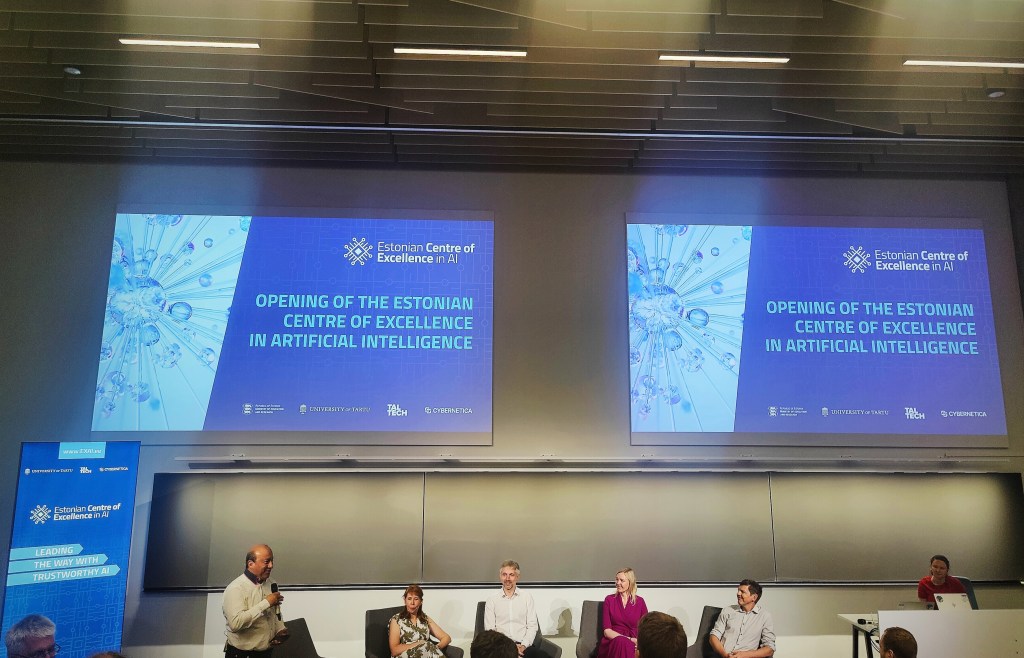
A pivotal moment for AI research and application in Estonia – opening of the Estonian Centre of Excellence in Artificial Intelligence (EXAI) that brings together 13 research groups from the University of Tartu, Tallinn University of Technology, and Cybernetica, under the leadership of Meelis Kull. With a focus on extending the AI knowledge base, developing hybrid AI systems, and ensuring safeguards in trust, privacy, and security, EXAI is poised to make significant contributions in various domains including e-governance, cybersecurity, education, healthcare, and business process management.

Last week, we – University of Tartu – hosted members and guests of EXAI as part of the opening event titled “Leading the Way with Trustworthy AI”, during which initial ideas into how we can build and harness trustworthy AI for societal benefit were presented by EXAI representatives, representing both academy, industry and government – Meelis Kull (University of Tartu, Head of EXAI), Rain Ottis (Tallinn University of Technology), Liina Kamm (Cybernetica), Jaan Aru (University of Tartu), Mark Fišel (University of Tartu), Tanel Tammet (Tallinn University of Technology), Kristel Kriisa (Government Office of Estonia), Henrik Trasberg (Estonian Ministry of Justice), Sander Tars (MindTitan), Ando Saabas (Microsoft), Margit Sutrop (University of Tartu, Member of the Parliament of Estonia), Marlon Dumas (University of Tartu), culminating in a dynamic panel discussion titled “AI Estonia”.

Let’s look forward to the exciting developments ahead!

📢✍️🗞️New paper alert! “Sustainable open data ecosystems in smart cities: A platform theory-based analysis of 19 European cities”, Cities (Elsevier)

With this post I would like to introduce our new paper entitled “Sustainable open data ecosystems in smart cities: A platform theory-based analysis of 19 European cities” (authors: M. Lnenicka, A. Nikiforova, A. Clarinval, M. Luterek, D. Rudmark, S. Neumaier, K. Kević, M. P. R. Bolívar) that has been just published in Cities journal (Elsevier, Q1).

Smart cities aim to enhance citizens’ lives, urban services, and sustainability, with open data playing a crucial role in this development. Cities generate vast data that, if properly utilized within an open data ecosystem, can improve citizens’ lives and foster sustainability. Central to this ecosystem is the platform, which enables data collection, storage, processing, and sharing. Understanding modern Open Data Ecosystems is pivotal for sustainable urban development and governance, promoting collaboration and civic engagement. In this study, we aimed to identify key components shaping these efforts by conducting a platform theory-based multi-country comparative study of 19 🇪🇺 European cities across 8 countries – Austria 🇦🇹, Belgium 🇧🇪, Croatia 🇭🇷, Czech Republic 🇨🇿, Latvia 🇱🇻, Poland 🇵🇱, Sweden 🇸🇪. Considering both managerial and organizational, political and institutional, as well as information and technological contexts, drawing on both primary and secondary data, we:

  • 🔎🧐🔍identify 50 patterns that influence and shape sustainable Open Data Ecosystems and their platforms, i.e., Open Data Platform Ecosystems. We applied a cluster analysis to identify similarities between groups of patterns that influence and shape open (government) data efforts in smart cities.
  • 🔎🧐🔍explore the relationships between platforms and other Open Data Platform Ecosystems’ components by developing a respective model, and identifying internal platforms and other components that we classified into four categories, (a) data and information disclosure platforms such as open data portals, transparency portals, and official city websites, (b) thematic city development platforms focused on the subject of information such as smart city and smart projects platforms, participation platforms, citizen reporting or accountability platforms, crowdfunding platforms for local projects, startup platforms, etc., (c) specific data format disclosure platforms, and (d) content of information focused platforms, i.e., domain-specific platforms focused on data visualizations and storytelling, which include but are not limited to smart data portals, IoT and big data portals etc. In addition, we identify four OGD strategies used in the strategic planning of the city;
  • 🔎🧐🔍 empirically validate the conceptual findings of five types of Open Data Platform Ecosystems presented in the literature, redefining them from the conceptual to real-life implementation of the respective components in 19 cities with further description of how they contribute to the maturity concept of a sustainable ODE and respective platforms;
  • 🔎🧐🔍 considering the experience gained during the study and external pressures and environments that shape or influence Open Data Platform Ecosystems, based predominantly on best practices or pain points for Open Data Ecosystems in the sampled smart cities, we define 12 recommendations for policy planning and urban governance of more sustainable Open Data Ecosystems.

And this is just a short overview of our contributions. Sounds interesting? Read the article here!

In case of interest, cite this paper as: