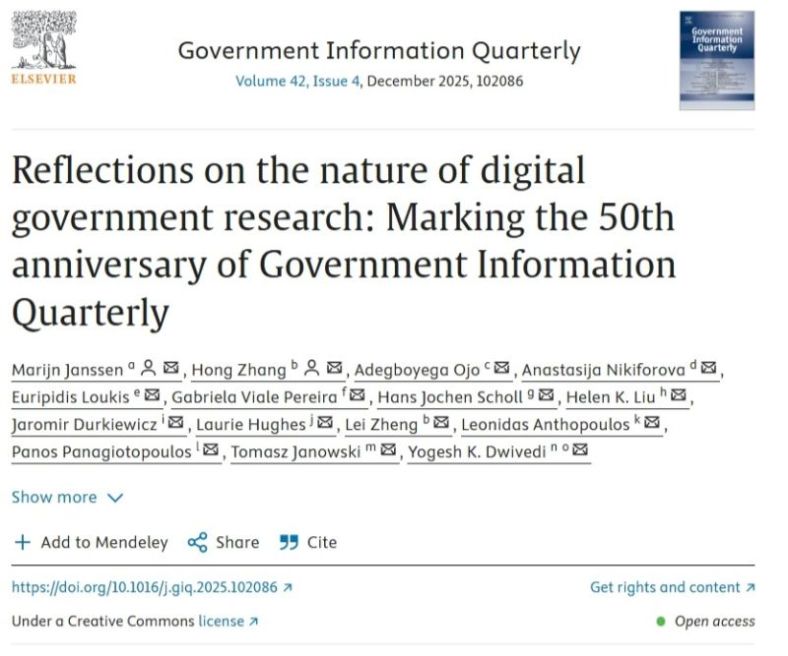
This collaborative piece brings together a group of scholars—Marijn Janssen, Hong Zhang, Adegboyega Ojo, Anastasija Nikiforova, Euripidis Loukis, Gabriela Viale Pereira, Hans J. Scholl, Helen Liu, Jaromir Durkiewicz, Laurie Hughes, Lei Zheng, Leonidas Anthopoulos, Panos Panagiotopoulos, Tomasz Janowski, and Yogesh K. Dwivedi—each offering a distinct perspective on how digital government research has evolved, diversified, and responded to societal and technological transformation.
A special thanks goes to Marijn Janssen, former Editor-in-Chief of GIQ, whose vision and coordination made this anniversary reflection possible.
Looking Back: Five Decades of Digital Government Research
Over 50 years, GIQ has chronicled—and often anticipated—the evolution of digital governance: from early computational systems to open government, data-driven innovation, smart cities, and the rise of AI. Throughout these cycles, the journal has remained the field’s intellectual anchor, publishing research that tackles foundational public sector challenges while engaging with emerging technologies such as blockchain, quantum computing, IoT, AR/VR, and the Metaverse.
Several characteristics continue to define GIQ’s identity:
• Methodological and epistemological pluralism GIQ’s hallmark is its openness to diverse paradigms, methods, and theoretical lenses. Rather than promoting a single theory of digital government, it invites multiple angles—qualitative, quantitative, mixed, conceptual, comparative—to analyze complex governance realities.
• “Blue-sky” thinking without hype GIQ encourages forward-looking, innovative, and boundary-pushing ideas, while maintaining analytical discipline. This balance keeps the field visionary yet grounded.
• Impact rooted in both theory and practice The journal has consistently insisted that strong methodology must lead to meaningful insights—advancing academic understanding while speaking directly to policymakers and practitioners.
• Clear communication to a broad audience GIQ’s readership extends well beyond academia. With government, industry, and civil society looking to the journal for guidance, clarity and accessibility are essential. As Shakespeare famously said, “brevity is the soul of wit.”
What Our Anniversary Article Contributes
Our contribution synthesizes insights from leading experts to illuminate the nature, evolution, and future of digital government research. Several overarching themes emerge:
epistemological pluralism and interdisciplinarity as fundamental characteristics of the field;
contextualized, value-driven, and practice-relevant research as the journal’s core strength;
digital transformation as a socio-technical phenomenon, where institutions, technology, data, governance models, and citizen expectations co-evolve;
the importance of studying both technology and context, avoiding the pitfalls of black-boxing either side of the equation;
GIQ’s role as a platform for blue-sky research, innovation, and rigorous theorization that remains relevant across countries and governance systems.
We dedicate this article to the late Professor Soon Ae Chun, former Co-Editor-in-Chief of GIQ. Her leadership, scholarship, and unwavering commitment to quality and community have left an enduring mark on the field.
The 50-year anniversary of GIQ is more than a celebration. It is a reminder that the future of digital government research depends on openness: in methods, theories, communication, and imagination. As digital governance accelerates, the journal’s role as a bridge—between disciplines, between theory and practice, and between local realities and global insights—has never been more essential.
Are you focusing on new topics emerging in the field of ICT and public sector, incl. public-private ecosystems? Then it is time to start preparing your submission for EGOV2025 – IFIP EGOV-CeDEM-EPARTEmerging Issues and Innovations Track, which this time we chair in the updated form, welcoming A. Paula Rodriguez Müller on the board with us – Francesco Mureddu (The Lisbon Council, Belgium)and myself – Anastasija Nikiforova (Tartu University, Estonia)).
EGOV2025 – IFIP EGOV-CeDEM-EPART is one of the most recognized conference in e-Government, ICT and public administration and related topics, which this year will be hosted in Belgium, in the heart of Europe, by University for Continuing Education Krems, Austria. This year, IFIP EGOV 2025 is dedicated to the broader areas of e-Government and e-Democracy, which include facets like Digital Government, e-Participation, Open Government, Smart Government, AI government, GovTech, Algoritmic Governance, and related topics to digitalization and government.
Innovation and application of emerging technologies are now more and more in the thinking of governments at all levels. While it would be easy to consider the public sector as being less flexible or slow in adoption, presentations at recent EGOV conferences proved that one should not come to such a conclusion too easily. Upcoming technologies, innovative organizational solutions, or new avenues of public sector involvement in the public sector are becoming more commonplace along with the potential challenges and issues these bring. Policymakers and public sector officials are now expected to embrace change, consider digital transformation, or improve governance practices. At the same time, public sector researchers are also influenced by new views, methods, tools, and techniques. The goal of this track is to provide a platform for the discussion of new ideas, issues, problems, and solutions entering the public sphere. Ideas that are emerging but might not fit other conference tracks are also welcome. Focus may include, but are not limited to:
Looking ahead into social innovation;
Future studies, the future of government, policy-making and democracy;
The future of digital governance;
Public values in transforming the government;
The role of government in smart cities (incl. smart sustainable cities) and sustainable living;
The role of the public sector in Human-Centered Society (Society 5.0);
New trends in public sector research such as Metaverse, Cityverse, Large Language Models (LLMs), generative AI and its implementations such as chatGPT, Claude, ChatSonic, Poe – benefits, risks, adoption and resistance to its adoption by the public sector and citizens;
Government in the Virtual Worlds and Web 4.0;
Decentralized Autonomous Organizations (DAOs), smart contracts and blockchain;
New technologies for automated decision-making and their policy implications;
Public sector use and regulation of AI, genAI, Industry 4.0, Industry 5.0, and the Internet of Things (IoT);
Digital Humanism (responsible and ethical integration of technology into society, ensuring that human values and dignity are prioritized in the development and use of digital tools and innovations);
The role of the public sector in competitiveness and tech sovereignty;
Global challenges that go beyond nation states (such as migration, climate change etc.) and which require international collaboration of individual governments;
Preparing for the policy challenges of future technologies;
Regulating misinformation;
Digital transformation in public sector contexts;
Self-Service Structures for Inclusion;
Public-private sector collaboration and integration;
GovTech initiatives and innovations;
Latest trends in co-creation and service delivery;
Online public community building;
Upcoming issues of eVoting / internet voting including application of digital signatures in the public sector;
Discussion of new research methods that have not been applied in this context;
Application of role theory in the analysis of public sector functions and processes;
Forward looking insights from case studies – let it be successful or failed experiments.
Utilization of digital billboards;
Public sector use and regulation of Fintech innovations;
Theoretical and practical approaches to experimentation and sandboxing in the public sector.Future studies, the future of government, policy-making and democracy
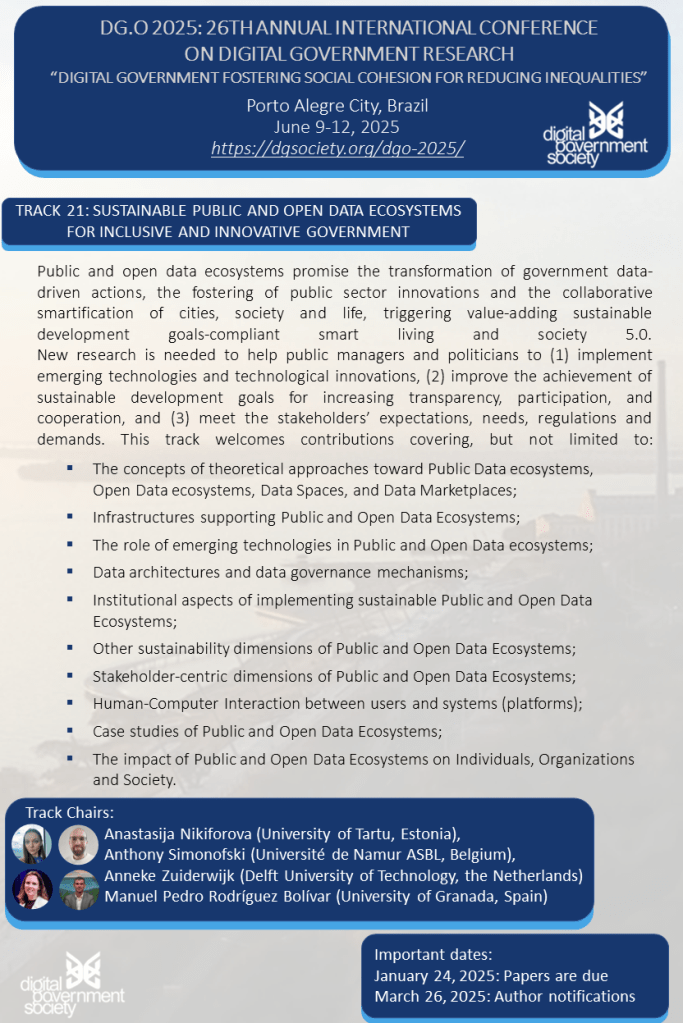
26th Annual International Conference on Digital Government Research (dg.o2025)is coming with continuation of the track we launched the last time – “Sustainable Public and Open Data Ecosystems for inclusive and innovative government” track (chairs: Anastasija Nikiforova (University of Tartu, Estonia), Anthony Simonofski (Université de Namur ASBL, Belgium), Anneke Zuiderwijk (Delft University of Technology, the Netherlands) & Manuel Pedro Rodríguez Bolívar (University of Granada, Spain)).
Briefly about the track… Today, the goal of an actor-centric public data ecosystem that would be sufficiently sustainable, resilient and fair, is defined as an approach capable of representing and keeping in balance the data interests of all actors[1], to bring expected value (both economic, social and environment) became central for public data ecosystems and other types of data infrastructures and data spaces[2] that are based on the concept of openness and data sharing among stakeholders. Public data and open (government) data ecosystems are seen as a political and socio-economic phenomenon that promise to benefit the economy, and increase transparency, efficiency, and quality of public services, including the transformation of government data-driven actions, stimulate public sector innovations in various areas of public life and promote civic engagement[3][4][5]. Having collaborative governance models in place is one of the prerequisites for a resilient and value-adding ecosystem, of which stakeholders are an inevitable element, making it necessary to ensure those ecosystems are stakeholder-oriented. These models are expected to support stakeholders/actors, who, however, may have different characteristics (incl. (open) data literacy and digital literacy), needs / demands and expectations (public sector, private sector, business, citizen) for public value creation and co-creation. Understanding, designing, and maintaining such an ecosystem is further complicated by the fact that both data, service and process quality must be ensured and kept maintained with a limited understanding of how the above are expected to be ensured even alone.
Recent research found that concepts affecting and shaping the ecosystem are: 1) stakeholders / actors and their roles, 2) phases of the data lifecycle, in which a stakeholder participates in the ecosystem, 3) technical and technological infrastructure, 4) generic services and platforms, 5) human capacities and skills of both providers and consumers, 6) smart city domains (thematic categories) as the targeted areas for data reuse, 7) externalities affecting goals, policy, and resources, 8) level of (de)centralization of data sources – development, restrictions, 9) perception of importance and support from public officials, and 10) user interface, user experience, and usability[6]. Moreover, these ecosystems same as its components are (co-)evolving over time[7] due to both internal and external factors. The latter – external factors – include technological developments. As such, the rapid development of emerging technologies such as big data, artificial intelligence (AI) is seen as a new trigger for public and open data development (AI for open data and open data for AI), machine learning (ML), federated learning (FL), internet of things (IoT), metaverse etc. provides new opportunities to improve these ecosystems in a disrupt way to be useful for collaborative governance models. Also, the link between Open Data Ecosystems and sustainable development goals (SDG) seems to be more relevant nowadays in their way to build more democratic cities based on government transparency, citizen participation, and citizen cooperation. Finally, higher expectations, needs and demands of businesses and citizens, derived from the implementation of B2G, C2G models, that influence and shape the design and development of these data environments, as well as expected to be affected, e.g., B2G in relation to which European Commission is taking regulatory action and is preparing the Data Act to set the rules and conditions, thereby changing the current voluntary model to a more mandatory data sharing. Current research suggests that these topics are of great importance to governments, as well as businesses and citizens, whose efforts should complement each other in order to enable effective data reuse and value co-creation
As such, as public and open data ecosystems promise the transformation of government data-driven actions, the fostering of public sector innovations and the collaborative smartification of cities, society and life, triggering value-adding sustainable development goals-compliant smart living and Society 5.0. New research is needed to help public managers and politicians for (1) implementing emerging technologies and technological innovations, (2) improving the achievement of sustainable development goals for increasing transparency, participation, and cooperation, and (3) meeting the stakeholders’ expectations, needs, regulations and demands.
As such, this track welcomes contributions covering, but not limited to:
The concepts of theoretical approaches toward Public Data ecosystems, Open Data ecosystems, Data Spaces, and Data Marketplaces;
Infrastructures supporting Public and Open Data Ecosystems;
The role of emerging technologies in Public and Open Data ecosystems (incl. but not limited to AI, Generative AI, LLM, NLP, cloud computing, green computing, Metaverse etc.);
Data architectures and data governance mechanisms;
Institutional aspects of implementing sustainable Public and Open Data Ecosystems;
Other sustainability dimensions of Public and Open Data Ecosystems;
Stakeholder-centric dimensions of Public and Open Data Ecosystems;
Human-Computer Interaction between users and systems (platforms);
Case studies of Public and Open Data Ecosystems, incl. but not limited to Local Government Level Data Ecosystems, e.g., Smart Cities Data Ecosystems;
The impact of Public and Open Data Ecosystems on Individuals, Organizations and Society.
The track welcomes both contributions covering the current state-of-the-art of public data ecosystems (what components constitute them, what are the relationships between these components, what makes an ecosystem resilient and sustainable), incl. individual case studies reflecting best or bad practices, as well as those addressing how these ecosystems can be transformed into more sustainable ecosystems that will “fuel” or “smartify” society (Information Society aka Society 4.0 to Super Smart Society aka Society 5.0 transition), cities and various areas of life.
The track is very aligned with the conference theme of DGO 2025, namely: Digital government fostering social cohesion for reducing inequalities. As mentioned in the theme description, “It focuses on strong social bonds in civic society, with responsive democracy and impartial law enforcement aiming at collaboratively addressing latent social conflicts. It involves building shared values in communities facing common challenges in an attempt to reduce disparities by increasing citizens’ feeling of belonging to a community and their engagement.” Public and open data ecosystems can be considered as environments that contribute to the above. Open data is aimed at reducing inequalities, open platforms constitute environments where data providers and data users find each other and collaborate and co-create to develop services and products useful for society, i.e., addressing their needs and tackling challenges society faces. While digital technologies enable the development of public and open data ecosystems, the adoption of such ecosystems has been fragmented. For instance, Van Loenen et al. (2021)[8] found that open data ecosystems “often do not balance open data supply and demand, exclude specific user groups and domains, are linear, and lack skill-training” (p. 2), which reduces their value-generation and sustainability.
Is your research related to any of the above topics? Then do not wait – submit!
🗓️🗓️🗓️Important Dates:
January 24, 2025: Papers, workshops, tutorials, and panels are due March 26, 2025: Author notifications (papers, workshops, tutorials, panels)
[1] Calzati, S., & van Loenen, B. (2023). A fourth way to the digital transformation: The data republic as a fair data ecosystem. Data & Policy, 5, e21.
[2] Lnenicka, M., Nikiforova, A., Luterek, M., Milic, P., Rudmark, D., Neumaier, S., … & Rodríguez Bolívar, M. P. (2023). Understanding the development of public data ecosystems: from a conceptual model to a six-generation model of the evolution of public data ecosystems. Available at SSRN 4831881.
[3] Nikiforova, A., Rizun, N., Ciesielska, M., Alexopoulos, C., Miletič, A.(2023). Towards High-Value Datasets determination for data-driven development: a systematic literature review. In: Lindgren,I., Csáki, C., Kalampokis, E., Janssen, M.,, Viale Pereira,G.,Virkar, S., Tambouris, E., Zuiderwijk, A.Electronic Government. EGOV 2023. Lecture Notes in Computer Science. Springer, Cham
[4] Kassen, M. (2020). Open data and its peers: understanding promising harbingers from Nordic Europe. Aslib Journal of Information Management, 72(5), 765-785.
[5] Santos-Hermosa, G., Quarati, A., Loría-Soriano, E., & Raffaghelli, J. E. (2023). Why Does Open Data Get Underused? A Focus on the Role of (Open) Data Literacy. In Data Cultures in Higher Education: Emergent Practices and the Challenge Ahead (pp. 145-177). Cham: Springer International Publishing.
[6] Lnenicka, M., Nikiforova, A., Luterek, M., Azeroual, O., Ukpabi, D., Valtenbergs, V., & Machova, R. (2022). Transparency of open data ecosystems in smart cities: Definition and assessment of the maturity of transparency in 22 smart cities. Sustainable Cities and Society, 82, 103906.
[7] Nikiforova, A., Lnenicka, M., Milić, P., Luterek, M., & Rodríguez Bolívar, M. P. (2024, August). From the evolution of public data ecosystems to the evolving horizons of the forward-looking intelligent public data ecosystem empowered by emerging technologies. In International Conference on Electronic Government (pp. 402-418). Cham: Springer Nature Switzerland.
[8] Loenen, B. van, Zuiderwijk, A., Vancauwenberghe, G., Lopez-Pellicer, F. J., Mulder, I., Alexopoulos, C., … & Flores, C. C. (2021). Towards value-creating and sustainable open data ecosystems: A comparative case study and a research agenda. JeDEM-eJournal of eDemocracy and Open Government, 13(2), 1-27.
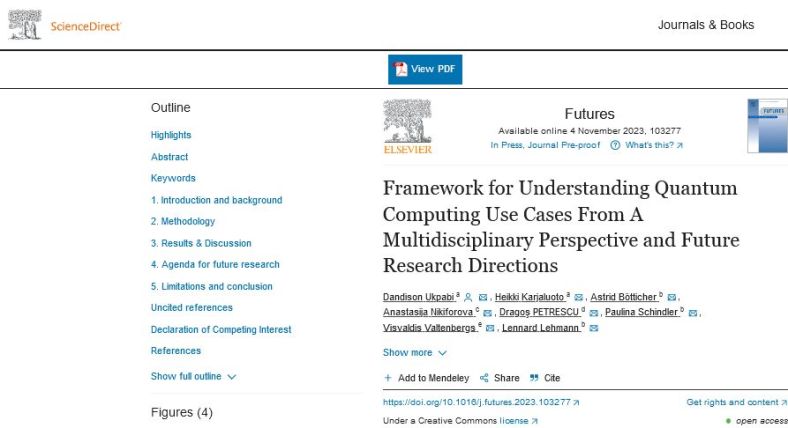
Recently, there has been increasing awareness of the tremendous opportunities inherent in quantum computing. It is expected that the speed and efficiency of quantum computing will significantly impact the Internet of Things, cryptography, finance, and marketing. Accordingly, there has been increased quantum computing research funding from national and regional governments and private firms. However, critical concerns regarding legal, political, and business-related policies germane to quantum computing adoption exist. Therefore, recently a call for a framework from an interdisciplinary perspective has been made to help an understanding the potential impact of quantum computing on society, which is vital to improve strategic planning and management by governments and other stakeholders. The lack of such a framework is due to the fact that quantum computing per se is a highly technical domain, hence most of the existing studies focus heavily on the technical aspects of quantum computing. In contrast, our study highlights its practical and social uses cases, which are needed for the increased interest of governments. More specifically, our study took this call and offered a preliminary version of a framework for understanding the social, economic and political use cases of quantum computing, as well as identified possible areas of market disruption and offer empirically based recommendations that are critical for forecasting, planning, and strategically positioning QCs for accelerated diffusion, incl. definition of 52 Research Questions that will be critical for the adoption of quantum computing.
To this end, we conducted a gray literature research, whose outputs were structured in accordance with Dwivedi et al. (2021) that embodies environment, users, & application areas. We then validated through the discussing the findings with the quantum computing community at QWorld Quantum Science Days 2023 (QSD 2023)(on which I posted before 👉 here).
In short:
the hottest applicationareas are 🔥🔥🔥 business & finance, renewable energy, medicine & pharmaceuticals, & manufacturing 🔥🔥🔥;
at the level of environment – ecosystem, security, jurisprudence, institutional change & geopolitics;
users – customers, firms, countries or governments, to be more precise, with the reference to both national and local governments.
We then dived into these areas, and come up with the most popular & promising & overlooked topics, and as the very end-result, define 52 research questions, i.e., very specific things that are expected to be covered in the future to understand the current state-of-the-art, as well as transformations needed at various levels. The insights offered by various contributors from diverse disciplines – business, information systems, quantum computing, political science, and law offer a broad-based view of the potential of quantum computing to different aspects of our technological, economic, and social development. This framework is intended to help in identifying possible areas of market disruption offering empirically based recommendations that are critical for forecasting, planning, and strategically positioning prior to quantum computing emergence.
This is a truly a “happy end!” for the consortia that we built ~3 years ago – with Germany, Spain, Finland, Romania, and Latvia – while working on a project proposal to CHANSE call “Transformations: Social and Cultural Dynamics in the Digital Age”. We went there much far beyond my expectations, i.e. in fact, we were notified that this time we will not be granted the funding for the project at the very last stage, having gone through all those intermediate evaluation rounds, which were already fascinating news (at least for me). While working on the proposal and building our network, we conducted a preliminary analysis of the area, which then, regardless of the output of the application, we decided to continue and bring to at least some logical end. We like our result so decided to make it publicly available.
All in all, this is our warm welcome to read the paper -> here
Dandison Ukpabi, Heikki Karjaluoto, Astrid Bötticher, Anastasija Nikiforova, Dragoş PETRESCU, Paulina Schindler, Visvaldis Valtenbergs, Lennard Lehmann, Framework for Understanding Quantum Computing Use Cases From A Multidisciplinary Perspective and Future Research Directions, Futures, 2023, 103277, ISSN 0016-3287, https://doi.org/10.1016/j.futures.2023.103277.
Dwivedi, Y. K., Ismagilova, E., Hughes, D. L., Carlson, J., Filieri, R., Jacobson, J., … & Wang, Y. (2021). Setting the future of digital and social media marketing research: Perspectives and research propositions. International Journal of Information Management, 59, 102168.
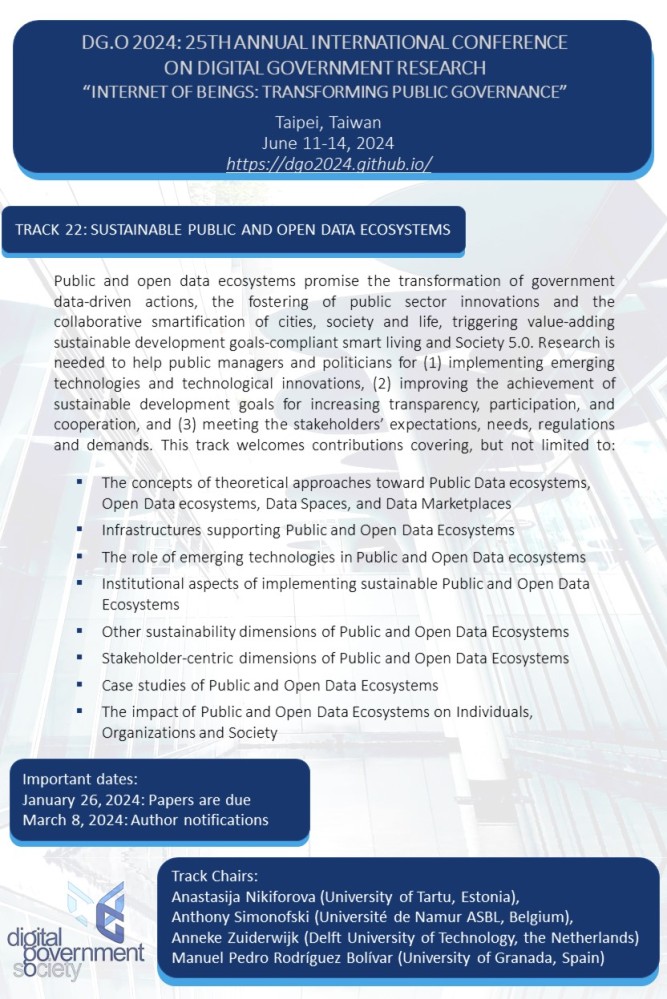
25th Annual International Conference on Digital Government Research (dg.o2024)is coming with the revised list of tracks, where the special attention I invite you to draw to is a new track “Sustainable Public and Open Data Ecosystems” (chairs: Anastasija Nikiforova (University of Tartu, Estonia), Anthony Simonofski (Université de Namur ASBL, Belgium), Anneke Zuiderwijk (Delft University of Technology, the Netherlands) & Manuel Pedro Rodríguez Bolívar (University of Granada, Spain)).
Briefly about the track… Public and open data ecosystems promise the transformation of government data-driven actions, the fostering of public sector innovations and the collaborative smartification of cities, society and life, triggering value-adding sustainable development goals-compliant smart living and society 5.0 (Nikiforova, 2021, Nikiforova et al., 2023). Recent research found that concepts affecting and shaping the ecosystem are: 1) stakeholders / actors and their roles, 2) phases of the data lifecycle, in which a stakeholder participates in the ecosystem, 3) technical and technological infrastructure, 4) generic services and platforms, 5) human capacities and skills of both providers and consumers, 6) smart city domains (thematic categories) as the targeted areas for data reuse, 7) externalities affecting goals, policy, and resources, 8) level of (de)centralization of data sources – development, restrictions, 9) perception of importance and support from public officials, and 10) user interface, user experience, and usability (Lnenicka et al., 2021). The body of knowledge in the above areas (not to say about putting them all together) is very limited. New research is needed to help public managers and politicians for (1) implementing emerging technologies and technological innovations, (2) improving the achievement of sustainable development goals for increasing transparency, participation, and cooperation, and (3) meeting the stakeholders’ expectations, needs, regulations and demands.
This track welcomes contributions covering, but not limited to:
💡 The concepts of theoretical approaches toward Public Data ecosystems, Open Data ecosystems, Data Spaces, and Data Marketplaces;
💡Infrastructures supporting Public and Open Data Ecosystems;
💡The role of emerging technologies in Public and Open Data ecosystems;
💡Institutional aspects of implementing sustainable Public and Open Data Ecosystems;
💡Other sustainability dimensions of Public and Open Data Ecosystems;
💡Stakeholder-centric dimensions of Public and Open Data Ecosystems;
💡Case studies of Public and Open Data Ecosystems;
💡The impact of Public and Open Data Ecosystems on Individuals, Organizations and Society.
The track welcomes both contributions covering the current state-of-the-art of public data ecosystems (what components constitute them, what are the relationships between these components, what makes an ecosystem resilient and sustainable), incl. individual case studies reflecting best or bad practices, as well as those addressing how these ecosystems can be transformed into more sustainable ecosystems that will “fuel” or “smartify” society (Information Society aka Society 4.0 to Super Smart Society aka Society 5.0 transition), cities and various areas of life.
The track is very in line with the conference theme of DGO 2024, namely: Internet of Beings – Transforming Public Governance, where, “the Internet of Beings focuses on digital technologies that enable integration, people-centric, and creation of open platforms for collaborative multi-user to co-create services and products” (as mentioned in the theme description). Public and open data ecosystems can be considered as such open platforms, where data providers and data users find each other and collaborate and co-create to develop services and products useful for society. While digital technologies enable the development of public and open data ecosystems, the adoption of such ecosystems has been fragmented.
Is your research related to any of the above topics? Then do not wait – submit!
🗓️🗓️🗓️Important Dates:
January 26, 2024: Papers, workshops, tutorials, and panels are due Feb 1, 2021: Application deadline for doctoral colloquium March 8, 2024: Author notifications (papers, workshops, tutorials, panels)





 Anastasija Nikiforova, PhD