This year we – University of Tartu, Institute of Computer Science – have a pleasure to host FMEC2023, taking place in conjunction with iMETA, where iMETA, as you can assume, is associated with the metaverse (more precisely, the International Conference on Intelligent Metaverse Technologies & Applications), while FMEC – for the The Eighth IEEE International Conference on Fog and Mobile Edge Computing.
FMEC 2023 conference aims to investigate the opportunities and requirements for Mobile Edge Computing dominance, and seeks for novel contributions that help mitigating Mobile Edge Computing challenges. That is, the objective of FMEC 2023 is to provide a forum for scientists, engineers, and researchers to discuss and exchange new ideas, novel results and experience on all aspects of Fog and Mobile Edge Computing (FMEC) covering one of its major areas, which include, but not limited to the following tracks:
- Track 1: Fog and Mobile Edge Computing fuels Smart Mobility
- Track 2: Edge-Cloud Continuum and Networking
- Track 3: Industrial Fog and Mobile Edge Computing Applications
- Track 4: Trustworthy AI for Edge and Fog Computing
- Track 5: Security and privacy in Fog and Mobile Edge Computing
- Track 6: Decentralized Data Management and Streaming Systems in FMEC
- Track 7: FMEC General Track
iMETA conference, in turn, aims to provide attendees with comprehensive understanding of the communication, computing, and system requirements of the metaverse. Through keynote speeches, panel discussions, and presentations, attendees had the opportunity to engage with experts and learn about the latest developments and future trends in the field, covering areas such as:
- AI
- Security and Privacy
- Networking and Communications
- Systems and Computing
- Multimedia and Computer Vision
- Immersive Technologies and Services
- Storage and Processing
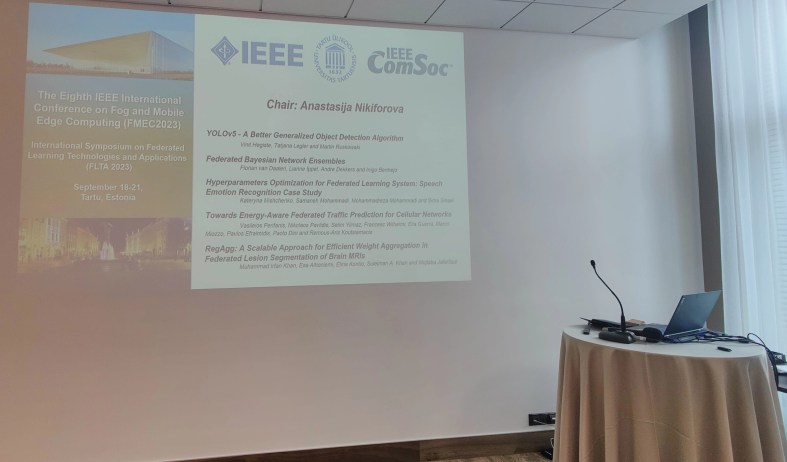
As part of these conferences, I had the pleasure of chairing one of the sessions, where the room was carefully selected by the organizers to make me feel as I would be at home – we were located in the so-called Baltic rooms of VSpa conference center, i.e., Estonia, Lithuania, and Latvia, so guess which room the session took place in? Bingo, Latvia! All in all, 5 talks were delivered:
- Federated Object Detection for Quality Inspection in Shared Production by Vinit Hegiste
- Federated Bayesian Network Ensembles by Florian van Daalen
- Hyperparameters Optimization for Federated Learning System: Speech Emotion Recognition Case Study by Mohammadreza Mohammadi
- Towards Energy-Aware Federated Traffic Prediction for Cellular Networks by Vasileios Perifanis
- RegAgg: A Scalable Approach for Efficient Weight Aggregation in Federated Lesion Segmentation of Brain MRIs by Muhammad Irfan Khan, Esa Alhoniemi, Elina Kontio, Suleiman A. Khan and Mojtaba Jafaritadi
Each of the above was followed by a very lively discussion, which continued also after the session. This, in turn, was followed by an insightful keynote delivered by Mérouane Debbah on “Immersive Media and Massive Twinning: Advancing Towards the Metaverse”.


Also, thanks to our colleagues from EEVR (Estonian VR and AR Association), I briefly went to my school times and chemistry lessons having a bit of fun – good point, I’ve always loved them (nerd and weirdo, I know…).
Thanks to the entire FMEC and iMETA organizing team!


 Anastasija Nikiforova, PhD