CFP for Data For Policy 2024 is open!

And CFP for Data For Policy 2024 scheduled for 9-11 July, 2024 is open! All submissions are welcome with the deadline of 27 November, 2023.

This year Data For Policy conference, which is organized in collaboration with Imperial College London and Cambridge University Press will take place in London, UK, and will be running under the title “Decoding the Future: Trustworthy Governance with AI” – trendy, isn’t it? In this edition the conference “[we] are focusing on the future of governance and decision making with AI. Firstly, what are the emerging capabilities, use cases, and best practices enabling innovation that could contribute to improved governance with AI? Secondly, what concerns are being raised regarding these advancements in areas such as data, algorithms, privacy, security, fairness, and potential risks? For both discussions, we invite proposals that delve into the role and capacity of governance in preventing AI-related harms and explore the potential for governance to generate added value through responsible AI deployment. For a more thorough consideration of the conference theme, please read this informative blog, by Zeynep Engin and conference co-chairs.

Data for Policy is looking forward to your submission to one of six areas of the respective Data & Policy journal, which are transformed into the tracks for this conference. In addition, this list is complemented with a rich list of 11 special tracks.

Of course, my personal recommendation is to consider Area 1 “Digital & Data-driven Transformations in Governance” (chairs: Sarah Giest, Sharique Manazir, Francesco Mureddu, Keegan McBride, Anastasija Nikiforova, Sujit Sikder). More specifically, the track seeks for contributions on topics that include but are not necessarily limited to:

  • From data to decisions: knowledge generation and evidence formation;
  • Process, psychology and behaviour of decision-making in digital era;
  • Government operations and services;
  • Government-citizen interactions; and open government;
  • Democracy, public deliberation, public infrastructure, justice, media;
  • Public, private and voluntary sector governance and policy-making.


Of course, do not ignore other tracks since each and every track definitely deserves your attention:

  • Area 1: Digital & Data-Driven Transformations in Governance – the one I just suggested;
  • Area 2: Data Technologies & Analytics for Governance;
  • Area 3: Policy & Literacy for Data;
  • Area 4: Ethics, Equity & Trustworthiness;
  • Area 5: Algorithmic Governance;
  • Area 6: Global Challenges & Dynamic Threats;
  • Special Track 1: Establishing an Allied by Design AI ecosystem
  • Special Track 2: Anticipating Migration for Policymaking: Data-Based Approaches to Forecasting and Foresight
  • Special Track 3: AI, Ethics and Policy Governance in Africa
  • Special Track 4: Social Media and Government
  • Special Track 5: Data and AI: critical global perspectives on the governance of datasets used for artificial intelligence
  • Special Track 6: Generative AI for Sound Decision-making: Challenges and Opportunities
  • Special Track 7: Governance of Health Data for AI Innovation
  • Special Track 8: Accelerating collective decision intelligence
  • Special Track 9: Artificial Intelligence, Bureaucracy, and Organizations
  • Special Track 10: AI and data science to strengthen official statistics
  • Special Track 11: Data-driven environmental policy-making

To sum up:

🗓️ WHEN? 9-11 July, 2024 -> deadline for papers and abstracts – 27 November, 2023

WHERE? London, UK

WHY? To understand what are the emerging capabilities, use cases, and best practices enabling innovation that could contribute to improved governance with AI? what concerns are being raised regarding these advancements in areas such as data, algorithms, privacy, security, fairness, and potential risks? For a more thorough consideration of the conference theme, please read this.

Find your favorite among tracks and submit! See detail on the official website.

International conference on the Intelligent Data Science (IDSTA2021): one conference – a ton of impressions

This November I had another great experience – participation in one of my favorite conferences – International conference on the Intelligent Data Science (IDSTA2021) collocated with Blockchain Computing and Applications (BCCA). Unfortunately, due to the pandemics we were not able to meet each other in person in Tartu, Estonia – a local organizer of this edition. But the organization was still perfect from their side. I was super delighted to serve a publicity chair for this conference for the second time (I mean IDSTA2020 and IDSTA2021).

IDSTA2021
Source: IDSTA2021

In short – 2 days (November 15-16), 50+ talks delivered by very skilled, experienced and knowledgeable researchers ready to establish and develop discussions around their topics during 13 sessions, 4 incredible keynotes delivered by Tarik Taleb, Omer Rana, Helen (Eleni) Karatza, Srijith Rajamohan, Ph.D.. Very lively discussions, insightful presentations and great environment!

Apart of serving as a publicity chair, I act as a reviewer, so I am a part of Program Committee, the session chair (for 2 sessions) and the (co-)author and presenter of two papers. One conference – 5 roles 😀 And what is even cooler is that my efforts have been also noticed by organisers and listed in Message from the General Chairs – it is always pleasant to notice you have been mentioned as a person, who contributed and whose contribution and efforts have been really highly evaluated.

Very briefly on my talks :

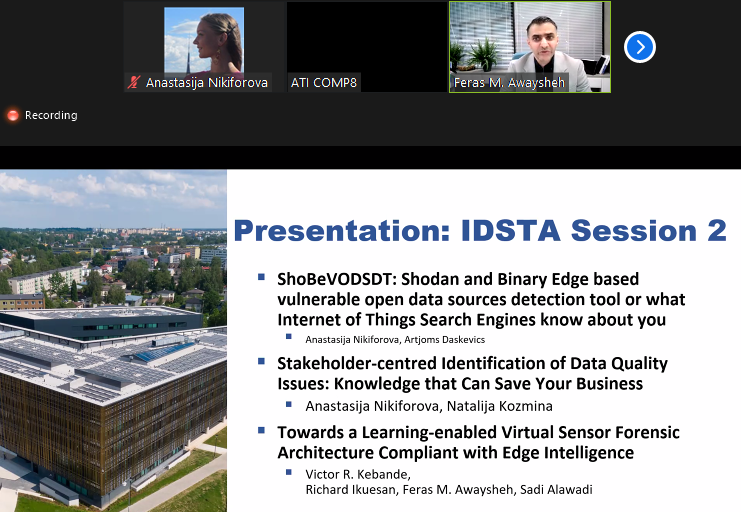
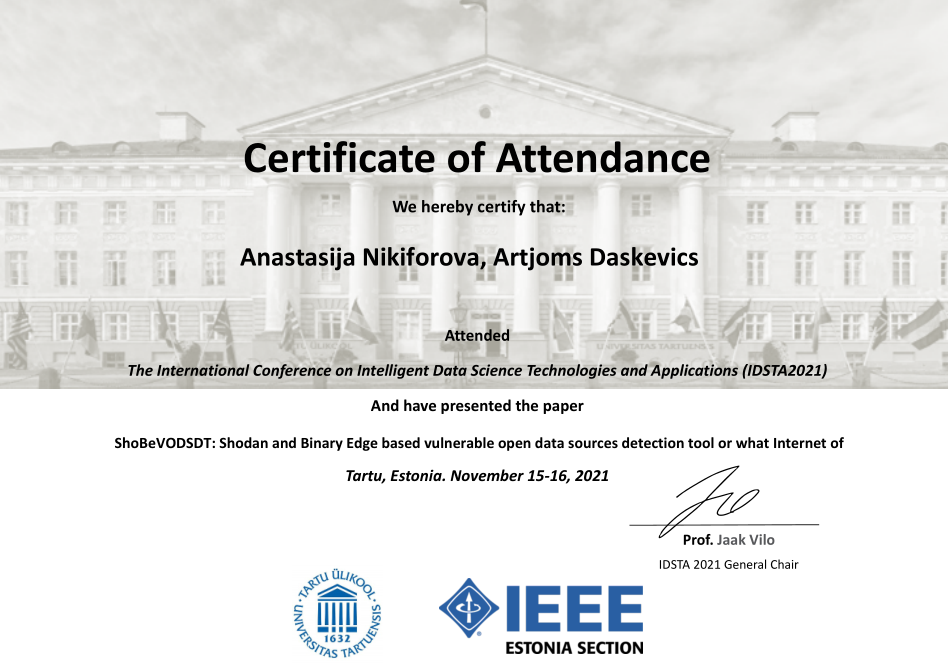
  • ShoBeVODSDT: Shodan and Binary Edge based vulnerable open data sources detection tool or what Internet of Things Search Engines know about you” (authored by Artjoms Daskevics and Anastasija Nikiforova) devoted to the study, which proposes a tool for non-intrusive testing of open data sources for detecting their vulnerabilities, called ShoBeVODSDT. It supports the identification of vulnerabilities at early security assessment stages and does not require the implementation of active and possibly disruptive techniques. ShoBeVODSDT uses two IoTSE (Internet of Things Search Engines) – Shodan and Binary Edge – by extending their features with the advanced capabilities built in it. It allows inspecting 8 predefined data sources, representing both rational databases, NoSQL databases and data stores – MySQL, PostgreSQL, MongoDB, Redis, Elasticsearch, CouchDB, Cassandra and Memcached – on their vulnerabilities and their extent. Our observation shows that security features built into the database allow to protect against unauthorized access, but there are databases with low security features, where it is possible to connect to nearly all IP addresses by retrieving information from them. Even more, in some cases the databases, which do not use security mechanisms, have been already compromised.
  • Stakeholder-centred Identification of Data Quality Issues: Knowledge that Can Save Your Business” (authored by Anastasija Nikiforova and Natalija Kozmina), in scope of which (1) we perform a literature analysis to compile a list of the most commonly occurring data quality issues, (2) considering the diversity and quantity of different data quality requirements and/or dimensions, we reduce the list of defects after running a brainstorming session followed by DELPHI analysis involving 12 experts, (3) the resulting list of defects is validated by 30 users with advanced data quality knowledge by means of applying the data quality analysis to real-world data that are freely accessible to all stakeholders (specifically, a pool of 30 open data sets). This leads us to the list of key data quality issues, which may be of advantage to the data holder and the data user giving both a higher level of confidence that the data are error-free and can be used without causing financial losses for business. These requirements, however, are expected to be used as input of the specification for the web-based data quality analysis tool to be developed.

Great event, great people, great emotions and impressions! Thank you, IDSTA2021 and your supportive and super-friendly team!