Research and Innovation Forum 2022: panel organizer, speaker, PC member, moderator and Best panel moderator award

As I wrote earlier, this year I was invited to organize my own panel session within the Research and Innovation Forum (Rii Forum). This invitation was a follow-up on several articles that I have recently published (article#1, article#2, article#3) and a Chapter to be published in “Big data & decision-making: how big data is relevant across fields and domains” (Emerald Studies in Politics and Technology) I was developing at that time. I was glad to accept this invitation, but I did not even think about how many roles I will act in Rii Forum and how many emotions I will experience. So, how was it?
First, what was my panel about? It was dedicated to data security entitled “Security of data storage facilities: is your database sufficiently protected?” being a part of the track called “ICT, safety, and security in the digital age: bringing the human factor back into the analysis“.

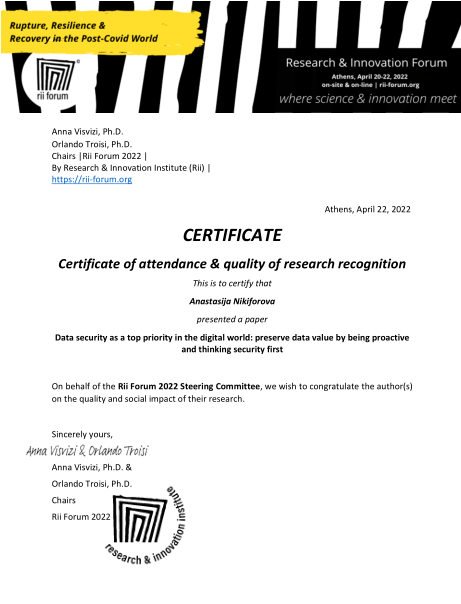
My own talk was titled “Data security as a top priority in the digital world: preserve data value by being proactive and thinking security first“, which makes it to be a part of the panel described above. In this talk I elaborated on the main idea of the panel, referring to an a study I recently conducted. In short, today, in the age of information and Industry 4.0, billions of data sources, including but not limited to interconnected devices (sensors, monitoring devices) forming Cyber-Physical Systems (CPS) and the Internet of Things (IoT) ecosystem, continuously generate, collect, process, and exchange data. With the rapid increase in the number of devices and information systems in use, the amount of data is increasing. Moreover, due to the digitization and variety of data being continuously produced and processed with a reference to Big Data, their value, is also growing. As a result, the risk of security breaches and data leaks. The value of data, however, is dependent on several factors, where data quality and data security that can affect the data quality if the data are accessed and corrupted, are the most vital. Data serve as the basis for decision-making, input for models, forecasts, simulations etc., which can be of high strategical and commercial / business value. This has become even more relevant in terms of COVID-19 pandemic, when in addition to affecting the health, lives, and lifestyle of billions of citizens globally, making it even more digitized, it has had a significant impact on business. This is especially the case because of challenges companies have faced in maintaining business continuity in this so-called “new normal”. However, in addition to those cybersecurity threats that are caused by changes directly related to the pandemic and its consequences, many previously known threats have become even more desirable targets for intruders, hackers. Every year millions of personal records become available online. Moreover, the popularity of IoTSE decreased a level of complexity of searching for connected devices on the internet and easy access even for novices due to the widespread popularity of step-by-step guides on how to use IoT search engine to find and gain access if insufficiently protected to webcams, routers, databases and other artifacts. A recent research demonstrated that weak data and database protection in particular is one of the key security threats. Various measures can be taken to address the issue. The aim of the study to which this presentation refers is to examine whether “traditional” vulnerability registries provide a sufficiently comprehensive view of DBMS security, or whether they should be intensively and dynamically inspected by DBMS holders by referring to Internet of Things Search Engines moving towards a sustainable and resilient digitized environment. The study brings attention to this problem and make you think about data security before looking for and introducing more advanced security and protection mechanisms, which, in the absence of the above, may bring no value.

Other presentations delivered during this session were “Information Security Risk Awareness Survey of non-governmental Organization in Saudi Arabia”, “Fake news and threats to IoT – the crucial aspects of cyberspace in the times of cyber war” and “Minecraft as a Tool to Enhance Engagement in Higher Education” – both were incredibly interesting, and all three talks were delivered by females, where only the moderator of the session was a male researcher, which he found to be very specific, given the topic and ICT orientation – not a very typical case 🙂 But, nevertheless, we managed to have a great session and a very lively and fruitful discussion, mostly around GDPR-related questions, which seems to be one of the hottest areas of discussion for people representing different ICT “subbranches”. The main question that we discussed was – is the GDPR more a supportive tool and a “great thing” or rather a “headache” that sometimes even interferes with development.

In addition, shortly before the start of the event, I was asked to become a moderator of the panel “Business in the era of pervasive digitalization“. Although, as you may know, this is not exactly in line with my area of expertise, it is in line with what I am interested in. This is not surprising, since both management, business, the economics are very closely connected and dependent on ICT. Moreover, they affect ICT, thereby pointing out the critical areas that we as IT-people need to refer to. All in all, we had a great session with excellent talks and lively discussion at the end of the session, where we discussed different session-related topics, shared our experience, thoughts etc. Although it was a brilliant experience, there is one thing that made it even better… A day later, a ceremony was held where the best contributions of the forum were announced and I was named the best panel moderator as a recognition of “the academic merit, quality of moderation, scheduling, and discussion held during the panel”!!!

These were wonderful three days of the forum with very positive emotions and so many roles – panel organizer, speaker / presenter, program committee member and panel moderator with the cherry on the cake and such a great end of the event. Thank you Research and Innovation Forum!!! Even being at home and participating online, you managed to give us an absolute amazing experience and even the feeling that we were all together in Athens!

International conference on the Intelligent Data Science (IDSTA2021): one conference – a ton of impressions

This November I had another great experience – participation in one of my favorite conferences – International conference on the Intelligent Data Science (IDSTA2021) collocated with Blockchain Computing and Applications (BCCA). Unfortunately, due to the pandemics we were not able to meet each other in person in Tartu, Estonia – a local organizer of this edition. But the organization was still perfect from their side. I was super delighted to serve a publicity chair for this conference for the second time (I mean IDSTA2020 and IDSTA2021).

IDSTA2021
Source: IDSTA2021

In short – 2 days (November 15-16), 50+ talks delivered by very skilled, experienced and knowledgeable researchers ready to establish and develop discussions around their topics during 13 sessions, 4 incredible keynotes delivered by Tarik Taleb, Omer Rana, Helen (Eleni) Karatza, Srijith Rajamohan, Ph.D.. Very lively discussions, insightful presentations and great environment!

Apart of serving as a publicity chair, I act as a reviewer, so I am a part of Program Committee, the session chair (for 2 sessions) and the (co-)author and presenter of two papers. One conference – 5 roles 😀 And what is even cooler is that my efforts have been also noticed by organisers and listed in Message from the General Chairs – it is always pleasant to notice you have been mentioned as a person, who contributed and whose contribution and efforts have been really highly evaluated.

Very briefly on my talks :

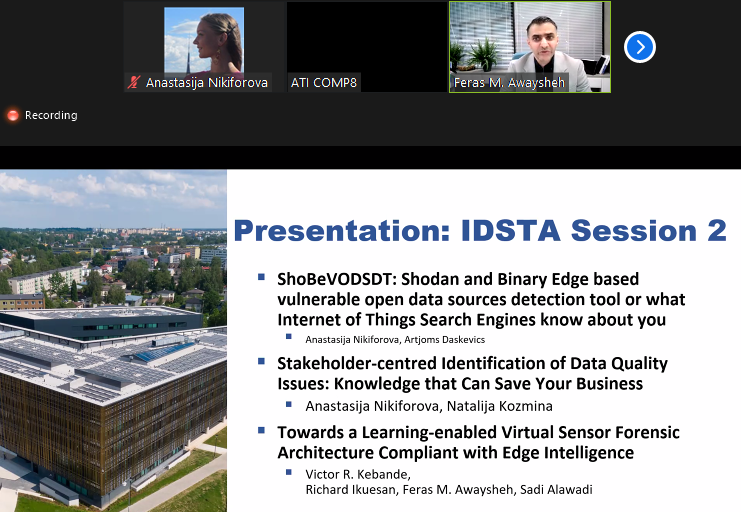
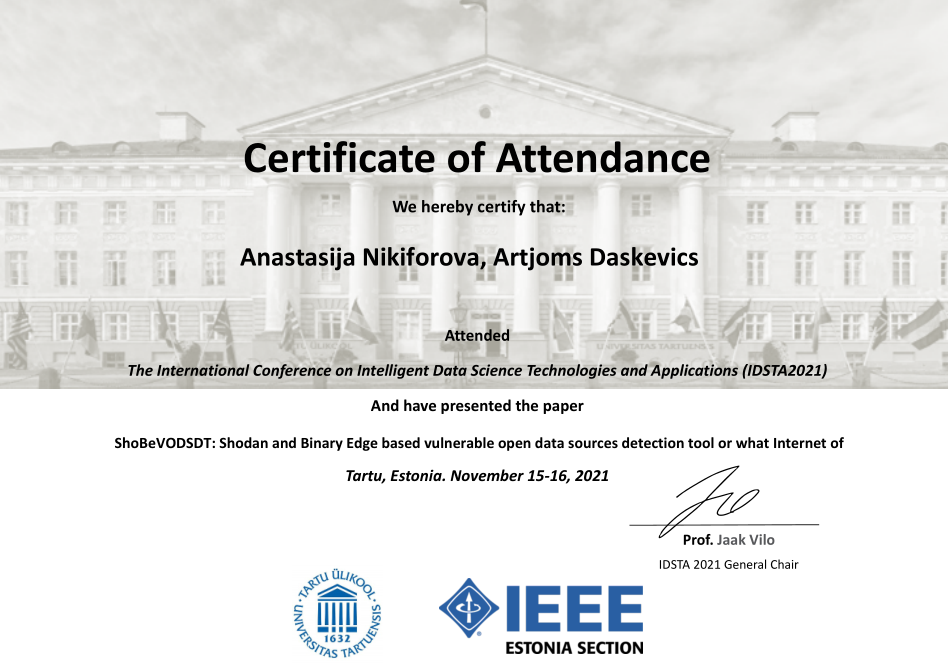
  • ShoBeVODSDT: Shodan and Binary Edge based vulnerable open data sources detection tool or what Internet of Things Search Engines know about you” (authored by Artjoms Daskevics and Anastasija Nikiforova) devoted to the study, which proposes a tool for non-intrusive testing of open data sources for detecting their vulnerabilities, called ShoBeVODSDT. It supports the identification of vulnerabilities at early security assessment stages and does not require the implementation of active and possibly disruptive techniques. ShoBeVODSDT uses two IoTSE (Internet of Things Search Engines) – Shodan and Binary Edge – by extending their features with the advanced capabilities built in it. It allows inspecting 8 predefined data sources, representing both rational databases, NoSQL databases and data stores – MySQL, PostgreSQL, MongoDB, Redis, Elasticsearch, CouchDB, Cassandra and Memcached – on their vulnerabilities and their extent. Our observation shows that security features built into the database allow to protect against unauthorized access, but there are databases with low security features, where it is possible to connect to nearly all IP addresses by retrieving information from them. Even more, in some cases the databases, which do not use security mechanisms, have been already compromised.
  • Stakeholder-centred Identification of Data Quality Issues: Knowledge that Can Save Your Business” (authored by Anastasija Nikiforova and Natalija Kozmina), in scope of which (1) we perform a literature analysis to compile a list of the most commonly occurring data quality issues, (2) considering the diversity and quantity of different data quality requirements and/or dimensions, we reduce the list of defects after running a brainstorming session followed by DELPHI analysis involving 12 experts, (3) the resulting list of defects is validated by 30 users with advanced data quality knowledge by means of applying the data quality analysis to real-world data that are freely accessible to all stakeholders (specifically, a pool of 30 open data sets). This leads us to the list of key data quality issues, which may be of advantage to the data holder and the data user giving both a higher level of confidence that the data are error-free and can be used without causing financial losses for business. These requirements, however, are expected to be used as input of the specification for the web-based data quality analysis tool to be developed.

Great event, great people, great emotions and impressions! Thank you, IDSTA2021 and your supportive and super-friendly team!

October – the month of Guest Lectures

This autumn, and more precisely in October, there were a lot of public activities, including delivering my talk at the ICEGOV2021 (14th International Conference on Theory and Practice of Electronic Governance (ICEGOV2021) “Smart Digital Governance for Global Sustainability“: “Towards enrichment of the open government data: a stakeholder-centered determination of high-value data sets for Latvia“ – this year I was able to take part in it in an online mode but hope this will change at some point), my Invited Talk delivered at the Nanotech2021, my participation in the Latvian Open Geospatial Data hackathon as a mentor – my team won, by the way 🙂 and my participation in the Europe Biobank Week 2021.

Yet another experience was related to a very new experience – the guest lectures. In the past, I had a few minor experiences, but these were mostly short talks that cannot be considered as normal lectures or lectures delivered only to Latvian students. It’s changed this autumn!

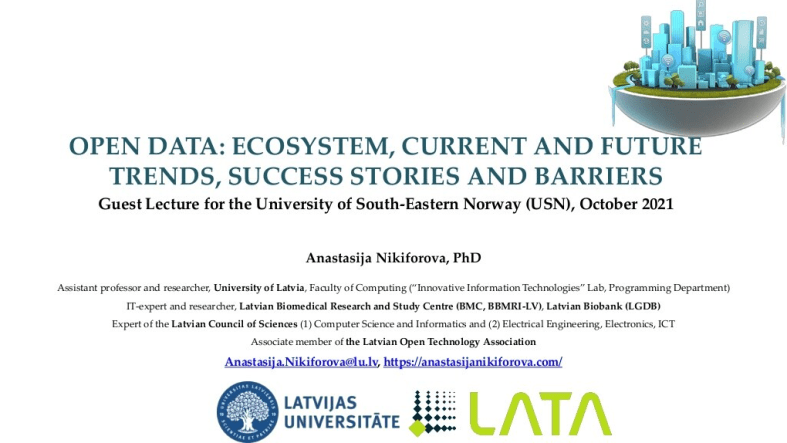
This autumn has changed this! I was very pleased and honoured to serve twice as a Guest Lecturer this October. One lecture for the University of South-Eastern Norway (USN) on the open data – its ecosystem, barriers, current and future trends in both worldwide and Norway context (see slides here), focusing on data quality, which the audience found to be especially interesting. I was extremely pleased to have such a lively discussion on the variety of points that we were able to cover during this lecture, because students have shown both an interest in my talk and what is more – their knowledge and ability to think and elaborate on the given points even without prior knowledge in this area. A very educated and intelligent audience!

The second lecture, however, was delivered at my neighboring Faculty of Social Sciences, University of Latvia (Latvijas Universitāte), on the potential of open data, reflecting the Latvian case and pointing out some examples that we can take over from other countries (see slides here). This lecture will also stay in my memory as one with a very fruitful discussion – hopefully this conclusion will be the same for the audience!

To sum up, thank you, for those professors who have invited me to serve as a Guest Lecture – Salah Uddin Ahmed and Visvaldis Valtenbergs. Hope that this was a great experience for us both!