AMCIS2026 Human–AI Collaboration and Governance for Responsible and Sustainable Digital Ecosystems mini-track

As digital transformation accelerates, the convergence of AI, data governance, and ecosystem thinking is reshaping how organizations create strategic value, build competitiveness, and sustain innovation advantage. Digital and data ecosystems are increasingly complex, spanning cloud, edge, and decentralized architectures such as data meshes and lakehouses, raising critical questions of trustworthiness, responsibility, and sustainability in AI integration.

This AMCIS2026 mini-track (by Association of Information Systems (AIS)) explores how AI, including increasingly agentic systems, acts as both a strategic enabler and active participant in digital and data ecosystems, enhancing governance, augmenting and automating decision-making, and transforming how organizations create value, while raising important governance, ethical, and human-agency considerations. We invite research examining how these ecosystems can remain responsible, resilient, and sustainable, while enhancing organizational agility, competitiveness, and long-term strategic performance across sectors such as government, healthcare, finance, manufacturing, and education.

The track bridges perspectives from information systems, data science, AI governance, and sustainability research to understand how the strategic and responsible design and management of AI-driven data ecosystems can support long-term value creation, competitiveness, and societal transformation. We invite interdisciplinary contributions from fields such as computer science, management science, data science, process science, decision science, organizational design, policy-making, complexity, behavioral economics, and the social sciences. Submissions may include conceptual, design science, empirical, theoretical, or case-based studies, including literature reviews.

Topics of interest include but are not limited to:

  • AI for governance, accountability, and trustworthiness in digital and data ecosystems;
  • human–AI collaboration and delegation, human-in-the-loop and hybrid governance;
  • responsible, sustainable, and strategically aligned management of AI-augmented data ecosystems, including Green AI;
  • governance and data management in emerging architectures (e.g., data mesh, data lakehouse), including data quality, transparency, and explainability;
  • transition from centralized to decentralized data architectures – organizational and design challenges;
  • ethical, interoperable, observable, and explainable AI in connected and cross-sectoral data ecosystems;
  • co-evolution of digital and data ecosystem components;
  • coopetition between digital and data ecosystems;
  • resilience, sustainability, and long-term governance of digital infrastructures;
  • socio-technical, organizational, and policy approaches to trustworthy and responsible data ecosystems;
  • emerging technologies (e.g., blockchain, edge computing, generative AI, digital twins, IoT, AR/VR) shaping responsible, sustainable, and energy- or resource-efficient strategic ecosystem innovation;
  • empirical studies and sectoral case analyses (e.g., healthcare, finance, government, education) on evolving AI-driven ecosystems;
  • design science, conceptual, and interdisciplinary frameworks for responsible, sustainable, and strategically effective data ecosystem innovation.

This mini-track will serve as a platform for interdisciplinary dialogue on the critical role of responsible, sustainable, and strategically oriented digital and data ecosystems in driving competitive and societal innovation. Researchers and practitioners are invited to share insights, theoretical perspectives, and empirical findings in this rapidly evolving domain.

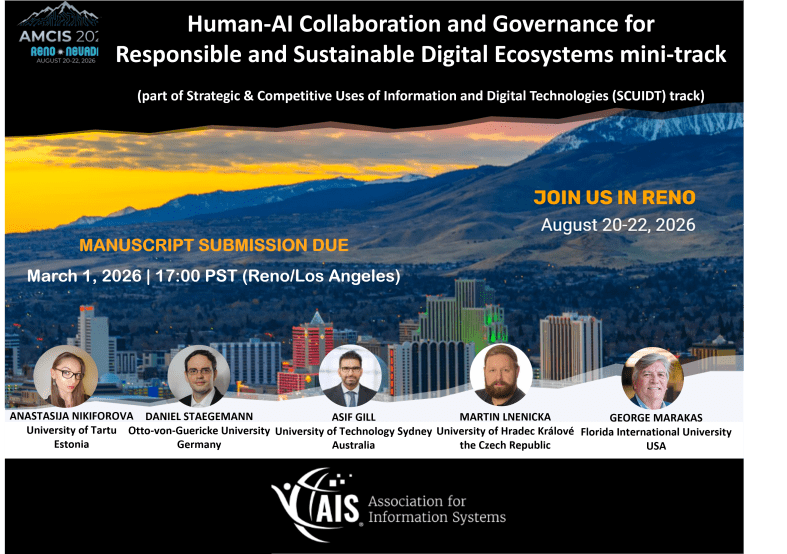
📌 Submission Deadline: March 1, 2026
📍 Venue: AMCIS 2026 — Reno, Nevada (August 20–22)

Mini-Track Chairs

Anastasija Nikiforova – University of Tartu, Estonia
Daniel Staegemann – Otto von Guericke University Magdeburg, Germany
Asif Gill – University of Technology Sydney, Australia
Martin Lnenicka – University of Hradec Králové, Czech Republic
George Marakas – Florida International University, USA

Read more and submit papers via AMCIS2026 website.

CFP for AMCIS2025 “Sustainable Digital and Data Ecosystems – Navigating the Age of AI” mini-track

The Association for Information Systems (AIS) organized America’s Conference on Information Systems is coming! This year it will be held in Montreal (Canada), running under the general theme of “Intelligent technologies for a better future” and the revised list of (mini-)tracks, where the special attention I invite you to draw to is a new “Sustainable Digital and Data Ecosystems – Navigating the Age of AI” mini-track (chairs: Anastasija Nikiforova, Daniel Staegemann, George Marakas, Martin Lnenicka).

In an increasingly data-driven world, well-designed and managed digital and data ecosystems are critical to strategic innovation and competitive advantage. With the rise of new data architectures, the shift from centralized to decentralized systems, and the integration of artificial intelligence (AI) in data management, these ecosystems are becoming more dynamic, interconnected, and complex.

The growing importance of emerging data architectures such as data lakehouses and data meshes coupled with the emerging technologies of AI, blockchain, cloud computing to name a few, requires us to rethink how we manage, govern, and secure data across these ecosystems. Moreover, AI is no longer a mere component but an active agent/actor in these ecosystems, transforming processes such as data governance, data quality management, and security. Simultaneously, there is a pressing need to address how these systems can remain resilient and sustainable in the face of technological disruption and societal challenges, and how interdisciplinary approaches can provide new insights into managing these digital environments.

This mini-track seeks to explore the evolving nature of these ecosystems and their role in fostering sustainable, resilient, and innovative digital environments.

We encourage research from an ecosystem perspective (grounded in systems theory) that takes a holistic view, as well as more focused studies on specific components such as policies, strategies, interfaces, methodologies, or technologies. Special attention will be paid to the ongoing evolution of these ecosystems, especially their capacity to remain trustworthy, sustainable, and resilient over time.

Potential topics include but are not limited to:

  • data management and governance in emerging data architectures (data lakehouse, data mesh, etc.), including data governance, data quality management, and security;
  • the role of AI in data management, including AI-augmented governance, data quality management, and security;
  • AI-driven resilience and sustainability in digital and data ecosystems, incl. AI-augmentation of data lifecycle- and business- processes;
  • conceptualization and evolution of digital and data ecosystem components and their interrelationships;
  • emerging technologies, such as blockchain, cloud computing, sensors etc., shaping the strategic development of digital and data ecosystems;
  • case studies on the transition from centralized (data warehouse, data lake, data lakehouse) to decentralized data architectures (e.g., data mesh);
  • human/user factors in digital and data ecosystems (acceptance, interactions, participation etc.);
  • empirical studies on the sustainability, trustworthiness, and resilience of digital ecosystems;
  • methodologies and strategies for managing evolving digital ecosystems in different sectors (e.g., finance, healthcare, government / public sector, education).
  • interdisciplinary approaches to building, managing, and sustaining digital and data ecosystems.

The research and innovation in digital and data ecosystems requires an interdisciplinary approach. Therefore, this track invites papers from various disciplines such as information systems, computer science, management science, data science, decision science, organizational design, policy making, complexity, and behavioral economics, and social science to continue the problematization exploration of concepts, theories, models, and tools for building, managing and sustaining ecosystems. These can be conceptual, design science research, empirical studies, industry and government case studies, and theoretical papers, including literature reviews.

As such, this mini-track will serve as a platform for interdisciplinary dialogue on the critical role of sustainable digital and data ecosystems in driving strategic innovation and competitive advantage. We invite researchers and practitioners alike to share their insights, theoretical perspectives, and empirical findings in this rapidly evolving domain.

This mini-track is part of “Strategic & Competitive Uses of Information and Digital Technologies (SCUIDT)” track (chairs: Jack Becker, Russell Torres, Parisa Aasi, Vess Johnson).

For more information, see AMCIS2025 website (for this (min-)track, navigate to “Strategic & Competitive Uses of Information and Digital Technologies (SCUIDT)” track).

Is your research related to any of the above topics? Then do not wait – submit! 📅📅📅Submissions are due February 28, 2025.

UT & Swedbank Data Science Seminar “When, Why and How? The Importance of Business Intelligence”

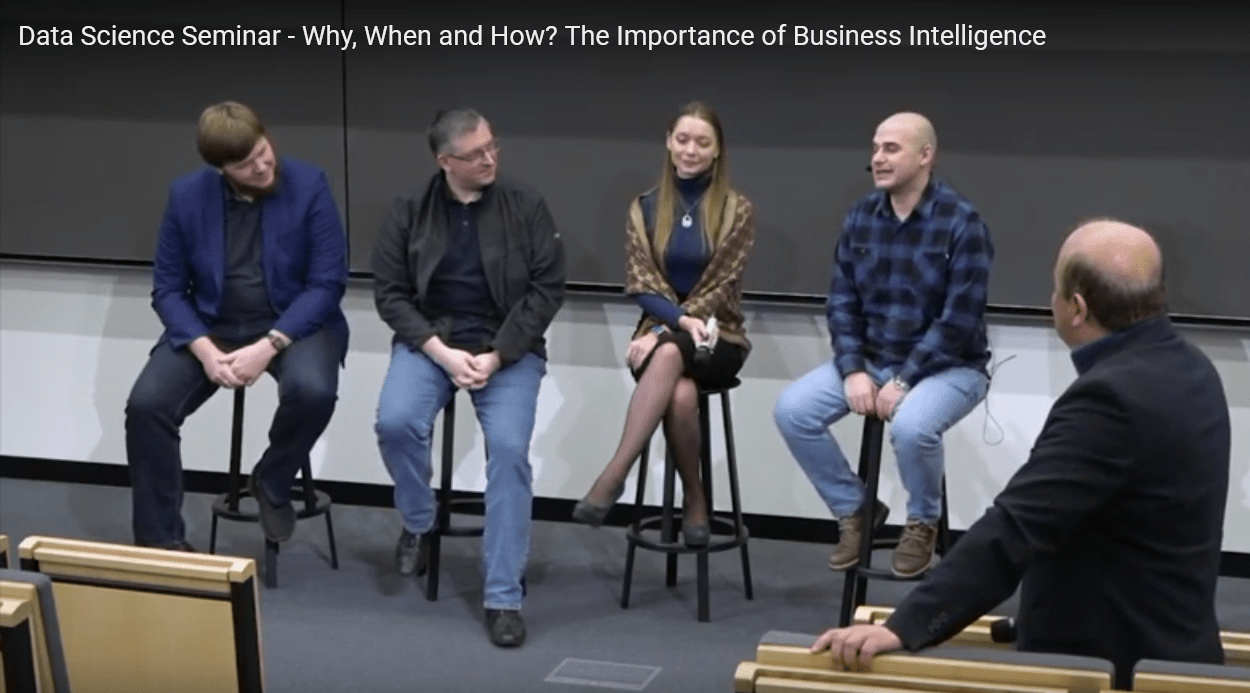
Last week I had the pleasure of taking part in a Data Science Seminar titled “When, Why and How? The Importance of Business Intelligence. In this seminar, organized by the Institute of Computer Science  (University of Tartu) in cooperation with Swedbank, we (me, Mohammad Gharib, Jurgen Koitsalu, Igor Artemtsuk) discussed the importance of BI with some focus on data quality. More precisely, 2 of 4 talks were delivered by representatives of the University of Tartu and were more theoretical in nature, where we both decided to focus our talks on data quality (for my talk, however, this was not the main focus this time), while another two talks were delivered by representatives of Swedbank, mainly elaborating on BI – what it can give, what it already gives, how it is achieved and much more. These talks were followed by a panel moderated by prof. Marlon Dumas.

In a bit more detail…. In my presentation I talked about:

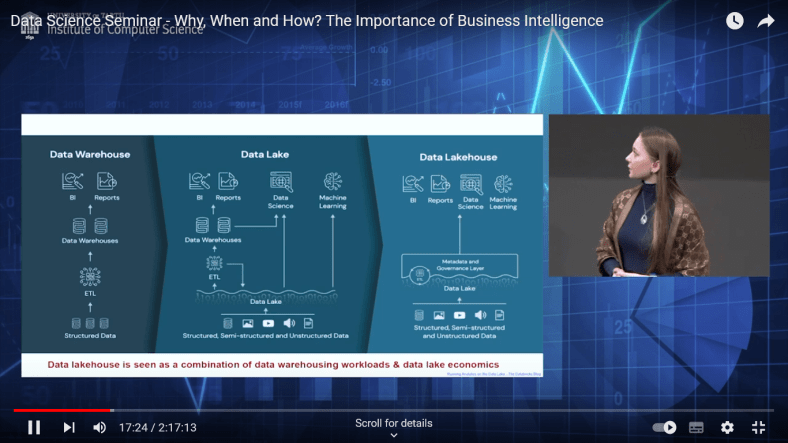
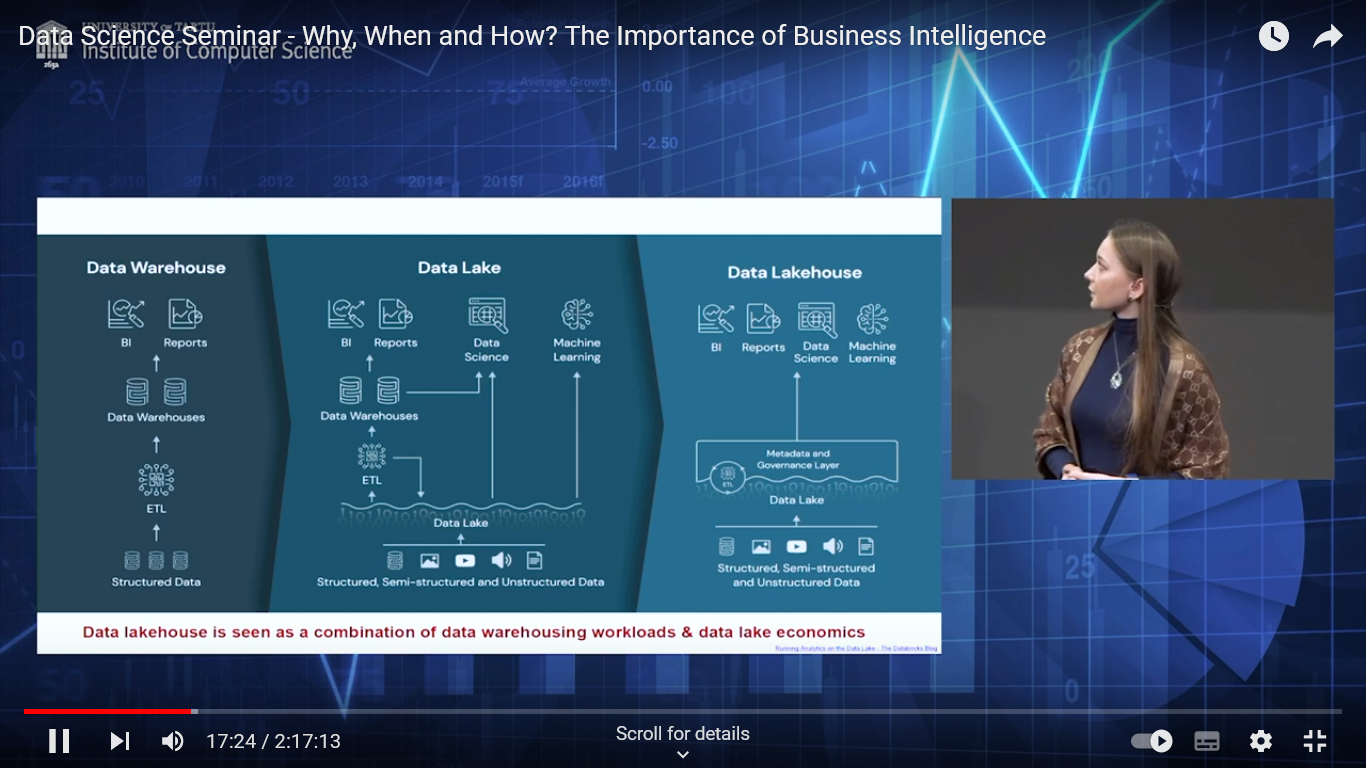
  • Data warehouse vs. data lake – what are they and what is the difference between them?” – in a very few words – structured vs unstructured, static vs dynamic (real-time data), schema-on-write vs schema on-read, ETL vs ELT. With further elaboration on What are their goals and purposes? What is their target audience? What are their pros and cons? 
  • Is the Data warehouse the only data repository suitable for BI?” – no, (today) data lakes can also be suitable. And even more, both are considered the key to “a single version of the truth”. Although, if descriptive BI is the only purpose, it might still be better to stay within data warehouse. But, if you want to either have predictive BI or use your data for ML (or do not have a specific idea on how you want to use the data, but want to be able to explore your data effectively and efficiently), you know that a data warehouse might not be the best option.
  • So, the data lake will save my resources a lot, because I do not have to worry about how to store /allocate the data – just put it in one storage and voila?!” – no, in this case your data lake will turn into a data swamp! And you are forgetting about the data quality you should (must!) be thinking of!
  • But how do you prevent the data lake from becoming a data swamp?” – in short and simple terms – proper data governance & metadata management is the answer (but not as easy as it sounds – do not forget about your data engineer and be friendly with him [always… literally always :D) and also think about the culture in your organization.
  • So, the use of a data warehouse is the key to high quality data?” – no, it is not! Having ETL do not guarantee the quality of your data (transform&load is not data quality management). Think about data quality regardless of the repository!
  • Are data warehouses and data lakes the only options to consider or are we missing something?“– true! Data lakehouse!
  • If a data lakehouse is a combination of benefits of a data warehouse and data lake, is it a silver bullet?“– no, it is not! This is another option (relatively immature) to consider that may be the best bit for you, but not a panacea. Dealing with data is not easy (still)…

In addition, in this talk I also briefly introduced the ongoing research into the integration of the data lake as a data repository and data wrangling seeking for an increased data quality in IS. In short, this is somewhat like an improved data lakehouse, where we emphasize the need of data governance and data wrangling to be integrated to really get the benefits that the data lakehouses promise (although we still call it a data lake, since a data lakehouse, although not a super new concept, is still debated a lot, including but not limited to, on the definition of such).

However, my colleague Mohamad Gharib discussed what DQ and more specifically data quality requirements, why they really matter, and provided a very interesting perspective of how to define high quality data, which further would serve as the basis for defining these requirements.

All in all, although we did not know each other before and had a very limited idea of what each of us will talk about, we all admitted that this seminar turned out to be very coherent, where we and our talks, respectively, complemented each other, extending some previously touched but not thoroughly elaborated points. This allowed us not only to make the seminar a success, but also to establish a very lively discussion (although the prevailing part of this discussion took place during the coffee break – as it usually happens – so, unfortunately, is not available in the recordings, the link to which is available below).