The Association for Information Systems (AIS) organized America’s Conference on Information Systems is coming! This year it will be held in Montreal (Canada), running under the general theme of “Intelligent technologies for a better future” and the revised list of (mini-)tracks, where the special attention I invite you to draw to is a new “Sustainable Digital and Data Ecosystems – Navigating the Age of AI” mini-track (chairs: Anastasija Nikiforova, Daniel Staegemann, George Marakas, Martin Lnenicka).
In an increasingly data-driven world, well-designed and managed digital and data ecosystems are critical to strategic innovation and competitive advantage. With the rise of new data architectures, the shift from centralized to decentralized systems, and the integration of artificial intelligence (AI) in data management, these ecosystems are becoming more dynamic, interconnected, and complex.
The growing importance of emerging data architectures such as data lakehouses and data meshes coupled with the emerging technologies of AI, blockchain, cloud computing to name a few, requires us to rethink how we manage, govern, and secure data across these ecosystems. Moreover, AI is no longer a mere component but an active agent/actor in these ecosystems, transforming processes such as data governance, data quality management, and security. Simultaneously, there is a pressing need to address how these systems can remain resilient and sustainable in the face of technological disruption and societal challenges, and how interdisciplinary approaches can provide new insights into managing these digital environments.
This mini-track seeks to explore the evolving nature of these ecosystems and their role in fostering sustainable, resilient, and innovative digital environments.
We encourage research from an ecosystem perspective (grounded in systems theory) that takes a holistic view, as well as more focused studies on specific components such as policies, strategies, interfaces, methodologies, or technologies. Special attention will be paid to the ongoing evolution of these ecosystems, especially their capacity to remain trustworthy, sustainable, and resilient over time.
Potential topics include but are not limited to:
data management and governance in emerging data architectures (data lakehouse, data mesh, etc.), including data governance, data quality management, and security;
the role of AI in data management, including AI-augmented governance, data quality management, and security;
AI-driven resilience and sustainability in digital and data ecosystems, incl. AI-augmentation of data lifecycle- and business- processes;
conceptualization and evolution of digital and data ecosystem components and their interrelationships;
emerging technologies, such as blockchain, cloud computing, sensors etc., shaping the strategic development of digital and data ecosystems;
case studies on the transition from centralized (data warehouse, data lake, data lakehouse) to decentralized data architectures (e.g., data mesh);
human/user factors in digital and data ecosystems (acceptance, interactions, participation etc.);
empirical studies on the sustainability, trustworthiness, and resilience of digital ecosystems;
methodologies and strategies for managing evolving digital ecosystems in different sectors (e.g., finance, healthcare, government / public sector, education).
interdisciplinary approaches to building, managing, and sustaining digital and data ecosystems.
The research and innovation in digital and data ecosystems requires an interdisciplinary approach. Therefore, this track invites papers from various disciplines such as information systems, computer science, management science, data science, decision science, organizational design, policy making, complexity, and behavioral economics, and social science to continue the problematization exploration of concepts, theories, models, and tools for building, managing and sustaining ecosystems. These can be conceptual, design science research, empirical studies, industry and government case studies, and theoretical papers, including literature reviews.
As such, this mini-track will serve as a platform for interdisciplinary dialogue on the critical role of sustainable digital and data ecosystems in driving strategic innovation and competitive advantage. We invite researchers and practitioners alike to share their insights, theoretical perspectives, and empirical findings in this rapidly evolving domain.
This mini-track is part of “Strategic & Competitive Uses of Information and Digital Technologies (SCUIDT)” track (chairs: Jack Becker, Russell Torres, Parisa Aasi, Vess Johnson).
For more information, see AMCIS2025 website (for this (min-)track, navigate to “Strategic & Competitive Uses of Information and Digital Technologies (SCUIDT)” track).
Is your research related to any of the above topics? Then do not wait – submit! 📅📅📅Submissions are due February 28, 2025.
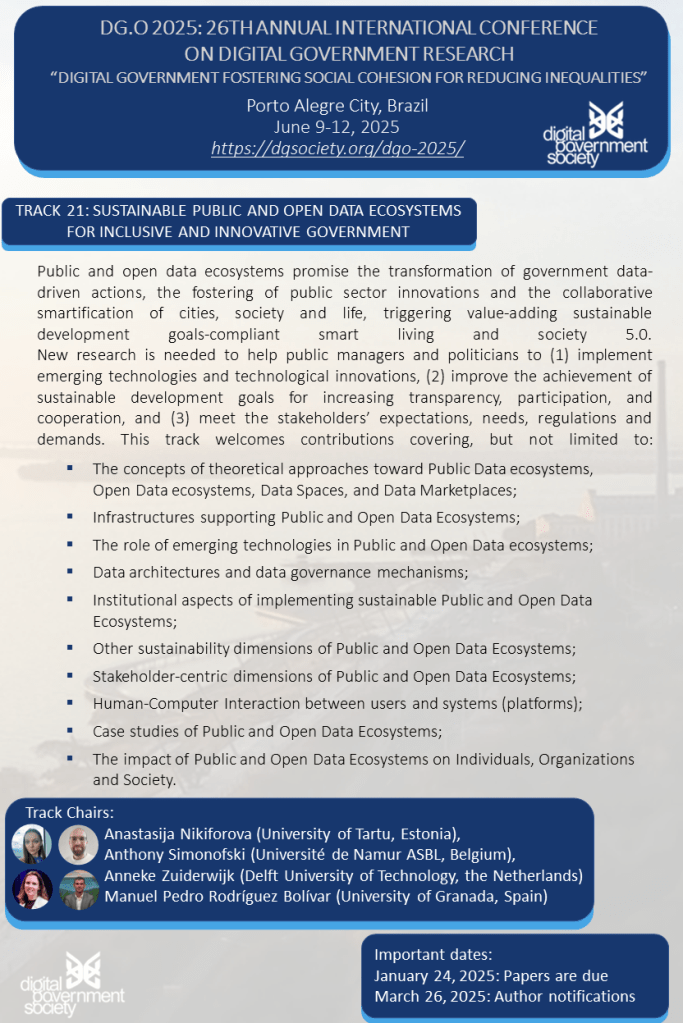
26th Annual International Conference on Digital Government Research (dg.o2025)is coming with continuation of the track we launched the last time – “Sustainable Public and Open Data Ecosystems for inclusive and innovative government” track (chairs: Anastasija Nikiforova (University of Tartu, Estonia), Anthony Simonofski (Université de Namur ASBL, Belgium), Anneke Zuiderwijk (Delft University of Technology, the Netherlands) & Manuel Pedro Rodríguez Bolívar (University of Granada, Spain)).
Briefly about the track… Today, the goal of an actor-centric public data ecosystem that would be sufficiently sustainable, resilient and fair, is defined as an approach capable of representing and keeping in balance the data interests of all actors[1], to bring expected value (both economic, social and environment) became central for public data ecosystems and other types of data infrastructures and data spaces[2] that are based on the concept of openness and data sharing among stakeholders. Public data and open (government) data ecosystems are seen as a political and socio-economic phenomenon that promise to benefit the economy, and increase transparency, efficiency, and quality of public services, including the transformation of government data-driven actions, stimulate public sector innovations in various areas of public life and promote civic engagement[3][4][5]. Having collaborative governance models in place is one of the prerequisites for a resilient and value-adding ecosystem, of which stakeholders are an inevitable element, making it necessary to ensure those ecosystems are stakeholder-oriented. These models are expected to support stakeholders/actors, who, however, may have different characteristics (incl. (open) data literacy and digital literacy), needs / demands and expectations (public sector, private sector, business, citizen) for public value creation and co-creation. Understanding, designing, and maintaining such an ecosystem is further complicated by the fact that both data, service and process quality must be ensured and kept maintained with a limited understanding of how the above are expected to be ensured even alone.
Recent research found that concepts affecting and shaping the ecosystem are: 1) stakeholders / actors and their roles, 2) phases of the data lifecycle, in which a stakeholder participates in the ecosystem, 3) technical and technological infrastructure, 4) generic services and platforms, 5) human capacities and skills of both providers and consumers, 6) smart city domains (thematic categories) as the targeted areas for data reuse, 7) externalities affecting goals, policy, and resources, 8) level of (de)centralization of data sources – development, restrictions, 9) perception of importance and support from public officials, and 10) user interface, user experience, and usability[6]. Moreover, these ecosystems same as its components are (co-)evolving over time[7] due to both internal and external factors. The latter – external factors – include technological developments. As such, the rapid development of emerging technologies such as big data, artificial intelligence (AI) is seen as a new trigger for public and open data development (AI for open data and open data for AI), machine learning (ML), federated learning (FL), internet of things (IoT), metaverse etc. provides new opportunities to improve these ecosystems in a disrupt way to be useful for collaborative governance models. Also, the link between Open Data Ecosystems and sustainable development goals (SDG) seems to be more relevant nowadays in their way to build more democratic cities based on government transparency, citizen participation, and citizen cooperation. Finally, higher expectations, needs and demands of businesses and citizens, derived from the implementation of B2G, C2G models, that influence and shape the design and development of these data environments, as well as expected to be affected, e.g., B2G in relation to which European Commission is taking regulatory action and is preparing the Data Act to set the rules and conditions, thereby changing the current voluntary model to a more mandatory data sharing. Current research suggests that these topics are of great importance to governments, as well as businesses and citizens, whose efforts should complement each other in order to enable effective data reuse and value co-creation
As such, as public and open data ecosystems promise the transformation of government data-driven actions, the fostering of public sector innovations and the collaborative smartification of cities, society and life, triggering value-adding sustainable development goals-compliant smart living and Society 5.0. New research is needed to help public managers and politicians for (1) implementing emerging technologies and technological innovations, (2) improving the achievement of sustainable development goals for increasing transparency, participation, and cooperation, and (3) meeting the stakeholders’ expectations, needs, regulations and demands.
As such, this track welcomes contributions covering, but not limited to:
The concepts of theoretical approaches toward Public Data ecosystems, Open Data ecosystems, Data Spaces, and Data Marketplaces;
Infrastructures supporting Public and Open Data Ecosystems;
The role of emerging technologies in Public and Open Data ecosystems (incl. but not limited to AI, Generative AI, LLM, NLP, cloud computing, green computing, Metaverse etc.);
Data architectures and data governance mechanisms;
Institutional aspects of implementing sustainable Public and Open Data Ecosystems;
Other sustainability dimensions of Public and Open Data Ecosystems;
Stakeholder-centric dimensions of Public and Open Data Ecosystems;
Human-Computer Interaction between users and systems (platforms);
Case studies of Public and Open Data Ecosystems, incl. but not limited to Local Government Level Data Ecosystems, e.g., Smart Cities Data Ecosystems;
The impact of Public and Open Data Ecosystems on Individuals, Organizations and Society.
The track welcomes both contributions covering the current state-of-the-art of public data ecosystems (what components constitute them, what are the relationships between these components, what makes an ecosystem resilient and sustainable), incl. individual case studies reflecting best or bad practices, as well as those addressing how these ecosystems can be transformed into more sustainable ecosystems that will “fuel” or “smartify” society (Information Society aka Society 4.0 to Super Smart Society aka Society 5.0 transition), cities and various areas of life.
The track is very aligned with the conference theme of DGO 2025, namely: Digital government fostering social cohesion for reducing inequalities. As mentioned in the theme description, “It focuses on strong social bonds in civic society, with responsive democracy and impartial law enforcement aiming at collaboratively addressing latent social conflicts. It involves building shared values in communities facing common challenges in an attempt to reduce disparities by increasing citizens’ feeling of belonging to a community and their engagement.” Public and open data ecosystems can be considered as environments that contribute to the above. Open data is aimed at reducing inequalities, open platforms constitute environments where data providers and data users find each other and collaborate and co-create to develop services and products useful for society, i.e., addressing their needs and tackling challenges society faces. While digital technologies enable the development of public and open data ecosystems, the adoption of such ecosystems has been fragmented. For instance, Van Loenen et al. (2021)[8] found that open data ecosystems “often do not balance open data supply and demand, exclude specific user groups and domains, are linear, and lack skill-training” (p. 2), which reduces their value-generation and sustainability.
Is your research related to any of the above topics? Then do not wait – submit!
🗓️🗓️🗓️Important Dates:
January 24, 2025: Papers, workshops, tutorials, and panels are due March 26, 2025: Author notifications (papers, workshops, tutorials, panels)
[1] Calzati, S., & van Loenen, B. (2023). A fourth way to the digital transformation: The data republic as a fair data ecosystem. Data & Policy, 5, e21.
[2] Lnenicka, M., Nikiforova, A., Luterek, M., Milic, P., Rudmark, D., Neumaier, S., … & Rodríguez Bolívar, M. P. (2023). Understanding the development of public data ecosystems: from a conceptual model to a six-generation model of the evolution of public data ecosystems. Available at SSRN 4831881.
[3] Nikiforova, A., Rizun, N., Ciesielska, M., Alexopoulos, C., Miletič, A.(2023). Towards High-Value Datasets determination for data-driven development: a systematic literature review. In: Lindgren,I., Csáki, C., Kalampokis, E., Janssen, M.,, Viale Pereira,G.,Virkar, S., Tambouris, E., Zuiderwijk, A.Electronic Government. EGOV 2023. Lecture Notes in Computer Science. Springer, Cham
[4] Kassen, M. (2020). Open data and its peers: understanding promising harbingers from Nordic Europe. Aslib Journal of Information Management, 72(5), 765-785.
[5] Santos-Hermosa, G., Quarati, A., Loría-Soriano, E., & Raffaghelli, J. E. (2023). Why Does Open Data Get Underused? A Focus on the Role of (Open) Data Literacy. In Data Cultures in Higher Education: Emergent Practices and the Challenge Ahead (pp. 145-177). Cham: Springer International Publishing.
[6] Lnenicka, M., Nikiforova, A., Luterek, M., Azeroual, O., Ukpabi, D., Valtenbergs, V., & Machova, R. (2022). Transparency of open data ecosystems in smart cities: Definition and assessment of the maturity of transparency in 22 smart cities. Sustainable Cities and Society, 82, 103906.
[7] Nikiforova, A., Lnenicka, M., Milić, P., Luterek, M., & Rodríguez Bolívar, M. P. (2024, August). From the evolution of public data ecosystems to the evolving horizons of the forward-looking intelligent public data ecosystem empowered by emerging technologies. In International Conference on Electronic Government (pp. 402-418). Cham: Springer Nature Switzerland.
[8] Loenen, B. van, Zuiderwijk, A., Vancauwenberghe, G., Lopez-Pellicer, F. J., Mulder, I., Alexopoulos, C., … & Flores, C. C. (2021). Towards value-creating and sustainable open data ecosystems: A comparative case study and a research agenda. JeDEM-eJournal of eDemocracy and Open Government, 13(2), 1-27.
IEEE Transactions on Technology & Society launches the new Special Issue on the “Trustworthy Data Ecosystems for Digital Societies“, edited by Asif Gill, Anastasija Nikiforova, Ina M. Sebastian, Martin Lnenicka, Anushri Gupta. On behalf of the editors of this SI, I sincerely invite you to consider submitting your work to it.
Key topics surround intersection of data ecosystem and AI topics, i.e., AI in and for trustworthy data ecosystems, and include, but are not limited to:
Impact of trustworthy data ecosystem on digital societies at the local, national and global levels
Conceptualization of trustworthy data ecosystems domains and characteristics for digital societies
Data trust regulations, polices, strategies and standards
Trustworthy data ecosystem infrastructure as a social construct
Trustworthy data ecosystem architecture, interfaces, methodologies, orchestration, patterns, solutions, and technology platforms
System and data quality, governance, security, privacy, protection, and safety
Data linking, interoperability, sharing and observability





 Anastasija Nikiforova, PhD