
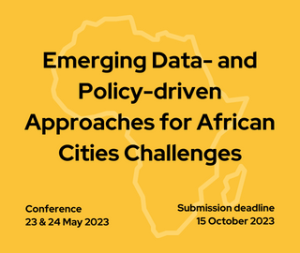
On behalf of Guest Editors I sincerely invite you to consider submitting your work to our Special Issue ”Emerging Data- and Policy-driven Approaches for African Cities Challenges” as part of the open-access journal Data & Policy at Cambridge University Press.
This Special Issue aims to expand the reach and scope of urban data research, innovation and entrepreneurship activities and policies to address urban challenges in Africa through the digitisation of cities. It will compile recent expert work on the topic to advance and promote scientific advance / excellence, promote the digital transition and its benefits for creating, collecting, storing and using urban data to achieve sustainable development goals (SDG) in African cities.
African cities and their local actors and managers have been at the forefront of the digital transformation for several years now (Oke et al., 2020). Several urban projects across the continent, from north to south and east to west, are claiming to use the term “smart city” (Söderström et al., 2021). This apparently attractive name is often associated with an “isolationist” technical vision that is provided and marketed by operators with a very western and global vision. Digital and smart city projects are often implemented with citizens and the local ecosystem managed step by step by the municipalities, the digital transition can be primarily aimed at a “smart city of general interest”. In developing countries, and especially in Africa, where the young, female and urban population is becoming increasingly connected, the adoption of digital technologies is exponential and tends to occur without public intervention, including but not limited due to “datafication of cities” (Bibri & Krogstie, 2020; Plantinga, 2022; Oksman & Raunio, 2018). As a result, there is a risk that local authorities will “drop out” of the market, which may manifest itself in the development of alternative digital services by third parties that disrupt or compete with local public services. Another risk is that the local authority may have only limited or incomplete access to data produced by users and businesses within its territory, depriving it of the necessary material for its action. Local authorities in Africa, as in the North, are in a learning phase in their smart city or digital city policies and, in particular, policies regarding data collection / acquisition, storage and use to solve urban challenges (Plantinga, 2022; Oksman & Raunio, 2018).
Indeed, data is one of the essential pillars of an emerging smart or digital city that is best used to support decision making in urban planning and management to address the challenges of cities in Africa. Therefore, it will be appropriate for this to cover all topics related to digital cities in Africa, including urban data and policy for urban planning applications, African smart city, Smart geoinformation systems (Smart GIS), smart governance, challenges of digital cities in Africa, urban sustainability, planning/management issues of emerging cities in Africa, urban socio-economic challenges (education, health, employment, youth, economy, food security, etc.), urban environment, information and communication technologies applied to the city.
In addition to its thematic focus, it aims to advance interdisciplinary research by bridging the disciplinary divide between different academic cultures of the humanities, sciences, and application-oriented research, as well as the sectoral divide between urban development actors in Africa. Thus, this special issue will update and strengthen the existing literature on African cities through the results of scientific research based on qualitative and quantitative analysis techniques and methods on topics including, but not limited to data- and policy-driven approaches to address the challenges of African cities and mainly those related to:
💡Water and energy management;
💡Smart waste management and sanitation;
💡Digital management of education and health;
💡Digital mobility and transport management;
💡Quality of Life and social classes;
💡Strategies for digital and smart cities in Africa;
💡Digital and Smart African city stakeholders;
💡Digital and Smart city infrastructure;
💡Artificial intelligence and applications;
💡Digital governance for smart cities;
💡Citizen participation and engagement;
💡Datafication of smart cities;
💡Collective sensing & spatial big urban data;
💡Smart geo-addressing and participatory addressing;
💡Digital transformation and smart Governance;
💡Citizen and Collaborative Governance;
💡Climate and pollution. Environmental monitoring;
💡Disaster risks;
💡Urban Health
Papers to be submitted when ready, with final deadline: January 8, 2024.
Data & Policy publishes the following article types. Authors should consider which is the most appropriate category for their work before they submit:
- Research articles: original work that uses rigorous methods to investigate how data science can inform or impact policy.
- Commentaries: shorter articles that discuss and/or problematize an issue relevant to the special issue topic. (Approx 4,000 words in length).
- Translational articles: focus on the policy setting or environment in which data science principles and approaches are being applied, with the aim of improving the transfer of knowledge from research to practice (and vice versa).
- Data papers: provide structured descriptions of a data set relevant to the special issue. The data paper should describe the study design and methods that generated the data, but the focus should be to help others re-use the data rather than presenting new findings.
Guest Editors:
- Jérôme Chenal, CEAT, EPFL, Lausanne, Switzerland
- Stéphane C. K. Tekouabou, Center of Urban Systems (CUS), UM6P, Benguérir, Morocco
- El Arbi Allaoui Abdellaoui, ENS, Mouley Ismail University, Meknès, Morocco
- Anastasija Nikiforova, University of Tartu, Tartu, Estonia
References:
- Bibri, S. E., & Krogstie, J. (2020). The emerging data–driven Smart City and its innovative applied solutions for sustainability: The cases of London and Barcelona. Energy Informatics, 3, 1-42.
- Oke, A. E., Aghimien, D. O., Aigbavboa, C. O., & Akinradewo, O. I. (2020). Appraisal of the drivers of smart city development in South Africa. Construction Economics and Building, 20(2), 109-126.
- Oksman, V., & Raunio, M. (2018, March). Citizen-centric smart city planning for africa: a qualitative case study of early stage co-creation of a Namibian smart community. In The twelfth international conference on digital society and egovernments (pp. 30-35).
- Söderström, O., Blake, E., & Odendaal, N. (2021). More-than-local, more-than-mobile: The smart city effect in South Africa. Geoforum, 122, 103-117.
- Plantinga, P. (2022). Digital discretion and public administration in Africa: Implications for the use of artificial intelligence. Information Development, 02666669221117526.


 Anastasija Nikiforova, PhD