CFP for The IEEE International Conference on Intelligent Computing, Communication, Networking and Services (ICCNS2023)

On behalf of the organizers (Technical Program Chair, Steering Committee, and finally publicity chair) of the IEEE International Conference on Intelligent Computing, Communication, Networking and Services (ICCNS2023), I am inviting everyone, who is conducting research in this area, to consider submitting the paper to it.

Call for Papers:

New advancements in wireless communication systems such as Fifth-Generation (5G), Beyond Fifth-Generation (B5G), and Sixth-Generation (6G) networks will allow for new and unprecedented services to be made available for users with nearly unlimited capacity. These services will be the core driver for future digital transformation of our cities and communities. This will be accompanied by a ubiquitous deployment of Internet of Things (IoT) infrastructure and supported by computing capacity that will be available at the edge of the network and in the cloud. This computing infrastructure will handle the processing of data generated by users and services. Such a complex and diverse system will require the applications running on the computing/networking infrastructure to be Intelligent, efficient and sustainable. Additionally, the infrastructure will require smart control and automation systems to integrate and manage its different components. Artificial Intelligence (AI) and its applications will play a significant role in the design, deployment, automation, and management of future services. This will include applications that will be running on the edge and on cloud servers, networking applications to handle the flow of data between the users and the computing system, and intelligent automation and management software operating on the system. The International Conference on Intelligent Computing, Networking, and Services is aiming to provide an opportunity to present state of the art research in the intersections of Computing, Networking, and Services that are supported by Artificial Intelligence.

Submission Link: https://easychair.org/conferences/?conf=iccns2023

Researchers from both the industry and academia are encouraged to submit their original research contributions in all major areas, which include, but are not limited to the following main tracks:

💡Track 1: Artificial Intelligence Fundamentals

  • Artificial Intelligent Systems
  • Artificial Intelligent Theory
  • Artificial Intelligent applications in Computers and Communications
  • Artificial Intelligent and Robotics Technologies
  • Artificial Intelligent and cloud computing
  • Artificial Intelligent for Economic paradigms and game theory
  • Machine and Deep Learning of Knowledge
  • Artificial Intelligent based Distributed Knowledge and Processing
  • Artificial Intelligent for Human-Robot Interactions

💡Track 2: Intelligent Internet of Things and Cyber-Physical Systems

  • Intelligent IoT Applications and Services
  • Intelligent security for the Internet of Things and cyber-physical systems
  • Intelligent Internet of Things architectures and protocols
  • Intelligent Cyber Physical Systems (CPS)
  • Blockchain-based application in Intelligent Manufacturing: Industrial Internet of Things,
  • Blockchain and Secure Critical Infrastructure with Industry 4.0
  • Intelligent manufacture and management
  • Consensus and mining algorithms suited for resource-limited IoTs
  • Blockchain-based Controlled mobility and QoS
  • Blockchain-based energy optimization techniques in WSN
  • Blockchain-based Software defined networks

💡Track 3: Edge Intelligence and Federated Learning

  • Distributed and federated machine learning in edge computing
  • Theory and Applications of Edge Intelligence
  • Middleware and runtime systems for Edge Intelligence
  • Programming models compliant with Edge Intelligence
  • Scheduling and resource management for Edge Intelligence
  • Data allocation and application placement strategies for Edge Intelligence
  • Osmotic computing with edge continuum, Microservices and MicroData architectures
  • ML/AI models and algorithms for load balancing
  • Theory and Applications of federated learning
  • Federated learning and privacy-preserving large-scale data analytics
  • MLOps and ML pipelines at edge computing
  • Transfer learning, interactive learning, and Reinforcement Learning for edge computing
  • Modeling and simulation of EI and edge-to-cloud environments
  • Security, privacy, trust, and provenance issues in edge computing
  • Distributed consensus and blockchains at edge architecture
  • Blockchain networking for Edge Computing Architecture
  • Blockchain technology for Edge Computing Security
  • Blockchain-based access controls for Edge-to-cloud continuum
  • Blockchain-enabled solutions for Cloud and Edge/Fog IoT systems
  • Forensic Data Analytics compliant with Edge Intelligence

💡Track 4: Intelligent Networking in Beyond 5G (B5G) and 6G Wireless Communication

  • Intelligent Networking in Beyond 5G/6G Network Architectures
  • large-scale Internet of Things in B5G/6G
  • Vehicular networks in B5G/6G
  • Blockchain with lightweight computation
  • Service and applications for vehicular clouds in B5G/6G
  • Future internet architectures for B5G/6G
  • Intelligent networking services
  • Emerging networks in B5G/6G
  • Byzantine-tolerant FL
  • Churn-tolerant FL
  • FL for NGN and 6G
  • B5G/6G based IoT healthcare systems

💡Track 5: Intelligent Big Data Management and Processing

  • Intelligent Data Fusion
  • Intelligent Analytics and Data mining
  • Intelligent Distributed data management
  • Distributed transaction for blockchain
  • Intelligent Data Science and Data Engineering
  • Protocols for management and processing of data

💡Track 6: Intelligent Security and Privacy

  • Authentication and authorization
  • Applications of blockchain technologies in digital forensic
  • Privacy technologies
  • Blockchain-based threat intelligence and threat analytics techniques
  • Blockchain-based open-source tools
  • Forensics readiness of blockchain technologies
  • Blockchain Attacks on Existing Systems
  • Blockchain Consensus Algorithms
  • Blockchain-based Intrusion Detection/Prevention
  • Security and Privacy in Blockchain and Critical Infrastructure
  • Attacks on Blockchain and Critical Infrastructure
  • Blockchain and Secure Critical Infrastructure with Smart Grid

💡Track 7: Blockchain Research & Applications for Intelligent Networks and Services

  • State-of-the-art of the Blockchain technology and cybersecurity
  • Blockchain-based security solutions of smart cities infrastructures
  • Blockchain in connected and autonomous vehicles (CAV) and ITS)
  • Blockchain Technologies and Methodologies
  • Recent development and emerging trends Blockchain
  • New models, practical solutions and technological advances related to Blockchain
  • Theory of Blockchain in Cybersecurity
  • Applications of blockchain technologies in computer & hardware security
  • Implementation challenges facing blockchain technologies
  • Blockchain in social networking
  • Performance metric design, modeling and evaluation of blockchain systems
  • Network and computing optimization in blockchains
  • Experimental prototyping and testbeds for blockchains
  • Blockchain networking for Edge Computing Architecture
  • Blockchain technology for Edge Computing Security
  • Blockchain-based access controls for Edge-to-cloud continuum
  • Blockchain-enabled solutions for Cloud and Edge/Fog IoT systems
  • Forensic Data Analytics compliant with Edge Intelligence

Two workshops are scheduled to take place as part of ICCNS that you cannot miss, namely:

🗓️🗓️🗓️ IMPORTANT DATES

  • Full paper submission: April 21st, 2023 (Firm and Final)
  • Full paper acceptance notification: May 6th, 2023
  • Full paper camera-ready submission: May 20th, 2023

For any inquiries, please contact: intelligenttechorg@gmail.com.

Submit the paper and meet our team in Valencia in June, 2023!
 

With best wishes,

ICCNS2023 organizers
Rii Forum 2023 “Innovation 5.0: Navigating shocks and crises in uncertain times Technology-Business-Society” & a plenary debate “Advances in ICT & the Society”

This April the next edition of the Research and Innovation Forum (Rii Forum) on which I posted previously will take place. For those, who are not familiar with Rii Forum yet, it is an annual conference that brings together researchers, academics, and practitioners in conceptually sound inter- and multi-disciplinary, empirically driven debate on key issues influencing the dynamics of social interaction today. Such a wide scope makes it a great event for those who do not want to be limited to a particular area or research question and want to be aware of everything that happens in today’s dynamic and multidisciplinary world. This, in turn, allows you not only to see another perspectives and topics, but also reconsider your topic, revealing something new, i.e. taking a look on it from a different angle, which is exceptionally valuable!

Technology, innovation, and education, as well as issues and topics located at their intersection, define the key dimensions of all discussions held during the Rii Forum. In continuously fragile international and domestic contexts, characterized by shocks, crises, and uncertainty, the Rii Forum 2023 seeks to address the multifaceted question of how to navigate these shocks, crises and uncertainty and deliver value to our society. Thus, the topic of Rii Forum 2023 is “Innovation 5.0.: Navigating shocks and crises in uncertain times Technology – Business – Society” with seven tracks:

  • TRACK 1: Education in times of shocks, crises and uncertainty
  • TRACK 2: Smart cities and communities
  • TRACK 3: Big data, business and society: Managing the distributed risks and opportunities
  • TRACK 4: Management: Rethinking management in times of profound change
  • TRACK 5: Innovation, entrepreneurship, and innovation management in the era of Industry 5.0.
  • TRACK 6: ICT and the medicine and healthcare cluster
  • TRACK 7: Data-driven approaches & human resource management in the era of digitalization

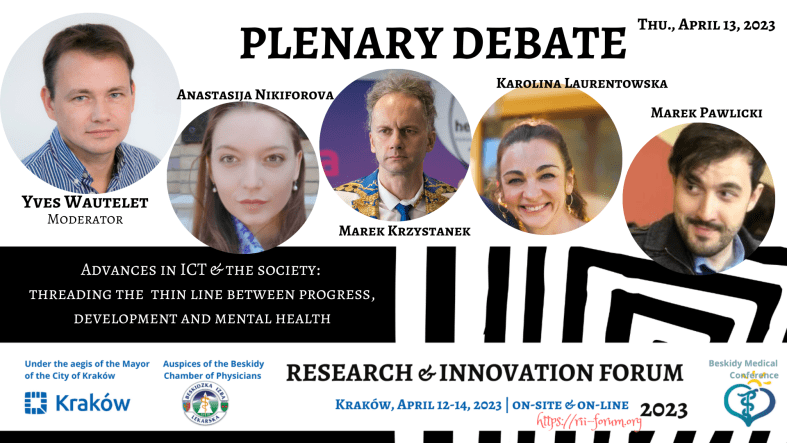
As part of Rii Forum 2023 a plenary debate “Advances in ICT & the Society: threading the thin line between progress, development and mental health” will take place, where I was honored to be invited as one of four plenary speakers, particularly considering that according tot he invitation, the organizers see me as the person whose “expertise and your contribution to the academic debate make you one of the trendsetters in current debate on open data and data quality management”, as well as leading voice and influencer. The other three panel discussants are Prof. Dr. Marek Krzystanek, Karolina Laurentowska & Prof. Marek Pawlicki. Hope this will be an interactive, fruitful and productive discussion with further involvement of the audience!

Read more here and stay tuned for more information and reflections on the conference, in case you will not be able to attend it.

The International Open Data Day and my role of Keynote Speaker for the 5th International Conference on Advanced Research Methods and Analytics (CARMA 2023) 🎤🎤🎤

This post is dedicated to two very pleasant events for me, namely the international Open Data Day 🎉🍾🥂, and the announcement of the keynote talk that I was kindly invited to deliver at the 5th International Conference on Advanced Research Methods and Analytics (CARMA) organized and sponsored by Universidad de Sevilla, Cátedra Metropol Parasol, Cátedra Digitalización Empresarial, IBM, Universitat Politècnica de València, Joint Research Center – European Commission and 🥁 🥁 🥁 Coca-Cola – what a delicious conference!🍸🍸🍸

CARMA is a forum for researchers and practitioners to exchange ideas and advances on how emerging research methods and sources are applied to different fields of social sciences as well as to discuss current and future challenges with main focus on the topics such as Internet and Big Data sources in economics and social sciences including Social media and public opinion mining, Web scraping, Google Trends and Search Engine data, Geospatial and mobile phone data, Open data and public data, Big Data methods in economics and social sciences such as Sentiment analysis, Internet econometrics, AI and Machine learning applications, Statistical learning, Information quality and assessment, Crowdsourcing, Natural Language processing, Explainability and interpretability, the applications of the above including but not limited to Politics and social media, Sustainability and development, Finance applications, Official statistics, Forecasting and nowcasting, Bibliometrics and sciencetometrics, Social and consumer behaviour, mobility patterns, eWOM and social media marketing, Labor market, Business analytics with social media, Advances in travel, tourism and leisure, Digital management, Marketing Intelligence analytics, Data governance, and Digital transition and global society, which, in turn, expects contributions in relation to Privacy and legal aspects, Electronic Government, Data Economy, Smart Cities, Industry adoption.

And as almost each and every conference, CARMA expects to have keynotes, which are two – Patrick Mikalef, who will talk about Responsible AI and Big Data Analytics, and me, whose keynote talk will be devoted to the topics I studied in recent years titled “Public data ecosystems in and for smart cities: how to make open / Big / smart / geo data ecosystems value-adding for SDG-compliant Smart Living and Society 5.0?” Sounds interesting? (I hope so) Stay tuned to know more! And return back, since I plan to reflect on the content of both talks and the conference in general.

The CARMA 2023 conference will be held on 28 June – 30 June 2023 in the University of Seville.

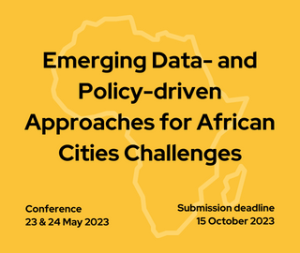
Call for Papers: Emerging Data- and Policy-driven Approaches for African Cities Challenges, Data & Policy, Cambridge University Press

On behalf of Guest Editors I sincerely invite you to consider submitting your work to our Special Issue ”Emerging Data- and Policy-driven Approaches for African Cities Challenges” as part of the open-access journal Data & Policy at Cambridge University Press.

This Special Issue aims to expand the reach and scope of urban data research, innovation and entrepreneurship activities and policies to address urban challenges in Africa through the digitisation of cities. It will compile recent expert work on the topic to advance and promote scientific advance / excellence, promote the digital transition and its benefits for creating, collecting, storing and using urban data to achieve sustainable development goals (SDG) in African cities.

African cities and their local actors and managers have been at the forefront of the digital transformation for several years now (Oke et al., 2020). Several urban projects across the continent, from north to south and east to west, are claiming to use the term “smart city” (Söderström et al., 2021). This apparently attractive name is often associated with an “isolationist” technical vision that is provided and marketed by operators with a very western and global vision. Digital and smart city projects are often implemented with citizens and the local ecosystem managed step by step by the municipalities, the digital transition can be primarily aimed at a “smart city of general interest”. In developing countries, and especially in Africa, where the young, female and urban population is becoming increasingly connected, the adoption of digital technologies is exponential and tends to occur without public intervention, including but not limited due to “datafication of cities” (Bibri & Krogstie, 2020; Plantinga, 2022; Oksman & Raunio, 2018). As a result, there is a risk that local authorities will “drop out” of the market, which may manifest itself in the development of alternative digital services by third parties that disrupt or compete with local public services. Another risk is that the local authority may have only limited or incomplete access to data produced by users and businesses within its territory, depriving it of the necessary material for its action. Local authorities in Africa, as in the North, are in a learning phase in their smart city or digital city policies and, in particular, policies regarding data collection / acquisition, storage and use to solve urban challenges (Plantinga, 2022; Oksman & Raunio, 2018).

Indeed, data is one of the essential pillars of an emerging smart or digital city that is best used to support decision making in urban planning and management to address the challenges of cities in Africa.  Therefore, it will be appropriate for this to cover all topics related to digital cities in Africa, including urban data and policy for urban planning applications, African smart city, Smart geoinformation systems (Smart GIS), smart governance, challenges of digital cities in Africa, urban sustainability, planning/management issues of emerging cities in Africa, urban socio-economic challenges (education, health, employment, youth, economy, food security, etc.), urban environment, information and communication technologies applied to the city. 

In addition to its thematic focus, it aims to advance interdisciplinary research by bridging the disciplinary divide between different academic cultures of the humanities, sciences, and application-oriented research, as well as the sectoral divide between urban development actors in Africa. Thus, this special issue will update and strengthen the existing literature on African cities through the results of scientific research based on qualitative and quantitative analysis techniques and methods on topics including, but not limited to data- and policy-driven approaches to address the challenges of African cities and mainly those related to:

💡Water and energy management;
💡Smart waste management and sanitation;
💡Digital management of education and health;
💡Digital mobility and transport management;
💡Quality of Life and social classes;
💡Strategies for digital and smart cities in Africa;
💡Digital and Smart African city stakeholders;
💡Digital and Smart city infrastructure;
💡Artificial intelligence and applications;
💡Digital governance for smart cities;
💡Citizen participation and engagement;
💡Datafication of smart cities;
💡Collective sensing & spatial big urban data;
💡Smart geo-addressing and participatory addressing;
💡Digital transformation and smart Governance;
💡Citizen and Collaborative Governance;
💡Climate and pollution. Environmental monitoring;
💡Disaster risks;
💡Urban Health


Papers to be submitted when ready, with final deadline: January 8, 2024.

Data & Policy publishes the following article types. Authors should consider which is the most appropriate category for their work before they submit:

  • Research articles: original work that uses rigorous methods to investigate how data science can inform or impact policy.
  • Commentaries: shorter articles that discuss and/or problematize an issue relevant to the special issue topic. (Approx 4,000 words in length).
  • Translational articles: focus on the policy setting or environment in which data science principles and approaches are being applied, with the aim of improving the transfer of knowledge from research to practice (and vice versa).
  • Data papers: provide structured descriptions of a data set relevant to the special issue. The data paper should describe the study design and methods that generated the data, but the focus should be to help others re-use the data rather than presenting new findings.

Guest Editors:

  • Jérôme Chenal, CEAT, EPFL, Lausanne, Switzerland
  • Stéphane C. K. Tekouabou, Center of Urban Systems (CUS), UM6P, Benguérir, Morocco
  • El Arbi Allaoui Abdellaoui, ENS, Mouley Ismail University, Meknès, Morocco
  • Anastasija Nikiforova, University of Tartu, Tartu, Estonia

References:

  • Bibri, S. E., & Krogstie, J. (2020). The emerging data–driven Smart City and its innovative applied solutions for sustainability: The cases of London and Barcelona. Energy Informatics, 3, 1-42.
  • Oke, A. E., Aghimien, D. O., Aigbavboa, C. O., & Akinradewo, O. I. (2020). Appraisal of the drivers of smart city development in South Africa. Construction Economics and Building, 20(2), 109-126.
  • Oksman, V., & Raunio, M. (2018, March). Citizen-centric smart city planning for africa: a qualitative case study of early stage co-creation of a Namibian smart community. In The twelfth international conference on digital society and egovernments (pp. 30-35).
  • Söderström, O., Blake, E., & Odendaal, N. (2021). More-than-local, more-than-mobile: The smart city effect in South Africa. Geoforum, 122, 103-117.
  • Plantinga, P. (2022). Digital discretion and public administration in Africa: Implications for the use of artificial intelligence. Information Development, 02666669221117526.

“Emerging issues and innovations” track as part of IFIP EGOV-CeDEM-EPART 2023 is open for submissions!

On behalf of the co-chair of “Emerging issues and innovations” track I sincerely invite everyone whose research focuses on new topics emerging in the field of ICT and public sector, including public-private ecosystems, to submit their work to this track, which is part of EGOV2023 – IFIP EGOV-CeDEM-EPART – one of the most recognized conference in e-Government, ICT and public administration and related topics!

The annual IFIP EGOV2023 will be hosted 5-7 September 2023 in Budapest by the Corvinus University of Budapest, Hungary. The conference focuses on e-Government, Digital Government, Open Government, Smart Government, GovTech, eParticipation and e-Democracy, and related topics like social media, digital transformation, Digital society, artificial intelligence, policy information, policy informatics, smart cities, and social innovation. Several types of submissions are possible, including completed research, ongoing research, reflections & viewpoints, posters, and workshops. The conference consists of 10 tracks:

  • General E-Government and E-Governance Track
  • General e-Democracy & e-Participation track
  • ICT and Sustainable Development Goals Track
  • Digital Society Track
  • AI, Data Analytics & Automated Decision Making Track
  • Smart Cities (Government, Districts, Communities & Regions) Track
  • Open data: social and technical aspects Track
  • Emerging Issues and Innovations Track
  • Digital and Social Media Track
  • Legal Informatics

And while the conference consists of 10 tracks you will definitely find relevant, my personal recommendation is “Emerging issues and innovations” track (chairs: Marijn Janssen, Anastasija Nikiforova, Dr. Csaba Csaki, Francesco Mureddu).


🎯🎯🎯 “Emerging issues and innovations” track focuses on new topics emerging in the field of ICT and public sector, including public-private ecosystems. Topics of interest include but are not limited to:
💡Looking ahead into Social innovation
💡The future of government, policy making and democracy
💡Global challenges that go beyond nation states (such as migration, climate change etc.) and require international collaboration of individual governments
💡Digital transformation in public sector context
💡The future of digital governance
💡Public values in transforming the government
💡The role of government in eCities and sustainable living
💡The role of the public sector in Human Centered Society
💡Self Service Structures for Inclusion
💡Public-private sector collaboration and integration;
💡Decentralized Autonomous Organizations (DAO), smart contracts and blockchain
💡Preparing for the policy challenges of future technologies;
💡Regulating misinformation
💡New technologies for automated decision-making
💡The future public sector use and regulation of latest AI solutions;
💡Public use as well as regulations of industry 4.0 and the internet of things
💡The relationships of governments and Fintech
💡Upcoming issues of eVoting including application of digital signatures in the public sector
💡Online public community building
💡Utilization of digital billboards
💡Latest trends in co-creation and service delivery
💡Forward looking insights from case studies – let it be successful or failed experiments.
 

🗓️🗓️🗓️ IMPORTANT DATES
Deadline for submissions: 31 March 2023
PhD Colloquium deadline for submissions: 1 May 2023
Poster submission deadline: 20 May 2023
PhD Colloquium: 4 September 2023
Conference: 5-7 September 2023

Do not miss 3 days of discussions around e-Government, Digital Government, Open Government, Smart Government, GovTech, eParticipation and e-Democracy, and related topics like social media, digital transformation, Digital society, artificial intelligence, policy information, policy informatics, smart cities, and social innovation. Mark your calendar – 31 March 2023 for submitting your paper, and 5-7 September 2023 for attending the conference!

The conference is organized by the IFIP 8.5 Working group (WG8.5) and the Digital Government Society (DGS). The aim of WG 8.5 is to improve the quality of e-government information systems at international, national, regional and local levels. The WG8.5 emphasis is on interdisciplinary approaches for information systems in public administration. DGS is a global, multi-disciplinary organization of scholars and practitioners interested in the development and impacts of digital government. Read more here.