Editorial Board Member of Data & Policy (Cambridge University Press)

Since July 2022, I am elected by Syndicate of Cambridge University Press as an Editorial Board Member of the Cambridge University Journal Data & Policy. Data & Policy is a peer-reviewed, open access venue dedicated to the potential of data science to address important policy challenges. For more information about the goal and vision of the journal, read the Editorial Data & Policy: A new venue to study and explore policy–data interaction by Stefaan G. Verhulst, Zeynep Engin, and Jon Crowcroft. More precisely, I act as an Area Editor of “Focus on Data-driven Transformations in Policy and Governance” area (with a proud short name “Area 1“). This Area focuses on the high-level vision for philosophy, ideation, formulation and implementation of new approaches leading to paradigm shifts, innovation and efficiency gains in collective decision making processes. Topics include, but are not limited to:

  • Data-driven innovation in public, private and voluntary sector governance and policy-making at all levels (international; national and local): applications for real-time management, future planning, and rethinking/reframing governance and policy-making in the digital era;
  • Data and evidence-based policy-making;
  • Government-private sector-citizen interactions: data and digital power dynamics, asymmetry of information; democracy, public opinion and deliberation; citizen services;
  • Interactions between human, institutional and algorithmic decision-making processes, psychology and behaviour of decision-making;
  • Global policy-making: global existential debates on utilizing data-driven innovation with impact beyond individual institutions and states;
  • Socio-technical and cyber-physical systems, and their policy and governance implications.

The remaining areas represent more specifically the current applications, methodologies, strategies which underpin the broad aims of Data & Policy‘s vision: Area 2 “Data Technologies and Analytics for Policy and Governance“, Area 3 “Policy Frameworks, Governance and Management of Data-driven Innovations“, Area 4 “Ethics, Equity and Trust in Policy Data Interactions“, Area 5 “Algorithmic Governance“, Area 6 “Data to Tackle Global Issues and Dynamic Societal Threats“.

Editorial committees of Data & Policy (Area 1)

For the types of submission we are interested in, they are four:

  • Research articles that use rigorous methods that investigate how data science can inform or impact policy by, for example, improving situation analysis, predictions, public service design, and/or the legitimacy and/or effectiveness of policy making. Published research articles are typically reviewed by three peer reviewers: two assessing the academic or methodological rigour of the paper; and one providing an interdisciplinary or policy-specific perspective. (Approx 8,000 words in length).
  • Commentaries are shorter articles that discuss and/or problematize an issue relevant to the Data & Policy scope. Commentaries are typically reviewed by two peer reviewers. (Approx 4,000 words in length).
  • Translational articles are focused on the transfer of knowledge from research to practice and from practice to research. See our guide to writing translational papers. (Approx 6,000 words in length).
  • Replication studies examine previously published research, whether in Data & Policy or elsewhere, and report on an attempt to replicate findings.

Read more about Data & Policy and consider submitting your contribution!

Moreover, as a part of this journal, we (Data & Policy community) organize a hybrid physical-virtual format, with one-day, in-person conferences held in three regions: Asia (Hong Kong), America (Seattle) and Europe (Brussels). “Data for Policy: Ecosystems of innovation and virtual-physical interactions” conference I sincerely recommend you to consider and preferably to attend! While this is already the seventh edition of the conference, I take part in its organization for the first year, thus am especially excited and interested in its success!
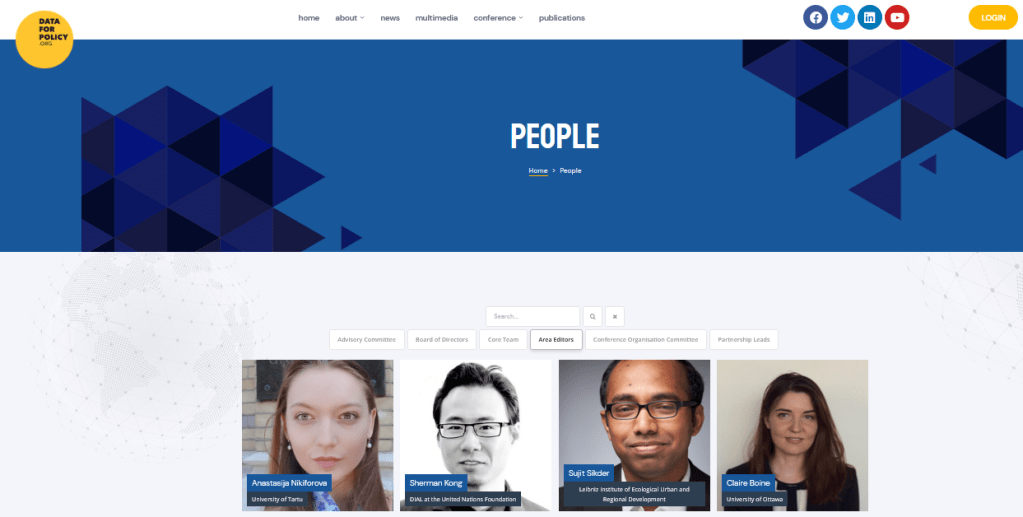
Data for policy, Area Editors

In addition to its six established Standard Tracks, and reflecting its three-regions model this year, the Data for Policy 2022 conference highlights “Ecosystems of innovation and virtual-physical interactions” as its theme. Distinct geopolitical and virtual-physical ecosystems are emerging as everyday operations and important socio-economic decisions are increasingly outsourced to digital systems. For example, the US’s open market approach empowering multinational digital corporations contrasts with greater central government control in the Chinese digital ecosystem, and radically differs from Europe’s priority on individual rights, personal privacy and digital sovereignty. Other localised ecosystems are emerging around national priorities: India focuses on the domestic economy, and Russia prioritises public and national security. The Global South remains underrepresented in the global debate. The developmental trajectory for the different ecosystems will shape future governance models, democratic values, and the provision of citizen services. In an envisioned ‘metaverse’ future, boundaries between physical and virtual spaces will become even more blurred, further underlining the need to scrutinise and challenge the various systems of governance.

The Data for Policy conference series is the premier global forum for multiple disciplinary and cross-sector discussions around the theories, applications and implications of data science innovation in governance and the public sector. Its associated journal, Data & Policy, published by Cambridge University Press has quickly established itself as a major venue for publishing research in the field of data-policy interactions. Data for Policy is a non-profit initiative, registered as a community interest company in the UK, supported by sustainer partners Cambridge University Press, the Alan Turing Institute and the Office for National Statistics.

Read more about Data for Policy and become a part of it!

Research and Innovation Forum 2022: panel organizer, speaker, PC member, moderator and Best panel moderator award

As I wrote earlier, this year I was invited to organize my own panel session within the Research and Innovation Forum (Rii Forum). This invitation was a follow-up on several articles that I have recently published (article#1, article#2, article#3) and a Chapter to be published in “Big data & decision-making: how big data is relevant across fields and domains” (Emerald Studies in Politics and Technology) I was developing at that time. I was glad to accept this invitation, but I did not even think about how many roles I will act in Rii Forum and how many emotions I will experience. So, how was it?

First, what was my panel about? It was dedicated to data security entitled “Security of data storage facilities: is your database sufficiently protected?” being a part of the track called “ICT, safety, and security in the digital age: bringing the human factor back into the analysis“.

My own talk was titled “Data security as a top priority in the digital world: preserve data value by being proactive and thinking security first“, which makes it to be a part of the panel described above. In this talk I elaborated on the main idea of the panel, referring to an a study I recently conducted. In short, today, in the age of information and Industry 4.0, billions of data sources, including but not limited to interconnected devices (sensors, monitoring devices) forming Cyber-Physical Systems (CPS) and the Internet of Things (IoT) ecosystem, continuously generate, collect, process, and exchange data. With the rapid increase in the number of devices and information systems in use, the amount of data is increasing. Moreover, due to the digitization and variety of data being continuously produced and processed with a reference to Big Data, their value, is also growing. As a result, the risk of security breaches and data leaks. The value of data, however, is dependent on several factors, where data quality and data security that can affect the data quality if the data are accessed and corrupted, are the most vital. Data serve as the basis for decision-making, input for models, forecasts, simulations etc., which can be of high strategical and commercial / business value. This has become even more relevant in terms of COVID-19 pandemic, when in addition to affecting the health, lives, and lifestyle of billions of citizens globally, making it even more digitized, it has had a significant impact on business. This is especially the case because of challenges companies have faced in maintaining business continuity in this so-called “new normal”. However, in addition to those cybersecurity threats that are caused by changes directly related to the pandemic and its consequences, many previously known threats have become even more desirable targets for intruders, hackers. Every year millions of personal records become available online. Moreover, the popularity of IoTSE decreased a level of complexity of searching for connected devices on the internet and easy access even for novices due to the widespread popularity of step-by-step guides on how to use IoT search engine to find and gain access if insufficiently protected to webcams, routers, databases and other artifacts. A recent research demonstrated that weak data and database protection in particular is one of the key security threats. Various measures can be taken to address the issue. The aim of the study to which this presentation refers is to examine whether “traditional” vulnerability registries provide a sufficiently comprehensive view of DBMS security, or whether they should be intensively and dynamically inspected by DBMS holders by referring to Internet of Things Search Engines moving towards a sustainable and resilient digitized environment. The study brings attention to this problem and make you think about data security before looking for and introducing more advanced security and protection mechanisms, which, in the absence of the above, may bring no value.

Other presentations delivered during this session were “Information Security Risk Awareness Survey of non-governmental Organization in Saudi Arabia”, “Fake news and threats to IoT – the crucial aspects of cyberspace in the times of cyber war” and “Minecraft as a Tool to Enhance Engagement in Higher Education” – both were incredibly interesting, and all three talks were delivered by females, where only the moderator of the session was a male researcher, which he found to be very specific, given the topic and ICT orientation – not a very typical case 🙂 But, nevertheless, we managed to have a great session and a very lively and fruitful discussion, mostly around GDPR-related questions, which seems to be one of the hottest areas of discussion for people representing different ICT “subbranches”. The main question that we discussed was – is the GDPR more a supportive tool and a “great thing” or rather a “headache” that sometimes even interferes with development.

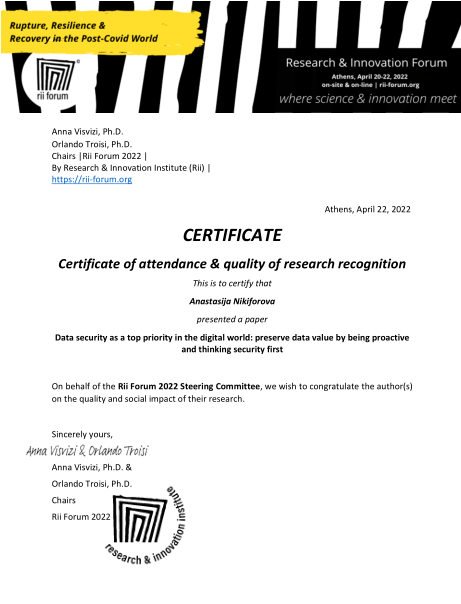
In addition, shortly before the start of the event, I was asked to become a moderator of the panel “Business in the era of pervasive digitalization“. Although, as you may know, this is not exactly in line with my area of expertise, it is in line with what I am interested in. This is not surprising, since both management, business, the economics are very closely connected and dependent on ICT. Moreover, they affect ICT, thereby pointing out the critical areas that we as IT-people need to refer to. All in all, we had a great session with excellent talks and lively discussion at the end of the session, where we discussed different session-related topics, shared our experience, thoughts etc. Although it was a brilliant experience, there is one thing that made it even better… A day later, a ceremony was held where the best contributions of the forum were announced and I was named the best panel moderator as a recognition of “the academic merit, quality of moderation, scheduling, and discussion held during the panel”!!!

These were wonderful three days of the forum with very positive emotions and so many roles – panel organizer, speaker / presenter, program committee member and panel moderator with the cherry on the cake and such a great end of the event. Thank you Research and Innovation Forum!!! Even being at home and participating online, you managed to give us an absolute amazing experience and even the feeling that we were all together in Athens!

The International Day of Women and girls in Science and my new role – Keynote Speaker for the international Innovation and Smart Government (ISGov) conference

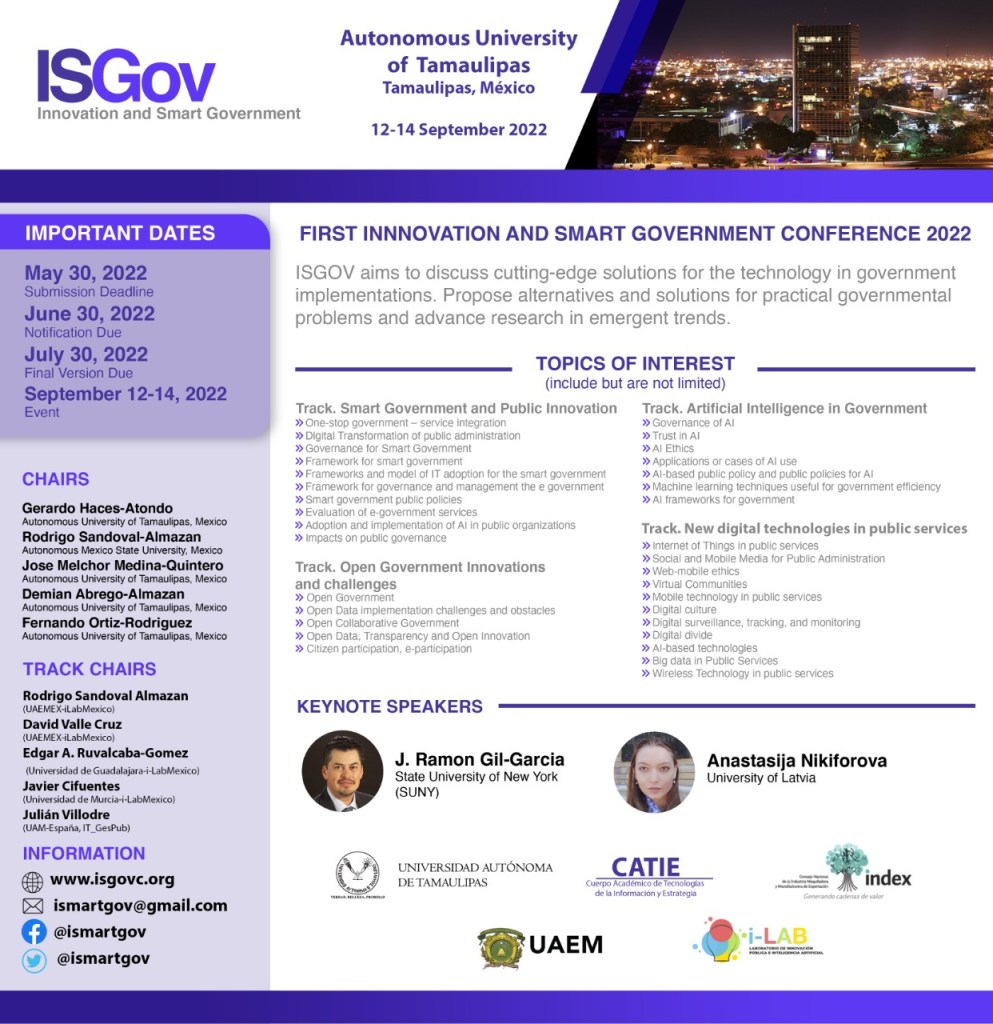
And today, celebrating the International Day of Women and Girls in Science dedicated to celebration of both science and gender equality (as part of United Nations Transforming our World: 2030 Agenda for Sustainable Development), I would like to share the information about very special event, in which I am invited to take a part – this time the role of mine is to be a keynote speaker for the international Innovation and Smart Government (ISGov) conference!!!

In case you are interested in topics related to public innovation, smart government, public governance, open government data, and changes in government organizations, I believe that this event, in which I will act as a keynote, could be of interest for you.

This conference aims to discuss cutting-edge solutions for the technology in government implementations. Propose alternatives and solutions for practical governmental problems and advance research in emergent trends. This conference seeks for contributions representing 4 different tracks:

  • TRACK 1. Smart Government and Public Innovation focused on research for public innovation and smart government in this challenging times. This track seeks research on new frameworks, ideas and evaluation of e-government services. Topics include but are not limited to: One-stop government – service integration, Digital Transformation of public administration, Governance for Smart Government, Framework for smart government, Frameworks and model of IT adoption for the smart government, Framework for governance and management the e government, Smart government public policies, Evaluation of e-government services, Adoption and implementation of AI in public organizations, Impacts on public governance, e-Government;
  • TRACK 2. Artificial Intelligence in Government  focused on discussing AI applications, experiences, and unintended consequences, drawing on a variety of methodologies, techniques, applications, theoretical frameworks, and empirical cases, in order to capture the unique phenomena triggered by the increasing adoption of AI. Topics include but are not limited to: Governance of AI, Trust in AI, AI Ethics, Applications or cases of AI use, AI-based public policy and public policies for AI, Machine learning techniques useful for government efficiency, AI frameworks for government;
  • TRACK 3. Open Government Innovations and challenges focused on research about open government and related topics, such as government transparency, citizen participation, accountability, open data, among others. This track seeks to concentrate and disseminate research work on new case studies, theoretical frameworks, and evaluation of institutional openness policies. 
  • TRACK 4. New digital technologies in public services focused on the investigation of the improvement of public services through new digital technologies. The investigations can be frameworks, applications, case studies, methodologies and empirical cases that allow knowing the impact of these technologies on public services. Topics include but are not limited to: Internet of Things in public services, Social and Mobile Media for Public Administration, Web-mobile ethics, Virtual Communities, Mobile technology in public services, Digital culture, Digital surveillance, tracking, and monitoring, Digital divide, AI-based technologies, Big data in Public Services, Wireless Technology in public services.

Two keynote speeches will be delivered during this event, delivered by J. Ramon Gil-Garcia and me. As regards Dr. J. Ramon Gil-Garcia, he is an Associate Professor of Public Administration and Policy and the  Director of the Center for Technology in Government, University at Albany, State University of New York (SUNY). He is considered the most prolific author in  the  field of digital government research worldwide and in 2013 he was selected for the Research Award, which is “the highest distinction given annually by the Mexican Academy of Sciences to outstanding young researchers.” More recently, Dr. Gil-Garcia was named “One of the World’s 100 Most Influential People in Digital Government” in 2018 and 2019 by Apolitical. Dr. Gil-Garcia is the author or co-author of articles in prestigious international journals in Public Administration, Information Systems, and Digital Government and some of his publications are among the most cited in the field of digital government research worldwide. His research interests include collaborative electronic government, inter-organizational information integration, smart cities and smart governments, adoption and implementation of emergent technologies, digital divide policies, and multi-method research approaches. This makes my participation as the second keynote to be even more pleasant for me as for relatively young researcher.

At this moment, the topics of our speeches are not very well known, since we both work actively on our ongoing studies and perhaps will be ready to present some the most recent results, but, hopefully, despite the final decision on the topic to be covered (within the general scope of the conference, of course) they will be of interest for the audience and will result in a lively and fruitful discussion!

And Happy International Day of Women and Girls in Science! 👩‍🎓💻

First International Electronic Governance with Emerging Technologies Conference (EGETC)

As the general co-chair of the First International Conference in Electronic Governance with Emerging Technologies (EGETC-2022), I sincerely invite you to consider your participation as authors and presenters or the attendees in this event.

First International Electronic Governance with Emerging Technologies Conference

Over the last decade, the importance of emerging technologies in government and public administrations has grown significantly. The growing demand for services that better meet changing user expectations for responsiveness and personalization, coupled with higher expectations of the role of government in the digital age, calls for a technologically mature public sector. There are many new emerging technologies serving as enablers to new forms of governance and novel applications in traditional governance functions, which role has been witnessed across various domains, including healthcare, medicine, education, tourism, and industry etc.. 

The aim of the First International Conference in Electronic Governance with Emerging Technologies (EGETC-2022) is to provide a forum for academics, scholars, and practitioners from academia and industry to share and exchange the recent developments in the domain of eGovernment and governance of digital organizations to shed light on the emerging research trends and their applications. 

Topics of interest include, but not limited to:

  • Intelligent systems for coordination in crisis emergency management
  • Distributed ledgers and Blockchains: governance, decentralized autonomous organizations (DAO)
  • Machine Learning (ML), Artificial Intelligence (AI) and Big Data management for Public Sector
  • Privacy, security and legal Informatics – AI and Law
  • Open Data, Open Government Data: transparency, trust, public participation, co-creation and Open Innovation
  • Digital transformation and Society 5.0
  • Linked Data, Linked Open Data (LOD)
  • Semantic E-government applications
  • Public Sector Knowledge Representation
  • Decision Support Systems (DSS) in Digital Governance
  • Natural Language Processing (NLP)
  • Cloud Computing
  • Bots, Automation agents, Self-learning systems 
  • Cryptocurrencies and incentive mechanism design
  • Multimedia and multilingual systems

It is particularly important that, in order to ensure the widest possible participation of communities, despite the availability of funding, the conference does not foresee any charges. I.e. both authors and presenters, and attendees/ listeners are welcome without registration fees.

First International Electronic Governance with Emerging Technologies  Conference (author: Anastasija Nikiforova)

In addition to the great team of organizers and members of the program committee, which has a rich list of outstanding experts, participants of this event will have an opportunity to enjoy the keynote speeches by Prof. Marijn Janssen – Full Professor in ICT & Governance at TU Delft, Netherlands, Dr. B K Murthy, CEO – Innovation and Technology Foundation, IIT Bhilai, Prof. Luis Martinez – Full Professor, University of Jaén, Jaén Spain. More information on their talk will follow…

Accepted papers presented at the EGETC2022 will be published in the proceeding published by Springer in Lecture Notes in Computer Science series (approval pending…). A short list of best papers will be invited for a post-conference publication in Government Information Quarterly (GIQ), Elsevier, Q1, Cite Score: 11.6, Impact Factor: 7.279 and Technological Forecasting and Social Change, An International Journal, Elsevier, Q1, Cite Score: 12.1, Impact Factor: 8.593.

If you are interested in submitting your paper, add to your calendar the submission date – May 30, while the event will take place during September 12-14, 2022.

Due to the unpredictability of the current situation in the light of pandemic, we expect to have a hybrid event, i.e. both online and on-site participation will be possible. For the later mode, we will be very glad to meet participants, who will be able to attend the event physically, in peaceful and spectacular city of Tamaulipas, Mexico in mid-September, 2022. Hope to meet you there!!!

2021 Summary

Here is the time to summarize the events, activities and achievements of 2021. Although there were some challenges and issues hat have been overcome, it was quite fruitful, and I am absolutely grateful for that. Therefore, in this post I would like to refer to positive events and their results.

Perhaps the first achievement to be mentioned is the LATA award. More specifically, this year, for my research, public activity and other achievements, the LATA (Latvian Open Technologies Association) has recognized me as a person of the year and has awarded me for promoting open data and open technologies. I believe it gave me strength, forces and inspiration for future activities.

So, I have worked hard this year, both independently and with some very skilled and intelligent colleagues, and this gave some results. In short:

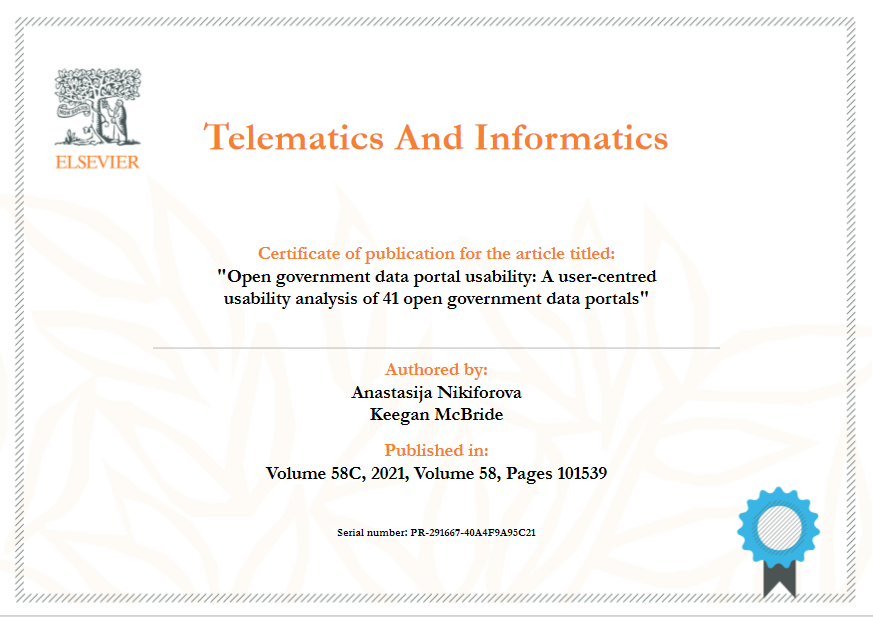
  • 16 papers, including one chapter (some of them will be officially published in 2022), 6 conference papers, 9 journal articles, including 6 articles in Q1 journals. Some of these articles have been recommended by international organizations, including the world’s largest and most significant open data portal data.europa.eu, the Open Data Daily (PSI Monitor), World Health Organization, Europe PMC and FreeMedArt etc.;
  • 7 international conferences attended as a speaker with 5 papers, 2 posters, 2 more talks on the results of ongoing projects and 1 invited talk. Thank you RCIS (International Conference on Research Challenges in Information Science), ICEGOV (International Conference on Theory and Practice of Electronic Governance “Smart Digital Governance for Global Sustainability“), IDSTA (International Conference on Intelligent Data Science Technologies and Applications), IoTSMS (International conference on Internet of Things, Systems, Management and Security), EBW (European Biobank week), International Conference and Expo on Nanotechnology and Nanomaterials – it was a really great experience, and it is great that, despite the pandemic, you have managed to organize such great events with such a nice audience and brilliant speakers (both participants and keynotes).

Some of these activities were the results of very independent non-funded studies (mostly relates to open (government) data-related studies), others were the results of projects in which I was involved in recent months and years:

Over the next months, I have joined several associations and teams with which we have worked on different topics. In particular:

  • joined the above mentioned European Open Science Cloud (EOSC) Task Force “FAIR metrics and data quality”;
  • became a part of Quantum Humanities Network hosted by the university of Jena (Friedrich-Schiller-Universität Jena, Germany), which is represented by researchers from Germany, Spain, Finland, Latvia and Romania. With the colleagues forming this network, the application for CHANSE funding has been submitted and has already successfully passed the first round of review.
  • became an expert of the Latvian Council of Sciences – (1) Natural Sciences – Computer Science and Informatics and (2) Engineering and Technology-Electrical Engineering, Electronics, Information and Communication Technologies (ICT);
  • became a part of BBMRI-ERIC node, Quality Management Task Force;
  • and even took part (although in a tiny activity) in providing an input for proposal for a European Interoperability Framework for Smart Cities and Communities (EIF4SCC) – the study conducted by Deloitte and KU Leuven (Belgium) for the European Commission.

In addition, although I had some experience in reviewing papers for both journals and conferences, this year I took a step further and became part of the Editorial Board and / or Editor for several venues and even became the general chair of one international conference. More precisely:

In addition, I have gained a new experience of delivering Invited Talks and Guest Lectures. The Invited Talk entitled “Open Data as a driver of Society 5.0: how you and your scientific outputs can contribute to the development of the Super Smart Society and transformation into Smart Living? was delivered during the International Conference and Expo on Nanotechnology and Nanomaterials, which organizers have invited me to speak about the open science and its role in current scientific community. For the Guest Lectures, they were two – (1) Open data: ecosystem, current and future trends, success stories and barriers, the University of South-Eastern Norway (USN) (Norway, web-based), (2) Open data potential, LU Faculty of Social Sciences/ Institute for Social and Political Studies, Latvia. I am grateful to both, the colleagues who have invited me and the audience – I was very surprised by your passionate for the knowledge and lively discussion we had at the end of these lectures. Although here I should also refer to my own students and particularly Accenture students – you really are a dream audience. And thank you for your very positive feedback you left – it is my pleasure and I am so pleased that you really appreciate the efforts I have invested in my lectures and courses and feel my support.

In addition, there were some local activities and achievements, such as:

  • developed and successfully launched a course for master and doctoral students (Faculty of Computer Science), entitled “Open government data in a data-driven world” (3 ECTS),
  • served as an expert / mentor for Latvian open geospatial data hackathon for pupils 2021 organized by the National Centre for Education Republic of Latvia – the team I have mentored, won!
  • served as an expert for the “Idea Laboratory 2021” in scope of the Emerging Technologies and Innovations Days of University of Latvia here the same, the team I have mentored, won!
  • supervised 15 thesis, successfully defended by my students. For two of them conference papers have been developed and already published, thus doing my best to find new talents and engage them in the scientific community;
  • delivered lectureOpen data: ecosystem, use-case, potential advantages and open questions to participants of the School of Excellence (in collaboration with the youth Foundation “Vertical” (“Vertikāle”)) in addition to invited lectures I mentioned above;
  • served as an advisor for the Faculty of Social Sciences/Institute for Social and Political Studies;
  • delivered a talk during the 14th conference of Latvian Association of Open Technologies “How to Stay Open in the New Era” entitled “Timeliness of open pandemic related data in national open data portals: a long way from the data publisher to the data user
  • participated in the 79th International Conference of the University of Latvia and presented two talks – (1) “User-centered analysis of the usability of Open Government Data (OGD) portals“ and (2) DQMBT or data quality model-based testing of information systems.

This is just a short list of the activities conducted and the achievements achieved, for which I would like to thank both 2021 and all those who have supported me. Thank you 2021 and bye! Welcome 2022!