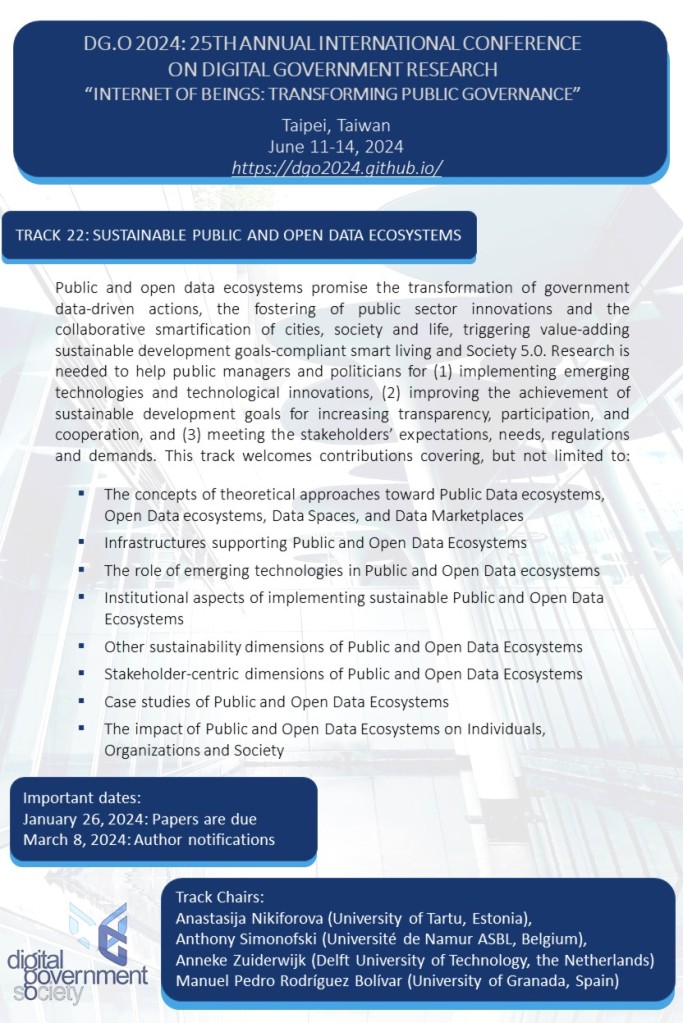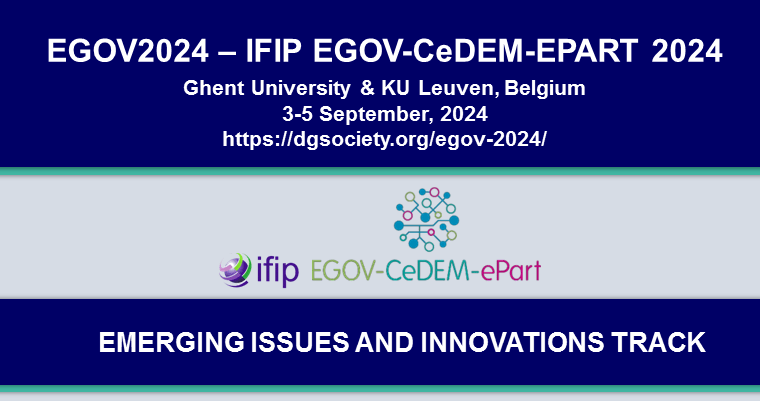
EGOV2024 – IFIP EGOV-CeDEM-EPART 2024 & our Emerging Issues and Innovations Track

Are you focusing on new topics emerging in the field of ICT and public sector, incl. public-private ecosystems? Then it is time to start preparing your submission for EGOV2023 – IFIP EGOV-CeDEM-EPART Emerging Issues and Innovations Track (chairs: Anastasija Nikiforova, Marijn Janssen, Francesco Mureddu).

EGOV2023 – IFIP EGOV-CeDEM-EPART is one of the most recognized conference in e-Government, ICT and public administration and related topics, which this year will be hosted in Belgium, in the heart of Europe, by Ghent University and KU Leuven – both top 100 universities.

 Innovation and application of emerging technologies is now more and more in the thinking of Governments at all levels. While it would be easy to consider the public sector as being less flexible or slow in adoption, presentations at recent EGOV-CeDEM-ePart conferences proved that one should not come to such a conclusion too easily. Upcoming technologies, innovative organizational solutions, or new avenues of involvement in public sector activities seem to be more commonplace – along with the potential issues and challenges that come with such endeavours. Policy-makers and public sector officials are now expected to embrace change, consider digital transformation, or improve governance practices. At the same time, public sector researchers are also influenced by new views, methods, tools and techniques.

🎯The goal of this track is to provide a platform for the discussion of new ideas, issues, problems, and solutions, that keep entering the public sphere. Ideas that are emerging but might not fit other conference tracks are also welcome. Focus may include but is not limited to:

  • 💡 Looking ahead into social innovation
  • 💡Future studies, the future of government, policy-making and democracy
  • 💡New trends in public sector research such as Metaverse, Large Language Models (LLMs), generative AI and its implementations such as chatGPT, Claude, ChatSonic, Poe – benefits, risks, adoption and resistance to its adoption by the public sector and citizens;
  • 💡Global challenges that go beyond nation states (such as migration, climate change etc.) and which require international collaboration of individual governments;
  • 💡Digital transformation in public sector context;
  • 💡The future of digital governance;
  • 💡Public values in transforming the government;
  • 💡The role of government in smart cities (incl. smart sustainable cities) and sustainable living;
  • 💡The role of the public sector in Human-Centered Society known as Society 5.0;
  • 💡Government in the metaverse;
  • 💡Self-Service Structures for Inclusion;
  • 💡Public-private sector collaboration and integration;
  • 💡Decentralized Autonomous Organizations (DAOs), smart contracts and blockchain;
  • 💡Preparing for the policy challenges of future technologies;
  • 💡Regulating misinformation;
  • 💡New technologies for automated decision-making;
  • 💡The future public sector use and regulation of latest AI or genAI solutions;
  • 💡Public use as well as regulations of industry 4.0 and Industry 5.0 and the Internet of Things (IoT);
  • 💡The relationships of governments and Fintech;
  • 💡Upcoming issues of eVoting / internet voting including application of digital signatures in the public sector;
  • 💡Online public community building;
  • 💡Utilization of digital billboards;
  • 💡Latest trends in co-creation and service delivery;
  • 💡Discussion of new research methods that have not been applied in this context;
  • 💡Application of role theory in the analysis of public sector functions and processes;
  • 💡Forward looking insights from case studies – let it be successful or failed experiments.

Track Chairs

  • Anastasija Nikiforova, Tartu University, Estonia
  • Marijn Janssen, Delft University of Technology, the Netherlands
  • Francesco Mureddu, The Lisbon Council, Belgium

This time International Federation for Information Processing (IFIP) EGOV-CeDEM-EPART will be hosted by KU Leuven and Ghent University, September 2024, while the deadline for submitting your paper is set to March, 2024.

Stay tuned, more info to come!
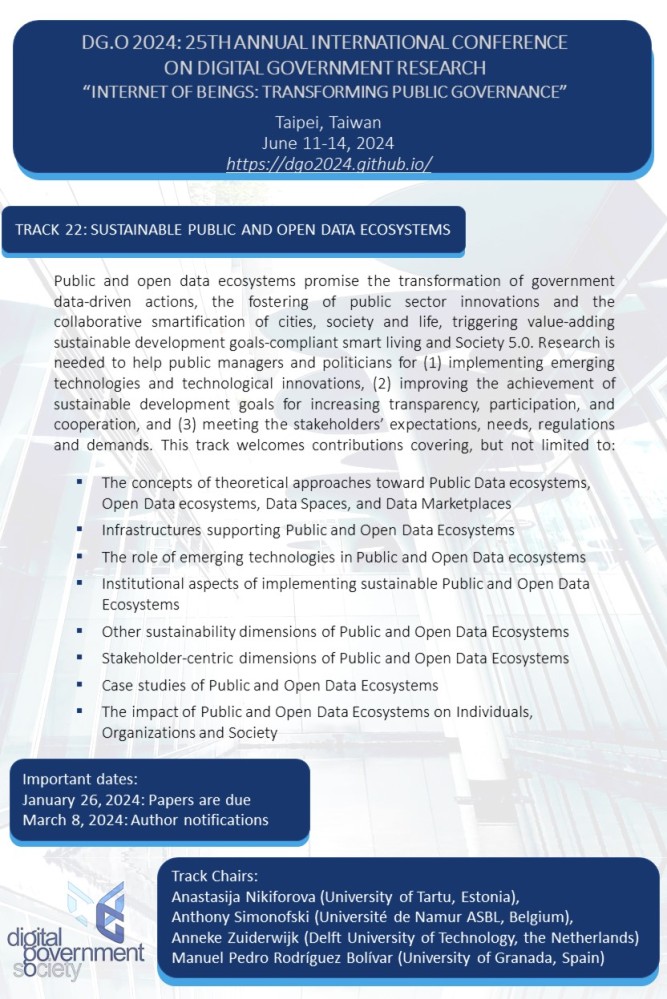
CFP for a new dg.o2024 SUSTAINABLE PUBLIC AND OPEN DATA ECOSYSTEMS track

25th Annual International Conference on Digital Government Research (dg.o2024) is coming with the revised list of tracks, where the special attention I invite you to draw to is a new track “Sustainable Public and Open Data Ecosystems” (chairs: Anastasija Nikiforova (University of Tartu, Estonia), Anthony Simonofski (Université de Namur ASBL, Belgium), Anneke Zuiderwijk (Delft University of Technology, the Netherlands) & Manuel Pedro Rodríguez Bolívar (University of Granada, Spain)).

Briefly about the track… Public and open data ecosystems promise the transformation of government data-driven actions, the fostering of public sector innovations and the collaborative smartification of cities, society and life, triggering value-adding sustainable development goals-compliant smart living and society 5.0 (Nikiforova, 2021, Nikiforova et al., 2023). Recent research found that concepts affecting and shaping the ecosystem are: 1) stakeholders / actors and their roles, 2) phases of the data lifecycle, in which a stakeholder participates in the ecosystem, 3) technical and technological infrastructure, 4) generic services and platforms, 5) human capacities and skills of both providers and consumers, 6) smart city domains (thematic categories) as the targeted areas for data reuse, 7) externalities affecting goals, policy, and resources, 8) level of (de)centralization of data sources – development, restrictions, 9) perception of importance and support from public officials, and 10) user interface, user experience, and usability (Lnenicka et al., 2021). The body of knowledge in the above areas (not to say about putting them all together) is very limited. New research is needed to help public managers and politicians for (1) implementing emerging technologies and technological innovations, (2) improving the achievement of sustainable development goals for increasing transparency, participation, and cooperation, and (3) meeting the stakeholders’ expectations, needs, regulations and demands.

This track welcomes contributions covering, but not limited to:

💡 The concepts of theoretical approaches toward Public Data ecosystems, Open Data ecosystems, Data Spaces, and Data Marketplaces;

💡Infrastructures supporting Public and Open Data Ecosystems;

💡The role of emerging technologies in Public and Open Data ecosystems;

💡Institutional aspects of implementing sustainable Public and Open Data Ecosystems;

💡Other sustainability dimensions of Public and Open Data Ecosystems;

💡Stakeholder-centric dimensions of Public and Open Data Ecosystems;

💡Case studies of Public and Open Data Ecosystems;

💡The impact of Public and Open Data Ecosystems on Individuals, Organizations and Society.

The track welcomes both contributions covering the current state-of-the-art of public data ecosystems (what components constitute them, what are the relationships between these components, what makes an ecosystem resilient and sustainable), incl. individual case studies reflecting best or bad practices, as well as those addressing how these ecosystems can be transformed into more sustainable ecosystems that will “fuel” or “smartify” society (Information Society aka Society 4.0 to Super Smart Society aka Society 5.0 transition), cities and various areas of life.

The track is very in line with the conference theme of DGO 2024, namely: Internet of Beings – Transforming Public Governance, where, “the Internet of Beings focuses on digital technologies that enable integration, people-centric, and creation of open platforms for collaborative multi-user to co-create services and products” (as mentioned in the theme description). Public and open data ecosystems can be considered as such open platforms, where data providers and data users find each other and collaborate and co-create to develop services and products useful for society. While digital technologies enable the development of public and open data ecosystems, the adoption of such ecosystems has been fragmented.

Is your research related to any of the above topics? Then do not wait – submit!

🗓️🗓️🗓️Important Dates:

January 26, 2024: Papers, workshops, tutorials, and panels are due
Feb 1, 2021: Application deadline for doctoral colloquium
March 8, 2024: Author notifications (papers, workshops, tutorials, panels)

References:

Nikiforova, A. (2021). Smarter open government data for society 5.0: are your open data smart enough?. Sensors, 21(15), 5204.

Nikiforova, A., Flores, M. A. A., & Lytras, M. D. (2023). The role of open data in transforming the society to Society 5.0: a resource or a tool for SDG-compliant Smart Living?. In Smart Cities and Digital Transformation: Empowering Communities, Limitless Innovation, Sustainable Development and the Next Generation (pp. 219-252). Emerald Publishing Limited.

Lnenicka, M., Nikiforova, A., Luterek, M., Azeroual, O., Ukpabi, D., Valtenbergs, V., & Machova, R. (2022). Transparency of open data ecosystems in smart cities: Definition and assessment of the maturity of transparency in 22 smart cities. Sustainable Cities and Society, 82, 103906.

“Emerging issues and innovations” track as part of IFIP EGOV-CeDEM-EPART 2023 is open for submissions!

On behalf of the co-chair of “Emerging issues and innovations” track I sincerely invite everyone whose research focuses on new topics emerging in the field of ICT and public sector, including public-private ecosystems, to submit their work to this track, which is part of EGOV2023 – IFIP EGOV-CeDEM-EPART – one of the most recognized conference in e-Government, ICT and public administration and related topics!

The annual IFIP EGOV2023 will be hosted 5-7 September 2023 in Budapest by the Corvinus University of Budapest, Hungary. The conference focuses on e-Government, Digital Government, Open Government, Smart Government, GovTech, eParticipation and e-Democracy, and related topics like social media, digital transformation, Digital society, artificial intelligence, policy information, policy informatics, smart cities, and social innovation. Several types of submissions are possible, including completed research, ongoing research, reflections & viewpoints, posters, and workshops. The conference consists of 10 tracks:

  • General E-Government and E-Governance Track
  • General e-Democracy & e-Participation track
  • ICT and Sustainable Development Goals Track
  • Digital Society Track
  • AI, Data Analytics & Automated Decision Making Track
  • Smart Cities (Government, Districts, Communities & Regions) Track
  • Open data: social and technical aspects Track
  • Emerging Issues and Innovations Track
  • Digital and Social Media Track
  • Legal Informatics

And while the conference consists of 10 tracks you will definitely find relevant, my personal recommendation is “Emerging issues and innovations” track (chairs: Marijn Janssen, Anastasija Nikiforova, Dr. Csaba Csaki, Francesco Mureddu).


🎯🎯🎯 “Emerging issues and innovations” track focuses on new topics emerging in the field of ICT and public sector, including public-private ecosystems. Topics of interest include but are not limited to:
💡Looking ahead into Social innovation
💡The future of government, policy making and democracy
💡Global challenges that go beyond nation states (such as migration, climate change etc.) and require international collaboration of individual governments
💡Digital transformation in public sector context
💡The future of digital governance
💡Public values in transforming the government
💡The role of government in eCities and sustainable living
💡The role of the public sector in Human Centered Society
💡Self Service Structures for Inclusion
💡Public-private sector collaboration and integration;
💡Decentralized Autonomous Organizations (DAO), smart contracts and blockchain
💡Preparing for the policy challenges of future technologies;
💡Regulating misinformation
💡New technologies for automated decision-making
💡The future public sector use and regulation of latest AI solutions;
💡Public use as well as regulations of industry 4.0 and the internet of things
💡The relationships of governments and Fintech
💡Upcoming issues of eVoting including application of digital signatures in the public sector
💡Online public community building
💡Utilization of digital billboards
💡Latest trends in co-creation and service delivery
💡Forward looking insights from case studies – let it be successful or failed experiments.
 

🗓️🗓️🗓️ IMPORTANT DATES
Deadline for submissions: 31 March 2023
PhD Colloquium deadline for submissions: 1 May 2023
Poster submission deadline: 20 May 2023
PhD Colloquium: 4 September 2023
Conference: 5-7 September 2023

Do not miss 3 days of discussions around e-Government, Digital Government, Open Government, Smart Government, GovTech, eParticipation and e-Democracy, and related topics like social media, digital transformation, Digital society, artificial intelligence, policy information, policy informatics, smart cities, and social innovation. Mark your calendar – 31 March 2023 for submitting your paper, and 5-7 September 2023 for attending the conference!

The conference is organized by the IFIP 8.5 Working group (WG8.5) and the Digital Government Society (DGS). The aim of WG 8.5 is to improve the quality of e-government information systems at international, national, regional and local levels. The WG8.5 emphasis is on interdisciplinary approaches for information systems in public administration. DGS is a global, multi-disciplinary organization of scholars and practitioners interested in the development and impacts of digital government. Read more here.

Editorial Board Member of Data & Policy (Cambridge University Press)

Since July 2022, I am elected by Syndicate of Cambridge University Press as an Editorial Board Member of the Cambridge University Journal Data & Policy. Data & Policy is a peer-reviewed, open access venue dedicated to the potential of data science to address important policy challenges. For more information about the goal and vision of the journal, read the Editorial Data & Policy: A new venue to study and explore policy–data interaction by Stefaan G. Verhulst, Zeynep Engin, and Jon Crowcroft. More precisely, I act as an Area Editor of “Focus on Data-driven Transformations in Policy and Governance” area (with a proud short name “Area 1“). This Area focuses on the high-level vision for philosophy, ideation, formulation and implementation of new approaches leading to paradigm shifts, innovation and efficiency gains in collective decision making processes. Topics include, but are not limited to:

  • Data-driven innovation in public, private and voluntary sector governance and policy-making at all levels (international; national and local): applications for real-time management, future planning, and rethinking/reframing governance and policy-making in the digital era;
  • Data and evidence-based policy-making;
  • Government-private sector-citizen interactions: data and digital power dynamics, asymmetry of information; democracy, public opinion and deliberation; citizen services;
  • Interactions between human, institutional and algorithmic decision-making processes, psychology and behaviour of decision-making;
  • Global policy-making: global existential debates on utilizing data-driven innovation with impact beyond individual institutions and states;
  • Socio-technical and cyber-physical systems, and their policy and governance implications.

The remaining areas represent more specifically the current applications, methodologies, strategies which underpin the broad aims of Data & Policy‘s vision: Area 2 “Data Technologies and Analytics for Policy and Governance“, Area 3 “Policy Frameworks, Governance and Management of Data-driven Innovations“, Area 4 “Ethics, Equity and Trust in Policy Data Interactions“, Area 5 “Algorithmic Governance“, Area 6 “Data to Tackle Global Issues and Dynamic Societal Threats“.

Editorial committees of Data & Policy (Area 1)

For the types of submission we are interested in, they are four:

  • Research articles that use rigorous methods that investigate how data science can inform or impact policy by, for example, improving situation analysis, predictions, public service design, and/or the legitimacy and/or effectiveness of policy making. Published research articles are typically reviewed by three peer reviewers: two assessing the academic or methodological rigour of the paper; and one providing an interdisciplinary or policy-specific perspective. (Approx 8,000 words in length).
  • Commentaries are shorter articles that discuss and/or problematize an issue relevant to the Data & Policy scope. Commentaries are typically reviewed by two peer reviewers. (Approx 4,000 words in length).
  • Translational articles are focused on the transfer of knowledge from research to practice and from practice to research. See our guide to writing translational papers. (Approx 6,000 words in length).
  • Replication studies examine previously published research, whether in Data & Policy or elsewhere, and report on an attempt to replicate findings.

Read more about Data & Policy and consider submitting your contribution!

Moreover, as a part of this journal, we (Data & Policy community) organize a hybrid physical-virtual format, with one-day, in-person conferences held in three regions: Asia (Hong Kong), America (Seattle) and Europe (Brussels). “Data for Policy: Ecosystems of innovation and virtual-physical interactions” conference I sincerely recommend you to consider and preferably to attend! While this is already the seventh edition of the conference, I take part in its organization for the first year, thus am especially excited and interested in its success!

Data for policy, Area Editors

In addition to its six established Standard Tracks, and reflecting its three-regions model this year, the Data for Policy 2022 conference highlights “Ecosystems of innovation and virtual-physical interactions” as its theme. Distinct geopolitical and virtual-physical ecosystems are emerging as everyday operations and important socio-economic decisions are increasingly outsourced to digital systems. For example, the US’s open market approach empowering multinational digital corporations contrasts with greater central government control in the Chinese digital ecosystem, and radically differs from Europe’s priority on individual rights, personal privacy and digital sovereignty. Other localised ecosystems are emerging around national priorities: India focuses on the domestic economy, and Russia prioritises public and national security. The Global South remains underrepresented in the global debate. The developmental trajectory for the different ecosystems will shape future governance models, democratic values, and the provision of citizen services. In an envisioned ‘metaverse’ future, boundaries between physical and virtual spaces will become even more blurred, further underlining the need to scrutinise and challenge the various systems of governance.

The Data for Policy conference series is the premier global forum for multiple disciplinary and cross-sector discussions around the theories, applications and implications of data science innovation in governance and the public sector. Its associated journal, Data & Policy, published by Cambridge University Press has quickly established itself as a major venue for publishing research in the field of data-policy interactions. Data for Policy is a non-profit initiative, registered as a community interest company in the UK, supported by sustainer partners Cambridge University Press, the Alan Turing Institute and the Office for National Statistics.

Read more about Data for Policy and become a part of it!