Rii Forum 2023 “Innovation 5.0: Navigating shocks and crises in uncertain times Technology-Business-Society” & a plenary debate “Advances in ICT & the Society”

This April the next edition of the Research and Innovation Forum (Rii Forum) on which I posted previously will take place. For those, who are not familiar with Rii Forum yet, it is an annual conference that brings together researchers, academics, and practitioners in conceptually sound inter- and multi-disciplinary, empirically driven debate on key issues influencing the dynamics of social interaction today. Such a wide scope makes it a great event for those who do not want to be limited to a particular area or research question and want to be aware of everything that happens in today’s dynamic and multidisciplinary world. This, in turn, allows you not only to see another perspectives and topics, but also reconsider your topic, revealing something new, i.e. taking a look on it from a different angle, which is exceptionally valuable!

Technology, innovation, and education, as well as issues and topics located at their intersection, define the key dimensions of all discussions held during the Rii Forum. In continuously fragile international and domestic contexts, characterized by shocks, crises, and uncertainty, the Rii Forum 2023 seeks to address the multifaceted question of how to navigate these shocks, crises and uncertainty and deliver value to our society. Thus, the topic of Rii Forum 2023 is “Innovation 5.0.: Navigating shocks and crises in uncertain times Technology – Business – Society” with seven tracks:

  • TRACK 1: Education in times of shocks, crises and uncertainty
  • TRACK 2: Smart cities and communities
  • TRACK 3: Big data, business and society: Managing the distributed risks and opportunities
  • TRACK 4: Management: Rethinking management in times of profound change
  • TRACK 5: Innovation, entrepreneurship, and innovation management in the era of Industry 5.0.
  • TRACK 6: ICT and the medicine and healthcare cluster
  • TRACK 7: Data-driven approaches & human resource management in the era of digitalization

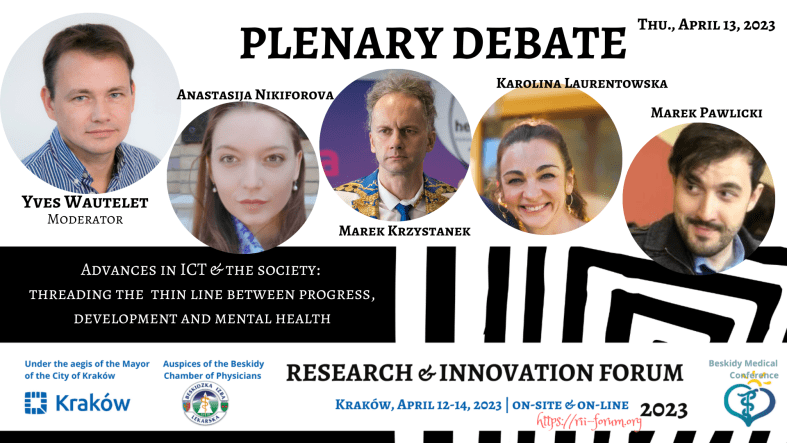
As part of Rii Forum 2023 a plenary debate “Advances in ICT & the Society: threading the thin line between progress, development and mental health” will take place, where I was honored to be invited as one of four plenary speakers, particularly considering that according tot he invitation, the organizers see me as the person whose “expertise and your contribution to the academic debate make you one of the trendsetters in current debate on open data and data quality management”, as well as leading voice and influencer. The other three panel discussants are Prof. Dr. Marek Krzystanek, Karolina Laurentowska & Prof. Marek Pawlicki. Hope this will be an interactive, fruitful and productive discussion with further involvement of the audience!

Read more here and stay tuned for more information and reflections on the conference, in case you will not be able to attend it.


The International Open Data Day and my role of Keynote Speaker for the 5th International Conference on Advanced Research Methods and Analytics (CARMA 2023) 🎤🎤🎤

This post is dedicated to two very pleasant events for me, namely the international Open Data Day 🎉🍾🥂, and the announcement of the keynote talk that I was kindly invited to deliver at the 5th International Conference on Advanced Research Methods and Analytics (CARMA) organized and sponsored by Universidad de Sevilla, Cátedra Metropol Parasol, Cátedra Digitalización Empresarial, IBM, Universitat Politècnica de València, Joint Research Center – European Commission and 🥁 🥁 🥁 Coca-Cola – what a delicious conference!🍸🍸🍸

CARMA is a forum for researchers and practitioners to exchange ideas and advances on how emerging research methods and sources are applied to different fields of social sciences as well as to discuss current and future challenges with main focus on the topics such as Internet and Big Data sources in economics and social sciences including Social media and public opinion mining, Web scraping, Google Trends and Search Engine data, Geospatial and mobile phone data, Open data and public data, Big Data methods in economics and social sciences such as Sentiment analysis, Internet econometrics, AI and Machine learning applications, Statistical learning, Information quality and assessment, Crowdsourcing, Natural Language processing, Explainability and interpretability, the applications of the above including but not limited to Politics and social media, Sustainability and development, Finance applications, Official statistics, Forecasting and nowcasting, Bibliometrics and sciencetometrics, Social and consumer behaviour, mobility patterns, eWOM and social media marketing, Labor market, Business analytics with social media, Advances in travel, tourism and leisure, Digital management, Marketing Intelligence analytics, Data governance, and Digital transition and global society, which, in turn, expects contributions in relation to Privacy and legal aspects, Electronic Government, Data Economy, Smart Cities, Industry adoption.

And as almost each and every conference, CARMA expects to have keynotes, which are two – Patrick Mikalef, who will talk about Responsible AI and Big Data Analytics, and me, whose keynote talk will be devoted to the topics I studied in recent years titled “Public data ecosystems in and for smart cities: how to make open / Big / smart / geo data ecosystems value-adding for SDG-compliant Smart Living and Society 5.0?” Sounds interesting? (I hope so) Stay tuned to know more! And return back, since I plan to reflect on the content of both talks and the conference in general.

The CARMA 2023 conference will be held on 28 June – 30 June 2023 in the University of Seville.

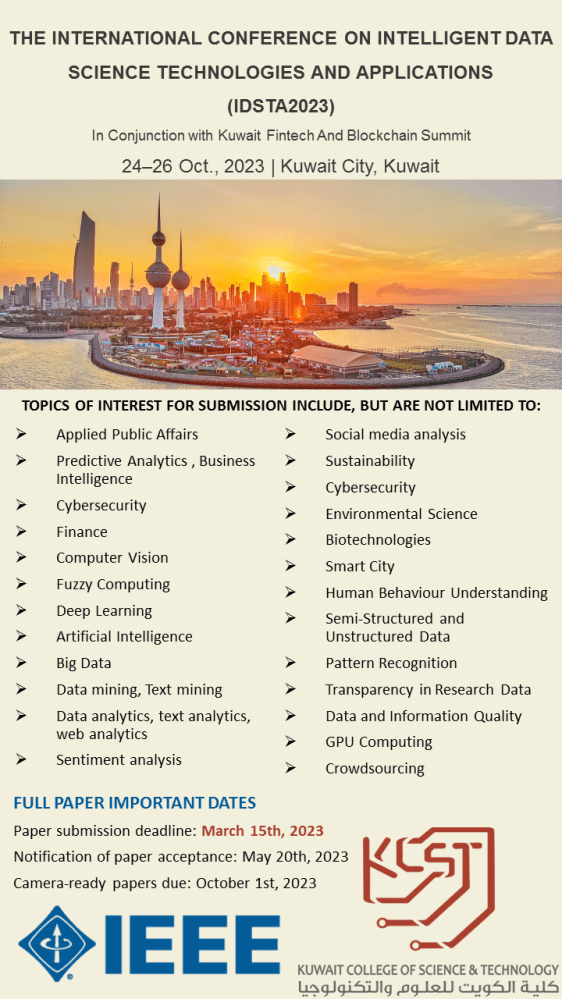
CFP: The International Conference on Intelligent Data Science Technologies and Applications (IDSTA2023)

On behalf of the organizers and as a publicity chair, I sincerely invite you to consider submitting the results of your recent research to The International Conference on Intelligent Data Science Technologies and Applications (IDSTA2023), which will be held in conjunction Kuwait Fintech and Blockchain Summit.

Huge amount of data is being generated and transmitted everyday. To be able to deal with this data, extract useful information from it, store it, transmit it, and represent it, intelligent technologies and applications are needed. The International Conference on Intelligent Data Science Technologies and Applications (IDSTA) is a peer reviewed conference, whose objective is to advance the Data Science field by giving an opportunity for researchers, engineers, and practitioners to present their latest findings in the field. It will also invite key persons in the field to share their current knowledge and their future expectations for the field. Topics of interest for submission include, but are not limited to:

💡Applied Public Affairs, incl. but not limited to Campaign Management, Mass Communication Politics, Political Analysis, Survey Sampling
💡Business Analytics, incl. but not limited to Stock Market Analysis, Predictive Analytics, Business Intelligence
💡Finance, incl. but not limited to Risk Management, Algorithmic Trading, Fraud Detection, Financial Analysis
💡Computer Science, incl. but not limited to Database Management Systems, Scientific Computing, Computer Vision, Fuzzy Computing, Feature Selection, Neural Networks, Deep Learning, Meta-Learning, Process Mining, Artificial Intelligence, Data Mining, Big Data, Web Analytics, Text Mining, Natural Language Processing, Sentiment Analysis, Social Media Analysis, Data Fusion, Performance Analysis and Evaluation, Evolutionary Computing and Optimization, Hybrid Methods, Granular Computing, Recommender Systems, Data Visualization, Predictive Maintenance, Internet of Things (IoT), Web Scraping
💡Sustainability, incl. but not limited to Datasets on Sustainability, Sustainability Modeling, Energy Sustainability, Water Sustainability, Environmental Sustainability, Risk Analysis
💡Cybersecurity, incl. but not limited to Data Privacy and Security, Network Security, Communication Security, Cryptography, Fraud Detection, Blockchain
💡Environmental Science, incl. but not limited to GIS, Climatographic, Remote Sensing, Spatial Data Analysis, Weather Prediction and Tracking,
💡Biotechnologies, incl. but not limited to Gnome Analysis, Drug Discovery and Screening and Side Effect Analysis, Structural and Folding Pattern, Disease Discovery and Classification, Bioinformatics, Next-Gen Sequencing
💡Smart City, incl. but not limited to City Data Management, Smart Traffic, Surveillance, Location-Based Services, Robotics
💡Human Behaviour Understanding
💡Semi-Structured and Unstructured Data
💡Pattern Recognition
💡Transparency in Research Data
💡Data and Information Quality
💡GPU Computing
💡Crowdsourcing


🗓️🗓️🗓️ IMPORTANT DATES

  • Paper submission:  March 15, 2023  
  • Acceptance notification:  May 20th, 2023
  • Full paper camera-ready submission: October 1st, 2023
    Conference Dates: October 24-26, 2023

All papers that are accepted, registered, and presented in IDSTA2023 and the workshops co-located with it will be submitted to IEEEXplore for possible publication. 
For any inquiries, contact intelligenttechorg@gmail.com.

Submit the paper and meet our team in Kuwait in October, 2023!
 

With best wishes,

IDSTA2023 organizers

CFP: 3rd International Workshop on Advanced Data Systems Management, Engineering, and Analytics (MegaData): where the Edge meets the Cloud

On behalf of the organizers, I sincerely invite you to consider submitting the results of your recent research to The Third International Workshop on Advanced Data Systems Management, Engineering, and Analytics (MegaData), which will be held in conjunction with the 23rd  IEEE/ACM International Symposium on Cluster, Cloud and Internet Computing (CCGRID2023).

The MegaData objective is to bring together researchers, practitioners, system administrators, system programmers, and others interested in sharing and presenting their perspectives on the effective management of big data systems. The focus of the workshop is on a novel and practical, systems-oriented work, where MegaData, whose moto this year is “MegaData: where the Edge meets the Cloud”, offers an opportunity to showcase the latest advances in this area and discuss and identify future directions and challenges in management and engineering of big data systems.

MegaData covers the area of Big Data operations (management, engineering, and analytics) within Cloud and Edge computing models. It aims to report on the advances and trends in Big Data deployment architectures from both the infrastructure and application levels. Papers presenting recent results, research issues, practical applications, case studies, and industrial implementations are welcome.

Specific topics of interest include, but are not limited, to the following:

  • Resource management and scheduling mechanisms for data systems
  • Auto Scaling and elastic scaling approaches and mechanisms
  • Data governance and privacy of “data in motion” and “data at rest” over edge/cloud
  • Emerging Data deployment models in IoT, IoT-to-Cloud, Edge/fog
  • Federated Learning and edge intelligence for big data systems
  • Advances data storage models, including object stores and key-value stores
  • Techniques for data integrity, availability, reliability, and fault tolerance
  • Big Data workflows (data management, data wrangling, automated workflows)
  • Data pipeline (data lake to analytics, new data stream architectures, edge/fog, cloud enabled solutions)
  • High-performance Data Analytics applications
  • Adaptive offloading techniques among Fog, Edge, and Cloud Computing

Important dates

  • Submission open: December 1st, 2022
  • Paper submission Deadline: January 15th, 2023
  • Acceptance notification: February 10th, 2023
  • Camera-ready submission: March 17th, 2023
  • Conference Dates: May 1st, 2023

We invite original research papers that have not been previously published and are not currently under review for publication elsewhere. Submitted papers should be no longer than 8 pages (including references and appendices) in two-column IEEE template format. Papers need to be submitted through the EasyChair submission portal.

Best papers presented at the workshop will be selected, and the corresponding authors will be invited to submit an extended version of their papers for possible publications in: Special Issue on Emerging Topics in Big Data and Edge Intelligence on Springer Cluster Computing (IF 2.3)

Submit the paper and meet our team in Bangalore, India in May, 2023!

With best wishes,

MegaData organizers – Yaser Jararweh, Feras M. Awaysheh, Moath Jarrah, Anastasija Nikiforova, Sadi Alawadi

First paper in my Special Issue “Hybrid Data-Driven and Physical Modelling for Energy-Related Problems: Towards Smarter Energy Management”

As an academic editor of the Special Issue “Hybrid Data-Driven and Physical Modelling for Energy-Related Problems: Towards Smarter Energy Management” (Energies MDPI, Impact Factor:3.004 (2020); 5-Year Impact Factor: 3.085 (2020)), I am glad to announce that the first article has been published!

This very special for me issue belongs to the section “A8: Artificial Intelligence and Smart Energy” and it seeking for the latest research on advances in the field covering both data-related topics and next-generation power electronic techniques and their applications. All papers accepted for their publishing are published in an Open Access, thereby significantly contributing to the visibility of these papers, and are submitted for their indexation in both Scopus and Web of Science in addition to other databases. The journal also falls in Q1 (Cite Score, Control and Optimization).

Topics of interest for this Special Issue include, but are not limited to:

  • energy management systems
  • data-driven approaches to energy-related issues
  • advances in energy analytic, including open data on energy, its benefits, re-uses and impact
  • Big Data management in the context of energy data
  • machine learning (ML) techniques
  • physical modelling for energy-related problems
  • disruptive technology of renewable energy
  • blockchain for Internet of energy management
  • the role of the “energy” within the context of Industry 4.0 and Sustainable Goals
  • energy data management in the context of the internet of things (IoT)
  • energy data management via distributed systems
  • smart grid and microgrid
  • sustainable electrical energy systems
  • hybrid and electric vehicle.

This Special Issue is of articular importance, given that energy-related issues are becoming more and more relevant today, including the topic of disruptive technologies, where renewable energy is referred to as one of the 12 most significant disruptive technologies. The topic is no longer limited to energy production/generation and storage and supply as a source of energy; it is becoming broader, including the close links with the electrification of transport, including electric vehicles (smart and green transportation), industrial automation, energy storage systems, data storage and data management systems. With both being very common, and at the same time disruptive and new, energy-related issues relate to both the adaptation of well-known foundations for recent trends and the optimization of the methods and techniques already used, as well as introducing completely new methods and developing new applications, thereby promoting open innovation and smarter living.

Special Issue “Hybrid Data-Driven and Physical Modelling for Energy-Related Problems: Towards Smarter Energy Management”


The first paper accepted for its publishing in the SI is entitled “Machine Learning Schemes for Anomaly Detection in Solar Power Plants” and is authored by Mariam Ibrahim (German Jordanian University), Ahmad Alsheikh (Deggendorf Institute of Technology), Feras M. Awaysheh (University of Tartu Institute of Computer Science) and Mohammad Dahman Alshehri (Taif University). The paper deals with the anomaly detection in photovoltaic (PV) systems by evaluating the performance of different machine learning schemes – AutoEncoder Long Short-Term Memory (AE-LSTM), Facebook-Prophet, and Isolation Forest – and applying them to detect anomalies on photovoltaic components. These models allow the authors to identify the PV system’s healthy and abnormal actual behaviors. The results provide clear insights to make an informed decision, especially with experimental trade-offs for such a complex solution space. The issue explored is all the more topical considering the rapid industrial growth in solar energy, which gains an increasing interest in renewable power from smart grids and plants.

I am very glad and honored to be an academic editor of both this issue (together with my colleagues from Germany and Greece) and this paper in particular.

Special Issue, Academic Editor

Looking forward further submissions (particular focus on advances in the field covering both data-related topics and next-generation power electronic techniques and their applications)!!!