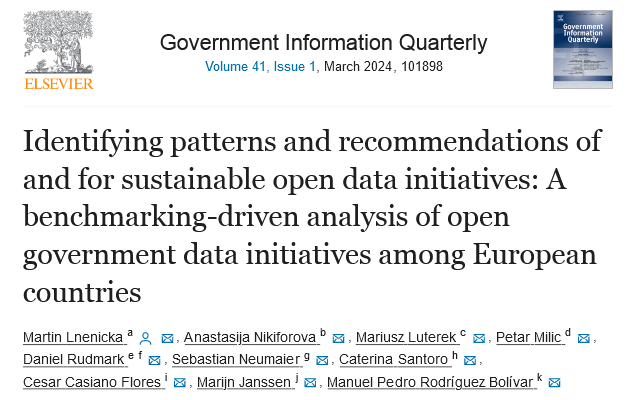
With this post I would like to introduce our new paper entitled “Identifying patterns and recommendations of and for sustainable open data initiatives: A benchmarking-driven analysis of open government data initiatives among European countries” (authors: Martin Lnenicka, Anastasija Nikiforova, Mariusz Luterek, Petar Milic, Daniel Rudmark, Sebastian Neumaier, Caterina Santoro, Cesar Casiano Flores, Marijn Janssen, and Manuel Pedro Rodríguez Bolívar) that has been just published in Government Information Quarterly journal (Elsevier) – the leading journal in the world for articles on e-governemnt, public administration, and, in fact, many other topics.
This paper focuses on benchmarking of open data initiatives over the years and attempts to identify patterns observed among European countries that could lead to disparities in the development, growth, and sustainability of open data ecosystems, considering different potentially relevant contexts such as e-government, open government data, open data indices and rankings, and others relevant for the country under consideration. Specifically, this study conducts a comparative analysis of different patterns of open (government) data initiatives and their effects in the eight European countries – Austria, Belgium, Czech Republic, Italy, Latvia, Poland, Serbia, Sweden, using six open data benchmarks Global Open Data Index (GODI), Open Data Maturity Report (ODMR), Open Data Inventory (ODIN), Open Data Barometer (ODB), Open, Useful and Re-usable data (OURdata) Index, Open Government Development Index (OGDI), two e-government reports (57 editions in total), and other relevant resources, covering the period of 2013–2022. In other words, to attain the objective of the study, we developed the composite benchmarks-driven analytical protocol.
Using the developed composite benchmarks-driven analytical protocol and a Delphi method, we reached a consensus within a panel of experts and validated a final list of 94 patterns, including their frequency of occurrence among studied countries and their effects on the respective countries. Finally, we took a closer look at the developments in identified contexts over the years and defined 21 recommendations for more resilient and sustainable open government data initiatives and ecosystems and future steps in this area.
We then performed the cluster analysis to find similarities between patterns based on their occurrence and effects (impacts). Both these analyses suggest a close link between approaches to benchmarking of open data initiatives and the development of e-government over the years. We found that e-government services, their interoperability, availability, transparency, efficiency, etc., have a positive influence here, i.e., to what extent OGD and related concepts will merge with e-government and can use its infrastructure and related services for their growth. Finally, we were also able to extract from the 25 patterns six high-level recommendations that are considered the key to success, i.e., for a sustainable and resilient OGD initiative. The discussion, in turn, allowed us to formulate 15 more recommendations for public administration, those who use/interpret indices, benchmarks, and reports, and academia, indicating some research agenda.
These are expected to lead to improved performance in applied indices and rankings and, more importantly, will facilitate the achievement of the benefits with which open (government) data are associated. While this is expected to be primarily important in instructing ODEs’ stakeholders (mainly policymakers), the findings identified the current research gaps to be further explored by researchers. As future research, we will expand the study to other countries, focusing our attention in specific areas of the OGD ecosystems to get valuable insights concerning OGD strategies used and in identifying development stages in OGD.
Sounds interesting? Read the article here!
In case of interest, cite this paper as:
- Lnenicka, M., Nikiforova, A., Luterek, M., Milic, P., Rudmark, D., Neumaier, S., Santoro, C., Casiano Flores, C., Janssen, M., & Rodríguez Bolívar, M. P. (2024). Identifying patterns and recommendations of and for sustainable open data initiatives: A benchmarking-driven analysis of open government data initiatives among European countries. Government Information Quarterly, 41(1): 101898. https://doi.org/10.1016/j.giq.2023.101898
 Anastasija Nikiforova, PhD