EGOV2024 – IFIP EGOV-CeDEM-EPART 2024 & our Emerging Issues and Innovations Track

Are you focusing on new topics emerging in the field of ICT and public sector, incl. public-private ecosystems? Then it is time to start preparing your submission for EGOV2023 – IFIP EGOV-CeDEM-EPART Emerging Issues and Innovations Track (chairs: Anastasija Nikiforova, Marijn Janssen, Francesco Mureddu).

EGOV2023 – IFIP EGOV-CeDEM-EPART is one of the most recognized conference in e-Government, ICT and public administration and related topics, which this year will be hosted in Belgium, in the heart of Europe, by Ghent University and KU Leuven – both top 100 universities.

 Innovation and application of emerging technologies is now more and more in the thinking of Governments at all levels. While it would be easy to consider the public sector as being less flexible or slow in adoption, presentations at recent EGOV-CeDEM-ePart conferences proved that one should not come to such a conclusion too easily. Upcoming technologies, innovative organizational solutions, or new avenues of involvement in public sector activities seem to be more commonplace – along with the potential issues and challenges that come with such endeavours. Policy-makers and public sector officials are now expected to embrace change, consider digital transformation, or improve governance practices. At the same time, public sector researchers are also influenced by new views, methods, tools and techniques.

🎯The goal of this track is to provide a platform for the discussion of new ideas, issues, problems, and solutions, that keep entering the public sphere. Ideas that are emerging but might not fit other conference tracks are also welcome. Focus may include but is not limited to:

  • 💡 Looking ahead into social innovation
  • 💡Future studies, the future of government, policy-making and democracy
  • 💡New trends in public sector research such as Metaverse, Large Language Models (LLMs), generative AI and its implementations such as chatGPT, Claude, ChatSonic, Poe – benefits, risks, adoption and resistance to its adoption by the public sector and citizens;
  • 💡Global challenges that go beyond nation states (such as migration, climate change etc.) and which require international collaboration of individual governments;
  • 💡Digital transformation in public sector context;
  • 💡The future of digital governance;
  • 💡Public values in transforming the government;
  • 💡The role of government in smart cities (incl. smart sustainable cities) and sustainable living;
  • 💡The role of the public sector in Human-Centered Society known as Society 5.0;
  • 💡Government in the metaverse;
  • 💡Self-Service Structures for Inclusion;
  • 💡Public-private sector collaboration and integration;
  • 💡Decentralized Autonomous Organizations (DAOs), smart contracts and blockchain;
  • 💡Preparing for the policy challenges of future technologies;
  • 💡Regulating misinformation;
  • 💡New technologies for automated decision-making;
  • 💡The future public sector use and regulation of latest AI or genAI solutions;
  • 💡Public use as well as regulations of industry 4.0 and Industry 5.0 and the Internet of Things (IoT);
  • 💡The relationships of governments and Fintech;
  • 💡Upcoming issues of eVoting / internet voting including application of digital signatures in the public sector;
  • 💡Online public community building;
  • 💡Utilization of digital billboards;
  • 💡Latest trends in co-creation and service delivery;
  • 💡Discussion of new research methods that have not been applied in this context;
  • 💡Application of role theory in the analysis of public sector functions and processes;
  • 💡Forward looking insights from case studies – let it be successful or failed experiments.

Track Chairs

  • Anastasija Nikiforova, Tartu University, Estonia
  • Marijn Janssen, Delft University of Technology, the Netherlands
  • Francesco Mureddu, The Lisbon Council, Belgium

This time International Federation for Information Processing (IFIP) EGOV-CeDEM-EPART will be hosted by KU Leuven and Ghent University, September 2024, while the deadline for submitting your paper is set to March, 2024.

Stay tuned, more info to come!

On my keynote “Unlocking the symbiotic relationship of Artificial Intelligence, Data Intelligence, and Collaborative Intelligence for Innovative Decision-Making and Problem Solving” (DemocrAI / PRICAI)

This November I was glad to deliver a keynote at The 3rd International Workshop on Democracy and AI (DemocrAI2023) held in conjunction with the 20th Pacific Rim International Conference on Artificial Intelligence (PRICAI2023), which I entitled “Unlocking the symbiotic relationship of Artificial Intelligence, Data Intelligence, and Collaborative Intelligence for Innovative Decision-Making and Problem Solving”.

In the pursuit of enhancing the efficiency and effectiveness of Artificial Intelligence, it is imperative to explore synergies with other form of intelligence, such Data Intelligence and Collaborative intelligence. These forms of intelligence (along with Embodied Intelligence) constitute a new transformative paradigm of intelligence proposed by Verhulst et al. (2021) that offers potential for increased added value when synergized. However, their synergy requires understanding and harnessing the symbiotic relationship between these intelligences. The reimagination of decision making and problem-solving processes, is essential to unlock this symbiotic potential fostering more meaningful, but at the very same time more sustainable AI utilization. In other words, AI itself brings a certain value that can be (and must be) increased through integration with other forms of Intelligence. This, in turn, has a list of preconditions / prerequisites that must be satisfied by the above – Artificial, Data and Collaborative Intelligence – components. These prerequisites are diverse in nature and span both the artifacts in question, such as AI, data (type, format, quality, value, availability, accessibility, incl. openness), stakeholders’ skills and literacies, but also management and organizational aspects. In other words, each form of Intelligence influences the others, making it crucial to explore their interconnections. This talk endeavoured to uncover this intricate web of relationships between the three forms of intelligence, taking a step towards a more meaningful and intelligent approach to decision making and problem solving.

As part of this talk we referred to the theory of multiple intelligences by Howard Gardner presented in his famous book “Frames of Mind: A Theory of Multiple Intelligences”. Then. we referred to the above mentioned intelligence paradigm proposed by Stefaan G. Verhulst, Peter Martey Addo, Dominik Baumann, Juliet Mcmurren, Andrew Young, Andrew J. Zahuranec in “Emerging Uses of Technology for Development: A New Intelligence Paradigm” To put it into the context of the workshop devoted to the role of AI to solving challenging problems by current-day communities and promoting conversational democracy, including but not limited to AI tools in social platforms, we reflected on democratic process, their variety – monitorial, deliberative and participatory democratic processes, and Democratic Activity Model of Open Data Use (DAMODU) proposed by Ruijer, E., Grimmelikhuijsen, S. and Meijer. Then, we finally turned to the discussion on the symbiotic relationship of Artificial Intelligence, Data Intelligence, and Collaborative Intelligence in several contexts with a focus on public and open data ecosystems, which included a brief reflections and outcomes on previous research jointly conducted with my colleagues (such as our paper on open data ecosystems, their calssification, transparency etc.) and indicating future avenues in the light of changing paradigms (or need for such) of both, intelligences, public and open data ecosystems, mechanisms for users (and citizens) engagement and processes accompanying these ecosystems.

This followed up by the fruitful discussion with the participants of the conference that I enjoyed very much (regardless of the fact it was 4AM my time 🙂 since the conference took place in Jakarta). Great thanks to the organizers of The 3rd International Workshop on Democracy and AI (DemocrAI2023) and 20th Pacific Rim International Conference on Artificial Intelligence (PRICAI2023) for having me!

Stanford University’s database of top-cited scientists for 2022 is published

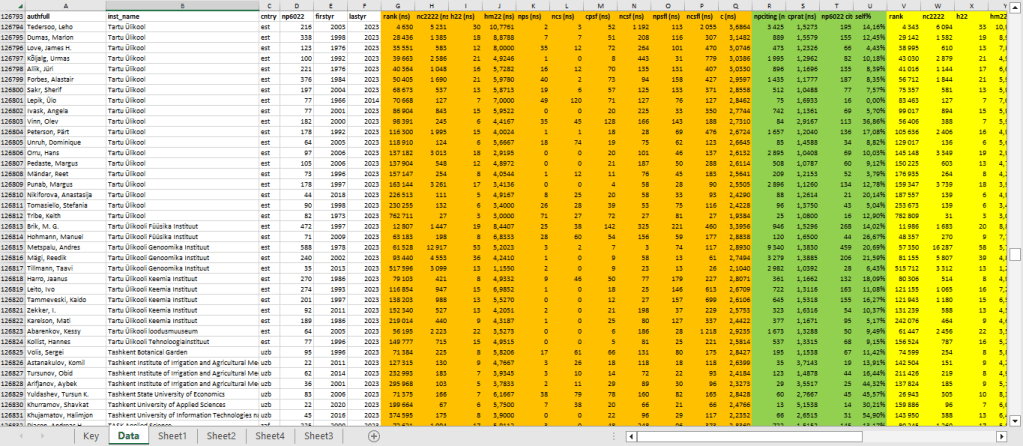
A few months ago, I celebrated 5 years since my first scientific publication – the time it took for me to get listed in the Stanford University‘s database of top 2% scientists! To be honest, I’ve missed this list, but given the growing number of LinkedIn posts on it, I decided to take a look at it and after browsing it for a while, decided – just out of curiosity – to check myself – can you imagine the level of my surprise? – all in all, quite surprised and honored, of course!

I recognize that this is just a single year category for 2022, it is about sub-fields (Artificial Intelligence – do not really get how Scopus knows this, given that although I am dealing with this topic, I do not much publish on it, Information Systems, Information & Communication Technologies) same as I realize that citation metrics-based evaluations is  not the best approach to assessing the impact and quality of research & researcher (although this database not only acknowledges, but also tries to tackle this issue to some extent), but for me it is still an achievement that makes this day special!

You might want to check out this list by Ioannidis and John (2023) and maybe it will make your day as well!

Ioannidis, John P.A. (2023), “October 2023 data-update for “Updated science-wide author databases of standardized citation indicators””, Elsevier Data Repository, V6, doi: 10.17632/btchxktzyw.6

CFP for Data For Policy 2024 is open!

And CFP for Data For Policy 2024 scheduled for 9-11 July, 2024 is open! All submissions are welcome with the deadline of 27 November, 2023.

This year Data For Policy conference, which is organized in collaboration with Imperial College London and Cambridge University Press will take place in London, UK, and will be running under the title “Decoding the Future: Trustworthy Governance with AI” – trendy, isn’t it? In this edition the conference “[we] are focusing on the future of governance and decision making with AI. Firstly, what are the emerging capabilities, use cases, and best practices enabling innovation that could contribute to improved governance with AI? Secondly, what concerns are being raised regarding these advancements in areas such as data, algorithms, privacy, security, fairness, and potential risks? For both discussions, we invite proposals that delve into the role and capacity of governance in preventing AI-related harms and explore the potential for governance to generate added value through responsible AI deployment. For a more thorough consideration of the conference theme, please read this informative blog, by Zeynep Engin and conference co-chairs.

Data for Policy is looking forward to your submission to one of six areas of the respective Data & Policy journal, which are transformed into the tracks for this conference. In addition, this list is complemented with a rich list of 11 special tracks.

Of course, my personal recommendation is to consider Area 1 “Digital & Data-driven Transformations in Governance” (chairs: Sarah Giest, Sharique Manazir, Francesco Mureddu, Keegan McBride, Anastasija Nikiforova, Sujit Sikder). More specifically, the track seeks for contributions on topics that include but are not necessarily limited to:

  • From data to decisions: knowledge generation and evidence formation;
  • Process, psychology and behaviour of decision-making in digital era;
  • Government operations and services;
  • Government-citizen interactions; and open government;
  • Democracy, public deliberation, public infrastructure, justice, media;
  • Public, private and voluntary sector governance and policy-making.


Of course, do not ignore other tracks since each and every track definitely deserves your attention:

  • Area 1: Digital & Data-Driven Transformations in Governance – the one I just suggested;
  • Area 2: Data Technologies & Analytics for Governance;
  • Area 3: Policy & Literacy for Data;
  • Area 4: Ethics, Equity & Trustworthiness;
  • Area 5: Algorithmic Governance;
  • Area 6: Global Challenges & Dynamic Threats;
  • Special Track 1: Establishing an Allied by Design AI ecosystem
  • Special Track 2: Anticipating Migration for Policymaking: Data-Based Approaches to Forecasting and Foresight
  • Special Track 3: AI, Ethics and Policy Governance in Africa
  • Special Track 4: Social Media and Government
  • Special Track 5: Data and AI: critical global perspectives on the governance of datasets used for artificial intelligence
  • Special Track 6: Generative AI for Sound Decision-making: Challenges and Opportunities
  • Special Track 7: Governance of Health Data for AI Innovation
  • Special Track 8: Accelerating collective decision intelligence
  • Special Track 9: Artificial Intelligence, Bureaucracy, and Organizations
  • Special Track 10: AI and data science to strengthen official statistics
  • Special Track 11: Data-driven environmental policy-making

To sum up:

🗓️ WHEN? 9-11 July, 2024 -> deadline for papers and abstracts – 27 November, 2023

WHERE? London, UK

WHY? To understand what are the emerging capabilities, use cases, and best practices enabling innovation that could contribute to improved governance with AI? what concerns are being raised regarding these advancements in areas such as data, algorithms, privacy, security, fairness, and potential risks? For a more thorough consideration of the conference theme, please read this.

Find your favorite among tracks and submit! See detail on the official website.

The International Conference on Intelligent Metaverse Technologies & Applications (iMeta) and the 8th IEEE International Conference on Fog and Mobile Edge Computing (FMEC) in Tartu

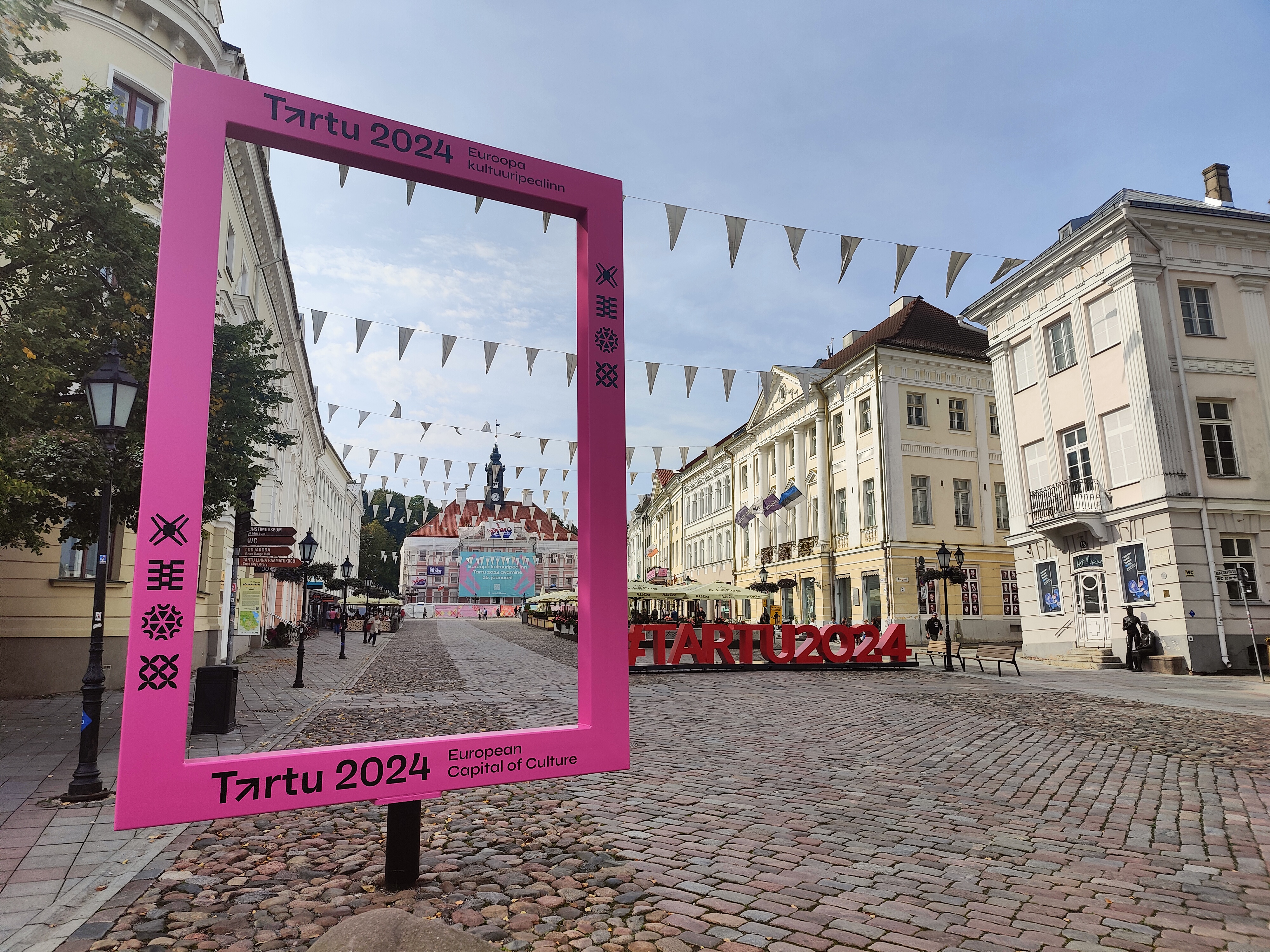
This year we – University of Tartu, Institute of Computer Science – have a pleasure to host FMEC2023, taking place in conjunction with iMETA, where iMETA, as you can assume, is associated with the metaverse (more precisely, the International Conference on Intelligent Metaverse Technologies & Applications), while FMEC – for the The Eighth IEEE International Conference on Fog and Mobile Edge Computing.

FMEC 2023 conference aims to investigate the opportunities and requirements for Mobile Edge Computing dominance, and seeks for novel contributions that help mitigating Mobile Edge Computing challenges. That is, the objective of FMEC 2023 is to provide a forum for scientists, engineers, and researchers to discuss and exchange new ideas, novel results and experience on all aspects of Fog and Mobile Edge Computing (FMEC) covering one of its major areas, which include, but not limited to the following tracks:

  • Track 1: Fog and Mobile Edge Computing fuels Smart Mobility
  • Track 2: Edge-Cloud Continuum and Networking
  • Track 3: Industrial Fog and Mobile Edge Computing Applications
  • Track 4: Trustworthy AI for Edge and Fog Computing
  • Track 5: Security and privacy in Fog and Mobile Edge Computing
  • Track 6: Decentralized Data Management and Streaming Systems in FMEC
  • Track 7: FMEC General Track

iMETA conference, in turn, aims to provide attendees with comprehensive understanding of the communication, computing, and system requirements of the metaverse. Through keynote speeches, panel discussions, and presentations, attendees had the opportunity to engage with experts and learn about the latest developments and future trends in the field, covering areas such as:

  • AI
  • Security and Privacy
  • Networking and Communications
  • Systems and Computing
  • Multimedia and Computer Vision
  • Immersive Technologies and Services
  • Storage and Processing

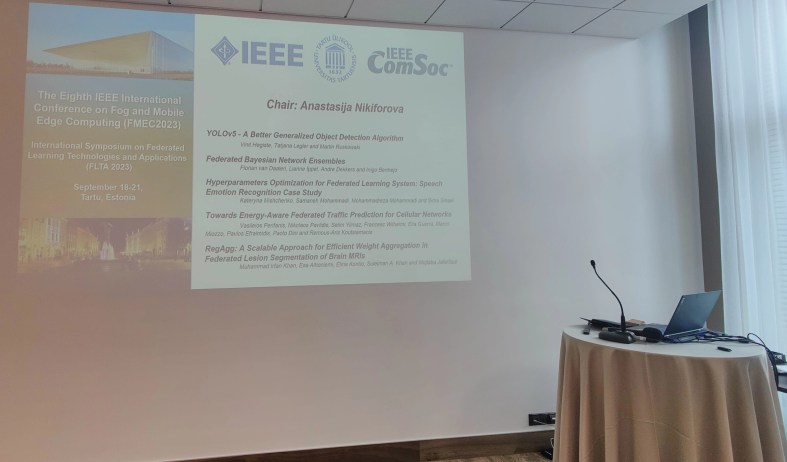
As part of these conferences, I had the pleasure of chairing one of the sessions, where the room was carefully selected by the organizers to make me feel as I would be at home – we were located in the so-called Baltic rooms of VSpa conference center, i.e., Estonia, Lithuania, and Latvia, so guess which room the session took place in? Bingo, Latvia! All in all, 5 talks were delivered:

  • Federated Object Detection for Quality Inspection in Shared Production by Vinit Hegiste
  • Federated Bayesian Network Ensembles by Florian van Daalen
  • Hyperparameters Optimization for Federated Learning System: Speech Emotion Recognition Case Study by Mohammadreza Mohammadi
  • Towards Energy-Aware Federated Traffic Prediction for Cellular Networks by Vasileios Perifanis
  • RegAgg: A Scalable Approach for Efficient Weight Aggregation in Federated Lesion Segmentation of Brain MRIs by Muhammad Irfan Khan, Esa Alhoniemi, Elina Kontio, Suleiman A. Khan and Mojtaba Jafaritadi

Each of the above was followed by a very lively discussion, which continued also after the session. This, in turn, was followed by an insightful keynote delivered by Mérouane Debbah on “Immersive Media and Massive Twinning: Advancing Towards the Metaverse”.

Also, thanks to our colleagues from EEVR (Estonian VR and AR Association), I briefly went to my school times and chemistry lessons having a bit of fun – good point, I’ve always loved them (nerd and weirdo, I know…).

Thanks to the entire FMEC and iMETA organizing team!