AI for Open Data or Open Data for AI? An invited talk for BBDU Development Program «Artificial Intelligence for Sustainable Development»🎤

Recently I was honored to contribute to Babu Banarasi Das University (BBDU, Department of Computer Science and Engineering) Development Program «Artificial Intelligence for Sustainable Development» with the talk entitled “Artificial Intelligence for Open Data or Open Data for Artificial Intelligence?”. More precisely, this series of workshops is organized for the industry, i.e. representatives of industry, who want to get an insight on the current advances in various topic-related areas (AI in the sustainability context) from people representing research and academia, which is organized by AI Research Centre, Department of Computer Science & Engineering, Babu Banarasi Das University (India), ShodhGuru Research Labs, Soft Computing Research Society, IEEE UP Section, Computational Intelligence Society Chapter. My session, for instance, was attended by more than 130 attendees, which I consider to be a very good rate!
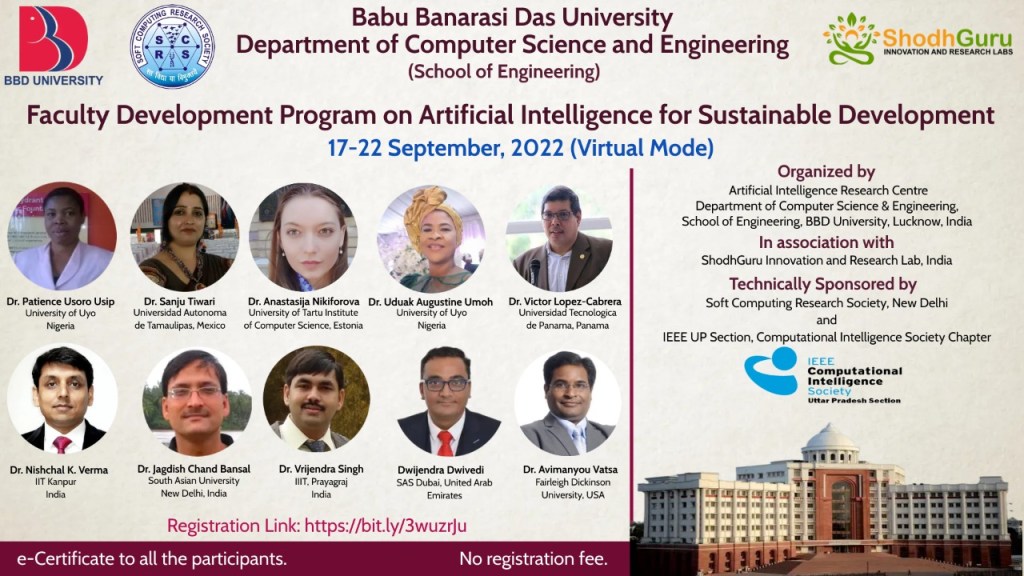

Regarding my talk, I was delighted to deliver in the last day of this event, being also a guest of honor for this event, when we speak about “Artificial Intelligence for Open Data or Open Data for Artificial Intelligence?” – in short, not OR but rather AND. In other words, AI for Open Data and Open Data for AI, where open data serves as a valuable asset for AI (of course, if a list of prerequisites is fulfilled), while AI defines new prerequisites for open data we should think of.

At the same time, although their combination is considered to play a transformational role in human society, and especially in prominent areas, as we discussed today, this “magic duo” is not always about “unicorns and ice creams“, where the current state-of-the-art suggests that open data my pose also certain risks.

Probably the most expressive example of such, I referred to, is an example, when based on easily obtainable open data on toxic molecules collected over the years, AI has managed to create 40,000 molecular associations potentially usable as biochemical weapons in just 6 hours. And while not all of them are actually usable, and the need to synthesize them still remains, some associations correspond to known chemical weapons with one even more toxic than the VX nerve gas, identified as a weapon of mass destruction by the United Nations.

So here comes a very interesting dilemma between openness as a philosophy and making data open, and threats it may pose, if used by a malevolent actor.

We also briefly touched a topic of risks associated with AI (although both perspectives of so-called cyber-pessimists and cyber-optimists in this regard were considered), open data, and their combination, along with the long list of benefits they can bring, including their contribution to the sustainability being in line with the general idea of this event.
And, of course, we could not ignore the topic of green AI and a strong need to consider FATE principles (Fairness, Accountability, Transparency & Explainability).

All in all, it was a very nice experience and the audience so curious and passionate of topics elaborated on within this 6-days long event with speakers from both continents Asia, Africa, America and Europe (represented by me! 🤓🤓🤓). Exceptional audience with so relevant questions leading to a lively and fruitful discussion being of interest for both participants and speakers. Glad to be part of it and get this experience!

This is just in a few words, although at some point I plan to extend this post with more details and thoughts.

First International Electronic Governance with Emerging Technologies Conference (EGETC)

As the general co-chair of the First International Conference in Electronic Governance with Emerging Technologies (EGETC-2022), I sincerely invite you to consider your participation as authors and presenters or the attendees in this event.

First International Electronic Governance with Emerging Technologies Conference

Over the last decade, the importance of emerging technologies in government and public administrations has grown significantly. The growing demand for services that better meet changing user expectations for responsiveness and personalization, coupled with higher expectations of the role of government in the digital age, calls for a technologically mature public sector. There are many new emerging technologies serving as enablers to new forms of governance and novel applications in traditional governance functions, which role has been witnessed across various domains, including healthcare, medicine, education, tourism, and industry etc.. 

The aim of the First International Conference in Electronic Governance with Emerging Technologies (EGETC-2022) is to provide a forum for academics, scholars, and practitioners from academia and industry to share and exchange the recent developments in the domain of eGovernment and governance of digital organizations to shed light on the emerging research trends and their applications. 

Topics of interest include, but not limited to:

  • Intelligent systems for coordination in crisis emergency management
  • Distributed ledgers and Blockchains: governance, decentralized autonomous organizations (DAO)
  • Machine Learning (ML), Artificial Intelligence (AI) and Big Data management for Public Sector
  • Privacy, security and legal Informatics – AI and Law
  • Open Data, Open Government Data: transparency, trust, public participation, co-creation and Open Innovation
  • Digital transformation and Society 5.0
  • Linked Data, Linked Open Data (LOD)
  • Semantic E-government applications
  • Public Sector Knowledge Representation
  • Decision Support Systems (DSS) in Digital Governance
  • Natural Language Processing (NLP)
  • Cloud Computing
  • Bots, Automation agents, Self-learning systems 
  • Cryptocurrencies and incentive mechanism design
  • Multimedia and multilingual systems

It is particularly important that, in order to ensure the widest possible participation of communities, despite the availability of funding, the conference does not foresee any charges. I.e. both authors and presenters, and attendees/ listeners are welcome without registration fees.

First International Electronic Governance with Emerging Technologies  Conference (author: Anastasija Nikiforova)

In addition to the great team of organizers and members of the program committee, which has a rich list of outstanding experts, participants of this event will have an opportunity to enjoy the keynote speeches by Prof. Marijn Janssen – Full Professor in ICT & Governance at TU Delft, Netherlands, Dr. B K Murthy, CEO – Innovation and Technology Foundation, IIT Bhilai, Prof. Luis Martinez – Full Professor, University of Jaén, Jaén Spain. More information on their talk will follow…

Accepted papers presented at the EGETC2022 will be published in the proceeding published by Springer in Lecture Notes in Computer Science series (approval pending…). A short list of best papers will be invited for a post-conference publication in Government Information Quarterly (GIQ), Elsevier, Q1, Cite Score: 11.6, Impact Factor: 7.279 and Technological Forecasting and Social Change, An International Journal, Elsevier, Q1, Cite Score: 12.1, Impact Factor: 8.593.

If you are interested in submitting your paper, add to your calendar the submission date – May 30, while the event will take place during September 12-14, 2022.

Due to the unpredictability of the current situation in the light of pandemic, we expect to have a hybrid event, i.e. both online and on-site participation will be possible. For the later mode, we will be very glad to meet participants, who will be able to attend the event physically, in peaceful and spectacular city of Tamaulipas, Mexico in mid-September, 2022. Hope to meet you there!!!