IJCAI2025 Workshop on Democracy and AI (DemocrAI 2025) workshop

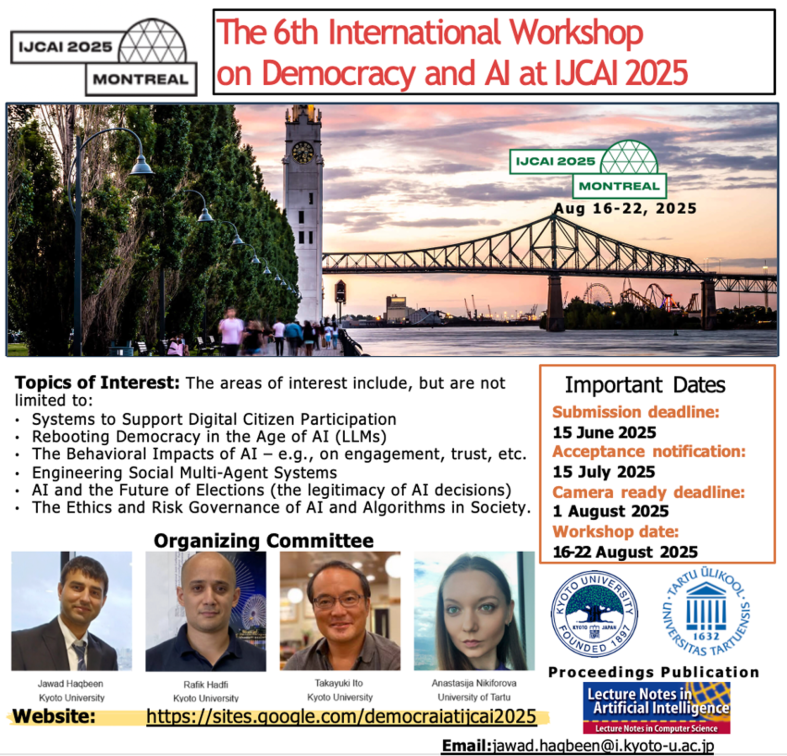
Join us – Jawad Haqbeen, Rafik Hadfi, Takayuki Ito, Anastasija Nikiforova (Kyoto University & University of Tartu) – at the 6th International Workshop on Democracy and AI (DemocrAI 2025) to take place conjunction with the 34th International Joint Conference on Artificial Intelligence (IJCAI 2025) in Montreal (Canada), August 16-22 to examine opportunities and risks associated with AI in democratic contexts.

Recent technical advances in machine learning, natural language processing, and multi-agent systems have greatly expanded the use of artificial intelligence (AI) applications in our daily lives. AI-driven systems are transforming the way we process, monitor, and manage data and services, offering innovative solutions for evidence-based policy planning and decision management. AI offers enormous potential to boost efficiency and improve decision-making by processing large amounts of data. For example, AI-assisted conversational chatbots can help strengthen democratic processes by delivering better public services, customizing services for citizens, facilitating engagement with large groups, connecting their ideas and fostering social participation. However, alongside these benefits, AI may pose risks to individuals, organizations, and society as a whole. One significant concern is that machines lack accountability while generating information and can make decisions that fundamentally affect the lives of ordinary citizens by generating (mis)information. The focus of this workshop will be on both the current and potential uses of AI in society.

This workshop welcomes research on the intersection of AI and democracy, focusing on, but are not limited to:

  • Systems to Support Digital Citizen Participation
  • Tools to Support Decision-Making Process
  • The behavioral impacts of AI – e.g., on civic motivation & engagement, trust, etc.
  • The impact of AI on planning & policy development
  • The role of Societal factors in the implementation of AI
  • Rebooting Democracy in the Age of AI
  • AI and the Future of Wellbeing
  • AI in governance and public participation 
  • AI and the Future of Elections (the legitimacy of algorithmic decisions)
  • The ethics and risk governance of AI and algorithms in society
  • Transparency, Accountability, and Ethical Issues in Artificial Intelligence

Important dates:

  • Paper submission deadline: June 15, 2025
  • Notification of acceptance: July 15, 2025
  • Camera ready submission: August 1, 2025
  • Workshop Date: August 16-22, 2025

Join us at IJCAI 2025 to help shape the future of AI for democratic governance.

HICSS2026 Sustainable and Trustworthy Digital and Data Ecosystems for Societal Transformation mini-track


Are you researching sustainable and trustworthy digital ecosystems? Then, submit your work to our HICSS2026 “Sustainable and Trustworthy Digital and Data Ecosystems for Societal Transformation” mini-track we chair together with Daniel Staegemann and Asif Gill at the Association for Information Systems Hawaii International Conference on System Sciences (HICSS-59)!

In an era where data is the foundation of digital transformation, well-designed and managed sustainable and trustworthy digital and data ecosystems are critical for artificial intelligence (AI), strategic innovation, governance, competitive advantage, and trust in increasingly digital societies. With the rise of new data architectures (e.g., data meshes and data lakehouses), the shift from centralized to decentralized systems, and the integration of AI in data governance and management among others emerging technologies (e.g., blockchain, cloud computing), these ecosystems are becoming more dynamic, interconnected, and complex. However, alongside their potential benefits that is a common focus of the research around these ecosystems, challenges related to trustworthiness, transparency, security, sustainability, and governance must be addressed.

HICSS2026 “Sustainable and Trustworthy Digital and Data Ecosystems for Societal Transformation” mini-track we chair together with Daniel Staegemann and Asif Gill invites research on how digital and data ecosystems evolve in terms of resilience, trustworthiness, and sustainability while enabling strategic innovation and societal transformation. We welcome studies that explore the interplay between AI, data governance, policies, methodologies, human factors, and digital transformation across sectors such as finance, government, healthcare, and education.
We seek theoretical, empirical, design science, case study, and interdisciplinary contributions on topics including, but not limited to:

  1. AI, trustworthiness, and governance in digital and data ecosystems:
    • AI as an actor and stakeholder in data ecosystems;
    • AI-augmented governance, security, and data quality management;
    • human factors in AI-integrated ecosystems (trust, user acceptance, participation);
    • interoperability, observability, and data linking across ecosystems;
  2. Emerging technologies and strategic innovation:
    • transition from centralized to decentralized data architectures (e.g., data lakehouses, data meshes);
    • emerging technologies for trustworthy ecosystems;
    • AI-driven business process augmentation and decision-making;
    • industry and government case studies on evolving data ecosystems;
  3. Resilience and sustainability of data ecosystems:
    • ethical AI and responsible innovation in data ecosystems;
    • sustainability and long-term governance of digital and data infrastructures;
    • cross-sectoral and interdisciplinary approaches for building sustainable ecosystems;
    • impact of data democratization on digital transformation and innovation.

By combining the strengths of strategic innovation, trustworthy AI, and data ecosystem governance, this track expects to offer a holistic perspective at the intersection of information systems, AI governance, data science, and digital transformation. It will serve as a platform for researchers and practitioners to explore how digital and data ecosystems can be sustainable, resilient, and trustworthy while driving innovation and societal transformation.

We welcome conceptual, empirical, design science, case study, and theoretical papers from fields such as information systems, computer science, data science, management and process science, policy-making, behavioral economics, and social sciences.

This mini-track is part of HICSS59 “Organizational Systems and Technology” track (chairs: Hugh Watson and Dorothy Leidner) and more information about it can be found here.

EGOV2025 – IFIP EGOV-CeDEM-EPART 2025 & our Emerging Issues and Innovations Track

Are you focusing on new topics emerging in the field of ICT and public sector, incl. public-private ecosystems? Then it is time to start preparing your submission for EGOV2025 – IFIP EGOV-CeDEM-EPART Emerging Issues and Innovations Track, which this time we chair in the updated form, welcoming A. Paula Rodriguez Müller on the board with us – Francesco Mureddu (The Lisbon Council, Belgium)and myself – Anastasija Nikiforova (Tartu University, Estonia)).

EGOV2025 – IFIP EGOV-CeDEM-EPART is one of the most recognized conference in e-Government, ICT and public administration and related topics, which this year will be hosted in Belgium, in the heart of Europe, by University for Continuing Education Krems, Austria. This year, IFIP EGOV 2025 is dedicated to the broader areas of e-Government and e-Democracy, which include facets like Digital Government, e-Participation, Open Government,  Smart Government, AI government, GovTech, Algoritmic Governance, and related topics to digitalization and government.

Innovation and application of emerging technologies are now more and more in the thinking of governments at all levels. While it would be easy to consider the public sector as being less flexible or slow in adoption, presentations at recent EGOV conferences proved that one should not come to such a conclusion too easily. Upcoming technologies, innovative organizational solutions, or new avenues of public sector involvement in the public sector are becoming more commonplace along with the potential challenges and issues these bring. Policymakers and public sector officials are now expected to embrace change, consider digital transformation, or improve governance practices. At the same time, public sector researchers are also influenced by new views, methods, tools, and techniques. The goal of this track is to provide a platform for the discussion of new ideas, issues, problems, and solutions entering the public sphere. Ideas that are emerging but might not fit other conference tracks are also welcome. Focus may include, but are not limited to:

  • Looking ahead into social innovation;
  • Future studies, the future of government, policy-making and democracy;
  • The future of digital governance;
  • Public values in transforming the government;
  • The role of government in smart cities (incl. smart sustainable cities) and sustainable living;
  • The role of the public sector in Human-Centered Society (Society 5.0);
  • New trends in public sector research such as Metaverse, Cityverse, Large Language Models (LLMs), generative AI and its implementations such as chatGPT, Claude, ChatSonic, Poe – benefits, risks, adoption and resistance to its adoption by the public sector and citizens;
  • Government in the Virtual Worlds and Web 4.0;
  • Decentralized Autonomous Organizations (DAOs), smart contracts and blockchain;
  • New technologies for automated decision-making and their policy implications;
  • Public sector use and regulation of AI, genAI, Industry 4.0, Industry 5.0, and the Internet of Things (IoT);
  • Digital Humanism (responsible and ethical integration of technology into society, ensuring that human values and dignity are prioritized in the development and use of digital tools and innovations);
  • The role of the public sector in competitiveness and tech sovereignty;
  • Global challenges that go beyond nation states (such as migration, climate change etc.) and which require international collaboration of individual governments;
  • Preparing for the policy challenges of future technologies;
  • Regulating misinformation;
  • Digital transformation in public sector contexts;
  • Self-Service Structures for Inclusion;
  • Public-private sector collaboration and integration;
  • GovTech initiatives and innovations;
  • Latest trends in co-creation and service delivery;
  • Online public community building;
  • Upcoming issues of eVoting / internet voting including application of digital signatures in the public sector;
  • Discussion of new research methods that have not been applied in this context;
  • Application of role theory in the analysis of public sector functions and processes;
  • Forward looking insights from case studies – let it be successful or failed experiments.
  • Utilization of digital billboards;
  • Public sector use and regulation of Fintech innovations;
  • Theoretical and practical approaches to experimentation and sandboxing in the public sector.Future studies, the future of government, policy-making and democracy

Stay tuned, more info to come!

45th International Conference on Information Systems (ICIS2024)

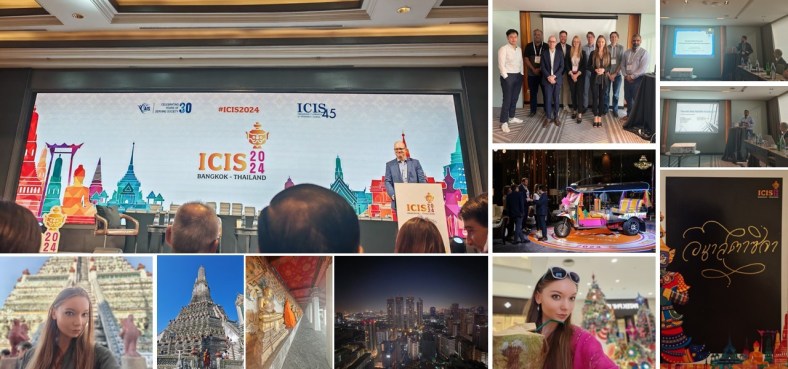
As the year comes to an end, so does the 45th edition of the International Conference on Information Systems (ICIS2024) —a conference filled with presentations, countless chats with old colleagues and friends and meeting new ones, and a tons of emotions coming from a warm Bangkok 🇹🇭

This year the conference held under theme “Digital Platforms for Emerging Societies” aimed at examining the expansive role of information technology in driving economic and societal transformation across the globe. Over 1.7K participants from 49 countries attended ICIS2024 this year, incl. Estonia 🇪🇪 – the only country of the Baltics – represented by both TalTech (Tallinn University of Technology) and finally University of Tartu (with me trying to bring the name of Latvia 🇱🇻 as well), in total accounting only three people – Mari-Klara Stein, myself and my PhD student – Dimitris Symeonidis, which is, however, a significant increase compared to previous editions, which is smth we – Mari-Klara and myself – are still not too happy about, as we still remain “rarities,” as I’ve been called several times, and will try to change that 👩‍🔬

The conference started for me with pre-ICIS Symposium SIGDSA (Special Interest Group on Decision Support and Analytics), which this year run under the “Emerging AI Platforms for Societal Good” theme, which was an action-packed day featuring a keynote by Apirak Kosayodhin (Former Governor of Bangkok), followed by a panel on the role of AI across society, business & academia, with Ofir T., discussing whether Artificial Intelligence, and GenAI in particular, is a “friend or foe” reflecting on our evolving attitudes toward it (through the lenses of other phenomenon, incl. dogs & how our attitudes towards them changed over centuries), Borworn Papasratorn addressing challenges of diffusing & adopting AI in Thai Higher Education Institutions, Kriengkrai Boonlert-U-Thai discussing the role of information technology in driving economic & societal transformation, moderated by Ramesh Sharda.

And as a follow-up to this, the paper of my former master student Jan-Erik Kalmus – “Generative AI adoption in higher education: exploring educator resistance in Estonian universities” was presented. In this study, Jan-Erik examined educator resistance to student use of GenAI in higher education focusing on Estonia, known as a “digital nation”, employing a theoretical model informed by the Innovation Resistance Theory (IRT) that we introduced in previous study presented at ECAI (on which I posted earlier).

It was continued with 7 hours of vibrant dialogue on digital government research as part of the pre-ICIS workshop on eGovernment, including:
✅the first ever study results of my 1st year PhD student – Dimitris Symeonidis – presented (“Reimagining Digital Government: a step towards Blockchain-Enabled Public Data Ecosystems”)
✅a concept of what we call Data Satellites introduced by Asif Gill as part of our “Towards a Data Satellite Architecture for Digital Government Ecosystems” study, in which we call for a data observability level missing in the current data ecosystems, thereby providing zero opportunities to get rid off or at least be informed about dark and toxic data (while the concept name might evolve based on community feedback, whereas happy that the concept itself found an acceptance with community, what we hoped for)
✅and 5 more super interesting studies by colleagues exploring digital transformation, AI in public administration (incl. framework to determine when AI is truly needed (i.e., smth close to the idea of automation as a default and the only in business process redesign – just don’t!), AI literacy, GenAI for citizen engagement), smart cities, and a methodological proposal for a soft digital ecosystem methodology for hybrid cities’ problem design
🎙️all of this masterfully moderated by Rony Medaglia – president of the current SIG-eGov, and tons of discussions around every study and the filed in general, incl. the future plans.

Finally, my first-year PhD student introduced himself to the IS community at probably the most prestigious IS conference, with yet another paper presented at the SIG SVC – AIS Special Interest Group for Services Workshop on Synergizing Service Ecosystems – “Integrating Generative AI with Public Data Ecosystems: Enhancing Decision Making and Efficiency in the Service Industry of the Private Sector”.

All in all, with four papers presented at three ICIS workshops & symposium, this was a very rich week, for which – a heartfelt thanks to the organizers!

CFP for AMCIS2025 “Sustainable Digital and Data Ecosystems – Navigating the Age of AI” mini-track

The Association for Information Systems (AIS) organized America’s Conference on Information Systems is coming! This year it will be held in Montreal (Canada), running under the general theme of “Intelligent technologies for a better future” and the revised list of (mini-)tracks, where the special attention I invite you to draw to is a new “Sustainable Digital and Data Ecosystems – Navigating the Age of AI” mini-track (chairs: Anastasija Nikiforova, Daniel Staegemann, George Marakas, Martin Lnenicka).

In an increasingly data-driven world, well-designed and managed digital and data ecosystems are critical to strategic innovation and competitive advantage. With the rise of new data architectures, the shift from centralized to decentralized systems, and the integration of artificial intelligence (AI) in data management, these ecosystems are becoming more dynamic, interconnected, and complex.

The growing importance of emerging data architectures such as data lakehouses and data meshes coupled with the emerging technologies of AI, blockchain, cloud computing to name a few, requires us to rethink how we manage, govern, and secure data across these ecosystems. Moreover, AI is no longer a mere component but an active agent/actor in these ecosystems, transforming processes such as data governance, data quality management, and security. Simultaneously, there is a pressing need to address how these systems can remain resilient and sustainable in the face of technological disruption and societal challenges, and how interdisciplinary approaches can provide new insights into managing these digital environments.

This mini-track seeks to explore the evolving nature of these ecosystems and their role in fostering sustainable, resilient, and innovative digital environments.

We encourage research from an ecosystem perspective (grounded in systems theory) that takes a holistic view, as well as more focused studies on specific components such as policies, strategies, interfaces, methodologies, or technologies. Special attention will be paid to the ongoing evolution of these ecosystems, especially their capacity to remain trustworthy, sustainable, and resilient over time.

Potential topics include but are not limited to:

  • data management and governance in emerging data architectures (data lakehouse, data mesh, etc.), including data governance, data quality management, and security;
  • the role of AI in data management, including AI-augmented governance, data quality management, and security;
  • AI-driven resilience and sustainability in digital and data ecosystems, incl. AI-augmentation of data lifecycle- and business- processes;
  • conceptualization and evolution of digital and data ecosystem components and their interrelationships;
  • emerging technologies, such as blockchain, cloud computing, sensors etc., shaping the strategic development of digital and data ecosystems;
  • case studies on the transition from centralized (data warehouse, data lake, data lakehouse) to decentralized data architectures (e.g., data mesh);
  • human/user factors in digital and data ecosystems (acceptance, interactions, participation etc.);
  • empirical studies on the sustainability, trustworthiness, and resilience of digital ecosystems;
  • methodologies and strategies for managing evolving digital ecosystems in different sectors (e.g., finance, healthcare, government / public sector, education).
  • interdisciplinary approaches to building, managing, and sustaining digital and data ecosystems.

The research and innovation in digital and data ecosystems requires an interdisciplinary approach. Therefore, this track invites papers from various disciplines such as information systems, computer science, management science, data science, decision science, organizational design, policy making, complexity, and behavioral economics, and social science to continue the problematization exploration of concepts, theories, models, and tools for building, managing and sustaining ecosystems. These can be conceptual, design science research, empirical studies, industry and government case studies, and theoretical papers, including literature reviews.

As such, this mini-track will serve as a platform for interdisciplinary dialogue on the critical role of sustainable digital and data ecosystems in driving strategic innovation and competitive advantage. We invite researchers and practitioners alike to share their insights, theoretical perspectives, and empirical findings in this rapidly evolving domain.

This mini-track is part of “Strategic & Competitive Uses of Information and Digital Technologies (SCUIDT)” track (chairs: Jack Becker, Russell Torres, Parisa Aasi, Vess Johnson).

For more information, see AMCIS2025 website (for this (min-)track, navigate to “Strategic & Competitive Uses of Information and Digital Technologies (SCUIDT)” track).

Is your research related to any of the above topics? Then do not wait – submit! 📅📅📅Submissions are due February 28, 2025.